

Wired vs Wireless CCTV in India (2026): Which One Should You Choose?
A cabled system on an NVR or DVR is rock-solid but needs drilling and runs; a Wi-Fi system goes up in an afternoon and is renter-friendly but leans on your router and power. An even-handed, India-grounded head-to-head that ends in a clear which-suits-whom verdict.
You have decided you want cameras. The very next question a shop or installer will ask is the one that quietly shapes everything else: wired or wireless? One puts a cable behind every camera and a recorder in a cupboard; the other sends video over your home Wi-Fi and can be up before lunch. Both are genuinely good. Both are genuinely sold to millions of Indian homes. Neither is simply "better".
The honest one-line answer: it depends on whether you value rock-solid reliability and permanence, or speed, tidiness and the freedom to take it with you. Wired trades effort for dependability; wireless trades a little dependability for convenience. This guide is the even-handed head-to-head — what each one actually is, how they compare across the things that matter in an Indian home, and, most usefully, which one suits which kind of home.
Scope and how to read this. This is a neutral decision guide, not a sales pitch and not a price list. Both wired and wireless are valid — each wins in a real context, and this guide gives each its true strengths and true weaknesses so you can match one to your home. It is not a buying or cost guide: for money, see the linked cost library; for detailed camera picking, the choosing guide. Any camera records footage, which is personal data under the Digital Personal Data Protection Act, 2023 — keep it on your own property and shared areas, change default passwords, and secure it. Mounting, drilling, cabling and any mains-electrical work belong to a licensed installer.
What each one actually is
The words "wired" and "wireless" get used loosely, so pin down what each really means before comparing them.
Wired CCTV means every camera is connected by a physical cable back to a central recorder — an NVR (for IP cameras, over an Ethernet cable) or a DVR (for analog cameras, over coax). That cable carries the video, and in a modern PoE (Power over Ethernet) system the same cable carries the power too, so there is one tidy run per camera. Footage is stored locally on a hard drive in the recorder. Once it is up, nothing about it depends on your Wi-Fi being healthy.
Wireless CCTV means the camera sends its video over your home Wi-Fi network instead of down a data cable. There are two flavours worth separating:
- Wi-Fi cameras on mains power. They still plug into a socket for power, but the video travels wirelessly to your router and usually up to a cloud service or an app. The common home "IP camera" sits here.
- Battery / "wire-free" cameras. These add a rechargeable battery (sometimes with a small solar panel), so there is genuinely no cable at all — for a while. They record on motion to save battery and lean heavily on cloud storage.
The single most important thing to understand up front: wireless refers to the video link, not the power. A mains Wi-Fi camera still needs a socket; a battery camera still needs recharging. "Wire-free" is a marketing promise about data, not about electricity — a point we come back to, because it changes the whole picture.
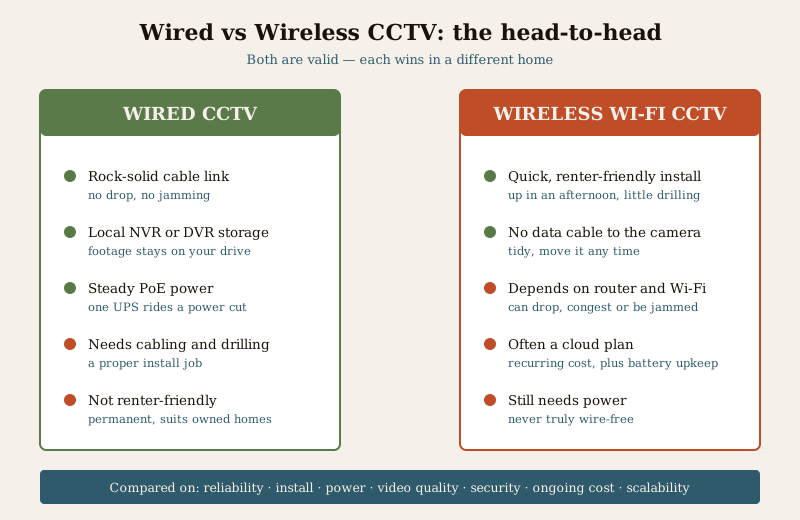
The head-to-head, dimension by dimension
This is where each side earns its keep. Read it as a balance sheet, not a scoreboard — most homes will weight these differently.
| Dimension | Wired (NVR / DVR, PoE) | Wireless (Wi-Fi, some battery) |
|---|---|---|
| Reliability | Rock-solid. A physical cable does not drop, congest or get jammed. | Can drop, slow under congestion, or be deliberately jammed; only as steady as your Wi-Fi. |
| Install effort | Higher. Cabling, drilling and neat runs; usually a professional job. | Low. Mount, power, connect to Wi-Fi; often DIY in an afternoon. |
| Renter-friendly | Poor. Drilling and permanent runs suit an owned home. | Excellent. Little or no drilling; unmount and take it to the next flat. |
| Power | Steady, from PoE or mains through the recorder; add one UPS/inverter and the whole system rides a cut. | Mains cameras still need a socket; battery cameras need periodic recharging. Never truly wire-free. |
| Video quality / latency | Steadier full-resolution recording, continuous, low lag. | Good in a strong signal; can compress, stutter or lag when the link is weak. |
| Range / coverage | Limited only by cable length (long runs are fine). | Limited by router range; walls, floors and distance weaken Wi-Fi fast. |
| Continuous vs event recording | Typically records 24/7 to the local drive. | Often records only on motion (especially battery) to save power and data. |
| Security exposure | Local storage, closed cabling; still needs passwords changed and firmware updated. | A poorly-secured Wi-Fi camera is a hacking and jamming risk; hardening is essential. |
| Ongoing cost | Mostly one-time; local storage, no forced subscription. | Convenience often pulls a recurring cloud plan; batteries wear and need replacing. |
| Scalability | Scales cleanly to many cameras on one recorder. | Every camera adds load to the same Wi-Fi; large counts strain the network. |
| India-specific | Rides power cuts well on a UPS; unaffected by weak Wi-Fi in a big house. | Convenient in a small flat with strong Wi-Fi; strained by thick walls and patchy signal. |
A few of these deserve a plain-language expansion, because they are where regret usually comes from.
Reliability is the wired trump card. A cable simply carries the signal. Wi-Fi shares the air with your phones, TV, neighbours' routers and the microwave, and in a crowded apartment block that air is busy. A weak or congested link shows up as a laggy app, a camera that "goes offline", or a clip that never made it to the cloud. It can also be jammed — a determined intruder can flood the Wi-Fi band and blind wireless cameras, which a cabled camera shrugs off. This does not make wireless useless; it makes reliability the thing you must be honest about for your specific home.
Install is the wireless trump card. No chasing walls, no conduit, no recorder cupboard, no re-cabling if you move a camera. For a rented flat, where drilling is often not allowed and you will move again, this is decisive. For a small home with strong Wi-Fi, it is simply the sensible, low-friction choice.
The honest caveat. Wireless is never truly wire-free, and it trades reliability for convenience. Mains cameras still need a socket; battery cameras still need recharging every few weeks or months, and a camera that is flat is a camera that saw nothing. If a wireless system is the right fit, go in knowing the trade you are making — you are buying speed and tidiness, and paying a little reliability and some ongoing upkeep for it.
Security: a Wi-Fi camera you must actually secure
Every camera that reaches the internet is a small computer on your network, and this is where wireless needs an extra beat of care. A poorly-secured Wi-Fi camera is a genuine hacking and privacy risk — left on its default password, or unpatched, it can be accessed by strangers, and the whole point of the camera is inverted. The defences are not optional:
- Change every default username and password the moment it is installed, to something long and unique.
- Keep firmware updated, and turn on two-factor authentication on the app if it offers it.
- Prefer the vendor's secure cloud or a strong local option over exposing the camera directly to the internet.
- Remember the jamming risk above: for anything security-critical, do not rely on a wireless link alone.
Wired systems are not exempt — a local NVR still needs its default password changed and its remote access locked down — but they carry less exposure by default because the video link itself is closed cabling and the storage is local. Either way, footage is personal data under the DPDP Act 2023: keep cameras to your own property and shared spaces, and secure what they record.
Which suits whom — the verdict by scenario
This is the part that actually decides it. Forget the general "which is better" argument and find the home that looks like yours.
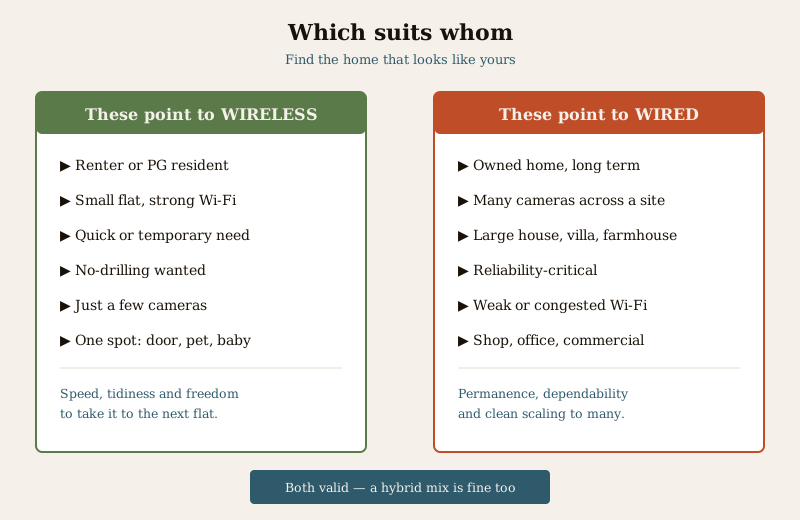
Choose wireless (Wi-Fi) when:
- You rent a flat, a PG or a place you will move out of — no drilling, and it comes with you.
- You have a small flat where the router covers every corner with a strong signal.
- You want cameras today, temporarily, or to watch one specific spot (the door, a nursery, a pet) without a project.
- You want a few cameras, low fuss, and are comfortable managing an app, passwords and the odd battery recharge.
Choose wired (NVR/DVR, PoE) when:
- You own the home and are securing it for the long term — cabling done once, running for a decade.
- You need many cameras across gate, porch, sides, terrace and parking — more than a home Wi-Fi network wants to carry.
- You have a large house, villa or farmhouse where Wi-Fi does not reach the far camera reliably.
- The system is reliability-critical and must never quietly drop the one clip you needed.
- It is a shop, office or commercial premises, where continuous local recording and dependability are the baseline expectation.
The in-between cases are common and fine. A hybrid approach — a wired core on the perimeter and the gate, plus a wireless camera or two for a spot that has no cable route — is a perfectly sensible answer for a home that is part-owned-forever, part-flexible. Matching the connection type to each location beats forcing one everywhere.
How to decide — a short framework
There is no universal winner, so decide with three questions in order, and let the answers tip you.
1. Will you own this home for years, or might you move? Move likely, or renting, tips wireless. Staying put tips wired.
2. How many cameras, and how big is the house? Many cameras or a large footprint tips wired; a handful in a small flat tips wireless.
3. How much does absolute reliability matter, and how good is your Wi-Fi? Reliability-critical, or weak/congested Wi-Fi, tips wired; strong Wi-Fi and convenience-first tips wireless.
If two of the three point the same way, you have your answer. Then sanity-check the honest trade one more time.
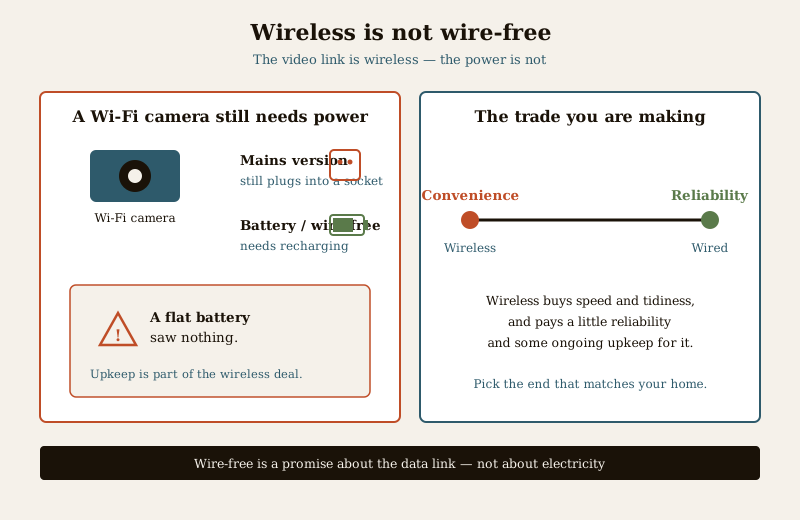
The trade in one image: slide toward convenience and you get wireless — fast, tidy, portable, but leaning on Wi-Fi, power top-ups and often a cloud plan. Slide toward reliability and you get wired — permanent, dependable, scalable, but a proper install job. Pick the end that matches your home, not the one the ad shouts loudest.
Where to go next
- The security comparisons pillar frames every "this vs that" security choice, and the analog vs IP CCTV guide is the closely related sibling decision once you have settled wired vs wireless.
- To turn the choice into a specific camera, see how to choose a CCTV camera.
- For the money side of the wireless route, the wireless CCTV cost guide covers cameras, cloud plans and the recurring bits; and if you go wired, the CCTV cable inspection guide keeps those runs healthy.
- For the whole picture, the CCTV hub ties the pieces together.
Key takeaways
- There is no universal winner — wired trades effort for rock-solid reliability; wireless trades a little reliability for speed and tidiness. Match one to your home.
- Wired (NVR/DVR, PoE) is the pick for owned homes, many cameras, large footprints, reliability-critical and commercial use — cabled once, dependable for years.
- Wireless (Wi-Fi, some battery) is the pick for renters, small flats, quick or temporary needs and no-drilling homes with strong Wi-Fi.
- Wireless is never truly wire-free — mains cameras need a socket, battery cameras need recharging; a flat battery saw nothing.
- A poorly-secured Wi-Fi camera is a hacking and jamming risk — change defaults, update firmware, use 2FA; footage is personal data under the DPDP Act 2023.
- A hybrid — wired core plus a wireless camera where no cable reaches — is often the honest best answer.
References
- Digital Personal Data Protection Act, 2023 — CCTV footage, whether stored locally on an NVR/DVR or in a cloud service, is personal data; keep cameras to your own property and shared areas, secure access, and limit retention to a legitimate purpose.
- Manufacturer specification sheets — verify a camera's power method (PoE, mains adapter or battery), storage model (local vs cloud, continuous vs motion-only), Wi-Fi band and security features before buying; "wire-free" refers to the data link, not the power.
- National Building Code of India (SP 7), Bureau of Indian Standards, and local municipal bye-laws for any structural, electrical or life-safety aspect of an install; verify the current edition (SP 7:2026) via the BIS catalogue: https://www.services.bis.gov.in/
This is an educational, even-handed overview to help you choose, not legal advice, a buying guide or a price list. Both wired and wireless CCTV are valid choices that win in different homes. Mounting, drilling, structured cabling, PoE and any mains-electrical work are qualified professional tasks — engage a licensed installer, secure any camera you fit, and verify any standard's current status via the BIS catalogue before relying on it.
Export this guide
Related Guides — Deep-dive reading
PoE vs Wi-Fi CCTV: Which Home Security Cameras Are Better?
One camera type runs power and video down a single Cat6 cable to an NVR and almost never drops out; the other clips to a wall in minutes and streams over your home Wi-Fi. This guide settles PoE vs Wi-Fi CCTV for Indian homes — reliability, video quality and bandwidth, cabling and power, retrofit versus new-build effort, NVR versus SD and cloud storage, hacking risk, real rupee costs, scalability and outdoor use — and gives a clear verdict for each kind of home.
Smart HomePoE vs Wi-Fi Cameras in India (2026): One Cable or Wireless?
A PoE camera carries data and power down a single Ethernet cable to a switch or NVR; a Wi-Fi camera sends video over the air but still needs its own power source. An even-handed, India-grounded head-to-head that ends in a clear which-suits-whom verdict.
SecurityCCTV Remote Access in India (2026): Watch From Your Phone, Safely
How to view your own cameras from anywhere without leaving the front door open to the internet — change the defaults, use strong credentials and 2FA, keep firmware current, prefer the vendor's secure cloud relay or a VPN, segment the camera network, and treat footage as personal data.
SecurityRelated Tools — Try Free
CCTV Cloud vs Local Cost Calculator
Compare cloud CCTV subscription against a local NVR + HDD — upfront, 5-year total, monthly fee and break-even.
Cloud vs LocalCCTV Camera Coverage & Count Calculator
Estimate how many CCTV cameras you need, the NVR channels, storage in TB for your retention period, and an indicative all-in cost with GST.
CCTV CalculatorCCTV System Type Selector
Answer five questions and get the right CCTV setup — analog / IP / hybrid, wired / wireless, local / cloud — with reasons.
CCTV Selector