
Waterproof Bathroom Paint in India: Anti-Fungal, Washable Emulsions for Walls & Ceilings
Which paint survives above the tile line — the moisture-resistant, anti-fungal, washable emulsions that stop peeling and black mould on Indian bathroom walls and ceilings. Sheen, prep, low-VOC and ₹/litre, brand-neutral.
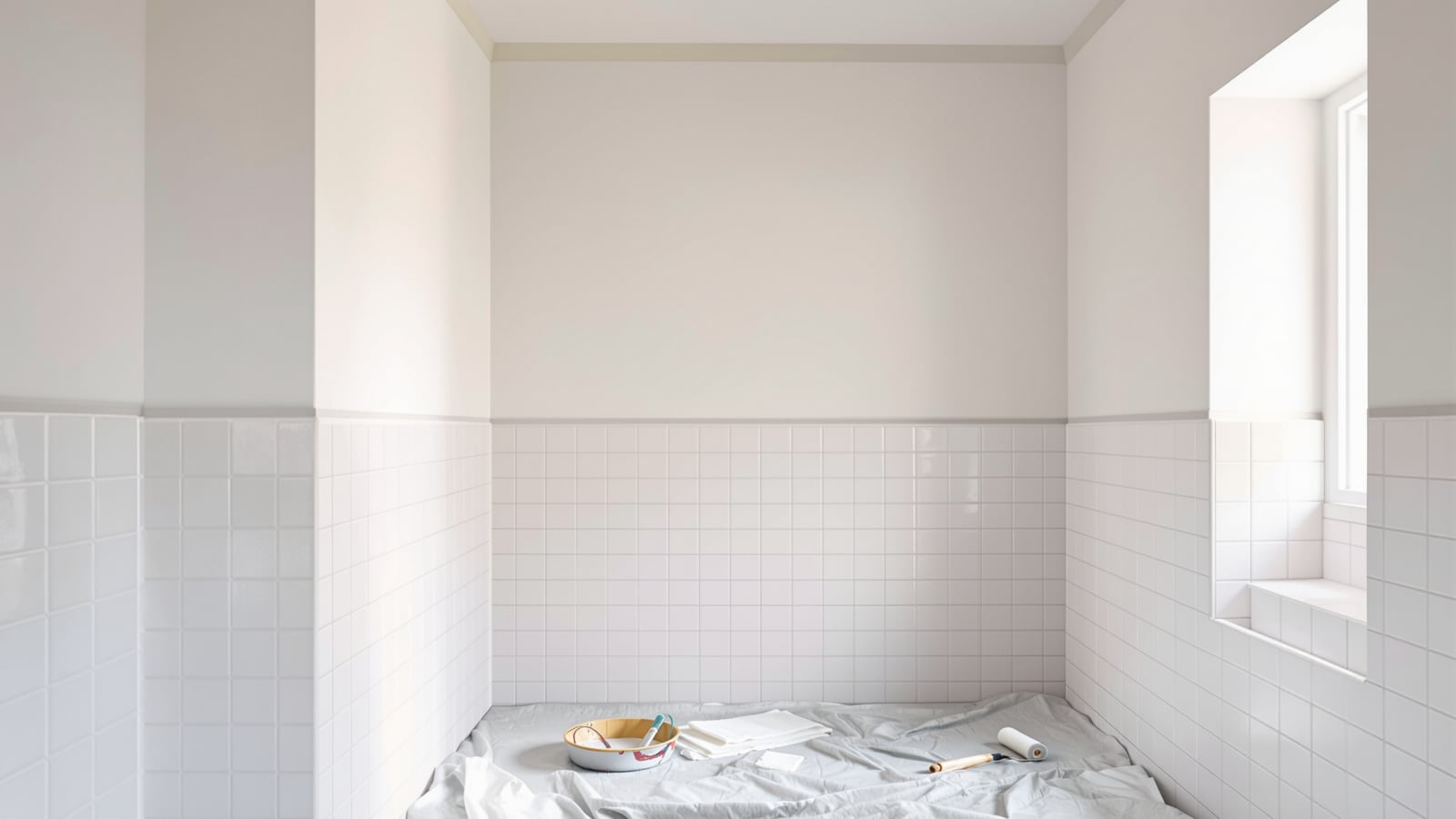
Tiles get all the attention, but in most Indian bathrooms only the lower two-thirds of the wall is tiled. Everything above the tile line — the top band of wall and the whole ceiling — is paint. And paint is exactly where bathrooms fail visibly: flaking above the shower, a spreading black bloom on the ceiling, chalky patches that smudge when you wipe them. None of that is bad luck. It is the wrong paint, on the wrong prep, in a room that stays damp longer than any other in the house.
This guide is about that painted zone specifically — not the tiled splash area (see Bathroom Wall Tiles Guide (India) for that), and not the structural membrane under the floor (see the Bathroom Design Guide (India) pillar). It covers which emulsions genuinely resist moisture and mould, why cheap distemper and economy paint peel within a monsoon, what sheen actually cleans best, how to prepare a damp-prone wall, and what it all costs in ₹ per litre. Brands like Asian Paints, Berger, Nerolac, Dulux and JSW are named only as examples so you know what to ask for.
Why "normal" paint fails in a bathroom
A bathroom is a humidity chamber. A hot shower can push relative humidity past 90% for 20–30 minutes, and without good bathroom ventilation that moisture condenses on the coolest surfaces — the ceiling and the upper walls. Ordinary interior paint fails there for three linked reasons:
- Water breaks the bond. Economy emulsions and distemper are porous. Moisture soaks into the film, gets behind it, and lifts it off the putty. That is the peeling and blistering you see above the shower.
- Mould eats the binder. Warm, damp, poorly-lit surfaces are ideal for Aspergillus and Cladosporium — the black and grey spots. Cheap paint has no biocide, so the mould colonises the film and the wall behind it. This is a health issue, not only a cosmetic one.
- It cannot be cleaned. Matte, low-quality films are chalky and absorbent. Wiping mould off just smears it and rubs the paint away, so the stain always returns.
The one takeaway: above the tile line, a bathroom needs a washable, anti-fungal emulsion with some sheen — not the same matte paint you used in the bedroom. The paint is a wearing surface, not a decoration.
What "waterproof bathroom paint" actually means
Strictly, no wall paint is a waterproofing membrane — do not confuse it with the cementitious or liquid membranes used below tiles. What the market calls waterproof or bathroom paint is a moisture-resistant, anti-fungal, washable acrylic emulsion. Four properties matter:
- Moisture / steam resistance — a tight, low-porosity acrylic film that resists condensation and does not blister.
- Anti-fungal + anti-bacterial — an in-can biocide (fungicide/algaecide) that stops mould growing on the film. This is the single most important property for a ceiling.
- Washable / scrubbable — you can wipe splashes and light mould off without burnishing the paint away.
- Low-VOC — a small, unventilated room concentrates fumes, so a low- or zero-VOC water-based emulsion is safer to live with.
The build-up you actually apply is a system, not one tin:
Choosing the sheen: why satin and semi-gloss win
Sheen is not just looks — glossier films are tighter, less porous and far easier to wipe. But too much gloss shows every roller mark and wall imperfection. For bathrooms the sweet spot is satin to semi-gloss.
| Sheen | Washability | Hides wall flaws | Best use in a bathroom |
|---|---|---|---|
| Matte / flat | Poor — burnishes | Best | Avoid; only a low-humidity guest WC ceiling |
| Eggshell / soft sheen | Fair | Good | Upper walls in a dry, well-ventilated bath |
| Satin | Good | Good | Default for walls above tiles |
| Semi-gloss | Very good | Fair | Ceilings, wet zones, splash-prone bands |
| High gloss | Excellent | Poor | Trims, doors, joinery only |
A practical split for most homes: semi-gloss anti-fungal emulsion on the ceiling (where mould loves to grow and you want maximum wipeability) and satin on the walls (clean-able but forgiving of surface texture). For the ceiling in particular, treat it as a moisture-resistant ceiling surface — it is the coldest plane and condenses first.
Surface prep on a damp-prone wall
Paint failures are prep failures. On a bathroom wall the sequence matters more than the tin you buy:
- Let it dry, and find the source. Never paint over an actively damp patch. If a wall stays wet, the problem is a leak or missing waterproofing, not paint — fix the ventilation and any seepage first. A moisture meter reading below ~12% is the target before painting.
- Kill existing mould. Scrape loose paint, then treat the area with a fungicidal wash (or a diluted bleach solution), let it dwell, and rinse. Painting over live mould just buries it — it grows back through the new film.
- Sand and clean. Remove chalky old paint, dust, and soap film. A greasy or dusty surface is a bond-breaker.
- Acrylic putty, then primer. Level with a water-resistant acrylic wall putty (not gypsum/POP, which is hygroscopic and softens in humidity), sand smooth, then apply a bonding/alkali-resistant primer. Primer is non-negotiable on fresh plaster because green concrete is alkaline and will saponify (soften) the topcoat.
- Two topcoats, thin. Two properly-thinned coats of the anti-fungal emulsion beat one thick coat every time — a thick film traps solvent and skins over.
Low-VOC and indoor air in a small, closed room
A bathroom is the smallest, least-ventilated room you paint, and people use it every day within hours of the work finishing. That makes VOC (volatile organic compound) content matter more here than anywhere else in the house. Cheap solvent-heavy paints and oil-bound distempers off-gas for weeks; in an unventilated WC that lingers and irritates the eyes and airways.
- Choose water-based acrylic emulsion, labelled low-VOC (below ~50 g/L) or zero-VOC. Most premium Indian lines now offer this, and the anti-fungal biocide does not require high solvent content.
- Ventilate while curing. Run the exhaust fan and keep the door open for 48–72 hours after painting — the same ventilation that later protects the film also clears the fumes.
- Avoid oil-based enamels on walls. Reserve enamel for the door and trims only, where its toughness earns the trade-off.
Low-VOC is also an IGBC Green Homes and GRIHA credit, so if the home is chasing a green rating, the bathroom paint spec is part of that scorecard — not an afterthought.
Cost, coverage and ₹ per litre
Bathroom-grade emulsion costs more than economy paint, but the painted area above the tiles is small, so the rupee difference on a real bathroom is minor — and far cheaper than repainting every monsoon.
| Paint type | Indicative ₹/litre | Coverage (2 coats) | Notes |
|---|---|---|---|
| Economy interior emulsion | ₹120–200 | 45–60 sq ft/L | Not for bathrooms — no biocide, poor wash |
| Premium washable emulsion | ₹280–450 | 40–55 sq ft/L | Satin; good general upper-wall choice |
| Anti-fungal "bathroom/kitchen" emulsion | ₹400–650 | 40–50 sq ft/L | In-can biocide; best value here |
| Exterior-grade acrylic (used indoors) | ₹350–550 | 40–50 sq ft/L | Tough, mould-resistant alternative |
| Acrylic wall putty (base) | ₹35–60/kg | 20–30 sq ft/kg | Two coats, then primer |
A typical bathroom has roughly 60–120 sq ft of paintable wall-plus-ceiling above the tiles. At ~45 sq ft/L over two coats that is about 3–5 litres of topcoat — so even premium anti-fungal paint adds only a few hundred rupees over economy paint for the whole room. Buy the good tin.
Quick do / don't:
- Do use exterior-grade acrylic on the ceiling if you cannot find a dedicated bathroom line — it is formulated to resist mould and moisture.
- Do run an exhaust fan or open a window after every shower; paint only manages moisture, ventilation removes it.
- Don't use POP/gypsum putty or oil-bound distemper in a bathroom — both hold water.
- Don't paint over persistent brown water-stains without a stain-blocking primer, or they bleed through.
If you want texture or colour on the painted band rather than a flat finish, see decorative bathroom wall finishes (India) — many microcement and lime-wash finishes are moisture-tolerant when sealed correctly.
Bottom line
Above the tile line, buy the paint that is designed for the job: a low-VOC, anti-fungal, washable acrylic emulsion — satin on the walls, semi-gloss on the ceiling — over a properly cleaned, mould-treated, puttied and primed surface. Do that once and the top of your bathroom stays clean for years. Skip the prep or save on the tin, and you will be scrubbing black mould off the ceiling every July.
References
- National Building Code of India (NBC) 2016, Part 8 (Building Services) and Part 9 (Plumbing Services) — ventilation and moisture-management requirements for wet areas.
- IS 15489: Plastic Emulsion Paint — specification for interior acrylic emulsion (washability and film grades).
- IS 5410: Cement Paint and IS 428: Distemper, oil emulsion — reference standards for lower-grade coatings not recommended for wet zones.
- IS 2932 / IS 2933: Synthetic enamel paints — for gloss trims and joinery in bathrooms.
- IGBC Green Homes / GRIHA — low-VOC interior coating criteria for indoor air quality credits.
- Bureau of Indian Standards (BIS) — current paint and putty specifications; confirm the latest amendment before specifying.
Export this guide
Related Guides — Deep-dive reading
Interior Wall Paint: The Complete Guide for Indian Homes
Everything under the colour — the layers beneath the paint, the five types to choose from, why sheen matters more than you think, how much you actually need, and the order of work that separates a job that lasts from one that peels.
Wall FinishesBathroom Wall Finishes: The Complete Guide for Indian Homes
Wet, splash and dry walls each need a different finish — the bathroom's zones, the best finish for each, why waterproofing comes first, tricks to enlarge a small bath, and three budget combinations.
Wall FinishesExterior Wall Paint: The Complete Guide for Indian Homes
The coat that fights the sun and the monsoon — the weatherproofing system beneath the colour, why your climate zone decides the paint, the five exterior types, how these paints fail, and the order of work that makes a warranty mean something.
Wall FinishesRelated Tools — Try Free
Painting Prep & Quality Checklist
Painting audit — 10 categories, 65+ checkpoints across surface prep, putty, primer, emulsion coats, enamel, external, ceilings, defects, final QC.
Painting QCCross-Ventilation Analyzer
Estimate airflow and air changes per hour (ACH) from room size, window areas, layout, and local wind — with NBC 2016 Part 8 compliance check.
Ventilation CalculatorDoor Paint Calculator
Estimate paint and primer litres and cost to paint your doors by size, number of doors, coats and paint type.
Door Calculator