
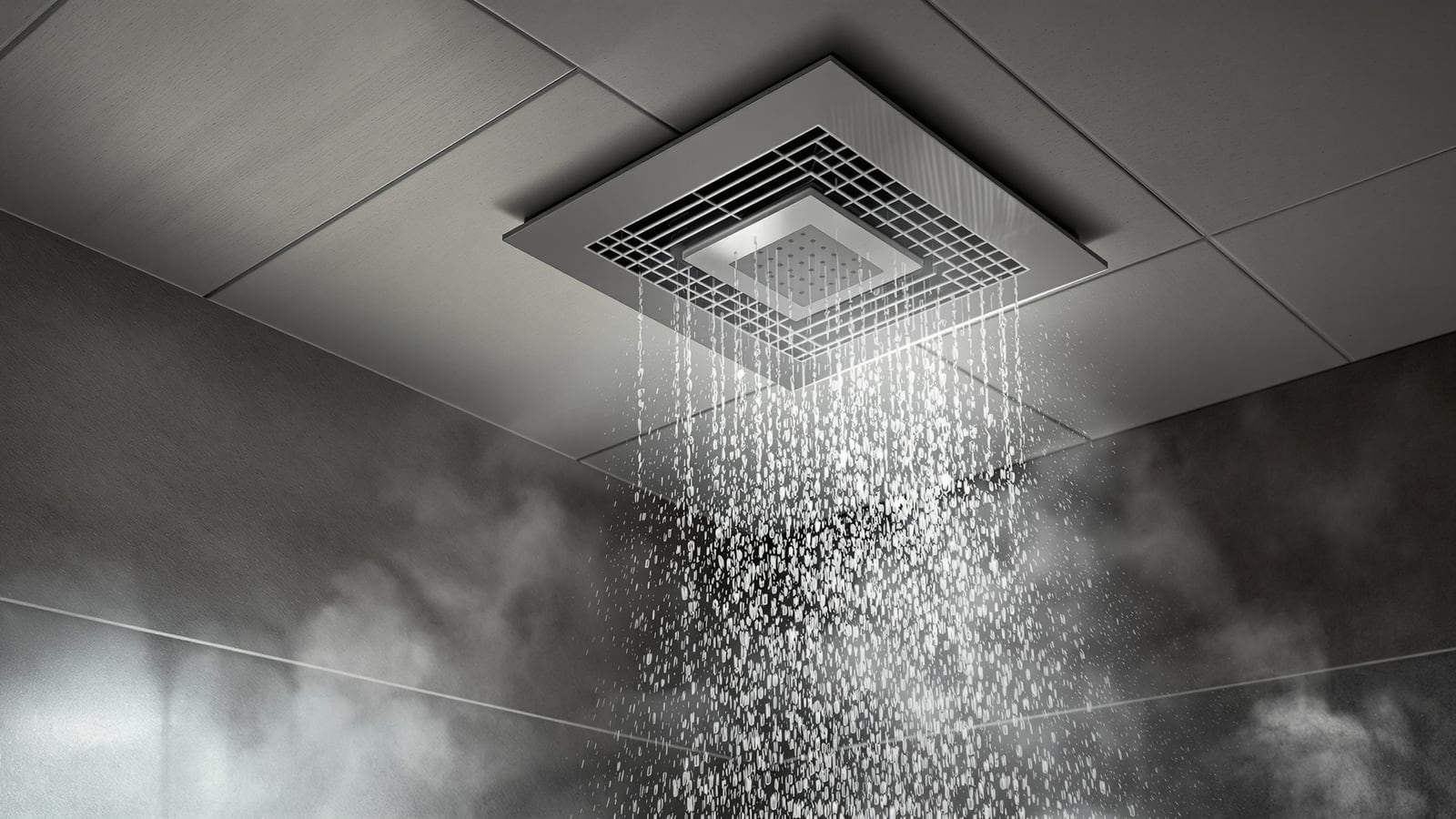
Moisture-Resistant Bathroom Ceiling India: PVC, Metal & Gypsum by Zone, Anti-Fungal Paint & Ventilation
How to design a bathroom ceiling that survives steam and condensation in an Indian home — matching waterproof PVC or metal over the wet zone, moisture-resistant gypsum in the dry zone, sizing the exhaust fan that actually protects it, and the anti-fungal paint, slope and drip detail that stops mould.
Almost nobody plans a bathroom ceiling, and almost every bathroom ceiling eventually shows it — a spreading grey bloom of mould in the corner over the shower, paint that lifts and peels in flakes, a gypsum board that sags and goes soft, brown drip stains that come back however many times you repaint. The culprit is rarely a leak from above. It is the room's own steam and condensation: a hot shower fills the space with warm, wet air, that air rises, hits the coolest surface — the ceiling — and gives up its moisture as a film of water. Do that twice a day for a monsoon and the ceiling is wet more often than it is dry.
A moisture-resistant bathroom ceiling is not one magic material. It is two decisions made together: choosing a ceiling that matches how wet each zone actually gets, and giving that ceiling a way to dry out — exhaust ventilation. Get the material right but starve the room of airflow and even a waterproof ceiling grows mould on its underside. This is the ceiling guide in the Studio Matrx bathroom hub. Read it alongside the bathroom false ceiling guide for India for the full false-ceiling build-up and lighting layout, and the complete bathroom design guide for the codes and fundamentals.
The ceiling is the last surface the steam touches and the first to show neglect. Match the material to the zone, then give the room enough air changes to dry the ceiling before the next shower — material without ventilation always loses.
Why bathroom ceilings fail: it is condensation, not a pipe
Understanding the failure mode tells you what to buy. Three things attack a bathroom ceiling, and only one of them is a plumbing leak.
- Condensation. Warm shower air holds a lot of water vapour. When it meets the ceiling — often the coolest surface in the room, especially if there is an unconditioned space or terrace above — the vapour condenses into liquid water on the surface and inside porous boards. This is the main killer.
- Steam absorption. Ordinary gypsum plasterboard and its paper facing are hygroscopic — they drink moisture from humid air, swell, lose strength and eventually sag or crumble even with no dripping water.
- Mould and mildew. Fungal spores are always in the air. Give them a damp, still, organic surface — paper-faced board, ordinary emulsion paint — and they colonise it. Mould is a ventilation problem wearing a paint disguise.
All three are driven by humid air that cannot escape — which is why this guide keeps returning to the exhaust fan: the material resists the assault, but ventilation removes it.
Match the material to the zone
The single most useful idea is to stop treating the ceiling as one surface. A wet-and-dry bathroom already splits the floor into a tanked shower zone and a dry vanity-and-WC zone — see the wet and dry zone layout guide. The ceiling above follows the same logic. Directly over the shower, air is hottest and wettest and the surface will get actual droplets; over the dry side it only sees ambient humidity.
Over the wet zone — use a genuinely waterproof ceiling. The material must shrug off droplets and steam and wipe clean without absorbing anything:
- uPVC ceiling panels. Interlocking hollow plastic planks clipped to a light metal frame. Fully waterproof, mould-resistant, cheapest, and the DIY-friendliest — but they can look plasticky and cheap panels yellow over years of heat.
- Aluminium / metal false ceiling. Powder-coated aluminium panels or a grid of baffles. Waterproof, fire-safe, durable, premium looking, and the go-to over a shower or steam area. Costlier and it can feel cold and commercial if overdone.
- Fibre-cement / calcium-silicate board. A rigid mineral board that does not rot, swell or feed mould, finished with tile or paint. More work than PVC but far more robust than gypsum where water is a real risk.
Over the dry zone — moisture-resistant (green) gypsum is fine and looks best. Standard white gypsum board must never go in a bathroom, but the moisture-resistant grade — usually green-faced, made with a water-repellent core and treated facing — is designed for humid rooms. It takes a crisp painted finish, hides service lines, and carries recessed lights cleanly. Over the dry vanity and WC, where it only sees ambient humidity and never direct spray, green board with the right paint is the smart, good-looking choice. Detailed build-up is in the gypsum bathroom ceiling guide.
| Ceiling material | Best zone | Waterproof? | Rough cost (₹/sq ft, supply+fix) | Watch-out |
|---|---|---|---|---|
| uPVC panel | Wet / full ceiling | Fully | 90 – 180 | Cheap panels yellow; can look plasticky |
| Aluminium / metal | Wet / shower | Fully | 220 – 500 | Costly; can feel cold, commercial |
| Fibre-cement board | Wet, high-risk | Yes (does not rot) | 130 – 260 | Heavier; needs sound framing |
| Moisture-resistant (green) gypsum | Dry zone | No — resists humidity only | 90 – 160 | Never over direct spray; needs a fan |
| Standard white gypsum | Nowhere | No | 70 – 130 | Sags, feeds mould — do not use |
Prices vary widely by city, brand and access; treat them as planning ranges, not quotes.
Ventilation is what actually protects the ceiling
This is the part most people skip, and it is the part that decides whether any ceiling survives. The best ceiling material still grows mould if the room stays humid for hours after every shower. A waterproof panel will not absorb water, but stale, saturated air deposits a greasy biofilm on its underside that mould happily colonises. Ventilation is not a comfort feature — it is ceiling protection.
The mechanism is simple: an exhaust fan pulls the warm, moist air out of the room and lets drier replacement air in, so the ceiling dries between uses instead of staying wet. NBC 2016 requires bathrooms to be ventilated, either by an openable window/opening of adequate area or by mechanical exhaust where a window is absent or inadequate — the norm for the majority of Indian apartment bathrooms, which are internal and windowless.
Sizing the fan. Work in air changes per hour (ACH). A bathroom wants roughly 6–8 air changes per hour; a shower or steam area is often designed nearer 10–15. The method:
- Room volume = length × breadth × height in metres → cubic metres.
- Required airflow = volume × ACH, then convert to the fan's rating (fans are sold in m³/h or CFM; 1 m³/h ≈ 0.59 CFM).
- Pick a fan at or above that number, and site it to pull air across the room — ideally over or near the shower, on the wall or ceiling opposite the door, so make-up air sweeps the whole space.
Three details make or break it in practice:
- Run it long enough. The fan must keep running through the shower and for 15–20 minutes after to clear the residual steam. A simple timer switch or humidity-sensing (humidistat) switch does this automatically and is the single best upgrade for ceiling life.
- Duct it out, not into the void. The extracted air must reach outside — through the wall or ducted to a shaft — not just dumped above a false ceiling, which only moves the mould problem into the ceiling void where you cannot see it.
- Let air in. A tightly sealed door starves the fan. A small undercut gap under the door (about 10–15 mm) or a louvre lets replacement air flow so the fan can actually extract.
Paint, slope and drip control: the finishing details
Once material and ventilation are right, three finishing choices keep the ceiling clean and dry.
Anti-fungal / anti-microbial paint. On any painted ceiling — especially green gypsum — never use ordinary interior emulsion. Use a bathroom-grade anti-fungal, washable emulsion with fungicide and algaecide additives, which most Indian majors sell as a kitchen-and-bath or "damp/anti-fungal" line. A primer/sealer coat first stops moisture reaching the board and gives the topcoat something to grip. Choose a satin or semi-gloss sheen, not matt: it repels surface water, wipes clean and does not trap the biofilm that matt films hold. The same logic runs through the waterproof bathroom paint guide.
Slope and drip control. A dead-flat ceiling lets condensation bead, pool and then release in big cold drops onto your head. Two small moves help: give a panelled or lined ceiling a barely-perceptible fall so any surface water runs to an edge rather than hanging in the middle, and keep the ceiling height generous — a higher ceiling keeps the coolest condensing surface further from the steam plume and buys drying time. Avoid deep coffers and sharp downstand pockets directly over the shower; they trap a pocket of still, saturated air that never clears.
Lights and openings are moisture entry points. Every recessed downlight, fan and access panel is a hole in your ceiling line. Over or near the shower, use IP-rated fittings — for a zone that can see spray, aim for at least IP44, and inside a shower enclosure follow the wiring zones and use fittings rated accordingly. Cheap unsealed downlights let humid air migrate into the ceiling void and condense on the cold slab above, seeding hidden mould. Wiring must follow IS 732; get any bathroom electrical work certified.
| Do | Don't |
|---|---|
| Waterproof PVC/metal over the shower | Standard white gypsum anywhere in the room |
| Green (MR) gypsum + anti-fungal paint on the dry side | Ordinary matt emulsion on a bathroom ceiling |
| Size the fan to 6–8 ACH (10–15 over a shower) | Rely on a small window alone in a humid climate |
| Run the fan 15–20 min after showering | Switch the fan off the moment you step out |
| Duct extract air outside | Dump moist air into the ceiling void |
| IP44+ sealed lights near wet zones | Cheap open downlights over the shower |
Do these six things and the ceiling stops being the surface that dates your bathroom. For how this ceiling sits within the wider false-ceiling design, lighting and service coordination, continue to the bathroom false ceiling guide; for the whole-room picture, the bathroom design guide for India ties material, waterproofing and ventilation together.
References
- National Building Code of India (NBC) 2016, Part 8 (Building Services) and Part 9 (Plumbing Services) — ventilation of bathrooms and water-closets, mechanical exhaust where natural ventilation is inadequate.
- IS 2095 — Gypsum plaster boards, including moisture-resistant grades (BIS).
- IS 2098 — Asbestos-free fibre-cement / calcium-silicate flat boards used for wet-area ceilings (BIS).
- IS 732 — Code of practice for electrical wiring installations; bathroom zones and IP ratings for luminaires and fans (BIS).
- Central Public Health and Environmental Engineering Organisation (CPHEEO) manuals — guidance on ventilation and humidity control in sanitary spaces.
- IGBC / GRIHA residential rating criteria — indoor environmental quality and ventilation provisions for wet areas.
Export this guide
Related Guides — Deep-dive reading
Waterproof Bathroom Paint in India: Anti-Fungal, Washable Emulsions for Walls & Ceilings
Which paint survives above the tile line — the moisture-resistant, anti-fungal, washable emulsions that stop peeling and black mould on Indian bathroom walls and ceilings. Sheen, prep, low-VOC and ₹/litre, brand-neutral.
BathroomsBathroom False Ceiling India: PVC, Gypsum, Aluminium Panels, Cost & the #1 Moisture Rule
A complete guide to bathroom false ceilings for Indian homes — why you fit one, the material choices (PVC, moisture-resistant gypsum, aluminium and metal panels, ACP), access panels, integrating the exhaust fan and lights, and a rupee cost comparison — with the one rule that keeps a wet-zone ceiling from sagging.
BathroomsBathroom Planning for New Homes in India: Get It Right Before You Build
The bathroom decisions you cannot undo once the slab is cast — location and stacking, sunken vs non-sunken slabs, waterproofing, and the plumbing, electrical and ventilation you must coordinate with the civil work, stage by stage.
BathroomsRelated Tools — Try Free
Cross-Ventilation Analyzer
Estimate airflow and air changes per hour (ACH) from room size, window areas, layout, and local wind — with NBC 2016 Part 8 compliance check.
Ventilation CalculatorFalse Ceiling Cost Estimator
Live ₹/sqft across 8 ceiling types — POP, gypsum, designer, metal, PVC, wooden — with cove and spot lighting for 20 Indian cities.
Cost CalculatorWindow Grill Design Selector
Pick a window grille style and material by priority — security, looks, budget, view — and estimate cost.
Window Tool