
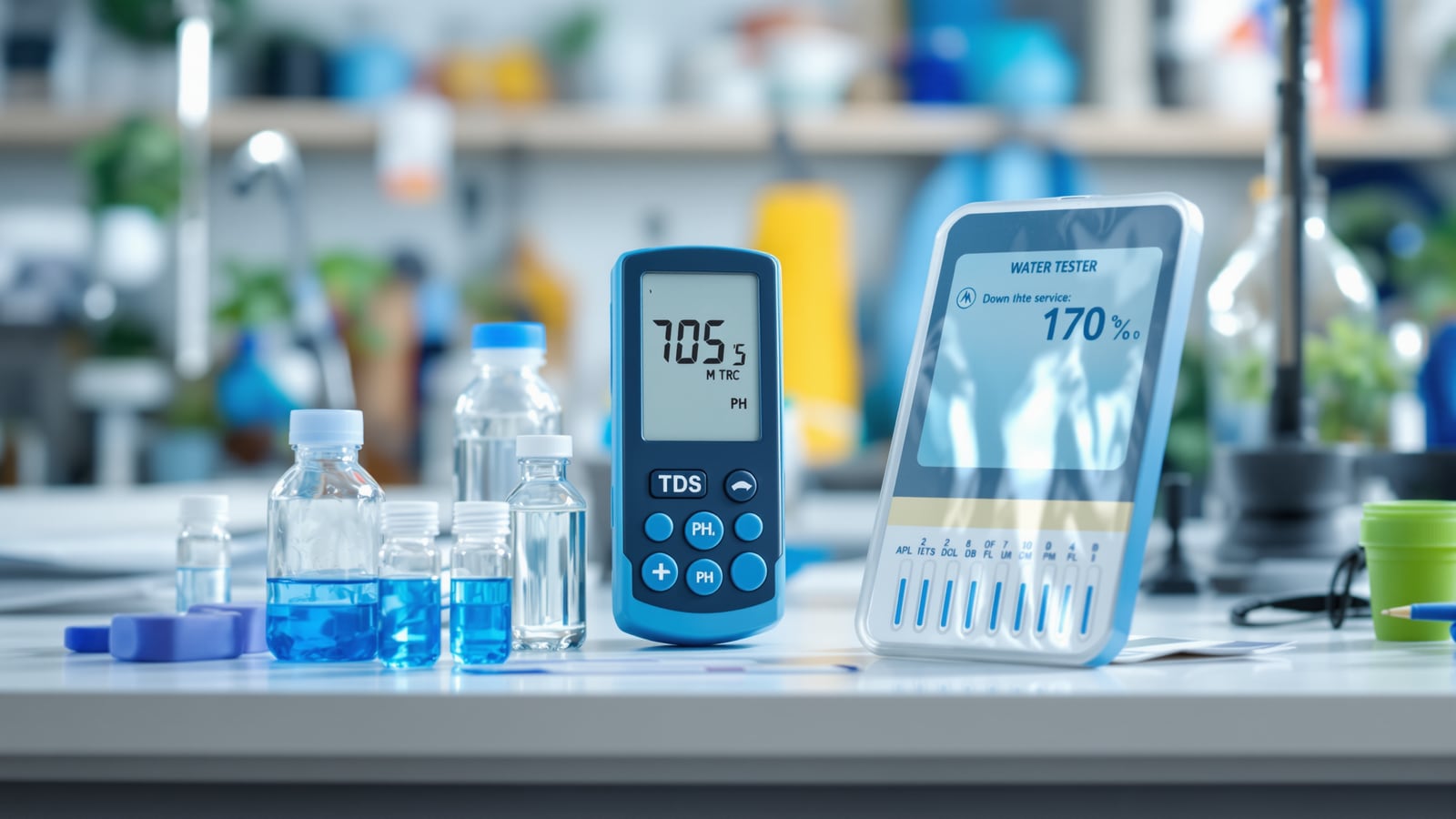
Water Quality Testing for Indian Homes: The First Step Before Any Treatment
Why you should test your household water before spending a rupee on treatment — the parameters that matter, IS 10500 acceptable limits, home TDS/pH/hardness tools vs a proper NABL lab test, how and where to get water tested in India, and how to turn a report into the right purifier.
Before you spend anything on an RO unit, a softener or a whole-house filter, answer one question: what is actually in your water? Almost every wasted rupee in home water treatment comes from skipping this step — buying an RO where the TDS was already fine, or a plain candle filter where the real problem was hardness or nitrate. Testing is the cheap, fast diagnosis that decides everything that follows.
This is the first-step guide in the Studio Matrx Plumbing Knowledge Hub's water-treatment cluster. It stays firmly on the domestic drinking-water side: how to measure the quality of the fresh water coming into your home, read the numbers against the Indian standard, and hand that report to the right treatment choice. Once you know your numbers, the pillar guide at /guides/water-treatment-guide-india maps them to solutions.
A treatment recommendation without a test is a guess. The single most common mistake in Indian homes is installing an RO out of habit — even on soft, low-TDS municipal water where it strips useful minerals and wastes reject water for no benefit. Test first; treat second.
Why test before you treat
Water treatment is targeted, not general. RO membranes remove dissolved salts; softeners swap out calcium and magnesium; UV kills microbes but changes no chemistry; activated carbon handles taste, chlorine and odour. Each fixes a specific problem. If you do not know which problems you have, you cannot pick the right combination — and you will almost certainly either over-treat (paying for RO you don't need, wasting water, stripping minerals) or under-treat (a filter that does nothing about your fluoride or bacteria).
Testing gives you three things:
- The right treatment. Numbers tell you whether you need softening, RO, disinfection, iron removal — or nothing.
- A baseline. Future retests show whether your source is changing (borewells often do) or whether a new purifier is actually working.
- Peace of mind. For microbes and metals especially, water can look and taste perfect and still be unsafe. Only a test reveals it.
The parameters that matter — and IS 10500 limits
The reference standard for drinking water in India is IS 10500, the Bureau of Indian Standards specification for drinking water. It defines an acceptable limit for each parameter and, where no alternative source exists, a higher permissible limit. You do not need to memorise it, but you should know the handful of parameters that decide most home treatment choices. The values below are indicative — always read the current IS 10500 tables and get your own water tested rather than assuming.
| Parameter | IS 10500 acceptable limit (indicative) | What a high value means / treatment cue |
|---|---|---|
| E. coli / total coliform | Shall not be detectable in 100 ml | Faecal/microbial contamination — needs UV, boiling or chlorination |
| Turbidity | 1 NTU | Cloudiness / suspended solids — needs sediment filtration first |
| pH | 6.5 to 8.5 | Low pH corrodes pipes and leaches metals; very high tastes soapy |
| Total dissolved solids (TDS) | 500 mg/L | High TDS = salty/scaling water; the classic case for RO |
| Total hardness (as CaCO3) | 200 mg/L | Scale in geysers, taps, kettles — points to a softener |
| Iron | 0.3 mg/L | Reddish stains, metallic taste — needs iron removal / oxidation |
| Fluoride | 1.0 mg/L | Excess causes dental and skeletal fluorosis — needs RO or activated alumina |
| Nitrate | 45 mg/L | Risk to infants (blue-baby syndrome); RO removes it |
| Chloride | 250 mg/L | Salty taste, corrosion; often tracks with high TDS |
Notice how the parameters cluster into three families that need different answers: microbes (coliform, E. coli — a disinfection problem), dissolved load (TDS, hardness, chloride, fluoride, nitrate — a membrane or ion-exchange problem), and physical/metals (turbidity, iron — a filtration or oxidation problem). A single number rarely tells the whole story, which is why a full report beats a lone TDS reading.
Home tools vs a proper lab test
You can measure some things yourself in minutes, and some things only a lab can tell you. The honest split: home tools screen; a lab diagnoses.
| Method | What it measures | Cost (indicative) | Good for |
|---|---|---|---|
| TDS meter | Total dissolved solids only | ₹300 to ₹800 | Quick check; deciding if RO is even relevant |
| pH strips / meter | Acidity / alkalinity | ₹150 to ₹1,500 | Corrosion and taste screening |
| Hardness test kit | Total hardness (drop titration) | ₹300 to ₹700 | Deciding if you need a softener |
| Multi-parameter strips | pH, hardness, chlorine, nitrate (rough) | ₹400 to ₹900 | A cheap first look before the lab |
| NABL-accredited lab test | Full IS 10500 panel incl. bacteria, metals, fluoride | ₹800 to ₹3,000+ | The real decision; anything you'll drink |
A TDS meter is worth owning — it is instant and tells you whether high dissolved salts are even in play. But it is widely misunderstood: TDS says how much is dissolved, not what. A TDS of 250 mg/L could be harmless minerals or could hide dangerous nitrate and fluoride at the same reading. Home kits cannot see bacteria, heavy metals (lead, arsenic), fluoride or nitrate reliably — and those are exactly the parameters where "looks fine" is most dangerous.
The rule of thumb: use home tools to screen and monitor, but before you choose treatment for water anyone will drink, get one proper lab test from a NABL-accredited laboratory. NABL accreditation (National Accreditation Board for Testing and Calibration Laboratories) is your assurance the numbers are trustworthy.
How and where to get water tested in India
You have several routes, and the right one depends on how far you need to trust the result:
- Government / municipal labs. Many state public-health engineering departments, municipal corporations and Jal Board offices test drinking water cheaply, and public-health labs handle bacterial testing. Ask your local water utility.
- Private NABL-accredited laboratories. Environmental and food-testing labs run full IS 10500 panels and email a report in a few days. This is the best route for a complete, defensible result.
- RO / purifier brand technicians. They will happily do a free on-the-spot TDS check — useful, but remember it is a sales visit and covers only TDS, not the full picture.
- Home lab-kit couriers. Some labs send a sample kit, you collect and post it back, and results come online.
Get the bacteriological test done alongside the chemical one if you are on borewell, tanker or any source with contamination risk — it is the parameter home kits cannot touch and the one most likely to make you ill.
Sampling correctly — or the numbers lie
A perfect lab cannot fix a bad sample. Get the collection right:
- Use a clean, rinsed container — a lab-supplied sterile bottle for bacterial tests (never reuse a juice or oil bottle).
- Run the tap for a minute or two first, so you sample the water in the line, not stagnant water sitting in the fitting overnight.
- Fill to the brim and cap tightly to minimise trapped air for chemical samples.
- Sample from the point that matters — the kitchen drinking tap if you're testing what you drink; the inlet if you're assessing the raw source.
- Deliver fast. Bacterial samples degrade quickly; get them to the lab within a few hours, kept cool. Don't collect on a Friday evening if the lab is shut all weekend.
- Note the source on the form — municipal, borewell, tanker or well — because the lab and you will interpret the same numbers differently by source.
How often to retest
Water quality is not fixed, so one test is a snapshot, not a guarantee:
- Borewell water: retest at least once a year, and again after the monsoon — recharge and surface run-off can push nitrate, turbidity and bacteria up sharply between seasons.
- Municipal / tanker supply: test when you move in, and again if taste, colour or smell changes.
- After any treatment install or change: retest to confirm the unit actually brought the flagged parameters within limits — this is how you prove the RO or softener is earning its keep.
- Any illness in the household you suspect is waterborne: test for bacteria immediately.
Borewell water deserves special attention because it draws on local geology — fluoride, iron, arsenic and hardness are all common and all invisible. If your home runs on a borewell, treat annual testing as routine maintenance, the way you would service a pump. See /guides/borewell-water-system-india for the source side of that story.
Turning the report into a decision
When the report lands, work down it parameter by parameter, flag anything above the IS 10500 acceptable limit, and match it to the treatment family. High TDS and salts point toward an RO system (/guides/ro-water-systems-india); hardness alone often needs only a softener; bacteria need UV or disinfection; iron or turbidity need pre-filtration. Most homes end up with a small train of steps in series rather than a single magic box — and you only build the steps your report actually demands.
For the full mapping of parameters to treatment technologies and indicative costs, go to the section pillar, /guides/water-treatment-guide-india. To keep the treated water safe all the way to the glass — storage, materials and a dedicated potable line — see /guides/drinking-water-systems-india. Test first, treat precisely, retest to confirm: that sequence is how a Studio Matrx home avoids both unsafe water and money wasted on treatment it never needed.
References
- IS 10500 — Bureau of Indian Standards, Drinking Water — Specification. The Indian reference for acceptable and permissible limits of drinking-water parameters. Read the current tables; treat all figures in this guide as indicative.
- NABL — National Accreditation Board for Testing and Calibration Laboratories, for identifying accredited water-testing laboratories in India.
- WHO — Guidelines for Drinking-water Quality, for background on health-based limits behind many parameters.
Export this guide
Related Guides — Deep-dive reading
RO vs UV Water Purifier: Which One Does Your Home Need? (India)
A fair, India-first head-to-head decided by one number — your feed-water TDS. RO strips dissolved salts and heavy metals for hard borewell water; UV only kills microbes and suits already-clear, low-TDS municipal supply. What each removes, water wastage, running cost, and a verdict by measured TDS.
PlumbingRO Water System for Indian Homes: How Reverse Osmosis Works, When You Need It, Reject Water and Cost
The point-of-use purifier that strips dissolved salts, TDS and heavy metals from high-TDS borewell and brackish water — how the membrane and cartridge train actually work, when RO is right (and when it just wastes water and strips minerals), how to reuse reject water, and what it costs to run in India.
PlumbingDrinking Water Systems for Indian Homes: Safe Potable Water at Every Tap
How to deliver genuinely safe drinking water at the point of use in an Indian home — what IS 10500 actually means, why a dedicated potable line beats treating every drop, point-of-use vs point-of-entry, safe covered storage, lead-free food-grade materials, and the water tests worth doing.
PlumbingRelated Tools — Try Free
Rainwater Tank Sizer
How big should your rainwater tank be? Computes annual harvest, recommended tank capacity in litres, water-bill savings, and payback — for 10 Indian cities.
RWH CalculatorWater Tank Chlorination Calculator
Work out how much household bleach to disinfect a water storage tank from tank volume, target chlorine dose and bleach strength.
Plumbing CalculatorBefore & After Studio
Generate AI before-and-after renders to preview how your redesign could look.
DesignAI