
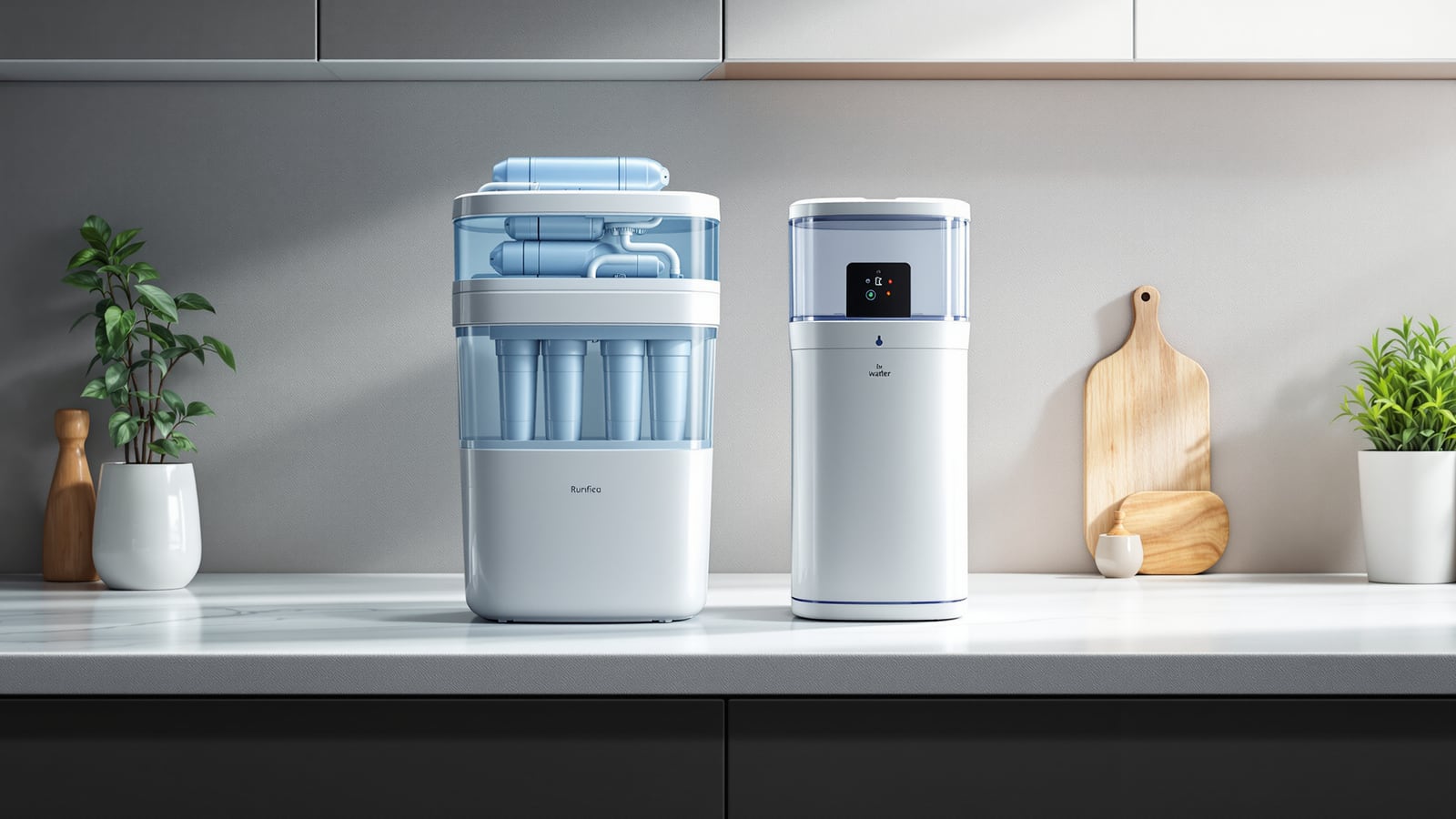
RO vs UV Water Purifier: Which One Does Your Home Need? (India)
A fair, India-first head-to-head decided by one number — your feed-water TDS. RO strips dissolved salts and heavy metals for hard borewell water; UV only kills microbes and suits already-clear, low-TDS municipal supply. What each removes, water wastage, running cost, and a verdict by measured TDS.
Walk into any appliance shop in India and the sales pitch collapses into three letters — "RO". But RO and UV solve two completely different problems, and buying the wrong one either wastes litres of water and strips useful minerals, or leaves live bacteria in your glass. The single fact that decides this whole choice is not a brand or a budget: it is your feed-water TDS (Total Dissolved Solids), and the only honest way to know it is to get your water lab-tested.
This is a fair, head-to-head verdict. Neither technology is "better" outright — RO removes dissolved impurities, UV kills living organisms, and they are strongest when they cover for each other's blind spots. That is exactly why so many units sold in India are RO+UV (often +UF) combos. Brands like Kent, Aquaguard, Pureit, Livpure and AO Smith are named only as familiar examples, not recommendations.
Each technology already has its own full technical guide — how it works, membranes, staging and install. This article stays strictly on the comparison. For the deep dives, see RO Water Systems (India) and UV Water Purifiers (India). For the whole picture, go up to the pillar Water Treatment Guide (India).
The one number that decides everything: TDS
TDS measures the total dissolved salts — calcium, magnesium, sodium, sulphates, nitrates, and any dissolved heavy metals — in your water, in milligrams per litre (mg/L or ppm). A UV lamp does nothing to dissolved solids; it cannot lower TDS or remove heavy metals or hardness. RO, by pushing water through a semi-permeable membrane, physically rejects those dissolved solids.
So the logic is blunt:
- High TDS (typical of borewell, tanker, coastal or "hard" groundwater) — you need RO to bring dissolved salts and metals down. UV alone will hand you clear-looking but still salty, hard, possibly metal-laden water.
- Low TDS but microbially unsafe (typical of a treated municipal line that picks up bugs in old pipes or an overhead tank) — UV is enough. Running such water through RO needlessly strips minerals, wastes water and adds cost.
Do not guess your TDS from taste or the plumber's opinion. Get it measured. A cheap handheld TDS meter gives a rough number, but a proper lab test also reveals hardness, nitrates, fluoride, arsenic, iron and bacterial load — the things that actually decide the machine. See Water Quality Testing (India) for how to test properly and read the report.
Feed water: what each one needs to work
This is the trap most buyers miss. UV needs water that is already clear and low in TDS — turbidity and dissolved solids shield microbes from the light and let some survive. That is why a bare UV purifier is only honest on a treated municipal line, and why combos put a sediment and carbon pre-filter (and often a UF membrane) ahead of the lamp.
RO is far more tolerant of dirty, hard, high-TDS water — that is its whole job. But RO membranes hate chlorine and heavy sediment, so RO systems carry their own pre-filters that need regular changing. Neglect those pre-filters and the expensive RO membrane clogs or gets chemically damaged early, turning a maintenance saving into a big replacement bill.
A useful way to picture it: UV is a finishing step that assumes the water reaching it is already physically clean, while RO is a bulk-removal step that changes what is dissolved in the water itself. That is why you can never substitute one for the other — they act on different categories of impurity. Chlorine and taste, incidentally, are handled by neither directly; that is the job of the activated carbon pre-filter both systems share.
Water wastage — the RO trade-off
RO produces a stream of reject (waste) water carrying the rejected salts. Older or poorly-tuned domestic RO units can reject a large share of the input, which is a real concern in water-scarce Indian cities. Mitigations: choose a unit with a better recovery ratio, and route the reject line to a bucket for mopping, gardening or flushing rather than the drain. UV wastes essentially nothing — every litre in is a litre out.
RO vs UV — side by side
| Factor | RO (Reverse Osmosis) | UV (Ultraviolet) |
|---|---|---|
| Primary job | Removes dissolved salts, metals, hardness | Kills bacteria, viruses, cysts |
| Effect on TDS | Lowers TDS significantly | No change to TDS |
| Ideal feed water | High-TDS borewell / tanker / hard water | Low-TDS, clear municipal water |
| Removes heavy metals? | Yes | No |
| Water wastage | Yes — reject stream | Negligible |
| Keeps natural minerals | Reduced (add mineraliser) | Yes, fully |
| Electricity | Needed (pump) | Needed (lamp) |
| Water pressure | Often needs pump / stored feed | Works at line pressure |
| Ongoing parts | Pre-filters + RO membrane | UV lamp + pre-filters |
| Best for | Hard, salty, contaminated groundwater | Already-safe-TDS but microbially risky water |
Minerals, and the "TDS controller" question
Because RO strips salts indiscriminately, it also removes some minerals your body genuinely uses. Most RO units answer this with a mineraliser or TDS controller / modulator stage that adds a measured amount back or blends in a little unfiltered water to lift the final TDS to a palatable level. UV never has this problem because it does not touch minerals at all. If your water is low-TDS to begin with, running it through RO and then re-mineralising is a wasteful round trip — a strong hint that you needed UV, not RO.
Running cost: it is the consumables, not the sticker
The purchase price is only the start. Both need periodic consumables and, in practice, an AMC (annual maintenance contract):
- RO — sediment and carbon pre-filters every several months, plus the RO membrane periodically (the single costliest part). Higher AMC.
- UV — the UV lamp loses intensity and must be replaced roughly yearly even if it still glows, plus pre-filters. Lower AMC.
Both draw electricity, though modest. Over a five-to-seven-year ownership window the consumables and AMC usually outweigh the original purchase price, so an RO bought for water that only needed UV keeps costing you more every single year — another reason the TDS test pays for itself many times over. Treat any figures as indicative and size the real spend against your water and usage in Water Treatment Cost (India).
Why so many units are RO+UV(+UF) combos
Real Indian water is rarely one clean problem. Borewell water can be both high-TDS and microbially contaminated; a municipal line can be low-TDS but pick up bacteria in an old overhead tank. A combo covers both: RO drops the TDS and metals, UV finishes the microbial kill, and UF (ultrafiltration) adds a membrane barrier that works without electricity. If your test shows both high TDS and a microbial problem, a combo is the honest answer — not a bare UV that leaves salts, nor a bare RO that may not fully guarantee microbial safety.
To weigh the wider buying decision — capacity, storage, RO vs UV vs UF vs combo, and features worth paying for — use Choosing a Water Purifier (India).
The verdict
There is no universal winner — there is a winner for your water:
- For high-TDS, hard, or metal-bearing supply (borewell, tanker, coastal): pick RO. UV cannot lower TDS or remove heavy metals, so on this water it is unsafe on its own. Add a UV/UF stage if the test also shows microbes.
- For clear, low-TDS municipal water that is only microbially risky: pick UV. RO here just wastes water, strips minerals and costs more for no benefit. Save the money and the reject water.
- For water that is both high-TDS and microbially unsafe: pick an RO+UV (+UF) combo — the two technologies were made to cover each other.
- If you have not tested your water: do that first. Every recommendation above hinges on a number you can only get by measuring.
Bottom line: UV kills what is alive, RO removes what is dissolved — so let your lab-tested TDS, not the salesperson, decide, and reach for a combo only when the report shows both problems.
Line this up against the other head-to-heads in the Plumbing Comparisons Guide (India).
Export this guide
Related Guides — Deep-dive reading
RO Water System for Indian Homes: How Reverse Osmosis Works, When You Need It, Reject Water and Cost
The point-of-use purifier that strips dissolved salts, TDS and heavy metals from high-TDS borewell and brackish water — how the membrane and cartridge train actually work, when RO is right (and when it just wastes water and strips minerals), how to reuse reject water, and what it costs to run in India.
PlumbingMunicipal Water vs Borewell: Which to Rely On for an Indian Home?
A fair, India-first head-to-head: corporation (municipal) supply is treated and cheap to run but comes for a few hours a day, while a borewell gives you your own 24x7 groundwater at an upfront drilling cost — with hardness and a falling water table to manage. When to pick each, and why most homes end up keeping both.
PlumbingHow to Choose a Water Purifier in India: RO vs UV vs UF, Sizing, AMC Cost and a Buyer's Checklist
The buying decision, not the technology lecture. Test your water first — because TDS and microbial quality decide whether you need RO, UV, UF or a combo — then size the storage, count the true running cost of filters and AMC, insist on BIS/ISI, and check the service network before you pay.
PlumbingRelated Tools — Try Free
Lift Annual Maintenance Cost Calculator
AMC cost for a home lift — comprehensive vs non-comprehensive, with a 5-year projection.
Lift CalculatorRO Water Wastage Calculator
See how much water a domestic RO purifier rejects for the purified water you use, from your daily use and recovery ratio.
Plumbing CalculatorWindow Cleaning Cost Calculator
Estimate professional window cleaning cost per visit and per year by access and frequency.
Window Calculator