
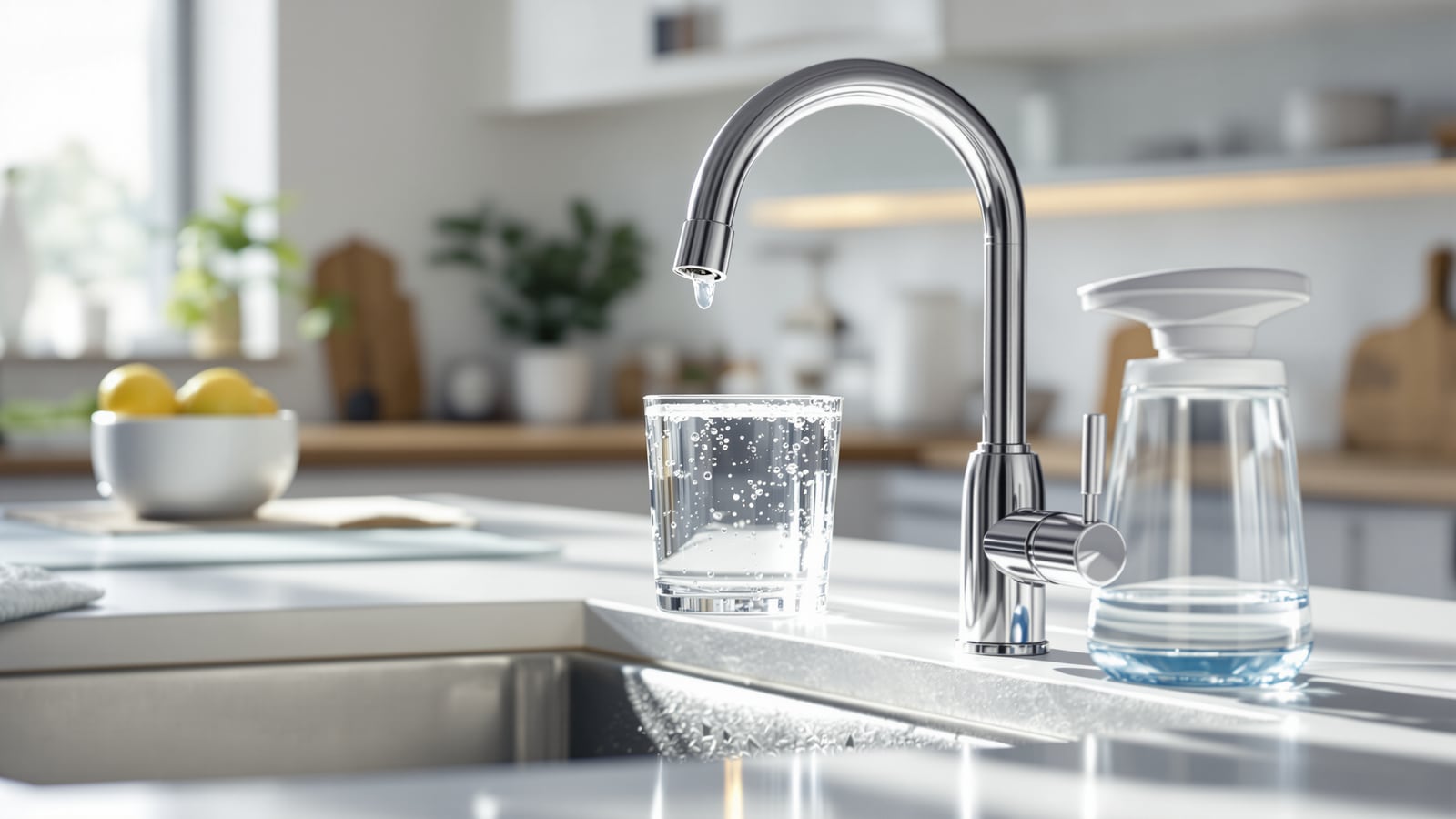
Drinking Water Systems for Indian Homes: Safe Potable Water at Every Tap
How to deliver genuinely safe drinking water at the point of use in an Indian home — what IS 10500 actually means, why a dedicated potable line beats treating every drop, point-of-use vs point-of-entry, safe covered storage, lead-free food-grade materials, and the water tests worth doing.
Every home in India has running water. Far fewer have water you can safely swallow straight from the tap. Between the source and your glass sit a covered tank, a run of pipe, a set of joints and — often — a purifier, and each one either protects the water or quietly spoils it. This guide is about that last stretch: how to get genuinely potable water to the point where you drink it.
This is a supply and safe-delivery guide inside the Studio Matrx Plumbing Knowledge Hub. It deliberately stays on the plumbing side — lines, taps, storage and materials. For the deep product detail of RO membranes, UV chambers and softeners we point you to the treatment resources at the end; here the question is simpler and more important: once water is clean, how do you keep it clean until someone drinks it?
Clean water and safe water are not the same thing. Water can leave a purifier perfectly potable and arrive at your lips contaminated — because of a dirty storage tank, a cross-connection, or a leaded fitting between the two. Drinking-water safety is a chain, and the chain is only as strong as its last metre.
What "potable" actually means
Potable simply means safe to drink — free of harmful microbes and within safe limits for dissolved chemicals and metals. In India the reference standard for what counts as drinking-quality water is IS 10500, the Bureau of Indian Standards specification for drinking water. It sets acceptable limits (and, where treatment is unavailable, permissible limits) for a long list of parameters: turbidity, pH, total dissolved solids, hardness, chlorides, fluoride, nitrate, iron, arsenic, lead and — critically — the absence of E. coli and other coliform bacteria.
You do not need to memorise the numbers, but a few indicative limits from IS 10500 give a feel for the targets:
| Parameter | Acceptable limit (IS 10500, indicative) | Why it matters |
|---|---|---|
| E. coli / coliforms | Shall not be detectable in 100 ml | Sewage / faecal contamination — the main acute risk |
| Turbidity | 1 NTU (acceptable) | Cloudiness; shields microbes from disinfection |
| pH | 6.5–8.5 | Very low pH corrodes pipes and leaches metals |
| Total dissolved solids | 500 mg/l (acceptable) | Taste, scaling; high TDS often needs RO |
| Total hardness (as CaCO₃) | 200 mg/l (acceptable) | Scale in geysers and taps; not a health risk itself |
| Fluoride | 1.0 mg/l (acceptable) | Excess causes dental/skeletal fluorosis |
| Nitrate | 45 mg/l | Risk to infants (blue-baby syndrome) |
| Lead | 0.01 mg/l | Neurotoxin; often from plumbing, not the source |
| Arsenic | 0.01 mg/l | Geogenic in parts of the Ganga–Brahmaputra belt |
Treat these as indicative — always read the current IS 10500 tables, and get your specific water tested rather than assuming. The point is that "safe" is measurable, and the parameters that trip up Indian homes cluster into three groups: microbes (from contamination), hardness/TDS (from groundwater), and metals (from geology or from the plumbing itself).
Treat everything, or just the drinking water?
The instinct is to make all the water in the house drinkable. In India that is almost always the wrong call — technically and financially.
A typical household uses roughly 135 litres per person per day (the CPHEEO domestic planning figure), but only a tiny slice of that is actually swallowed. Bathing, laundry, flushing, floor washing and the garden do not need drinking-grade water. Purifying the entire supply to IS 10500 means running your whole daily volume through expensive treatment — and RO in particular wastes a large fraction as reject water. It is like heating the whole house to warm one room.
The sensible architecture in most Indian homes is a dedicated drinking-water line: treat a small volume to potable standard and deliver it to one or two points — the kitchen drinking tap and perhaps a refrigerator — while the rest of the house runs on ordinary supply. This is the difference between point-of-entry (POE) and point-of-use (POU) treatment.
| Approach | Where it treats | Typical use in India | Indicative cost |
|---|---|---|---|
| Point-of-use (POU) | At one tap / one appliance | Kitchen RO+UV purifier, drinking tap | ₹12,000–₹25,000 per point |
| Point-of-entry (POE) | Where water enters the home | Whole-house sediment filter, softener | ₹20,000–₹80,000+ |
| Blended (recommended) | POE for sediment/hardness, POU for drinking | Softener/filter at inlet + POU purifier at kitchen | Varies |
- Point-of-use is where you make water drinkable. A single kitchen purifier is the right home for RO, UV and fine filtration because it treats only the litres you drink and cook with.
- Point-of-entry is where you make water usable — a sediment filter to catch grit before it reaches every tap, or a softener where hard borewell water is scaling geysers and taps. POE is about protecting the plumbing and appliances, not about drinking safety.
A well-planned home often uses both: a coarse sediment filter and, if needed, a softener at the inlet to protect the whole system, plus a compact POU purifier at the kitchen for genuinely potable water. For the softener and purifier product choices themselves, see the treatment resources linked below.
The dedicated drinking-water tap
Physically, a drinking-water line is short and simple: it runs from your POU purifier to a separate tap, usually mounted beside the main kitchen mixer. That separation matters for three reasons:
- It isolates potable water from the rest of the plumbing, so a problem in the utility lines cannot contaminate what you drink.
- It lets you use the best materials only where they count — a short lead-free, food-grade run is cheap; plumbing the whole house that way is not.
- It keeps the treated water fresh. Purified water that sits in long pipes goes stale and can grow biofilm; a short line drawn from often stays clean.
A dedicated tap is also the right place to stop a dangerous mistake — a cross-connection, where a non-potable line can back-feed into the drinking line. Keep the drinking line clearly separate, never plumb it downstream of a toilet cistern or garden tap, and use non-return protection where a purifier connects to the supply.
Safe storage: where clean water goes wrong
More Indian drinking-water problems come from storage than from the source. A covered municipal supply can arrive perfectly safe and then sit for days in a tank that undoes all of it. The rules are unglamorous but decisive:
- Keep it covered. Every overhead and underground tank needs a tight, insect- and light-proof lid. An open or cracked tank invites dust, lizards, bird droppings, mosquito breeding and algae.
- Use food-grade tanks. Water-storage tanks should be food-grade plastic (or lined) rated for potable water — not a random industrial drum.
- Stop stagnation. Water that sits still goes stale and grows biofilm. Size tanks for roughly a day or two of use, not a week, and make sure water actually turns over. Design inlet and outlet so the tank does not develop a permanently still "dead zone."
- Block light. Sunlight through a translucent tank drives algae. Use opaque tanks or shade them.
- Clean on a schedule. Drain, scrub and disinfect overhead and underground tanks at least twice a year — more if you see sediment or slime.
- Protect against back-flow and ingress. Underground sumps must be sealed against groundwater and sewage seepage; a sump next to a leaking drain is a contamination waiting to happen.
The single most common cause of "clean water that made us sick" in Indian homes is not the source — it is an uncovered, uncleaned tank, or a sump sitting too close to a leaking drain line. Fix the storage before you blame the supply.
Lead-free, food-grade materials for potable lines
What the water touches on its way to you can add contamination that no purifier upstream will catch. For any pipe, fitting or tap carrying drinking water, insist on lead-free, food-grade materials:
- Pipes: food-grade CPVC, PPR or PEX are standard for potable indoor plumbing in India and do not leach. Modern uPVC/CPVC systems are made for potable use.
- Metal fittings: where you use brass, specify lead-free (low-lead) brass for anything on the drinking line. Old brass and bronze fittings can contain lead that leaches into standing water — the classic reason a home's tap water shows lead when the source does not.
- Avoid legacy risks: old lead solder, galvanised iron gone to rust, and unknown salvaged fittings have no place on a drinking line.
- Flush stagnant water: even with good materials, run the tap for a few seconds first thing in the morning before filling a drinking glass — the water that sat overnight in the fittings is the most likely to carry leached metal.
Testing: know your water before you design
You cannot treat what you have not measured, and you cannot trust water you have never tested. A basic drinking-water test is inexpensive and settles the guesswork:
- What to test: at minimum microbiological (coliform / E. coli), TDS, hardness, pH, fluoride, nitrate and iron. In known-affected regions add arsenic (parts of West Bengal, Bihar, Assam, UP) and fluoride (parts of Rajasthan, Gujarat, Andhra Pradesh, Karnataka).
- Where: NABL-accredited water-testing labs, many municipal/state public-health labs, and university departments run drinking-water panels. Home TDS meters tell you dissolved solids only — useful, but not a safety test.
- When: test a new borewell before you rely on it, retest borewells after the monsoon, and test municipal water if colour, smell or illness ever appears. Retest at least annually.
- Then design: the results tell you what treatment you actually need. High coliform points to UV or boiling and a storage/cross-connection fix; high TDS/hardness points to RO or softening; high arsenic or fluoride needs specific media. Match the kit to the result — see the water-quality testing guide below for the full walkthrough.
Where this fits with the rest of your plumbing
Drinking-water safety is one layer of a larger supply system. How water reaches the house, how it is stored and pumped, and whether your source is municipal or borewell all shape the risks you are managing:
- Start with the pillar, Water Supply Systems in India, and the Plumbing Systems Guide for India.
- Understand your source: Municipal Water Supply in India and the Borewell Water System guide — borewell water especially drives your hardness, TDS and geogenic-contaminant decisions.
- For the treatment kit itself — RO, UV, softeners and smart purifiers — see the forthcoming Water Treatment Guide for India, the Water Quality Testing guide, and the smart water purifier guide.
Get the chain right — a tested source, a covered food-grade tank, a lead-free line, a right-sized POU purifier and a clean dedicated tap — and every glass you pour is genuinely safe. Skip any link and the cleanest source in the world can still make someone ill.
References
- IS 10500 — Bureau of Indian Standards, Drinking Water — Specification (acceptable and permissible limits for drinking-water quality parameters). Refer to the current published tables; figures above are indicative.
- CPHEEO Manual on Water Supply and Treatment, Ministry of Housing and Urban Affairs — domestic demand (~135 lpcd), storage and distribution guidance.
- National Building Code of India 2016, Part 9 (Plumbing Services) — water supply, storage and distribution requirements for buildings.
- Verify parameter limits, contaminant hotspots and material choices for your locality with a NABL-accredited lab and a licensed plumber; do not rely on indicative figures alone.
Export this guide
Related Guides — Deep-dive reading
RO vs UV Water Purifier: Which One Does Your Home Need? (India)
A fair, India-first head-to-head decided by one number — your feed-water TDS. RO strips dissolved salts and heavy metals for hard borewell water; UV only kills microbes and suits already-clear, low-TDS municipal supply. What each removes, water wastage, running cost, and a verdict by measured TDS.
PlumbingWater Supply Systems in India: How Water Reaches Every Tap in Your Home
The complete map of how water gets into an Indian home and out to every fixture — the sources it comes from, the sump-pump-overhead-tank storage model that buffers intermittent supply, how gravity and pressurised distribution differ, and the demand figures that size the whole thing.
PlumbingBathroom Planning for New Homes in India: Get It Right Before You Build
The bathroom decisions you cannot undo once the slab is cast — location and stacking, sunken vs non-sunken slabs, waterproofing, and the plumbing, electrical and ventilation you must coordinate with the civil work, stage by stage.
BathroomsRelated Tools — Try Free
Rainwater Tank Sizer
How big should your rainwater tank be? Computes annual harvest, recommended tank capacity in litres, water-bill savings, and payback — for 10 Indian cities.
RWH CalculatorCircadian Light Meter
Patient-centric circadian lighting visualizer for Indian healthcare design — time-of-day × intensity → CCT, melanopic lux (EML / mEDI), melatonin suppression, and an alertness curve. Calibrated against WELL v2 L03 Circadian Lighting Design, CIE S 026:2018, Brainard 2001, and Lucas et al. 2014.
Circadian ToolMaterial Schedule Generator
Generate a room-wise finish schedule — walls, floors, ceilings, trim, and joinery by location.
Material Schedule