
Water Softeners in India: Beat Hard Water, Scale and White Spots
Why Indian groundwater is so hard, what a water softener actually does, how ion-exchange and salt regeneration work, where to place it (whole-house vs point-of-use), how to size it by hardness and usage, running cost, why softened water is not for drinking, and the alternatives worth knowing.
If your geyser element burns out every couple of years, your taps grow crusty white deposits, glassware comes out of the wash cloudy, and your skin and hair feel filmy and dull after a bath, you almost certainly have hard water. It is one of the most common water problems in India — and a water softener is the standard fix.
This is a treatment guide inside the Studio Matrx Plumbing Knowledge Hub. It sits alongside the broader Water Treatment Guide for India and covers one job well: turning scaling, hard supply water into soft water that is kind to your plumbing, appliances and skin.
Softening is a plumbing-protection job, not a drinking-safety job. A softener removes hardness minerals to stop scale — it does not make unsafe water safe to drink. Keep those two decisions separate.
What "hard water" actually is
Hardness is simply the amount of dissolved calcium and magnesium in your water. These minerals come from groundwater moving through limestone and rock, which is why borewell water across much of India — the Deccan, Rajasthan, Gujarat, Punjab, Tamil Nadu — runs hard. When hard water is heated or left to evaporate, those minerals drop out as scale (limescale): the chalky crust inside geysers, kettles, pipes and on taps.
Hardness is measured two ways you will see on a lab report:
- mg/L (or ppm) as calcium carbonate — the SI-style figure Indian labs use.
- grains per gallon (GPG) — common on imported softener spec sheets. One grain per gallon is about 17.1 mg/L.
| Hardness (mg/L as CaCO₃) | Grains per gallon | Classification | What you notice |
|---|---|---|---|
| 0–60 | 0–3.5 | Soft | No scaling; lathers easily |
| 61–120 | 3.5–7 | Moderately hard | Mild scale over time |
| 121–180 | 7–10.5 | Hard | Visible scale, dull skin, spotty glass |
| 180+ | 10.5+ | Very hard | Rapid geyser scaling, crusty taps |
For reference, IS 10500 (the Indian drinking-water standard) sets a total hardness acceptable limit of 200 mg/L and a permissible limit of 600 mg/L where no alternative source exists. Hardness is not a health hazard — it is a nuisance and an appliance-killer. Plenty of Indian borewells test well above 300 mg/L, which is where softening earns its keep.
Do not guess — test first. A simple hardness test costs very little, and it drives every sizing decision below. See the Water Quality Testing guide for how and where to test, and the Borewell Water System guide if your source is groundwater.
How a water softener works: ion exchange
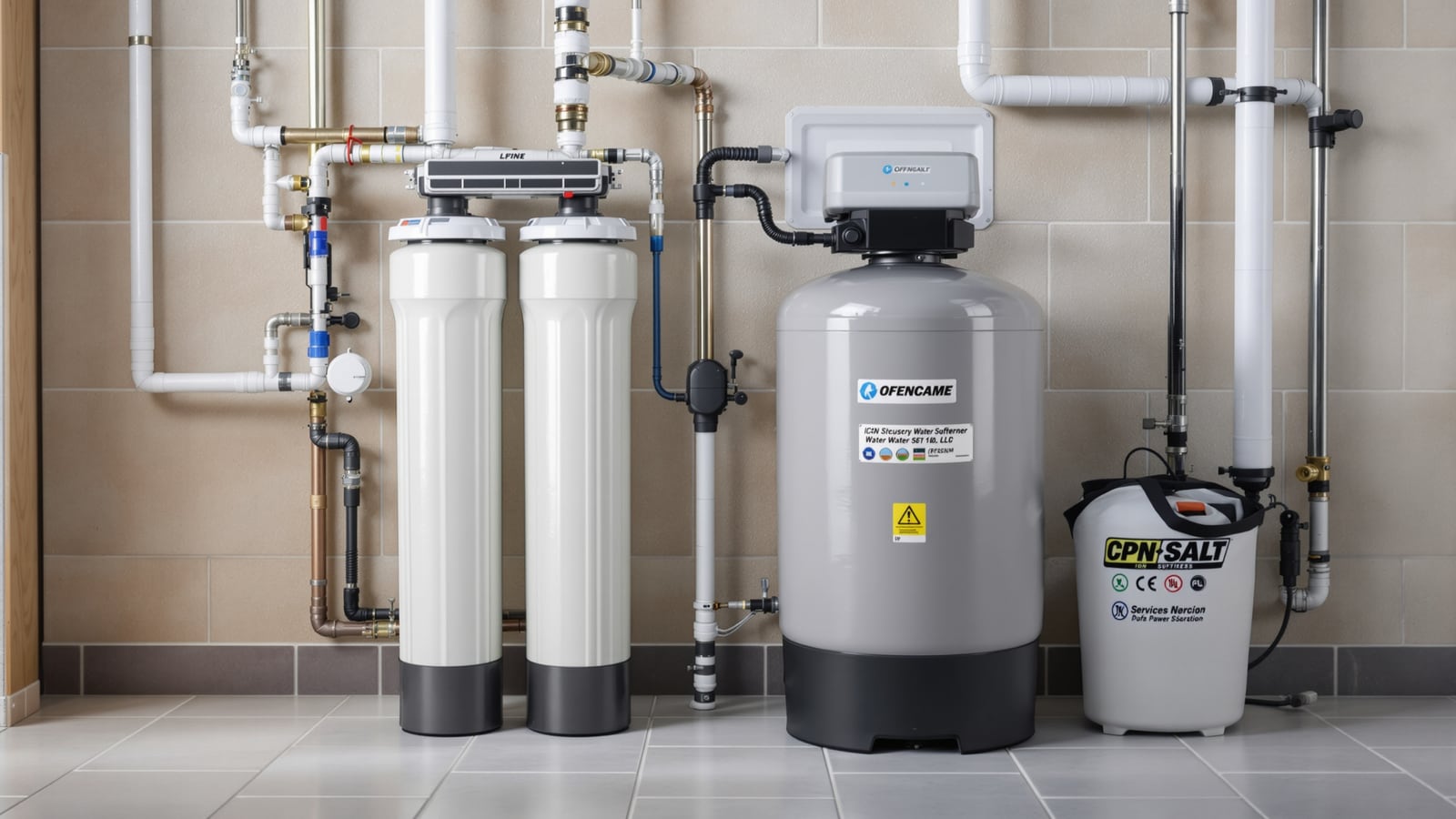
A conventional softener is a tank filled with thousands of tiny ion-exchange resin beads. The chemistry is elegant:
- The resin beads are pre-loaded with harmless sodium ions.
- As hard water passes through, the resin grabs the calcium and magnesium (it prefers them) and releases sodium in their place.
- The water leaving the tank has its hardness swapped out for a little sodium — it is now soft.
Eventually every bead is saturated with calcium and magnesium and can hold no more. The softener then regenerates: it flushes the resin with a strong salt (brine) solution from a separate salt tank. The flood of sodium forces the trapped calcium and magnesium off the beads and down the drain, recharging the resin with fresh sodium ready for the next cycle. This is why a softener needs a steady supply of salt and a drain connection.
Where it goes: whole-house vs point-of-use
Most softeners in India are installed as point-of-entry (POE) units — plumbed into the main incoming line, usually near the underground sump or on the terrace before the overhead tank, so the whole house gets soft water. This is the sensible default because hard water damages everything it touches.
- Whole-house / POE protects your geyser (scale on the heating element and tank is the number-one cause of geyser failure — size it right using the Geyser Size Calculator), the pipes themselves, taps, mixers, the washing machine and the dishwasher. It also gives you softer bathing water.
- Point-of-use (POU) softeners are compact units for a single appliance — most commonly the washing machine or a single bathroom — where whole-house softening is not justified.
A softener belongs at the inlet, upstream of your appliances. It is not the same as a drinking-water purifier, which belongs at the kitchen tap. Read the difference in the Drinking Water Systems guide.
Softened water is not drinking water — keep a hard/RO tap
This is the single most important rule. Ion-exchange softening swaps calcium and magnesium for sodium. The harder your water, the more sodium ends up in it. For anyone on a low-sodium diet — and for taste — that matters.
- Never drink softened water as your main supply. Keep a separate hard-water tap (a bypass tap taken before the softener) or an RO drinking system for cooking and drinking. See the RO Water Systems guide — an RO unit removes the sodium (and much else) and gives you genuinely potable water.
- A common, clean layout: softener on the whole house for bathing and appliances, plus one un-softened line to the kitchen feeding an RO purifier for drinking and cooking.
Sizing: match the softener to your hardness and usage
A softener is sized by its grain capacity — how many grains of hardness it can remove before it must regenerate. You size it so it regenerates roughly every 3–7 days, not several times a day.
The rough logic: daily grains removed = people × litres per person per day × hardness (in grains per gallon-equivalent). In practice, tell your supplier three numbers and let them size it: (1) your tested hardness in mg/L, (2) number of occupants, and (3) daily water usage (a common planning figure is ~135 litres per person per day).
| Household | Tested hardness | Typical softener capacity | Regeneration frequency |
|---|---|---|---|
| 2–3 people, apartment | 150–250 mg/L | ~0.5–1 m³/hr, 15–25 L resin | Every 5–7 days |
| 4–5 people, villa | 250–400 mg/L | ~1–2 m³/hr, 25–40 L resin | Every 3–5 days |
| Large home / high hardness | 400+ mg/L | ~2 m³/hr+, 40 L+ resin | Every 2–4 days |
Undersize it and it regenerates constantly, wastes salt and water, and lets hard water slip through when demand is high. Oversize it modestly rather than tightly.
Automatic vs manual regeneration
- Manual/semi-automatic softeners are cheaper. You turn a valve to start regeneration on a schedule you judge yourself. Common on small, budget units — but easy to forget, and forgetting means hard water sneaks back.
- Automatic softeners regenerate on their own, either on a timer (fixed schedule) or, better, on a metered/DIR basis (they measure water used and regenerate only when the resin is actually spent). Metered units waste the least salt and water. For most families the convenience of an automatic head is worth the extra cost.
Salt consumption and running cost
The ongoing cost of a softener is salt and water for regeneration, plus occasional service:
- Salt: use softener-grade salt (tablet or crystal). A typical Indian household refills the brine tank periodically; monthly salt cost is usually modest — treat exact figures as indicative because it scales with your hardness and usage.
- Water: each regeneration flushes a few tens of litres of brine and rinse water to drain. Metered regeneration minimises this.
- Servicing: resin lasts many years but slowly loses capacity; the control valve and seals need occasional attention.
| Item | Indicative cost (varies widely) |
|---|---|
| Point-of-use / small softener | ₹8,000–₹20,000 |
| Whole-house automatic softener (typical villa) | ₹25,000–₹60,000 |
| Large / high-capacity metered unit | ₹60,000–₹1,20,000+ |
| Softener salt (ongoing) | modest monthly refill |
| Resin replacement (every several years) | periodic service cost |
Treat every rupee figure as indicative — brand, capacity, valve type and installation swing the price a lot. Always get your water tested and take two or three quotes.
Alternatives: anti-scale, TAC and magnetic
Not everyone wants a salt-and-drain softener. There are salt-free options — but be clear about what they do:
- TAC / template-assisted crystallisation ("salt-free conditioners") do not remove hardness. They convert dissolved calcium into tiny crystals less likely to stick as scale. They add no sodium and need no salt or drain, but the water is still technically "hard" — good for scale reduction, not for that soft-water feel. Evidence for scale reduction is reasonable and depends on water chemistry.
- Magnetic / electronic "descalers" clamp onto the pipe and claim to alter scale with a field. Independent evidence for these is weak and inconsistent — treat strong marketing claims with caution.
- Whole-house sediment/anti-scale cartridges help with grit and give mild scale benefit but are not a true softener.
If your goal is genuinely soft water — no scale, better lather, kinder to skin and appliances — conventional ion-exchange softening remains the proven method. If you only need to slow scale and want no salt or drain, TAC is the credible salt-free option.
Maintenance
- Keep salt topped up — never let the brine tank run dry, or regeneration fails and hard water gets through.
- Break up salt bridges — a hard crust can form above the water in the brine tank; check and loosen it occasionally.
- Clean the brine tank once a year or so.
- Service the control valve and check resin capacity periodically; if soft water starts feeling hard despite salt, the resin may need replacing.
- Set regeneration to off-peak (late night) so soft water is available when the family needs it.
The bottom line
If a test shows your water is hard — and across much of borewell India it will be — a softener protects your geyser, pipes, taps and appliances and gives you better bathing water. Size it to your tested hardness and household, choose an automatic metered head if you can, keep a separate hard-water or RO line for drinking, and keep the salt topped up. Start with the Water Treatment Guide for India and the Water Quality Testing guide before you buy.
References
- IS 10500 — Bureau of Indian Standards, Drinking Water — Specification: total hardness (as CaCO₃) acceptable limit 200 mg/L, permissible 600 mg/L where no alternative source exists. Refer to the current published tables; figures here are indicative.
- CPHEEO Manual on Water Supply and Treatment, Ministry of Housing and Urban Affairs — domestic demand planning (~135 lpcd) and water-quality guidance.
- Get your specific water tested at a NABL-accredited lab before sizing or buying a softener; hardness, sodium tolerance, costs and product choices vary by locality and household — do not rely on indicative figures alone.
Export this guide
Related Guides — Deep-dive reading
RO vs UV Water Purifier: Which One Does Your Home Need? (India)
A fair, India-first head-to-head decided by one number — your feed-water TDS. RO strips dissolved salts and heavy metals for hard borewell water; UV only kills microbes and suits already-clear, low-TDS municipal supply. What each removes, water wastage, running cost, and a verdict by measured TDS.
PlumbingDomestic Water Treatment Guide for Indian Homes: Test First, Then Treat Right
A master overview of treating the water coming into an Indian home — how to test first, match each contaminant to the right treatment, choose point-of-use versus point-of-entry, build a treatment train in the correct order, avoid over-treating, and budget for maintenance and running cost.
PlumbingMunicipal Water vs Borewell: Which to Rely On for an Indian Home?
A fair, India-first head-to-head: corporation (municipal) supply is treated and cheap to run but comes for a few hours a day, while a borewell gives you your own 24x7 groundwater at an upfront drilling cost — with hardness and a falling water table to manage. When to pick each, and why most homes end up keeping both.
PlumbingRelated Tools — Try Free
Water Softener Size Calculator
Size a water softener from your hardness, daily water use and days between regeneration, with the grain capacity needed.
Plumbing CalculatorRainwater Tank Sizer
How big should your rainwater tank be? Computes annual harvest, recommended tank capacity in litres, water-bill savings, and payback — for 10 Indian cities.
RWH CalculatorWindow Cleaning Cost Calculator
Estimate professional window cleaning cost per visit and per year by access and frequency.
Window Calculator