
RO Water System for Indian Homes: How Reverse Osmosis Works, When You Need It, Reject Water and Cost
The point-of-use purifier that strips dissolved salts, TDS and heavy metals from high-TDS borewell and brackish water — how the membrane and cartridge train actually work, when RO is right (and when it just wastes water and strips minerals), how to reuse reject water, and what it costs to run in India.
Reverse osmosis (RO) is the only common household purifier that removes dissolved salts — the invisible stuff that no candle filter, boiling or UV can touch. If your borewell or municipal supply reads high on TDS, tastes salty or bitter, or carries nitrate or heavy metals, RO is usually the answer. But RO is also over-sold: on clean, low-TDS municipal water it wastes litres and strips out healthy minerals for no benefit. This guide explains how RO actually works, when you genuinely need it, and how to run it sensibly in an Indian home.
RO treats your fresh incoming drinking water. It is not sewage or wastewater treatment — for that, see the separate STP guides. For the water source itself, start with the borewell water system guide, and always test your water before you buy anything.
What problem RO solves
Ordinary filters catch particles and, with activated carbon, chlorine and odour. UV kills microbes. Neither removes anything dissolved in the water — total dissolved solids (TDS): sodium, chloride, calcium, magnesium, nitrate, fluoride, arsenic, lead and other salts and metals.
Reverse osmosis is the only home technology that does. A semi-permeable membrane with pores near 0.0001 micron lets water molecules through but blocks 90-98% of dissolved ions. Push water against that membrane under pressure and clean "permeate" comes out one side while a concentrated "reject" (or "brine") stream carries the rejected salts down the drain.
That is why RO is the go-to for:
- High-TDS water — borewell or bore-fed supply above ~500 mg/L, or clearly salty/brackish coastal and hard-water zones.
- Chemical contamination — excess nitrate, fluoride, or heavy metals like arsenic and lead, which are health risks no other home filter removes.
IS 10500 (the Indian drinking-water standard) sets an acceptable TDS limit of 500 mg/L, and a permissible limit of 2000 mg/L where no alternate source exists. Above the acceptable limit RO earns its keep; well below it, RO is usually the wrong tool.
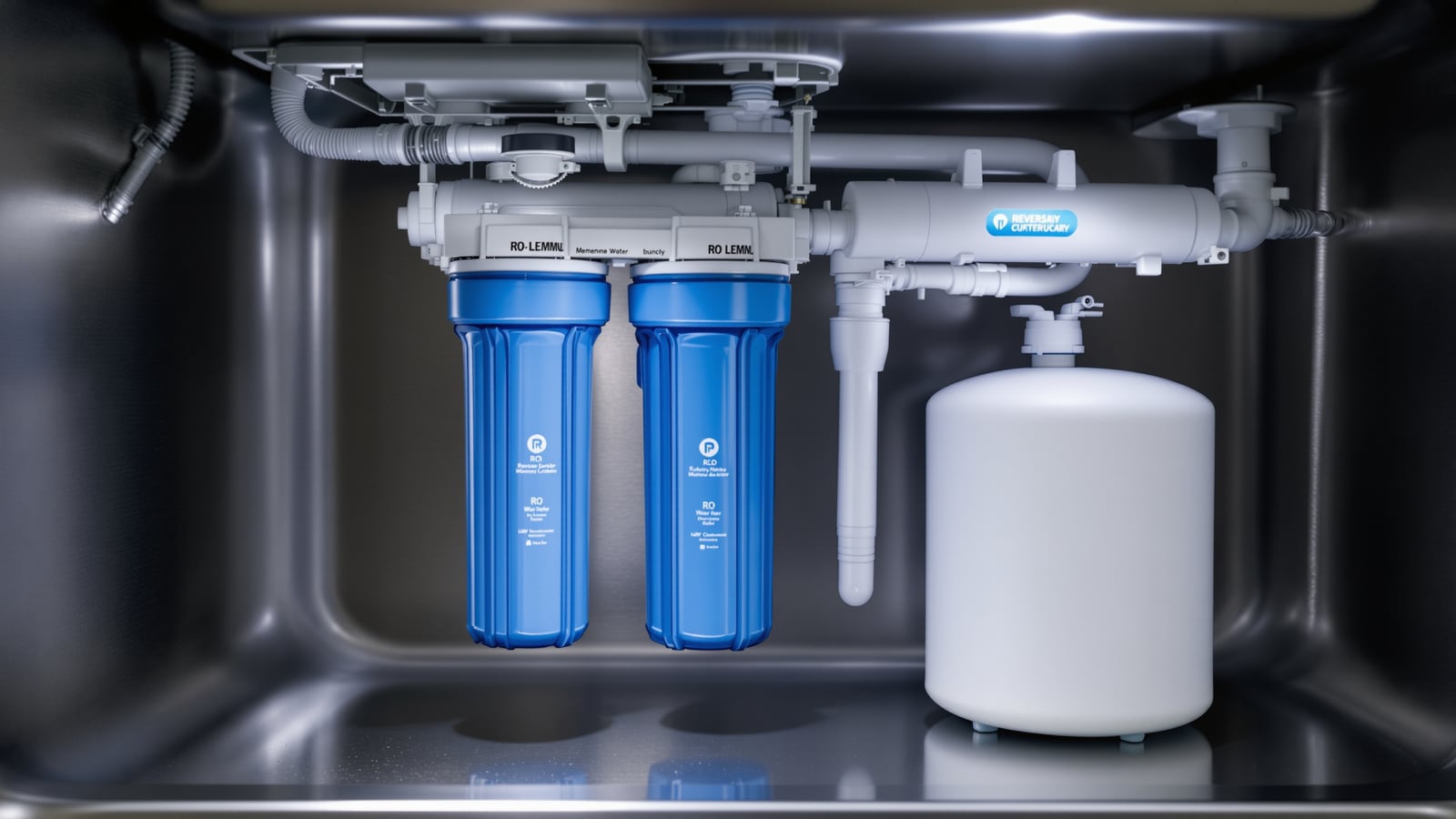
How an RO purifier works: the cartridge train
An RO purifier is not one filter — it is a train of stages, each protecting the next. The membrane is expensive and fragile, so cheap pre-filters do the rough work first.
- Sediment pre-filter — a 5-micron spun cartridge catches sand, silt and rust so they never reach the membrane.
- Carbon pre-filter (GAC/CTO) — activated carbon removes chlorine, which would otherwise oxidise and destroy the membrane, plus organics, taste and odour.
- RO membrane — the heart of the system; a thin-film composite (TFC) spiral-wound element that rejects the dissolved salts and metals.
- Post-carbon "polishing" filter — a final carbon stage that improves taste after storage in the tank.
- UV lamp (optional but common) — many Indian units add UV after RO to kill any microbes picked up in the storage tank. See UV water purifiers for how that stage works.
A booster pump raises inlet pressure to the ~5-7 bar an RO membrane needs, and a small pressurised tank stores treated water so you get instant flow at the tap.
The reject water problem — and how to reuse it
Because RO pushes salts into a concentrated stream, it wastes water by design. A typical domestic RO recovers only part of what it draws:
- Older / cheaper units: roughly 3 to 4 litres rejected for every 1 litre of pure water.
- Better units with recovery pumps: closer to 1:1.
In a household drinking 10-15 litres a day, that reject can add up to hundreds of litres a month down the drain — a real issue in water-stressed Indian cities.
Don't waste it. RO reject is not sewage; it is just saltier tap water. Plumb the reject line into a bucket or storage drum and reuse it for:
- Mopping floors and washing the car or balcony.
- Flushing toilets.
- Watering salt-tolerant plants (avoid delicate or potted plants — the higher salinity harms them over time).
Never feed reject water back to drink.
TDS controller and mineraliser — putting minerals back
RO is indiscriminate: it removes healthy calcium and magnesium along with the harmful salts. Water below roughly 50-70 mg/L TDS tastes flat and returns very little dietary mineral. Two features fix this:
- TDS controller — a simple valve that blends a little untreated (carbon-filtered) water back into the permeate, lifting output TDS into a pleasant, mineral-carrying range.
- Mineraliser / alkaliser cartridge — a post-stage that adds back calcium and magnesium and gently raises pH.
Aim for treated-water TDS around 80-150 mg/L: safe, palatable, not stripped bare. This is why blanket "RO for everyone" advice is wrong — on already-soft municipal water you would be spending money and wasting water to make water worse to drink.
Where RO fits: point-of-use vs point-of-entry
- Point-of-use (POU) — a compact RO under the kitchen sink (or a countertop unit) treating only the water you drink and cook with. This is where RO belongs: you only pay to purify, and waste, the 10-15 L a day you actually consume. Under-sink units keep the counter clear and feed a dedicated tap.
- Point-of-entry (POE) — whole-house treatment at the main inlet, treating every tap. POE is right for sediment filters, iron removal and water softeners (for hardness on bathing and appliances) — but almost never for RO. Running a whole home's bathing, washing and flushing water through RO membranes would be absurdly wasteful and expensive.
The sensible Indian setup is often POE softener/sediment for the house plus a POU RO at the kitchen for drinking. For the wider treatment picture, see the water treatment guide.
When you need RO — and when you don't
Test first. A ₹150-500 lab or TDS-meter check tells you far more than any salesperson.
| Your water | TDS (mg/L) | Right choice |
|---|---|---|
| Clean municipal, treated | Below 200 | UV or UV+UF — RO not needed |
| Municipal, moderate | 200-500 | UV+UF; RO optional if metals/nitrate present |
| Borewell / mixed, high | 500-2000 | RO (with mineraliser) |
| Brackish / coastal | Above 2000 | RO essential, sized for the load |
| Any source with nitrate, fluoride, arsenic, lead | Any | RO regardless of TDS |
| Contaminant | IS 10500 acceptable limit | Removed by |
|---|---|---|
| Total dissolved solids (TDS) | 500 mg/L | RO |
| Total hardness (as CaCO3) | 200 mg/L | Softener (POE) / RO |
| Nitrate (as NO3) | 45 mg/L | RO |
| Fluoride | 1.0 mg/L | RO |
| Chloride | 250 mg/L | RO |
| Turbidity | 1 NTU | Sediment filter |
Skip RO when your TDS is already comfortably under ~200-300 mg/L and free of chemical contaminants — a UV or UV+UF purifier will keep it microbiologically safe without wasting water or stripping minerals. Compare the two in UV water purifiers.
Maintenance
RO is a consumables business. Skipping service is the top cause of foul-tasting water and dead membranes.
- Sediment + carbon pre-filters — replace every 6-12 months (sooner on silty borewell water). This is the single most important service; a clogged carbon filter lets chlorine through and kills the membrane.
- RO membrane — lasts 2-3 years typically; longer on good water with fresh pre-filters, shorter on very high TDS.
- Post-carbon / mineraliser — annually.
- UV lamp — every ~12 months; UV output fades long before the bulb visibly fails.
- Tank sanitisation — periodic, to prevent biofilm in the storage tank.
Watch for warning signs: falling flow, rising output TDS on your meter, or a change in taste all signal a service is due.
Running cost — indicative
| Item | Indicative cost (₹) |
|---|---|
| Under-sink / countertop domestic RO unit | ₹8,000 - ₹25,000 |
| Sediment + carbon pre-filter set | ₹600 - ₹1,500 per change |
| RO membrane (domestic) | ₹1,500 - ₹4,000 |
| Annual service (AMC) | ₹2,000 - ₹5,000 |
| Electricity (booster pump) | Modest — a few units/month |
Figures are indicative and vary by brand, capacity and city; get a written AMC quote. Over a year, consumables and service typically run ₹3,000-6,000 for a home unit — still far cheaper than bottled water for a family.
Pros and cons
Pros
- The only home technology that removes dissolved salts, TDS, nitrate, fluoride and heavy metals.
- Makes genuinely brackish or borewell water drinkable and palatable.
- Compact POU footprint under the sink.
Cons
- Wastes water (reject stream) unless you actively reuse it.
- Strips healthy minerals — needs a TDS controller or mineraliser to correct.
- Needs adequate inlet pressure (a booster pump) and regular consumables.
- Pointless and wasteful on already-low-TDS municipal water.
The bottom line
RO is a precision tool, not a default. If a proper water test shows high TDS, brackishness, or nitrate/fluoride/metal contamination, a point-of-use RO with a mineraliser — and its reject water plumbed into a reuse bucket — is the right, safe choice for drinking water. If your water is already low-TDS municipal supply, a UV or UV+UF purifier does the job without the waste. Test, then decide; don't let TDS fear sell you a machine your water doesn't need.
References
- IS 10500 — Indian Standard, Drinking Water Specification (Bureau of Indian Standards), for acceptable and permissible limits of TDS, hardness, nitrate, fluoride and other parameters.
- WHO Guidelines for Drinking-water Quality — World Health Organization, for health-based limits on nitrate, fluoride, arsenic and lead.
- Studio Matrx guides: water treatment overview, UV water purifiers, water quality testing, and borewell water systems.
Export this guide
Related Guides — Deep-dive reading
RO vs UV Water Purifier: Which One Does Your Home Need? (India)
A fair, India-first head-to-head decided by one number — your feed-water TDS. RO strips dissolved salts and heavy metals for hard borewell water; UV only kills microbes and suits already-clear, low-TDS municipal supply. What each removes, water wastage, running cost, and a verdict by measured TDS.
PlumbingDomestic Water Filtration in India: Sediment & Carbon Filters for a Home
The first stage of almost every home water-treatment train — how sediment and activated-carbon filters strip out sand, silt, rust, chlorine, taste and odour, where to fit them (whole-house vs under-sink), how to pick a micron rating, when to replace a cartridge, and what filtration cannot remove.
PlumbingDomestic Water Treatment Guide for Indian Homes: Test First, Then Treat Right
A master overview of treating the water coming into an Indian home — how to test first, match each contaminant to the right treatment, choose point-of-use versus point-of-entry, build a treatment train in the correct order, avoid over-treating, and budget for maintenance and running cost.
PlumbingRelated Tools — Try Free
RO Water Wastage Calculator
See how much water a domestic RO purifier rejects for the purified water you use, from your daily use and recovery ratio.
Plumbing CalculatorLift Annual Maintenance Cost Calculator
AMC cost for a home lift — comprehensive vs non-comprehensive, with a 5-year projection.
Lift CalculatorWater Softener Size Calculator
Size a water softener from your hardness, daily water use and days between regeneration, with the grain capacity needed.
Plumbing Calculator