
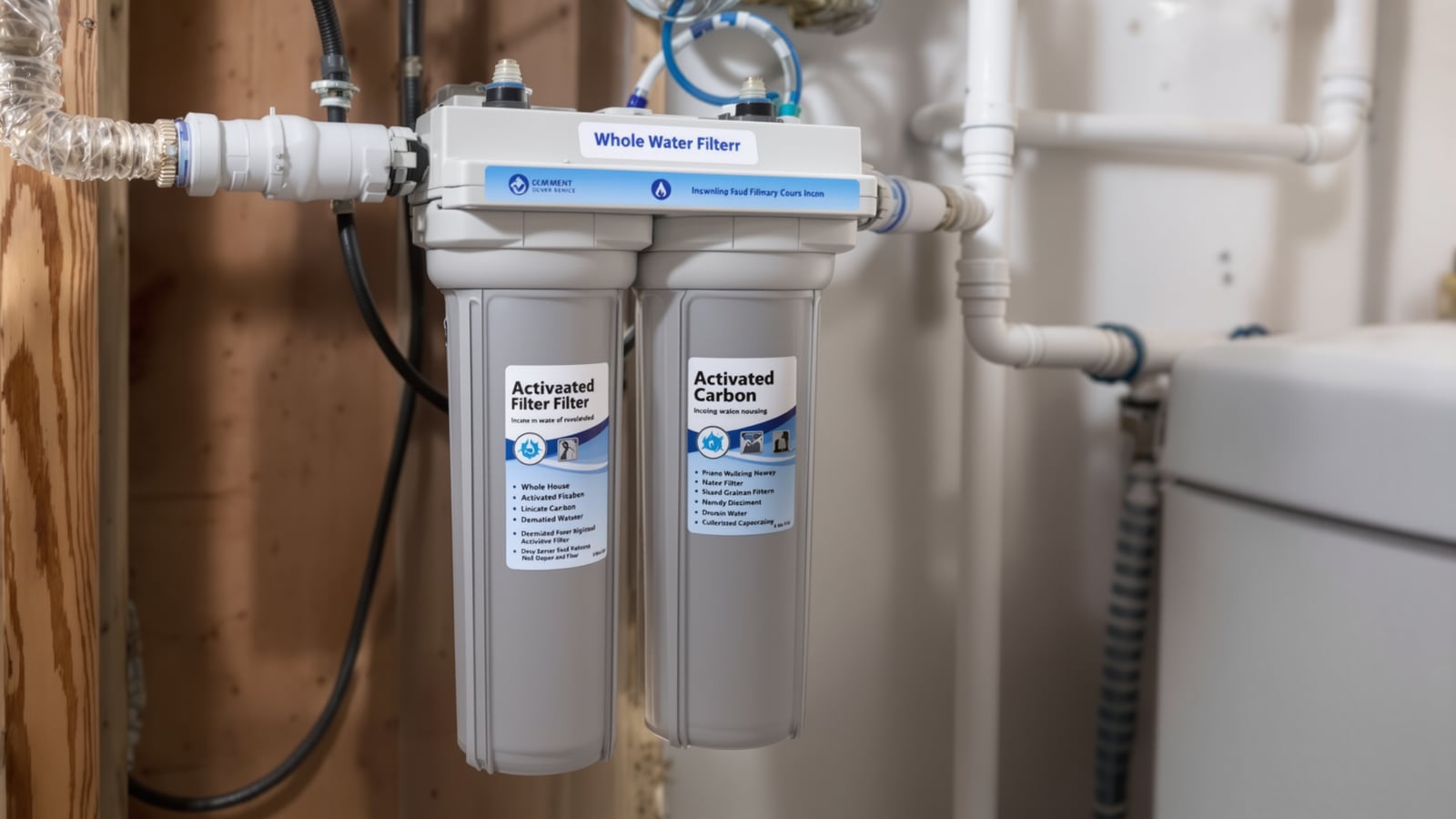
Domestic Water Filtration in India: Sediment & Carbon Filters for a Home
The first stage of almost every home water-treatment train — how sediment and activated-carbon filters strip out sand, silt, rust, chlorine, taste and odour, where to fit them (whole-house vs under-sink), how to pick a micron rating, when to replace a cartridge, and what filtration cannot remove.
Most Indian homes think of "water treatment" as the shiny RO purifier on the kitchen wall. But nearly every treatment system — RO, UV, softener or nothing at all — should sit behind a humbler pair of filters that do the unglamorous work first: a sediment filter to catch the grit, and an activated-carbon filter to take out chlorine, taste and smell. Get this first stage right and everything downstream lasts longer and works better.
This is a water-treatment guide inside the Studio Matrx Plumbing Knowledge Hub, and it stays deliberately on the mechanical-and-carbon side of the story. It is about making incoming fresh water cleaner and more pleasant — not about sewage or effluent, and not about the dissolved-salt and microbe removal that needs RO and UV. We link to those at every point where the boundary matters.
Filtration is a physical process. A sediment filter is a sieve; a carbon filter is a sponge for certain chemicals. Neither can remove dissolved salts you cannot see, and neither reliably kills bacteria. If your water is hard, high-TDS or microbiologically unsafe, filtration is a first step — not the whole answer. Always test first: /guides/water-quality-testing-india.
What each filter actually does
The two workhorses solve two completely different problems, which is exactly why they are usually installed as a pair, in order.
- Sediment filtration removes suspended solids — the particles that make water cloudy or gritty: sand, silt, fine clay, rust flakes from old GI pipe, and scale debris. It is rated in microns (µm): the smaller the number, the finer the particle it stops.
- Activated-carbon filtration removes dissolved organics and gases that a sieve cannot: free chlorine (the swimming-pool smell of municipal water), many taste and odour compounds, and some organic chemicals. It works by adsorption — molecules stick to the enormous internal surface area of the carbon.
| Filter type | Removes | Does NOT remove | Typical form |
|---|---|---|---|
| Sediment | Sand, silt, clay, rust, scale flakes, turbidity | Chlorine, dissolved salts, bacteria, hardness | Spun or pleated cartridge; backwash sand/multimedia |
| Activated carbon | Free chlorine, taste, odour, some organics, colour | Dissolved salts (TDS), hardness, most bacteria | Granular (GAC) or carbon-block cartridge |
Put simply: sediment handles what makes water look dirty; carbon handles what makes it smell and taste wrong. For anything dissolved-and-invisible — high TDS, hardness, fluoride, nitrate, arsenic — you move to reverse osmosis (/guides/ro-water-systems-india), and for live bacteria and viruses you need disinfection such as UV (/guides/uv-water-purifiers-india).
Sediment filters: micron ratings, spun vs pleated
The single most important spec on a sediment cartridge is its micron rating — the size of particle it stops. Municipal and borewell water in India ranges from visibly muddy after monsoon to merely fine-turbid, so the right rating depends on your water and what sits downstream.
| Micron rating | Stops | Typical use in an Indian home |
|---|---|---|
| 20 µm | Coarse sand, grit, large rust flakes | First-stage pre-filter for very silty borewell water |
| 10 µm | Fine sand, coarse silt | Common whole-house pre-filter |
| 5 µm | Fine silt, most turbidity, cyst-sized debris | Standard pre-filter before an RO purifier |
| 1 µm | Very fine silt, some cysts | Polishing stage where water is fairly clean already |
Two things follow from the table. First, finer is not always better: a 1 µm cartridge on muddy water will clog in days and choke your flow. On dirty water, stage it — a 20 µm cartridge protecting a 5 µm cartridge lasts far longer than a lone 5 µm one. Second, match the rating to the job: an RO membrane is happy behind a 5 µm sediment filter, so there is rarely a reason to go finer upstream.
Cartridge construction matters too:
- Spun (melt-blown) cartridges are the cheap, common white cylinders. They are depth filters — particles are trapped throughout the thickness — so they hold a lot of dirt before clogging. Disposable; you replace them.
- Pleated cartridges use a folded fabric or paper media for more surface area. Some grades are washable and reusable several times before replacement, which suits gritty borewell water and cuts running cost.
Whole-house (POE) vs under-sink (POU)
Where you put a filter decides what it protects.
- Point-of-entry (POE) / whole-house: a large filter housing (often 20-inch "Big Blue" style, or a backwash media tank) on the incoming main, before the water splits to the whole house. It protects every tap, appliance, geyser and the plumbing itself from grit, and takes chlorine out of bathing water. This is the right place for sediment and, if you dislike chlorine everywhere, a whole-house carbon stage.
- Point-of-use (POU) / under-sink or countertop: a smaller filter at one tap — usually the kitchen — feeding a drinking-water purifier. Sediment and carbon here are the pre-filters ahead of the RO/UV stage, guarding the expensive membrane and lamp.
Most Indian homes end up with both: a POE sediment filter (and sometimes carbon) on the main line, plus POU pre-filters inside the kitchen purifier. For how the safe drinking-water line and storage fit around all this, see /guides/drinking-water-systems-india; if your source is a borewell, its raw quality drives everything — /guides/borewell-water-system-india.
Cartridge filters vs backwash media filters
For sediment there are two families. Cartridge filters hold a replaceable element in a housing — cheap to buy, simple, but you must swap the cartridge when it clogs, and the dirt leaves the house as waste. Backwash media filters use a tank of graded sand, anthracite or multimedia; instead of replacing anything, a valve periodically reverses the flow to flush trapped dirt to drain. They suit high-turbidity borewell supplies and higher flow rates, cost more up front, and use some water to backwash — but the media lasts years.
| Approach | Up-front cost (indicative) | Ongoing | Best for |
|---|---|---|---|
| Cartridge (spun/pleated) | ₹1,500 – ₹8,000 per housing | Cartridge every 1-6 months | Most flats and homes |
| Backwash media tank | ₹25,000 – ₹1,20,000 | Backwash water; media top-up in years | Silty borewell, whole-house, high flow |
Maintenance: when to replace, and reading the pressure drop
A clogging filter announces itself. The clearest sign is a pressure drop — taps downstream of the filter run weaker, or the purifier takes longer to fill. In a clear "Big Blue" housing you can simply see the cartridge go brown. Two reliable ways to stay ahead of it:
- On a schedule. Sediment cartridges typically last 1-6 months depending on how dirty the water is; carbon cartridges are usually changed every 3-6 months (or by litres treated) because spent carbon stops adsorbing and can even shed what it held. RO and UV service intervals are covered in their own guides.
- On symptoms. Weak flow, chlorine smell/taste returning (carbon exhausted), or visible discolouration all mean "change now, don't wait." A cheap pressure gauge before and after the housing turns guesswork into a number — a large drop across the filter means it is clogged.
Keep spare cartridges of the right size and micron rating on hand; a clogged sediment filter can slow every tap in the house.
What filtration does NOT remove
This is the boundary that matters most, because it decides whether filtration is enough for your water:
- Dissolved salts (TDS), hardness, fluoride, nitrate, arsenic — invisible dissolved matter passes straight through sediment and carbon. High TDS or hardness needs reverse osmosis: /guides/ro-water-systems-india.
- Bacteria, viruses, cysts — standard filters are not disinfection. Even a 1 µm filter is not a reliable microbial barrier. For biologically unsafe water you need UV disinfection (or boiling / RO): /guides/uv-water-purifiers-india.
So the honest rule is: filtration cleans and protects, but does not make unsafe water safe on its own. It is the essential first stage — and often all that clean municipal supply needs for pleasant utility water — but for drinking water from a doubtful source it is one link in a longer chain. Decide what you actually need by testing the water first: /guides/water-quality-testing-india. For the full picture of every stage and how they combine, start at the section pillar, /guides/water-treatment-guide-india.
References
- IS 10500 — Bureau of Indian Standards, Drinking Water — Specification (acceptable and permissible limits for drinking-water quality parameters, including turbidity and total dissolved solids). Figures cited elsewhere in this hub are indicative; refer to the current published tables.
- IS 7402 / IS 8703 — Bureau of Indian Standards references relating to filter media and household water-filtration practice; confirm the current designation for your equipment with the manufacturer.
- National Building Code of India 2016, Part 9 (Plumbing Services) — water supply, storage and distribution requirements for buildings.
- Choose micron ratings, media and placement against a NABL-accredited lab test of your own water; do not size filtration from indicative figures alone.
Export this guide
Related Guides — Deep-dive reading
UV Water Purifiers in India: How Ultraviolet Disinfection Makes Drinking Water Safe
How a UV water purifier kills bacteria, viruses and protozoa in drinking water without chemicals or taste change — why it needs clear water first, what it does not remove, point-of-use vs whole-house placement, lamp and quartz-sleeve maintenance, running cost and indicative prices for Indian homes.
PlumbingRO vs UV Water Purifier: Which One Does Your Home Need? (India)
A fair, India-first head-to-head decided by one number — your feed-water TDS. RO strips dissolved salts and heavy metals for hard borewell water; UV only kills microbes and suits already-clear, low-TDS municipal supply. What each removes, water wastage, running cost, and a verdict by measured TDS.
PlumbingDomestic Water Treatment Guide for Indian Homes: Test First, Then Treat Right
A master overview of treating the water coming into an Indian home — how to test first, match each contaminant to the right treatment, choose point-of-use versus point-of-entry, build a treatment train in the correct order, avoid over-treating, and budget for maintenance and running cost.
PlumbingRelated Tools — Try Free
Pool Water Calculator
Chlorine, shock and salt doses plus top-up water for your pool — an indicative balancing guide.
Pool CalculatorRainwater Tank Sizer
How big should your rainwater tank be? Computes annual harvest, recommended tank capacity in litres, water-bill savings, and payback — for 10 Indian cities.
RWH CalculatorBefore & After Studio
Generate AI before-and-after renders to preview how your redesign could look.
DesignAI