
UV Water Purifiers in India: How Ultraviolet Disinfection Makes Drinking Water Safe
How a UV water purifier kills bacteria, viruses and protozoa in drinking water without chemicals or taste change — why it needs clear water first, what it does not remove, point-of-use vs whole-house placement, lamp and quartz-sleeve maintenance, running cost and indicative prices for Indian homes.
A UV water purifier does one job supremely well: it kills the living things in your drinking water. Bacteria, viruses and protozoa that survive a dirty tank or a compromised supply are inactivated as the water flows past an ultraviolet lamp — no chlorine, no boiling, no change in taste. But UV is a specialist, not an all-rounder, and using it in the wrong situation wastes money while leaving real risks untreated.
This is a domestic drinking-water treatment guide inside the Studio Matrx Plumbing Knowledge Hub. It covers ultraviolet disinfection for the fresh water you drink at home. It is not about sewage or effluent treatment, and it assumes clean supply and safe storage are already handled — for those, see the delivery and source guides linked at the end.
UV kills what is alive in water. It does nothing about what is dissolved in it. Get that one distinction right and every other decision about UV becomes obvious.
How UV disinfection works
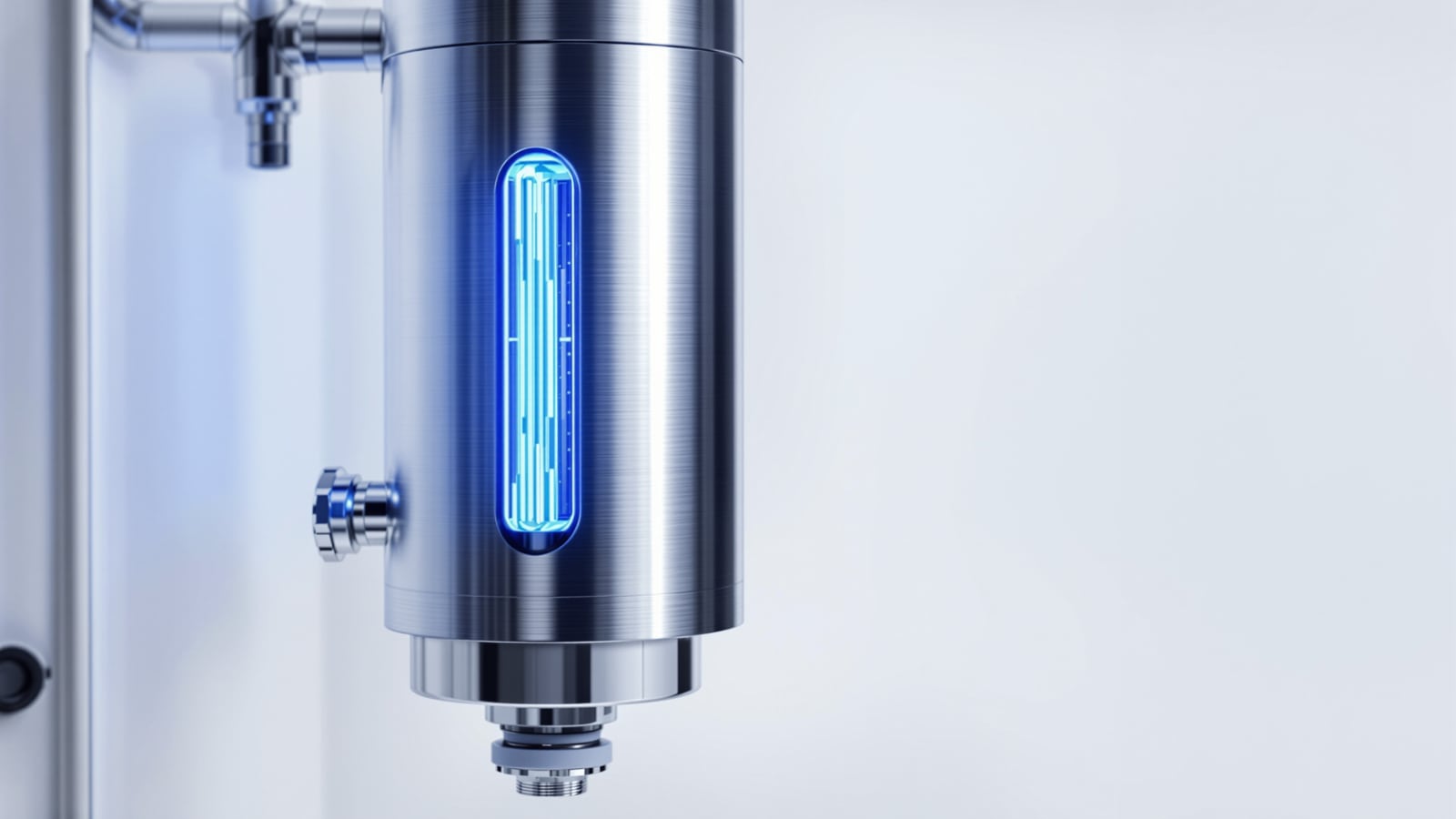
At the heart of a UV purifier is a low-pressure mercury or amalgam lamp that emits ultraviolet-C light, concentrated around a wavelength of 254 nanometres. Water flows in a thin annular gap around this lamp, which sits inside a protective quartz sleeve so the water never touches the glass.
UV-C light penetrates the cell wall of a microorganism and scrambles its DNA and RNA. The microbe is not filtered out or killed by poison — it is left unable to reproduce, which means it can no longer cause infection. Because nothing is added and nothing is removed, the water tastes and smells exactly as it did going in. There is no chlorine aftertaste, no by-products, and no change to the mineral content.
The effectiveness of UV depends on dose — the intensity of the light multiplied by the time the water is exposed. Dose is measured in millijoules per square centimetre (mJ/cm²). A common design target for drinking-water disinfection is around 30–40 mJ/cm², enough to inactivate the bacteria, viruses and protozoan cysts (including Giardia and Cryptosporidium) that matter for household safety. Two things set the dose you actually get: the flow rate (slower water sits in the light longer) and the clarity of the water.
UV inactivates microbes; it does not remove their dead bodies. That is fine for safety — a dead bacterium cannot infect you — but it is why UV is paired with fine filtration when appearance matters.
UV needs clear water — this is the rule that trips people up
The single most important thing to understand about UV is that it only works on water that is already clear. UV-C light must physically reach every microbe. If the water is turbid — carrying silt, clay, rust or fine particles — those particles scatter and absorb the light and, worse, shadow microbes hiding behind or inside them. A microbe in the shadow of a speck of clay receives a fraction of the dose and survives.
So a UV lamp is almost never installed alone. It sits at the end of a treatment train, after the water has been made optically clear:
- A sediment pre-filter (typically 5 micron then 1 micron) removes grit, sand and suspended solids.
- Often an activated carbon stage follows, removing chlorine, organic colour and odour that would otherwise absorb UV and change taste.
- Only then does clear water reach the UV chamber for disinfection.
Turbidity below about 1 NTU (the IS 10500 acceptable target) is the practical condition for reliable UV disinfection. If your water is cloudy, coloured or full of iron, fix that with filtration first — see the domestic filtration guide linked below. Feeding dirty water to a UV lamp gives you a false sense of safety.
What UV does not do
UV is a disinfectant, not a filter. It leaves everything dissolved in the water completely untouched:
- It does not remove dissolved salts, so it does not lower TDS.
- It does not soften water — hardness (calcium and magnesium) passes straight through, and scale still forms in your geyser and kettle.
- It does not remove chemical contaminants — fluoride, nitrate, arsenic, lead, pesticides all pass unchanged.
- It does not remove colour, turbidity or bad taste — that is the pre-filter's job.
This is why the right treatment depends entirely on what your water actually contains. Test first; do not guess.
| Contaminant / property | Does UV handle it? | What you actually need |
|---|---|---|
| Bacteria, viruses, protozoa | Yes — inactivates | UV (after clear water) |
| Turbidity / silt / rust | No | Sediment pre-filter |
| Chlorine, odour, colour | No | Activated carbon |
| Total dissolved solids (TDS) | No | RO (reverse osmosis) |
| Hardness (Ca / Mg scale) | No | Softener or RO |
| Fluoride, arsenic, nitrate, lead | No | RO or specific media |
The practical rule of thumb: if microbes are your only problem and the water is otherwise good, UV alone is enough. If the water is also hard, high-TDS or chemically contaminated, UV is one stage in a larger system alongside RO and carbon.
When UV alone is the right answer
There is a clear sweet spot for UV as a standalone purifier: low-TDS municipal water that is chemically fine but microbially unsafe.
Much of India's piped municipal supply is drawn from surface or treated sources with acceptable dissolved-solids levels (often well under 300–500 mg/L) — the water does not need RO. But it can still pick up bacterial contamination between the treatment plant and your tap: leaking mains, intermittent supply that sucks in groundwater, cross-connections, or a contaminated storage tank at home. Here, forcing the water through an RO membrane needlessly strips healthy minerals and wastes water. A UV purifier (with a sediment and carbon pre-stage) is the correct, economical fix.
Use this simple logic:
- Low TDS (roughly under 300–500 mg/L), no chemical issue, microbially unsafe — UV alone (with pre-filtration) is ideal.
- High TDS or hardness, or fluoride / arsenic / nitrate present — you need RO, usually as RO + UV so the membrane handles dissolved load and UV guards the storage tank of the purifier.
- Turbid or coloured water — filtration first, always, whatever comes after.
Always base this on a lab test of your specific water — see the water-quality testing guide linked below.
Point-of-use vs point-of-entry
A UV system can be installed in two very different places:
- Point-of-use (POU) — a compact unit at the kitchen, treating only the litres you drink and cook with. This is the common Indian home setup: a counter-top or under-sink purifier feeding a dedicated drinking tap. Flow rates are modest (around 1–2 litres per minute), so the water gets a generous UV dose.
- Point-of-entry (POE) — a larger UV chamber where water enters the house, disinfecting the whole supply. This is used where the entire incoming supply is microbially suspect (some borewell or tanker-fed homes) and every tap needs safe water. POE UV units are physically bigger, rated for higher flow (litres per minute across the whole house), and must be sized so the dose holds up at peak demand.
For most Indian homes on municipal water, POU at the kitchen is the sensible, affordable choice — you disinfect the water you swallow rather than treating every drop for bathing and flushing.
Power, lamps and maintenance
UV has three maintenance realities every owner should plan for.
It depends on electricity. The lamp only disinfects while it is powered and glowing. During a power cut a plain UV unit passes water untreated, so many purifiers include a flow shut-off that stops delivery if the lamp is off or has failed — look for this, and never assume "water is still coming out" means "water is still safe."
The lamp ages. A UV-C lamp does not usually burn out; instead its output fades over time even while it still glows visibly. Typical lamps are rated for roughly 9,000 hours of use — about one year of continuous operation — after which the dose may drop below the safe threshold. Replace the lamp annually as recommended, whether or not it has stopped lighting. A glowing lamp is not proof of a safe dose.
The quartz sleeve fouls. Over months, scale and film build up on the quartz sleeve around the lamp, blocking the light before it reaches the water. The sleeve must be cleaned periodically (wiped, and descaled where water is hard) so UV can pass through. A neglected, coated sleeve is a common cause of a "working" purifier that has quietly stopped disinfecting.
| Component | Typical service interval (indicative) | Note |
|---|---|---|
| Sediment pre-filter | 3–6 months | Sooner in turbid or high-sediment water |
| Carbon filter | 6–12 months | Restores taste, protects UV from organics |
| UV lamp | ~1 year (~9,000 hours) | Output fades before it stops glowing |
| Quartz sleeve cleaning | Every few months | Descale in hard water so light passes |
Because UV disinfects only and does not push water through a membrane, it produces no reject water — there is none of the RO wastage where a share of the feed goes down the drain. That makes UV both cheaper to run and kinder on water use, which matters in supply-constrained Indian cities.
Running cost, pros and cons
A domestic POU UV purifier draws very little power — the lamp is typically in the region of 11–40 watts — so electricity cost is minor. The recurring spend is consumables: the annual lamp and periodic pre-filter and carbon changes.
| Item | Indicative cost (verify locally) |
|---|---|
| POU UV purifier (with sediment + carbon) | ₹6,000–₹15,000 |
| RO + UV combined purifier | ₹12,000–₹25,000 |
| Point-of-entry / whole-house UV system | ₹25,000–₹80,000+ |
| Replacement UV lamp | ₹800–₹2,500 |
| Annual consumables (filters + lamp) | ₹2,000–₹4,000 |
Treat these figures as indicative — actual prices vary by brand, capacity and city.
Pros
- Kills bacteria, viruses and protozoa quickly and reliably (when water is clear).
- No chemicals added; no change to taste, odour or mineral content.
- No reject water — nothing wasted, unlike RO.
- Low power draw and simple, compact hardware.
Cons
- Removes nothing dissolved — no TDS, hardness, fluoride, arsenic or chemical reduction.
- Useless on turbid water — requires clear water and pre-filtration.
- Power-dependent; needs a flow shut-off to fail safe.
- Lamp and quartz sleeve need disciplined annual/periodic maintenance, and disinfection is invisible — you cannot see whether it is still working.
Where this fits with your water treatment
UV is one tool in a household water-treatment kit, chosen to match a tested water profile:
- Start with the pillar, Water Treatment Guide for India, for how the whole treatment train fits together.
- Pair or compare with RO Water Systems in India when your water is hard, high-TDS or chemically contaminated — RO plus UV is the common combination.
- Handle turbidity, sediment and taste first with Domestic Water Filtration in India — clear water is the precondition for UV to work.
- Make sure clean water stays clean all the way to the glass with Drinking Water Systems for Indian Homes, and test before you buy anything with the Water Quality Testing guide.
Match the kit to a lab test, keep the lamp and sleeve maintained, and a UV purifier gives you microbiologically safe drinking water with no chemicals and no change in taste — provided the water reaching it is already clear.
References
- IS 10500 — Bureau of Indian Standards, Drinking Water — Specification (acceptable and permissible limits, including turbidity ~1 NTU and the requirement that coliforms be undetectable). Refer to the current published tables; figures above are indicative.
- WHO Guidelines for Drinking-water Quality — guidance on UV disinfection dose and microbial inactivation for drinking water.
- Verify lamp ratings, dose (mJ/cm²), flow rate and maintenance intervals against your specific purifier's manual, and confirm your water profile with a NABL-accredited lab before choosing treatment.
Export this guide
Related Guides — Deep-dive reading
RO vs UV Water Purifier: Which One Does Your Home Need? (India)
A fair, India-first head-to-head decided by one number — your feed-water TDS. RO strips dissolved salts and heavy metals for hard borewell water; UV only kills microbes and suits already-clear, low-TDS municipal supply. What each removes, water wastage, running cost, and a verdict by measured TDS.
PlumbingDomestic Water Filtration in India: Sediment & Carbon Filters for a Home
The first stage of almost every home water-treatment train — how sediment and activated-carbon filters strip out sand, silt, rust, chlorine, taste and odour, where to fit them (whole-house vs under-sink), how to pick a micron rating, when to replace a cartridge, and what filtration cannot remove.
PlumbingDomestic Water Treatment Guide for Indian Homes: Test First, Then Treat Right
A master overview of treating the water coming into an Indian home — how to test first, match each contaminant to the right treatment, choose point-of-use versus point-of-entry, build a treatment train in the correct order, avoid over-treating, and budget for maintenance and running cost.
PlumbingRelated Tools — Try Free
Rainwater Tank Sizer
How big should your rainwater tank be? Computes annual harvest, recommended tank capacity in litres, water-bill savings, and payback — for 10 Indian cities.
RWH CalculatorRO Water Wastage Calculator
See how much water a domestic RO purifier rejects for the purified water you use, from your daily use and recovery ratio.
Plumbing CalculatorFull-Room BOQ — Living, Bedroom, Kitchen, Bath
Room-wise BOQ across living, bedrooms, kitchen, utility, and bathrooms with line-item pricing.
Full-Room BOQ