
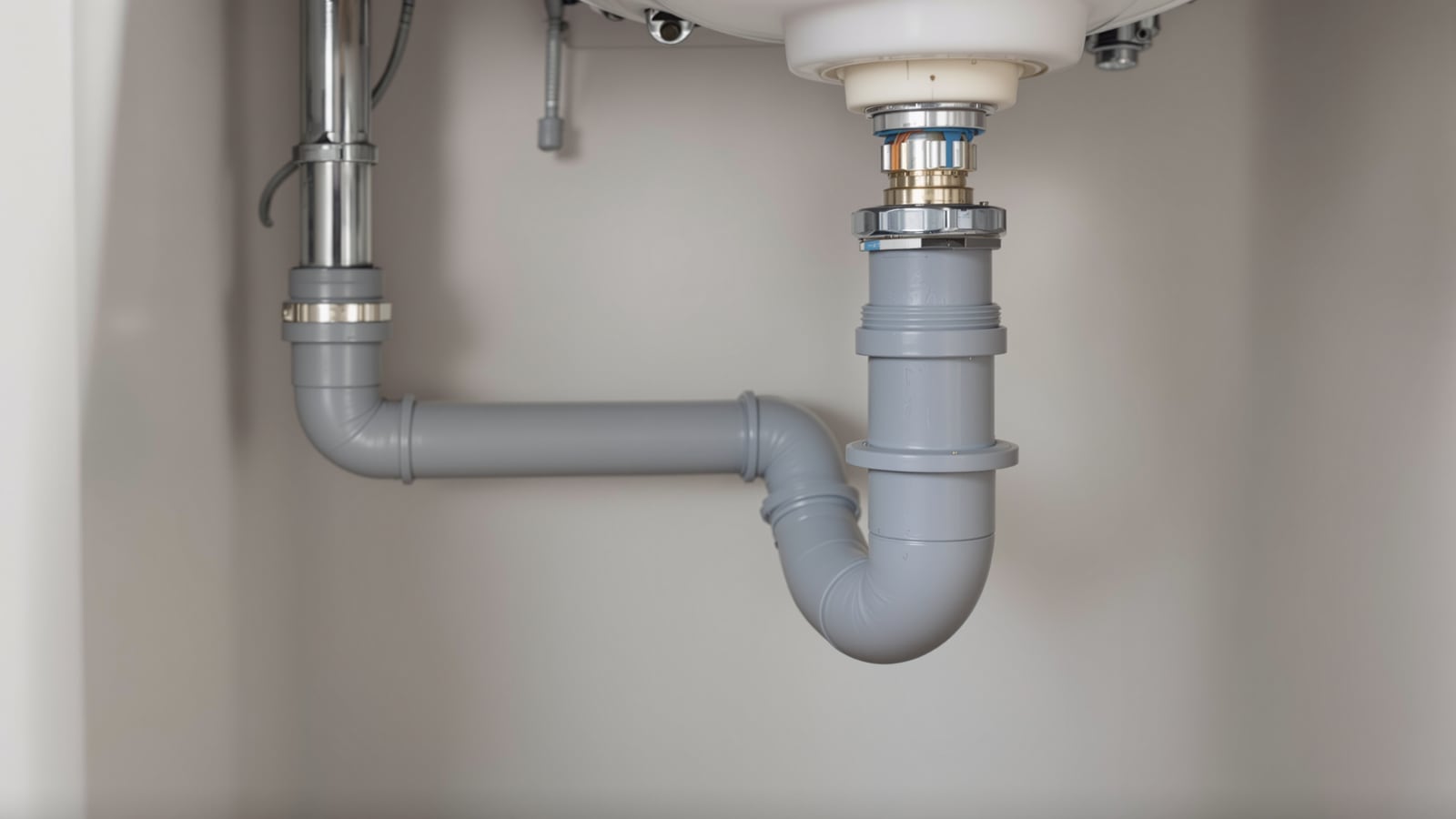
Waste Pipes in India: Grey-Water Lines from Basins, Sinks & Showers
The small-bore pipes that carry used water — but no faeces — from basins, sinks, showers, baths and washing machines. Waste versus soil, the 32 to 50 mm sizes, each fixture's trap, gradients, self-siphonage, venting and the grease blockages that plague kitchen lines.
Every Indian home has two kinds of drain pipe leaving it. One is fat and carries the toilet's discharge; the other is a set of slimmer pipes that carry the dirtier-but-not-foul water from your basins, kitchen sink, shower, bath and washing machine. Those slimmer pipes are the waste pipes — and this guide is about them.
The water they carry is called grey water: used, soapy, greasy or gritty, but with no faecal matter in it. Because it carries no solids of any size, a waste pipe can be much smaller than a toilet's soil pipe. Getting these small pipes right — the size, the fall, the trap and the venting — is what stops the two most common household smells and gurgles. This guide sits in the Studio Matrx Plumbing Knowledge Hub; for the whole drain-waste-vent picture see the drainage systems guide for India.
The one-line rule: soil pipe = the toilet; waste pipe = everything else that drains. A waste pipe never carries faeces, so it is smaller — but it still needs a trap and a vent, or it will smell.
Waste versus soil: the split that decides everything
The plumbing world divides foul drainage into two families, and confusing them is the single most common homeowner mistake.
- A soil pipe carries discharge from WCs and urinals — water plus solids. It is large (usually 110 mm) so solids never jam it. Its dedicated profile is the soil pipes guide for India.
- A waste pipe carries grey water only — from basins, sinks, showers, baths, bidets and washing machines. No solids, so 32 to 50 mm is plenty.
Both are "foul" in the sense that both must be trapped and vented and must not discharge into the open — grey water still turns septic and smells if it sits. But their sizes, falls and fittings differ, which is why plumbers keep them on separate branches that only meet at the main stack or the underground line.
| Soil pipe | Waste pipe | |
|---|---|---|
| Carries | WC / urinal discharge (with solids) | Grey water only, no solids |
| Typical fixtures | Toilet, urinal | Basin, sink, shower, bath, washing machine |
| Common size | 110 mm | 32, 40, 50 mm |
| Trap seal needed | ~50 mm | ~50 mm (75 mm where evaporation is a risk) |
| Blockage risk | Solids, wipes | Grease, hair, soap scum |
Typical waste pipe sizes
Waste pipe is sized to the fixture and how much it dumps at once. The numbers below are the everyday Indian defaults; local practice and the fitting on your trap decide the exact bore.
| Fixture | Waste pipe size (indicative) | Trap type |
|---|---|---|
| Wash basin | 32 mm (40 mm if long run) | Bottle trap or P-trap |
| Kitchen sink | 40 to 50 mm | P-trap / bottle trap |
| Shower / floor drain | 40 to 50 mm | Floor gully / P-trap |
| Bath tub | 40 to 50 mm | P-trap |
| Washing machine | 40 mm standpipe | Trapped standpipe |
| Bidet / health-faucet basin | 32 to 40 mm | Bottle trap |
A few rules ride on top of this table:
- Never reduce the pipe below the trap's outlet size. A 40 mm trap must not drain into a 32 mm pipe — it will choke and gurgle.
- The kitchen sink is the exception that wants the bigger 50 mm bore even on a short run, because it carries warm grease that congeals and narrows the pipe over years.
- A washing machine discharges a sudden pumped surge, so it drains into an open, trapped standpipe (a vertical 40 mm pipe with an air gap) rather than a sealed connection — that air gap stops dirty water siphoning back into the machine.
Every fixture needs a trap
Between each fixture and its waste pipe sits a trap — a U or bottle-shaped bend that holds a plug of water. That water plug, the trap seal, is what blocks drain smells and insects from rising into the room. A healthy seal is about 50 mm of water depth.
- Bottle traps are the compact chrome cylinders you see under modern basins — neat, but they restrict flow slightly.
- P-traps and S-traps are the classic bent pipes used on sinks, baths and floor drains.
- Floor gullies (the grated floor drain in a bathroom or utility area) are themselves trapped, and often collect several waste pipes at once.
For the full mechanics — seal depths, trap types and how seals are lost — see the dedicated plumbing traps guide for India. The key point for waste pipes is that the trap is only as good as the venting behind it, which is the next problem.
Gradient: the gentle fall that makes small pipes work
A waste pipe drains by gravity, so it must run downhill the whole way. Too flat and the water crawls, leaving grease and soap behind; too steep and the water races off and leaves the solids stranded. For small-bore waste pipes, the sweet spot is a fall of roughly 1 in 40 to 1 in 60 — that is 18 to 25 mm of drop per metre.
| Pipe size | Recommended fall (indicative) | Drop per metre |
|---|---|---|
| 32 mm waste | 1:40 to 1:50 | ~20 to 25 mm |
| 40 mm waste | 1:40 to 1:60 | ~17 to 25 mm |
| 50 mm waste | 1:50 to 1:70 | ~14 to 20 mm |
| 110 mm soil (for comparison) | 1:40 to 1:100 | ~10 to 25 mm |
Small pipes want the steeper end of the range because they carry so little water — there is not enough flow to self-clean a nearly level 32 mm line. For the exact fixture-by-fixture numbers when you are laying out a bathroom, use the bathroom drainage pipe calculator.
Watch the run length as much as the fall. A basin waste over about 1.7 m long is prone to losing its trap seal by siphonage — beyond that, plumbers step the pipe up a size or add a vent.
How waste pipes connect to the stack
Waste branches do not just end in the open. Grey water still smells, so every waste pipe must discharge into the sealed drainage system:
- Into the soil stack. In most flats the basin, sink and shower waste tee into the same vertical soil stack the WC uses, entering it above the WC branch so the two flows never back up into each other.
- Into a floor gully. On ground floors, waste pipes often drop into a trapped gully outside the wall — the grated pit you see below a kitchen window — which then runs to the underground line.
- Never straight to open ground. Discharging grey water onto the plot or into an open surface drain is what breeds mosquitoes and smell, and it is against good practice. If you want to reuse that grey water, that is a treatment question — see greywater versus blackwater and home greywater recycling systems. This guide only covers the pipe that carries it away.
Self-siphonage: why venting matters
Here is the invisible fault that makes a new bathroom smell within weeks. When a full basin drains, the slug of water rushing down the waste pipe acts like a piston. Behind it, it drags a partial vacuum — and that vacuum can suck the water straight out of the trap, leaving the seal empty and the drain open to the room. This is self-siphonage, and small-bore waste pipes are especially prone to it because the water fills the whole bore.
The cure is to let air in behind the draining water so no vacuum forms. Two ways:
- A vent pipe. A branch or the stack itself is carried up and open to the atmosphere, so air is always available to break the vacuum. This is the classic, most reliable method.
- An air admittance valve (AAV). A small one-way valve fitted above the trap that opens to let air in when the pipe drops to vacuum, then snaps shut so no smell escapes. Handy for an island sink or a basin far from the stack where a full vent is hard to run.
The full logic — vent stacks, branch vents and where an AAV is allowed — is in the drainage systems guide. The takeaway for waste pipes: if a basin or sink gurgles as it empties and later smells, it is losing its trap seal, and it needs a vent or an AAV.
Common blockages — grease is the enemy
Waste pipes fail differently from soil pipes. There are no wipes to jam them; instead they narrow slowly from the inside:
- Kitchen grease. Warm fat and oil pour down as liquid, then chill and set on the pipe wall, catching food scraps until the bore closes. This is why the kitchen sink gets the bigger 50 mm pipe and a steeper fall, and why you should scrape plates and never tip cooking oil down the sink.
- Hair and soap scum. Basin, shower and bath wastes clog with hair bound together by soap — the reason a simple hair strainer over the drain saves most call-outs.
- Lost trap seal (not a blockage but read as one). A dry trap smells like a blocked drain but flows fine; run the tap and the smell clears. If it keeps drying, the fix is venting, not rodding.
- Long flat runs. A waste pipe laid too level silts up with soap and grit. Re-lay it to a proper fall rather than rodding it repeatedly.
A rough cost picture, indicative only: a plumber's visit to clear a grease-blocked kitchen waste runs about ₹500 to ₹1,500; re-laying a badly sloped run in a small bathroom might be ₹4,000 to ₹12,000 depending on access and finishes. The material itself is cheap — the labour and the broken tile are the cost. For material choices behind these pipes, see the PVC pipes guide for India.
Quick homeowner checklist
- Basin 32 mm, kitchen sink 40 to 50 mm, shower and bath 40 to 50 mm, washing machine 40 mm standpipe.
- Every fixture keeps its trap with a ~50 mm seal — never remove it to "fix" a smell.
- Lay small-bore waste at a 1:40 to 1:60 fall; steeper for the shortest, smallest pipes.
- Keep basin waste runs under about 1.7 m or add a vent or AAV.
- If it gurgles then smells, it is self-siphonage — vent it, do not just pour water in.
- Fit a hair strainer on wet areas and never tip oil down the kitchen sink.
References
- National Building Code of India (NBC) 2016, Part 9 — Plumbing Services, Section on Drainage and Sanitation
- IS 1742 — Code of Practice for Building Drainage
- IS 12183 — Code of Practice for Plumbing in Multistoreyed Buildings (drainage)
- IS 13592 — Unplasticised PVC Pipes for Soil and Waste Discharge Systems
Figures such as pipe sizes, gradients, trap seals and costs are indicative for Indian homes; verify against current codes and local plumbing practice before you build.
Export this guide
Related Guides — Deep-dive reading
Drainage Systems Guide for Indian Homes: DWV, Traps, Slopes & Stacks
The section pillar for household drainage — the two waste streams, gravity and gradients, traps and the water seal, the soil stack and branch layout, why venting matters, keeping foul and rain separate, and how it all connects to sewer, septic or an STP at the plot boundary.
PlumbingBathroom Drainage India: Waste vs Soil Pipes, Slope, Sizes, Traps & Venting (2026)
How a bathroom's waste and soil pipes actually work — the difference between waste lines (basin, shower) and the soil line (WC), the fall you need, pipe sizes in mm, floor slope to the floor trap, how it all joins the stack, and how traps and venting stop blockages and smells.
BathroomsAir Admittance Valves (AAV) in India: How They Work, Fitting, Sizing & Code Limits
The one-way mechanical vent that lets air into a drainage system to break siphonage but seals against sewer gas — how an AAV works, where and how to fit it above the trap arm and flood level, how to size it by drainage fixture units, the rule that it can never replace every vent, and where it stands under Indian code.
PlumbingRelated Tools — Try Free
Bathroom Drainage Pipe Calculator
Recommended drain and waste pipe sizes, slopes and stack size for a bathroom's fixtures — indicative IS 1172 / NBC plumbing practice.
Bathroom CalculatorCross-Ventilation Analyzer
Estimate airflow and air changes per hour (ACH) from room size, window areas, layout, and local wind — with NBC 2016 Part 8 compliance check.
Ventilation CalculatorBathroom Floor Slope Calculator
Work out the floor fall to the drain and screed depth from the run and slope ratio — with a drains-properly verdict.
Bathroom Calculator