
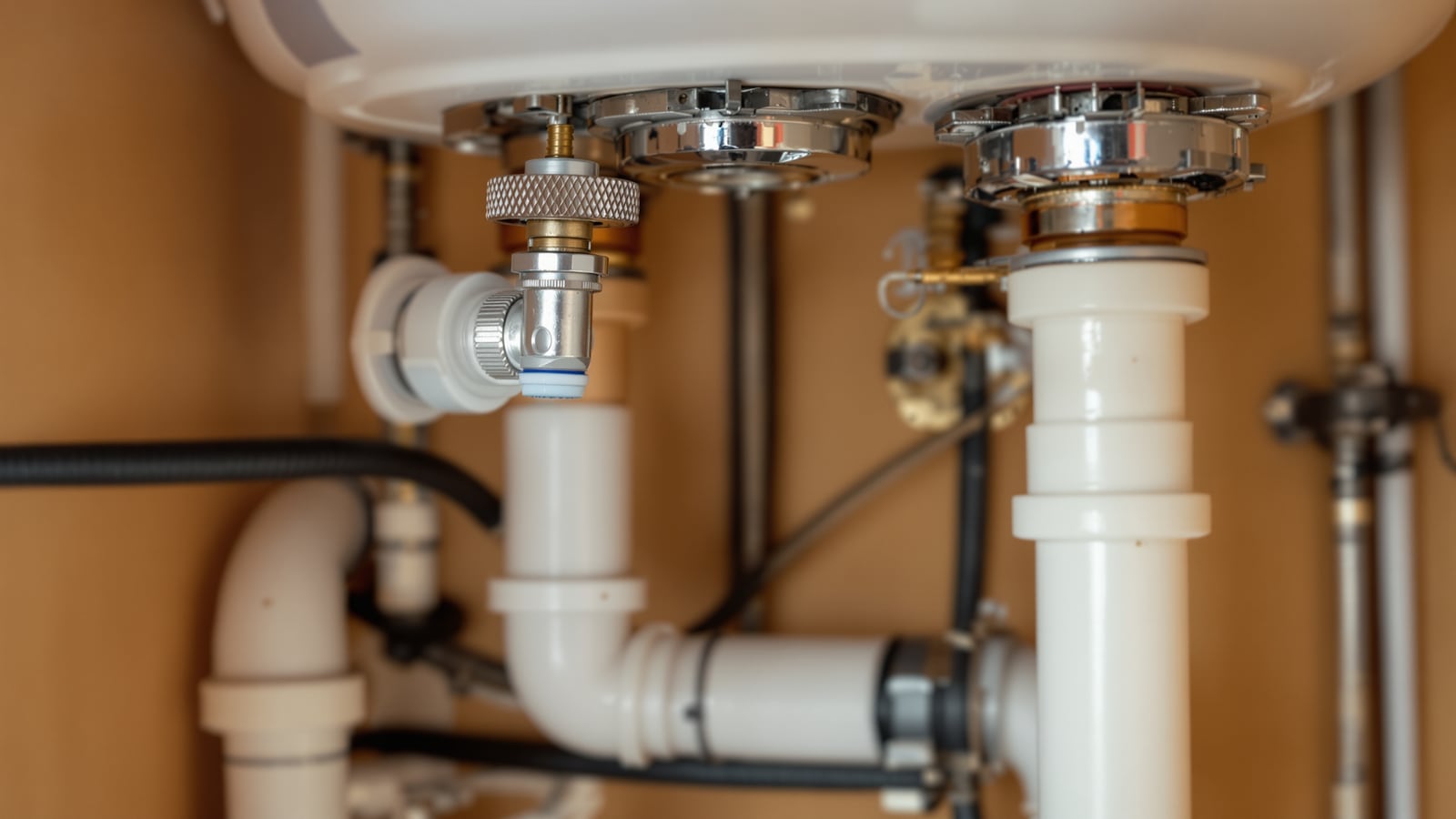
Air Admittance Valves (AAV) in India: How They Work, Fitting, Sizing & Code Limits
The one-way mechanical vent that lets air into a drainage system to break siphonage but seals against sewer gas — how an AAV works, where and how to fit it above the trap arm and flood level, how to size it by drainage fixture units, the rule that it can never replace every vent, and where it stands under Indian code.
An air admittance valve (AAV) is a small, spring-loaded, one-way vent that solves a specific and common problem: a fixture that needs venting where running a full vent pipe to roof level is impractical. It lets air rush into the drainage pipe the instant negative pressure appears — protecting the trap seal from being siphoned dry — and then closes under gravity so sewer gas can never escape into the room. Used well, it is elegant. Used as a shortcut, it fails silently.
This is a professional's guide to specifying, fitting and sizing AAVs in Indian work. It sits under the Studio Matrx drainage systems hub and is the companion to the plumbing ventilation guide, which explains why a drainage system needs venting at all, and to the guide on plumbing traps, whose water seal is the very thing an AAV exists to protect.
Why a drain needs air in the first place
A drainage stack is a two-phase system: water falls, and air has to move to make room for it. When a WC discharges or a sink empties, the slug of water pushes air ahead of it and pulls a partial vacuum behind it. That negative pressure, if it has nowhere to draw make-up air, does the only thing it can — it sucks the water out of the nearest trap seal. A siphoned trap is an open pipe to the sewer, and the gurgle you hear before the smell arrives is the seal being pulled through.
Traditional venting answers this by running a vent pipe up to and through the roof, open to atmosphere, so make-up air is always available and pressure stays balanced. That works and remains the backbone of every properly designed system. But a roof vent for every branch is not always achievable — an island sink has no wall to run a vent up, a retrofit bathroom sits far from the existing stack, and cutting a new roof penetration through a finished slab is expensive and leak-prone. This is exactly the gap an AAV fills.
An AAV does not replace ventilation — it supplies air locally where a pipe to atmosphere is impractical. The physics it manages is negative pressure only; it can admit air but it cannot relieve positive pressure, which is why it can never be the only vent on a system.
How an air admittance valve works
Inside the housing is a lightweight sealing diaphragm or membrane held down against a seat, sometimes assisted by a very light spring. Its whole behaviour is driven by pressure difference:
- At rest (drain static), the diaphragm sits closed under its own weight and the seal. The room side is sealed off from the pipe.
- Under negative pressure (a fixture discharges and pulls a vacuum), room air pushes the diaphragm up off its seat and flows down into the pipe, breaking the developing siphon and letting the trap seal hold.
- When flow stops, pressure equalises and the diaphragm drops back onto its seat. Any positive pressure in the stack presses it harder closed — so sewer gas is held back, not vented.
That one-directional behaviour is the entire value proposition: air in, gas never out. It is a mechanical part with a moving element and an elastomer seal, which is the source of both its usefulness and its eventual wear-out.
Where and how to fit an AAV
Fitting height and access decide whether an AAV works or becomes a hidden leak of sewer gas. The non-negotiable rules:
- Above the trap weir / branch it serves. The valve must sit above the highest point of the trap arm it protects, so the water seal can never rise into the valve.
- Above the flood level rim. As a general rule the valve body should be at least ~100–150 mm above the horizontal branch and well above the flood level rim of the highest fixture on that branch, so a blockage or surcharge cannot push waste up to the diaphragm. Confirm the exact minimum against the manufacturer's instruction and current code.
- Vertical, upright. Diaphragm valves are designed to seat under gravity — mount the valve vertical (unless the maker explicitly permits another orientation).
- In a ventilated, accessible space. The valve draws room air, so it must sit somewhere with a supply of air — under-sink cabinet, service duct, boxed riser — never sealed inside airtight insulation or buried in a wall chase. And because it is a wearing part, it must stay accessible for inspection and replacement without breaking finishes.
- Protected from freezing and dust — rarely a freezing issue in most of India, but dust and grease loading matters under a kitchen sink; some models take a removable cap.
The single most common defect is an AAV concealed permanently inside a plastered wall or a sealed box. When the diaphragm eventually fails, it becomes an undetectable path for sewer gas with no way to service it. If you cannot reach it, do not fit it there.
Sizing by drainage fixture units
An AAV is rated by the airflow it can pass, expressed as a maximum number of drainage fixture units (DFU) it can vent. Undersize it and it starves the branch of air under peak discharge; the trap siphons anyway. The rating must equal or exceed the total DFU load downstream of the valve.
Indicative branch-AAV selection (verify against the specific product's rated capacity and your code's DFU schedule):
| AAV connection size | Typical use | Indicative DFU capacity |
|---|---|---|
| 32–40 mm | Single basin / bidet vent | up to ~6 DFU |
| 50 mm | Sink, basin or small branch | up to ~20 DFU |
| 75–110 mm | Multi-fixture branch or a whole stack | up to ~150+ DFU |
Fixture-unit loads for common fixtures (indicative planning values — a WC and a kitchen sink dominate a branch):
| Fixture | Indicative DFU |
|---|---|
| Wash basin | 1 |
| Kitchen sink | 2 |
| Floor drain / bath waste | 2–3 |
| WC (cistern) | 4 |
| Full bathroom group | ~6 |
For the fixture-level pipe and slope arithmetic behind these loads, use the Studio Matrx bathroom drainage pipe calculator and bathroom floor slope calculator.
The rule you cannot break: at least one open vent
This is the point that separates competent AAV use from the "cheater vent" cowboy job. An AAV admits air but cannot exhaust it, and it cannot relieve positive pressure surges that build in a stack when a high-level discharge compresses the air column. A system entirely fitted with AAVs has no path to atmosphere, so positive transients have nowhere to go and will blow trap seals from the other side.
Every drainage system must retain at least one conventional vent open to atmosphere — normally the main stack carried to roof level. AAVs then handle the awkward branches: the island sink, the retrofit toilet, the loft bathroom added years later. They supplement the through-roof vent; they never abolish it.
Quality, lifespan and failure mode
An AAV is a moving mechanical seal, so it wears. The diaphragm stiffens or gathers grease and dust, and eventually it stops seating cleanly — at which point it can leak sewer gas continuously and silently.
- Buy to a standard. Choose valves certified to a recognised standard (the widely referenced international product standards for AAVs, and a reputable brand's own rating) rather than an unbranded moulding. The certification underwrites the DFU capacity and the seal life.
- Lifespan is finite. Quality valves are typically rated for a large number of cycles / many years, but treat them as a serviceable, replaceable part, not a lifetime fitting — another reason access is mandatory.
- Failure is a smell, not a flood. Unlike a burst pipe, a failed AAV gives no dramatic sign — just an intermittent sewer smell near the fixture. Make it inspectable so that symptom leads straight to the valve.
Code acceptance in India
AAVs are a long-established, standard-compliant device internationally, and they are used widely in Indian retrofit and island-fixture work. However, acceptance is not universal across every local authority, and the primary vent-to-roof principle is what Indian practice is built around.
- The National Building Code of India (NBC) 2016, Part 9 (Plumbing Services) and the associated Uniform Plumbing Code of India frame the venting requirements; AAVs are used as a supplementary solution within that framework, not a wholesale substitute for the stack vent.
- Local approval varies. Some municipal plumbing authorities and consultants accept AAVs freely for branch venting; others require conventional venting on the record drawing. Confirm acceptance with the local authority and the project's plumbing consultant before you rely on an AAV in a sanctioned design.
- Never use an AAV to hide a design failure — a branch that should have been vented properly at first fix, or a stack with no roof vent at all. That is where AAVs earn their "cheater vent" nickname and where inspectors reject them.
AAV vs traditional venting — pros and cons
| Factor | Air admittance valve | Vent-to-roof pipe |
|---|---|---|
| Relieves negative pressure | Yes | Yes |
| Relieves positive pressure | No | Yes |
| Roof penetration needed | No | Yes (leak/waterproofing risk) |
| Suits island sinks / retrofits | Yes | Difficult |
| Moving part / wears out | Yes — serviceable | No — passive, lifetime |
| Can be the only vent | No | Yes (the primary vent) |
| Install cost & disruption | Low | Higher |
The honest summary: a through-roof vent is the more robust, passive, "fit and forget" solution and must remain the backbone of the system; an AAV is the pragmatic, low-disruption tool for the branches where a roof vent is genuinely impractical. Use both for what each does best.
For the waste and treatment side that lies beyond the branch — where drainage stops and sewage handling begins — see the Studio Matrx STP resources such as what a sewage treatment plant is; an AAV has no role there, it only manages air in the drainage pipes.
References
- National Building Code of India (NBC) 2016, Part 9 — Plumbing Services, and the Uniform Plumbing Code of India — the governing framework for drainage and venting design in India, within which AAVs are used as a supplementary venting device.
- Manufacturer instructions and product certification — every AAV must be selected and installed to its own rated DFU capacity, minimum fixing height and orientation; the maker's data sheet overrides any general table here for warranty and compliance.
- The Studio Matrx drainage systems hub and plumbing ventilation guide for the wider DWV and venting context.
- All DFU capacities and fixing heights in this guide are indicative for planning; confirm the current code edition, local authority acceptance and the specific product's rating with a licensed plumber and the project consultant before installation.
Export this guide
Related Guides — Deep-dive reading
Bathroom Plumbing Code India: NBC 2016 Part 9, UPC-I & the IS Standards That Govern Pipework
A professional reference to the codes and standards that govern bathroom plumbing in India — the National Building Code (NBC 2016) Part 9 on Plumbing Services, the Uniform Plumbing Code India (UPC-I), the CPHEEO Manual, and the IS standards for water supply, drainage, trap seals, pipe sizing, slopes and venting — with a caveat to always verify the current code and your local authority.
BathroomsPlumbing Ventilation Guide (India): Vent Systems, Stack, Loop & Wet Vents
A professional, India-first reference to drainage venting — why traps lose their seal, how vents equalise pressure, and how to size and route main, branch, loop and wet vents to code.
PlumbingSoil and Waste Pipe India: The SWV Stack, the Vent, and Why the Terrace Cowl Matters
The soil, waste and vent (SWV) stack is the vertical spine that drains every stacked bathroom in a building. Here is how the 110 mm soil stack, the waste stack, and the roof vent actually work — and why the vent is the part that gets omitted and then regretted when the traps start smelling.
BathroomsRelated Tools — Try Free
Cross-Ventilation Analyzer
Estimate airflow and air changes per hour (ACH) from room size, window areas, layout, and local wind — with NBC 2016 Part 8 compliance check.
Ventilation CalculatorBathroom Drainage Pipe Calculator
Recommended drain and waste pipe sizes, slopes and stack size for a bathroom's fixtures — indicative IS 1172 / NBC plumbing practice.
Bathroom CalculatorDrainage Fixture Unit Calculator
Total the drainage fixture units (DFU) of a home's fixtures and get an indicative drain and soil-stack size.
Plumbing Calculator