
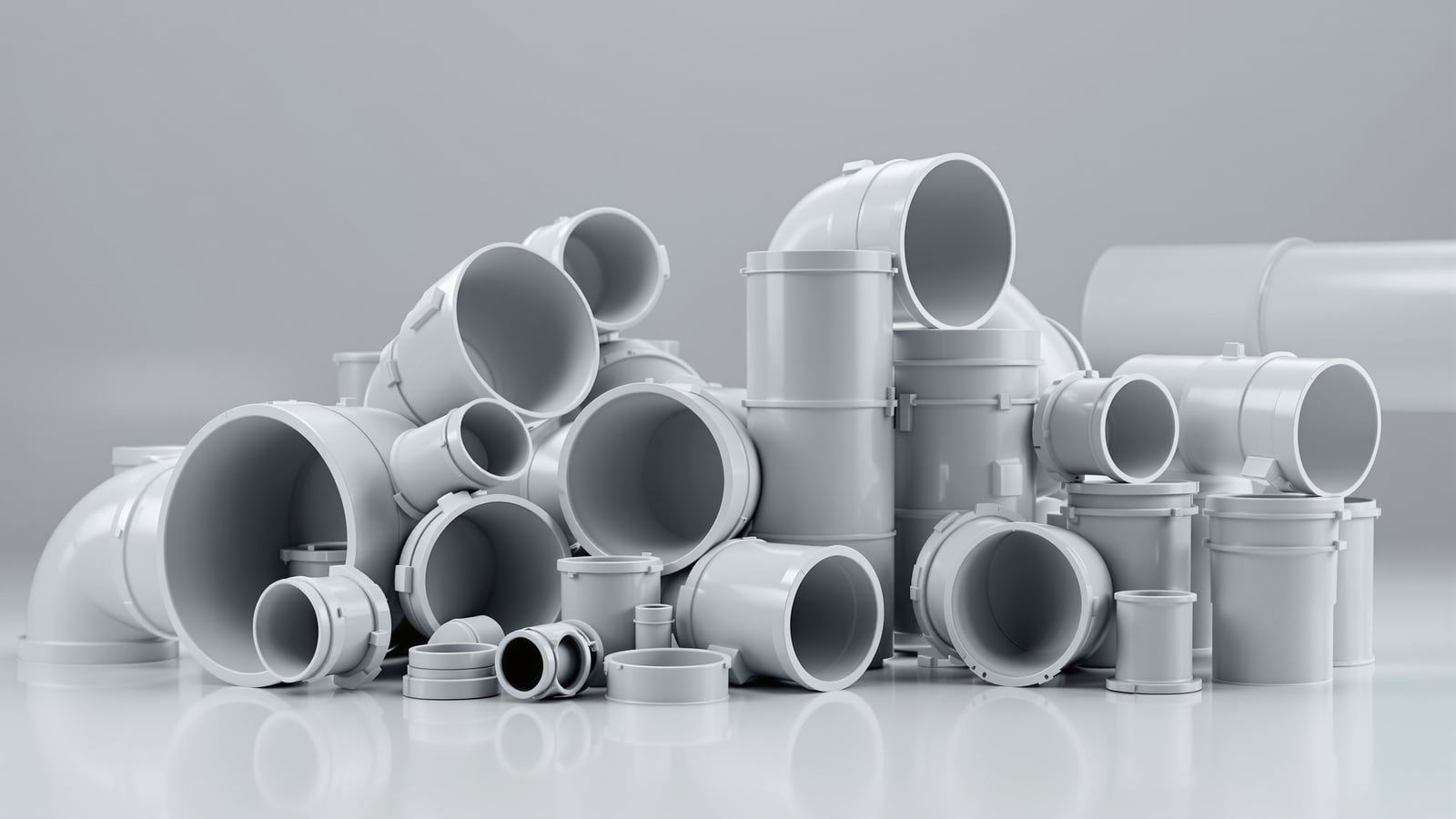
PVC Pipes in India: The Grey Drainage & Waste Pipe Explained
The rigid grey PVC pipe you see behind every Indian home is a drainage, waste, vent and rainwater workhorse — not a pressure or hot-water line. What PVC is, the SWR sizes (40 to 160 mm), solvent-cement jointing, its UV and temperature limits, and indicative costs.
If you look up the outside wall of almost any Indian house, you will see it: a fat grey plastic pipe carrying waste water down from the bathrooms and kitchen. That pipe is PVC — polyvinyl chloride — and it is the country's default material for drainage, waste, vent and rainwater lines. It is cheap, light, rot-proof and easy to join, which is exactly why it took over from cast iron and stoneware for these jobs.
This guide is a standalone profile of ordinary rigid grey PVC as a drainage material. The single most important thing to understand is what it is not: it is not a pressure pipe and not a hot-water pipe. The white or cream uPVC pressure pipe carries cold water under pressure, and the cream CPVC pipe carries hot water — both are different products for different jobs. This guide sits inside the Studio Matrx Plumbing Knowledge Hub; for the full material line-up see the plumbing pipes guide for India.
The rule of thumb every homeowner should carry away: grey PVC = things flowing down by gravity (waste, soil, rain, vents). If water is being pushed through the pipe by a pump or the mains, or if it is hot, grey PVC is the wrong pipe.
What PVC actually is
PVC is a rigid thermoplastic. In its drainage form it is compounded to be stiff, impact-resistant and, importantly, not designed to hold internal pressure. Because drainage pipe never sees more than the weight of the water briefly passing through it, the wall can be thinner and the pipe cheaper than a pressure pipe of the same diameter.
Its useful properties for a drain are:
- Corrosion-proof. It does not rust, rot or scale. Sewage, detergents, mild acids and salty water leave it untouched — the reason it replaced cast iron, which rusts, and stoneware, which is brittle.
- Smooth bore. The slick inner wall resists the greasy, soapy build-up that clogs rougher pipes, and lets solids move on a gentle slope.
- Light and workable. A 110 mm PVC pipe weighs a fraction of the cast-iron equivalent, so one person can carry and fix a full stack. It cuts with a hacksaw and joins with a tin of solvent cement.
- Quiet-ish and inert. It does not taint what flows through it, though it is not certified for pressurised drinking water — that is uPVC's or CPVC's job.
The grey drainage family is often sold as SWR pipe — Soil, Waste and Rain — the three things it carries. You will also hear it called "drainage PVC" or just "grey pipe".
Where PVC is used in the house
Think of PVC as the gravity plumbing of the home — everything that drains away rather than being supplied to a tap.
Its standard homes are:
- Soil pipe (the stack). The vertical 110 mm pipe that carries WC waste — solids and all — down to the underground drain. This is the big grey pipe on the outside wall.
- Waste pipe. The 40 to 75 mm branches that carry "grey water" from basins, showers, kitchen sinks and washing machines into the stack.
- Vent pipe. An open pipe carried above the roof so the drainage system can breathe. Without it, a flush would siphon the water out of nearby traps and let sewer gas into the room.
- Rainwater downpipe. From terrace and balcony outlets to ground level — usually 75 to 110 mm.
- Underground / external drainage. Buried lines running to inspection chambers, a soak pit, or the municipal sewer. A pipe merely carries sewage here — how it is treated is a separate subject; see the forthcoming drainage systems guide for India.
Where PVC does not belong: anything under pressure (the mains, pump lines, tank down-takes) and anything hot (geyser outlets, dishwasher hot feeds). Hot water softens ordinary PVC and pressure can burst it.
Sizes and where each is used
Drainage PVC is sold by outer diameter in mm, and a handful of sizes cover a whole house. The spec table below uses realistic figures for Indian SWR pipe; treat wall thickness and exact ratings as indicative and confirm against the product and current IS spec.
| Nominal OD | Wall class (SWR) | Max service temp | Typical use in the home |
|---|---|---|---|
| 40 mm | Type A / B | ~60 C brief only | Basin and washing-machine waste |
| 50 mm | Type A / B | ~60 C brief only | Shower, urinal, small sink waste |
| 75 mm | Type A / B | ~60 C brief only | Kitchen-sink waste, small rain downpipe |
| 110 mm | Type A / B | ~60 C brief only | Soil (WC) stack, main vent, rain downpipe |
| 160 mm | Type B | ~60 C brief only | Underground main drain, large buildings |
SWR pipe comes in two wall thicknesses — Type A (thinner, for ventilated above-ground waste that never runs full) and Type B (thicker, for soil, rainwater and underground runs that take more load). For most homeowners the safe default outdoors and underground is Type B; a plumber specifies the class per run.
Note the temperature column: drainage PVC will take the brief slug of hot water from a kitchen sink, but it is not rated for continuous hot flow. Sustained hot water (a hot-water supply line) needs CPVC, which is engineered for it.
How PVC is joined: solvent cement
The reason PVC drainage is so quick and cheap to install is its joint. There is no threading, no gasket to buy for the basic joint, no torch. Two methods dominate:
- Solvent-cement (welded) joints. The pipe end slides into a fitting socket, both faces are coated with PVC solvent cement, and the pipe is pushed home and held for a few seconds. The cement chemically softens and fuses the two surfaces into a single mass of plastic as it cures. Done right, the joint is stronger than the pipe itself. This is the standard for waste and vent lines.
- Push-fit / ring-seal joints. Larger SWR and underground pipe often uses a rubber ring in a moulded socket; the pipe pushes in and the ring seals it. This allows the pipe to expand and contract with temperature and lets long buried lines flex — which is why it is common for the 110 and 160 mm underground work.
A few site rules keep solvent joints leak-free:
- Cut square and deburr. A ragged end wipes the cement off as it enters the socket.
- Dry-fit before you glue. Once the cement grabs, you cannot rotate or pull the joint apart — it is permanent.
- Use the right cement for the diameter. Big 110 mm joints need a heavier-bodied cement than a 40 mm waste.
- Let it cure. Keep the run dry for the cure time on the tin before you test it.
Pros and cons for a homeowner
| Strengths | Limitations |
|---|---|
| Cheapest common drainage material | Not for pressure or hot water |
| Rust-proof, rot-proof, chemical-resistant | Degrades in years of direct sunlight (UV) |
| Light — one person can fix a full stack | Brittle in cold; can crack on hard impact |
| Fast solvent-cement or push-fit jointing | Softens and sags above ~60 C |
| Smooth bore resists clogging | Joints are permanent — no undo once glued |
| Long service life buried or shaded | Expands and contracts with temperature |
Two limitations deserve a homeowner's attention:
- UV / sunlight. Grey PVC left fully exposed to India's sun for years grows brittle and chalky and can eventually crack. On an exposed external stack, either use a UV-stabilised grade or give it a coat of exterior paint — paint is a cheap, effective UV shield.
- Temperature. It handles a brief hot slug from the kitchen, but a continuous hot-water line will sag and eventually fail. This is the single most common misuse — never plumb a geyser outlet in grey PVC.
Indicative cost
PVC is the value option, which is a large part of its appeal. Prices vary by brand, wall class and the steel-and-resin market, so treat these as indicative and get a current local quote.
- 40 mm waste pipe: roughly ₹40 to ₹90 per metre.
- 75 mm pipe: roughly ₹120 to ₹220 per metre.
- 110 mm SWR soil pipe: roughly ₹200 to ₹400 per metre.
- Fittings (bends, tees, couplers) and a tin of solvent cement add a modest amount; a small tin of cement is around ₹150 to ₹400.
For a full two-bathroom home, the drainage material bill is typically a small fraction of the supply-side pipework — one reason grey PVC has stayed the default for gravity plumbing.
How PVC compares to its cousins — in one line
- Grey PVC (this guide): gravity drainage, waste, vent, rain — no pressure, no hot water.
- uPVC: rigid, white/cream, for cold water under pressure (mains and supply).
- CPVC: cream, for hot and cold water under pressure — the geyser and mixer lines.
If you want the two pressure materials weighed against each other head-to-head, that comparison lives in the Bathrooms hub: CPVC vs uPVC pipes. This guide deliberately stays focused on the grey drainage pipe.
The bottom line
Grey PVC is the unglamorous, dependable backbone of Indian drainage: cheap, corrosion-proof and fast to fix, ideal for anything that flows down by gravity. Buy Type B for soil, rain and underground runs, join it carefully with solvent cement, protect any sun-exposed stack from UV, and never — ever — use it for pressure or hot water. Get those few things right and a PVC drainage system will quietly outlast the rest of the house.
References
- IS 13592 — Unplasticized PVC pipes for soil and waste discharge (SWR) systems inside buildings.
- IS 4985 — Unplasticized PVC pipes for potable water supply (the pressure uPVC standard, for contrast).
- Manufacturer product literature and pressure/temperature/wall-class ratings — always confirm against the current IS specification and the specific product before you buy.
Export this guide
Related Guides — Deep-dive reading
uPVC Pipes in India: Pressure Classes, Sizes, Joints, Borewell & Cold-Water Use, Cost and IS 4985
A homeowner's profile of rigid unplasticised PVC pressure pipe — the tough, chemical-proof cream or grey pipe that carries cold water supply, feeds rising mains and runs borewell and agricultural lines. What uPVC is, its pressure classes, the sizes it comes in, how it is jointed, why it is a cold-water pipe (not a hot-water one), and what it costs.
PlumbingBathroom Pipe Material in India: CPVC, UPVC, PEX, PPR & PVC Compared
A brand-neutral, India-first guide to choosing supply and drainage pipes for your bathroom — CPVC for hot and cold, UPVC and PEX for cold, PPR, why old GI corrodes and chokes, temperature ratings, jointing, IS/ASTM standards, a comparison table and ₹ cost.
BathroomsBathroom Plumbing India: The Complete Guide to Water Supply, Drainage, Traps & Pipes
The whole plumbing picture for an Indian bathroom in one place — the two systems (cold and hot water supply, and waste/soil drainage with its vented SWV stack), traps and the floor trap, slopes and gradients, concealed vs exposed pipework, pipe materials (CPVC/UPVC/PEX/GI) and the overhead-tank pressure reality — with the coordination that must happen before any civil work starts.
BathroomsRelated Tools — Try Free
Bathroom Drainage Pipe Calculator
Recommended drain and waste pipe sizes, slopes and stack size for a bathroom's fixtures — indicative IS 1172 / NBC plumbing practice.
Bathroom CalculatorPlumbing Pressure-Test & Leak Checklist
Pre-closure pressure and leak test — 9 categories, 60+ checkpoints across water supply, drainage, fixtures, waterproofing, hot water, tanks.
Pre-Closure TestRainwater Tank Sizer
How big should your rainwater tank be? Computes annual harvest, recommended tank capacity in litres, water-bill savings, and payback — for 10 Indian cities.
RWH Calculator