
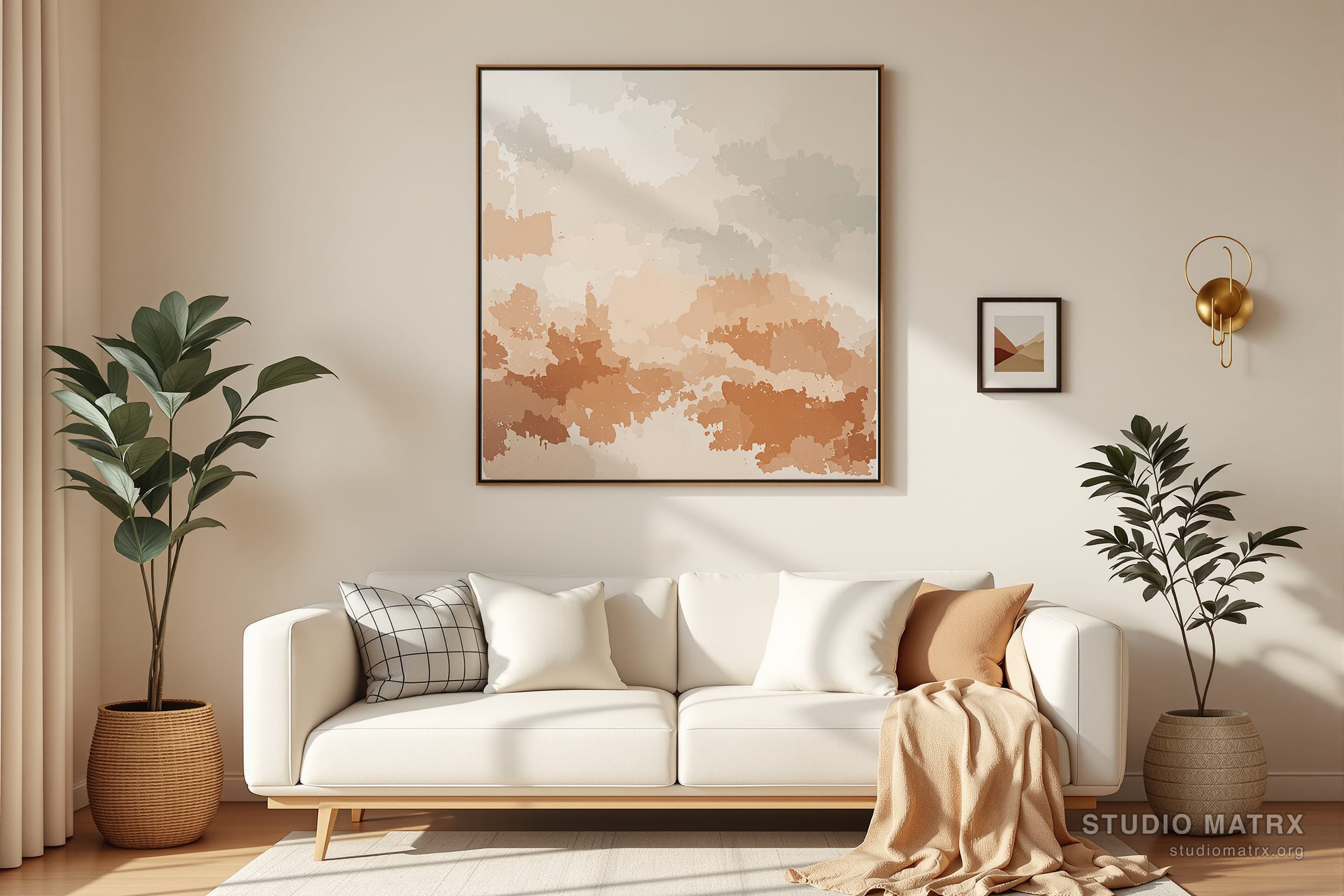
Wall Art & Paintings: How to Choose, Place & Combine Art at Home
Painting styles, wall-art forms, sizing, placement, combinations and care — for Indian homes
Art is the fastest, most personal way to finish a home. You can spend months getting the joinery, the flooring and the lighting right, yet a room can still feel unfinished until something on the wall says who lives there. A single well-chosen piece does in an afternoon what a renovation cannot do in a season: it adds colour, story and warmth at eye level, exactly where the eye lands.
Think of art as the opposite of a built-in. A wardrobe, a false ceiling or a wall niche is fixed, expensive and permanent. Art is movable, expressive and forgiving. You can rotate it, re-hang it, pass it to your children or sell it on. In an Indian home, where families grow and rooms change purpose, that flexibility is a quiet superpower. This guide walks you through every kind of wall art, how to choose and place it, what it costs in 2026, and how to keep it safe through our heat, dust and monsoon.
The two families: paintings and wall art
Almost everything you can hang falls into two broad families. The first is paintings and prints: flat, framed, image-led work, from an oil canvas to a Madhubani sheet to a digital print. The second is dimensional wall art: objects with material and depth that you mount rather than frame, such as metal pieces, wooden panels, ceramics, sculptures and textiles. Most beautiful walls use a little of both. Learn the styles within each family first, and the choosing becomes easy.
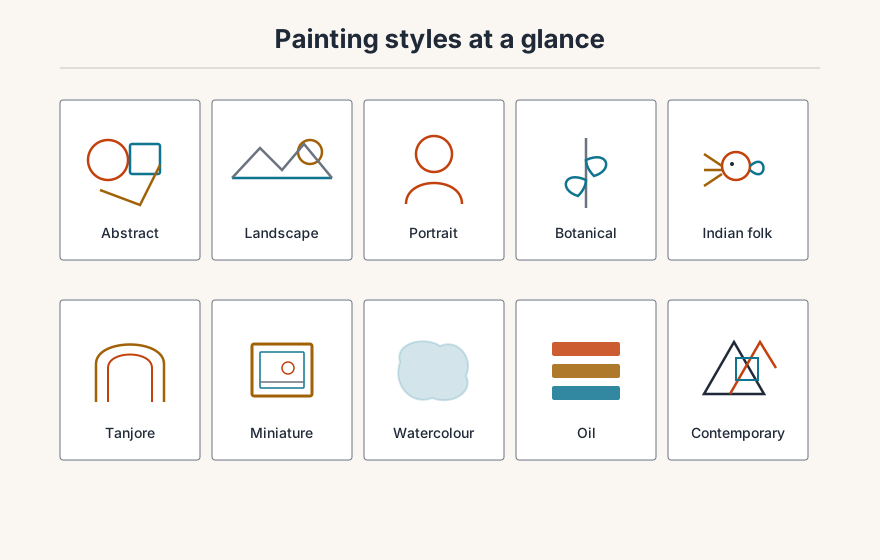
A field guide to painting styles
Abstract art
Abstract work uses colour, shape and gesture instead of recognisable objects. Because it carries no fixed story, it suits modern living rooms and reception areas where you want energy without a literal subject. It is the easiest style to scale large, which makes it a strong pick for a tall double-height wall common in newer Indian apartments. India has a deep abstract lineage, from S. H. Raza's bindu canvases to V. S. Gaitonde. Original mid-career abstracts start around ₹15,000 and rise quickly, but good large-format prints on canvas sit at ₹2,000 to ₹8,000.
Contemporary art
Contemporary is less a look than a now: living artists working in mixed media, pop, surreal or conceptual modes. It rewards the collector who wants conversation pieces and a home that feels current. For Indian buyers, platforms and gallery showcases make emerging-artist work approachable. Expect ₹8,000 to ₹40,000 for an emerging original, more for established names. Buy what you genuinely respond to rather than what is trending; contemporary value is unpredictable, but personal joy is not.
Landscape paintings
Landscapes carry calm. A misty Western Ghat, a Kerala backwater or a Himalayan ridge brings depth and a window-like sense of escape to a room. They are ideal for bedrooms, studies and staircases, where you want the eye to rest. Choose cooler, softer palettes for restful rooms and warmer light for living spaces. Indian landscape prints are inexpensive at ₹1,500 to ₹6,000; original plein-air or studio oils from regional artists run ₹10,000 upward.
Portraits
A portrait anchors a wall with a human presence. Family portraits in a foyer or stairwell make a home feel rooted; a striking single face gives a study gravitas. Commissioned portraits in oil or charcoal from an Indian artist typically cost ₹12,000 to ₹60,000 depending on size and medium. If commissioning feels heavy, a fine black-and-white photographic portrait, well printed and framed, achieves much of the same warmth for ₹3,000 to ₹8,000.
Botanical paintings
Botanicals are studies of leaves, flowers and plants, prized for their delicate detail and timeless appeal. They soften bedrooms, bathrooms, dining nooks and balconies, and pair beautifully with the indoor-plant look so popular in Indian homes now. A pair or trio in matching frames reads as quietly elegant. Vintage-style botanical prints are very affordable at ₹800 to ₹3,000 each; original watercolour botanicals from independent artists sit around ₹4,000 to ₹15,000.
Indian folk art (Madhubani, Warli, Gond)
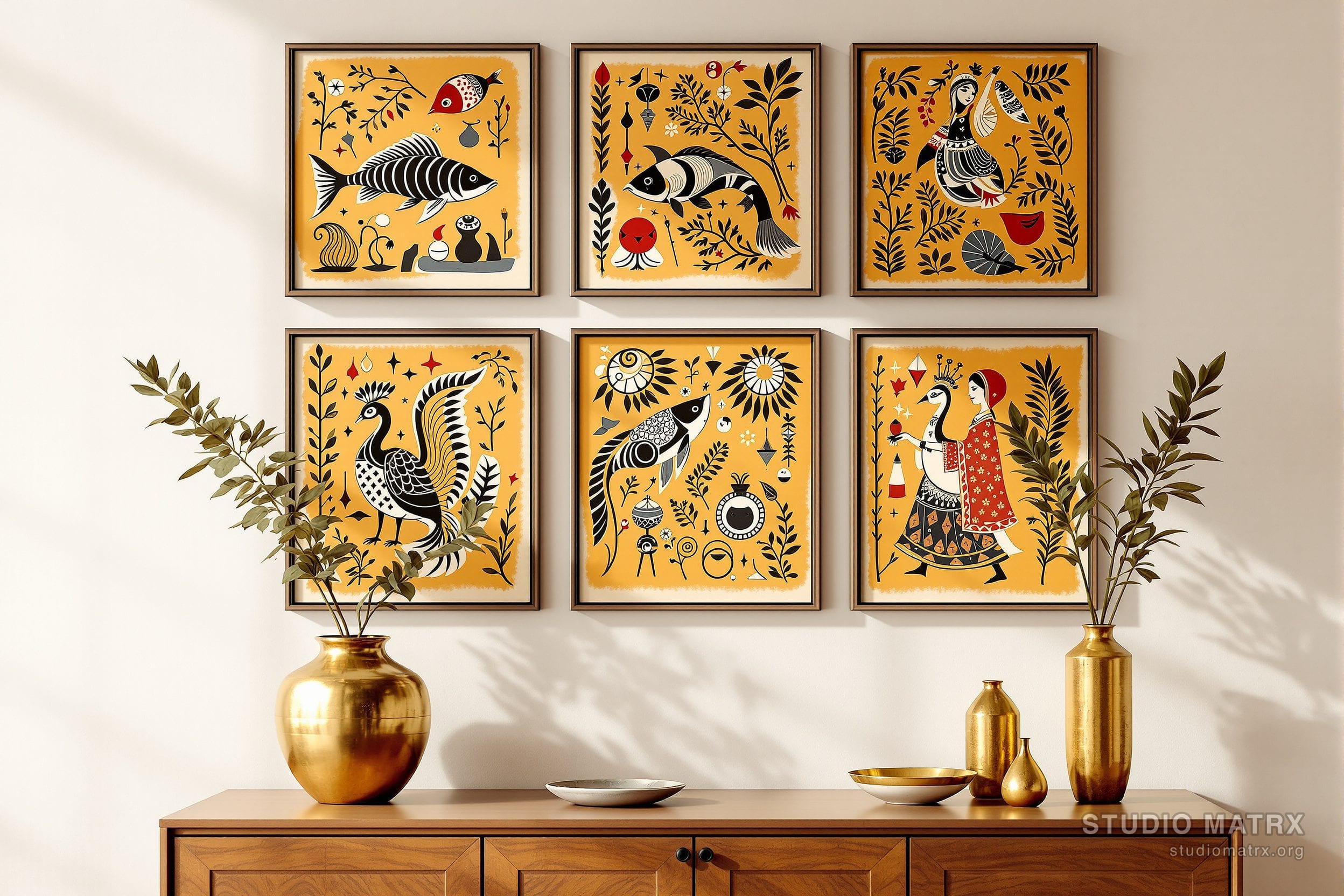
These are living traditions, each with its own grammar. Madhubani (from Bihar) is dense, symmetrical and richly coloured; Warli (from Maharashtra) uses white figures on an earthy ground; Gond (from Madhya Pradesh) builds animals and trees from fine dotted lines. They bring identity and craft to a foyer, a pooja-adjacent wall or a dining room. Buy original work from the artisans themselves at fairs such as Dastkar and Surajkund, or through cooperatives, so the maker is paid fairly. A genuine hand-painted Madhubani on handmade paper runs ₹2,000 to ₹20,000 by size and detail; large canvases by named artists cost far more.
Tanjore paintings
Tanjore (Thanjavur) painting is a South Indian devotional tradition known for gold-foil work, gesso relief and embedded stones, usually depicting deities. It radiates richness and is the classic choice near a pooja room, in a foyer or above a console for a touch of festive grandeur. Because of the gold and craftsmanship, even a modest authentic piece starts around ₹6,000 and a large, intricate one runs ₹30,000 to well over ₹1,00,000. Buy from established Thanjavur studios and ask about real versus imitation gold foil.
Miniature paintings
Mughal and Rajput miniatures are small, jewel-like works famous for astonishing fine detail, painted historically with squirrel-hair brushes and mineral pigments. A single framed miniature or a tight cluster brings refinement to a study, bedroom or reading corner. Authentic contemporary miniatures from Rajasthan studios (Udaipur, Jaipur, Kishangarh) range ₹3,000 to ₹25,000; antique originals belong to the auction world. The Victoria and Albert Museum holds one of the great collections if you want to train your eye first.
Watercolours
Watercolour is luminous and light, with soft edges and a hand-made feel that suits gentle, personal rooms: bedrooms, nurseries, breakfast corners. It frames small and pairs well in groups. Because watercolour is sensitive to light and damp, it must be framed under UV-protective glass with an acid-free mount, a real consideration in humid Indian cities. Original watercolours from independent artists are accessible at ₹2,000 to ₹12,000.
Oil paintings
Oil is the heavyweight: deep colour, visible texture and a sense of permanence that has anchored grand rooms for centuries. It suits living rooms, dining rooms and formal entrances where you want a clear focal point. Oils are robust but should be kept off damp external walls and away from direct sun. Original oils from emerging Indian artists begin around ₹10,000 and rise with reputation and size; gallery-represented work runs into lakhs.
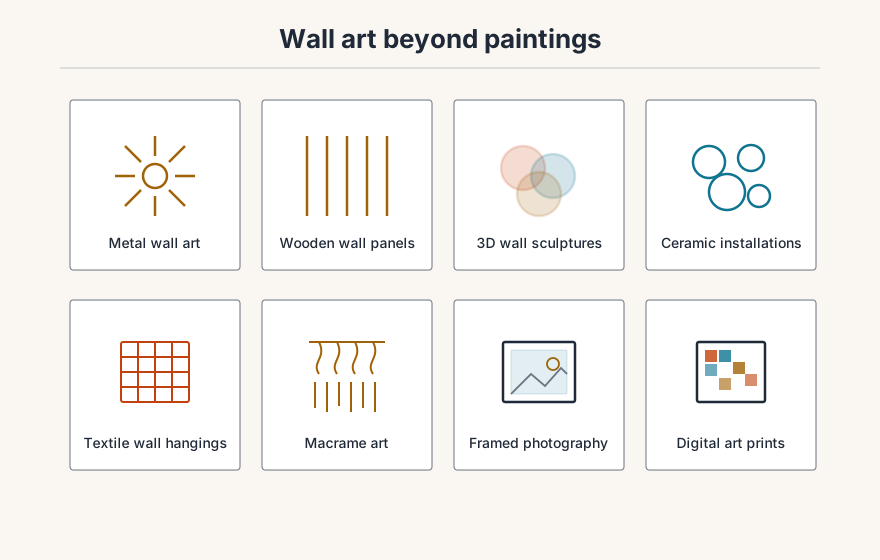
Beyond the frame: eight wall-art forms
Metal wall art
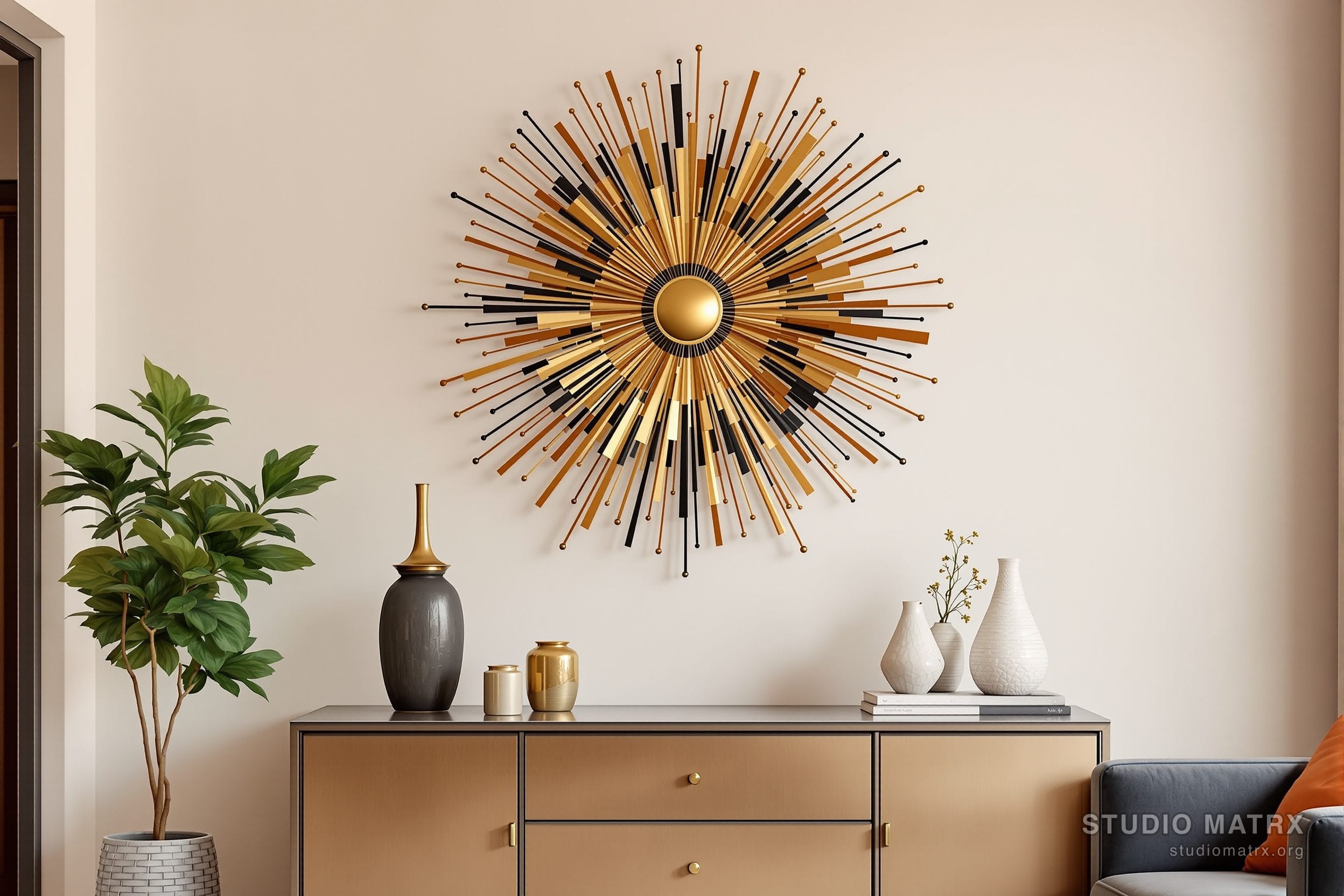
Cut, hammered or laser-etched metal (often iron, brass or aluminium) catches light and adds sculptural shine. It excels on a contemporary feature wall, in a stairwell or above a long sofa where a flat painting would feel ordinary. Moradabad in Uttar Pradesh is India's brass-and-metalcraft hub and a great source. Indoors it needs only dusting; for a balcony or external wall, insist on a powder-coated or rust-treated finish to survive humidity.
Wooden wall panels
Carved or slatted wooden panels add warmth and texture, from traditional Saharanpur and Rajasthan carving to clean modern fluted boards. They work behind a bed as a headboard wall, in a living room, or as an acoustic-softening feature. Choose seasoned or engineered wood and keep panels off damp walls; in coastal or monsoon-heavy regions, treated wood resists warping and borer far better than raw timber.
3D wall sculptures
These are dimensional relief works that cast real shadows, in resin, fibreglass, metal or plaster. A single large piece becomes the focal point of a bare wall without needing a frame, and the depth keeps a minimalist room from feeling flat. They dust easily and last well indoors. Lightweight resin pieces are affordable; bespoke metal sculptures from an artist command more.
Ceramic wall installations
Clusters of glazed ceramic tiles, plates or modular forms bring colour, craft and a tactile, handmade quality. Blue Pottery from Jaipur and terracotta from Bengal or the south make distinctly Indian installations. They suit dining walls, balconies and entryways. Mount each piece on secure plate-hangers or hidden brackets, and remember that ceramic is brittle, so fix into the wall plug rather than plaster alone.
Textile wall hangings
Woven, embroidered or block-printed textiles add softness, pattern and acoustic comfort no hard surface can match. India is the world's textile treasury: kalamkari, ikat, kantha, Pichwai cloth, Banjara embroidery. They warm bedrooms, reading corners and living rooms. Hang on a rod or hidden velcro batten, keep out of direct sun to prevent fading, and air them periodically in the monsoon to discourage mildew.
Macramé art
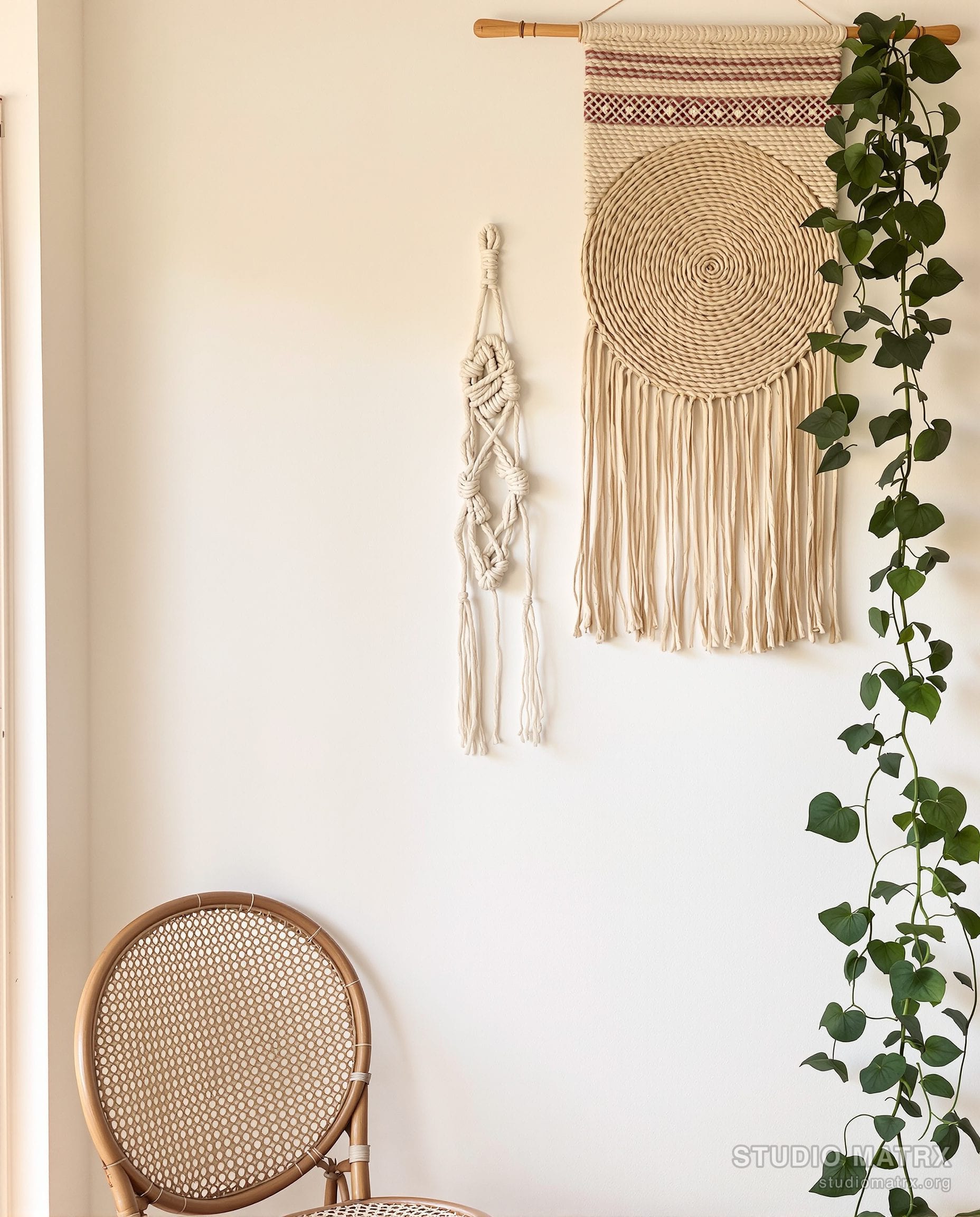
Knotted cotton-cord macramé brings a relaxed, boho, handcrafted feel and a play of light and shadow. It suits balconies, study corners, nurseries and casual living spaces, and pairs naturally with plants and rattan. It is light and easy to hang from a single hook on a dowel. Dust it gently and keep it dry; in humid coastal homes, natural cotton can hold moisture, so choose a ventilated spot.
Framed photography
Photography, whether your own travel and family images or fine-art prints, makes the most personal wall in the house. It suits hallways, staircases and studies, and groups beautifully into a gallery wall. Print on archival paper, frame with an acid-free mount, and for colour longevity ask your lab for pigment (giclée) prints rather than ordinary dye prints, which fade faster in our light.
Digital art prints
Digital and AI-assisted art, printed on paper, canvas or metal, is the budget-friendly, infinitely flexible option, ideal for renters and for refreshing a room seasonally. Quality depends entirely on the print: choose a good lab, high resolution and a proper frame, and a ₹1,500 print can look far richer than its cost. It is also the easiest way to test a colour or scale before investing in an original.
How to choose art (a simple framework)
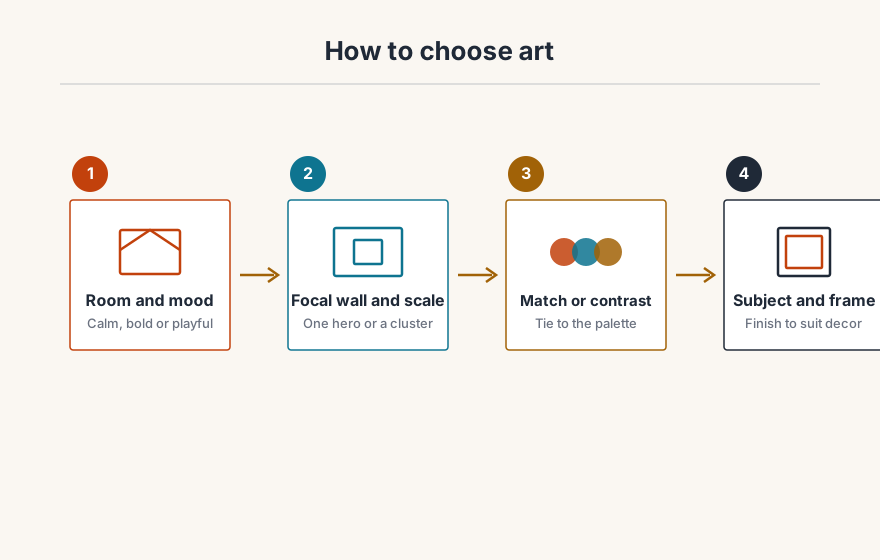
Start from the room, not the art. Ask what the room is for and how you want to feel in it: a bedroom wants calm, a living room can take energy, a study wants focus. Let that mood decide the subject before you fall for any single piece.
Then pick one focal wall per room, usually the first wall you see on entering or the one behind the main furniture. Concentrating your best piece there gives the eye a clear destination instead of scattering attention.
Next, decide whether to match or contrast with your palette. The simplest discipline is the 60-30-10 rule: roughly 60 percent dominant colour, 30 percent secondary, 10 percent accent. Art is a brilliant way to deliver that 10 percent accent: a single canvas can carry the boldest colour in the room. Match the art to your scheme for a calm, cohesive look, or let it contrast to create a deliberate jolt of focus.
Choose the subject by room. Calm landscapes and botanicals soothe bedrooms; bold abstract and contemporary work energises living rooms; devotional Tanjore, miniatures or folk art belong near a pooja space or in a foyer where they greet guests with identity. Where you can, buy original folk and Tanjore work from the artisans rather than mass prints; it costs a little more, supports the craft and ages into an heirloom. Finally, avoid the matchy showroom set of three identical prints sold as a bundle; one strong original almost always beats three forgettable copies.
Sizing, height and placement
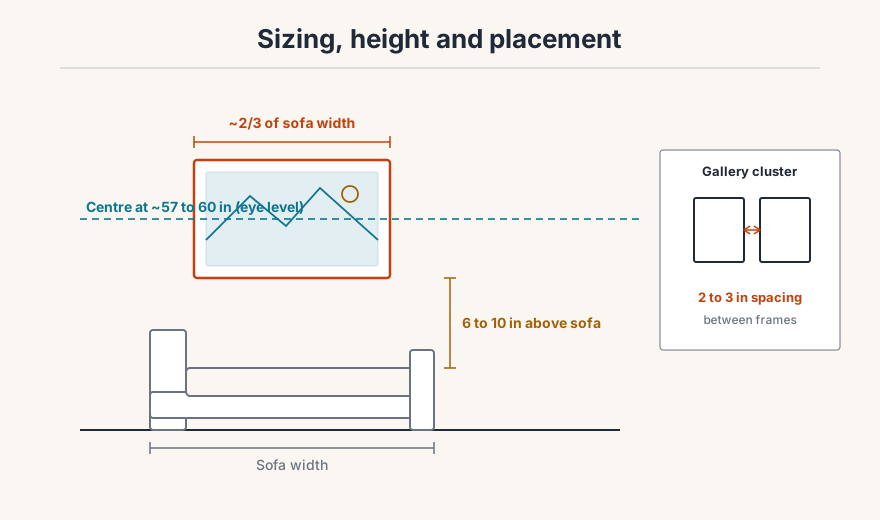
The single most useful rule is the museum standard: hang art so its centre sits at about 57 to 60 inches from the floor, roughly average eye level. Most Indian homes hang art far too high, often anchored to the ceiling rather than the eye. Centre it at eye level and the whole wall settles.
Scale to the furniture. A piece (or arrangement) over a sofa or console should span about two-thirds of the furniture's width, never less than half, or it looks marooned. Leave a comfortable gap of 6 to 10 inches between the bottom of the frame and the top of the furniture so the two read as one group. For a gallery wall, keep a consistent 2 to 3 inch gap between frames so the cluster holds together as a single shape.
Decide between one large statement and a cluster. A big bare wall wants either one generously sized piece or a deliberate grouping; a single small frame stranded on a large wall is the most common mistake of all. For lighting, aim a picture light or an angled track spot at the work and avoid placing valuable art in direct sunlight, which fades pigment and paper over time.
Indian walls and weather demand extra care. Avoid hanging precious art on external or bathroom-adjacent walls that turn damp in the monsoon; trapped moisture foxes paper and lifts paint. Use small spacers or cork pads behind the frame so air moves between the art and the wall, and always frame works on paper with acid-free mounts to prevent yellowing in our heat and humidity.
Combinations that work
| Room | Recommended art types | Palette / mood | Scale tip |
|---|---|---|---|
| Living room | Abstract, contemporary, metal, large oil | Bold accent, energetic | One large statement over the sofa, two-thirds of its width |
| Dining room | Botanicals, ceramic installation, still life | Warm, appetising | A trio or grid centred on the table |
| Bedroom | Landscape, watercolour, soft botanicals | Cool, calm, restful | Wide low piece above the headboard |
| Study | Miniatures, photography, framed prints | Focused, neutral | A tight gallery cluster at eye level |
| Foyer | Tanjore, folk art, portrait | Inviting, characterful | One welcoming focal piece |
| Balcony | Metal, ceramic, weatherproof prints | Relaxed, outdoorsy | Vertical or modular set on a narrow wall |
| Pooja room | Tanjore, devotional miniatures, brass relief | Reverent, golden | Modest and well lit, not oversized |
The richest walls mix media. Try a painting beside a slim metal piece and a soft textile in the same colour family: the contrast of flat, shiny and woven gives a wall real depth. On frames, pick one logic and commit. Consistent frames (all black, all natural wood) read calm and gallery-like; an eclectic mix of frames reads collected and personal, but only if a colour or material thread ties them loosely together.
Budget and where to buy in India
| Art type | Typical price band (₹) | Original vs print | Where to buy |
|---|---|---|---|
| Digital / canvas prints | 1,500 to 8,000 | Online marketplaces, local print-and-frame studios | |
| Watercolours / botanicals | 2,000 to 15,000 | Both | Independent artists, art fairs, online galleries |
| Folk art (Madhubani, Warli, Gond) | 2,000 to 30,000 | Original | Dastkar, Surajkund Mela, craft cooperatives, Kamala (Crafts Council) |
| Miniature paintings | 3,000 to 25,000 | Original | Rajasthan studios (Udaipur, Jaipur, Kishangarh) |
| Tanjore paintings | 6,000 to 1,00,000+ | Original | Established Thanjavur and Chennai studios |
| Oils / contemporary originals | 10,000 to several lakh | Original | Galleries, emerging-artist platforms, art fairs |
| Metal / wood / ceramic wall art | 2,000 to 50,000 | Original / craft | Moradabad (metal), Saharanpur (wood), Jaipur Blue Pottery |
| Photography prints | 3,000 to 20,000 | Fine-art labs, photographer studios, hotel-art suppliers |
A practical tip: separate the cost of the art from the cost of framing. Good museum-grade framing in a metro can add ₹2,000 to ₹8,000 per piece, and it is worth it for anything you intend to keep. Local framers vary widely in quality, so ask specifically for acid-free mounts and UV or anti-glare glass rather than ordinary glass.
Care and framing
Protect works on paper behind UV-filtering glass, which slows fading, and choose anti-glare (non-reflective) glass for pieces opposite a window. Always insist on acid-free, conservation-grade mounts; cheap mount board yellows and can bleed acid into the artwork within a few years in Indian heat. Dust frames and dimensional pieces gently with a soft dry cloth, never a wet one near paper or gilding.
The monsoon is the real enemy. Keep art off damp external walls, run a fan or dehumidifier in closed rooms during the wet months, and air textiles and macramé periodically to deter mildew. Rotate your art seasonally if you can; resting a piece away from light prolongs it and keeps your walls feeling fresh. For genuinely valuable originals, photograph them, keep purchase records, and consider adding them to your home contents insurance, which most Indian insurers will cover with a simple valuation.
Common mistakes
- Hanging art too high, anchored to the ceiling instead of eye level (centre at 57 to 60 inches).
- Choosing a piece too small for the wall or furniture below it.
- Ignoring lighting, so even fine art looks flat and dull.
- Over-matching everything, which drains the room of personality.
- Cheap frames and ordinary glass that visibly cheapen a good artwork.
- One lonely small piece stranded on a large empty wall.
Related reading
- Gallery Wall Ideas: Layouts, Spacing and How to Arrange One
- Sculptures & Art Objects: How to Choose, Place & Style Them
- Decorative Objects: Crystal, Glass, Ceramic & Collectibles
- Architectural Decorative Elements
- The 60-30-10 Rule for Interiors
- 2026 Interior Decor Trends in India
- Living Room Design (India)
- Browse Decor by Room - recolourable styling ideas
- Colour Palette Generator
References
1. Victoria and Albert Museum, London - extensive collections and scholarship on Indian miniature painting and South Asian art (vam.ac.uk).
2. Encyclopaedia Britannica - reference entries on Madhubani (Mithila) painting, Warli art and Tanjore (Thanjavur) painting.
3. National Museum, New Delhi - Indian miniatures, decorative arts and traditional painting collections.
4. The Metropolitan Museum of Art (Heilbrunn Timeline of Art History) - essays on Mughal and Rajput painting traditions.
5. Josef Albers, "Interaction of Color" - the standard text on how colours behave together, useful when matching art to a palette.
6. Crafts Council of India and Dastkar - organisations documenting and supporting India's living craft and folk-art traditions.
7. The American Society of Interior Designers and major museum hanging guidelines - source of the widely used 57 to 60 inch eye-level hanging standard.
8. Indira Gandhi National Centre for the Arts (IGNCA), New Delhi - research and archives on Indian folk and tribal art forms including Warli and Gond.
Export this guide
Related Guides — Deep-dive reading
Carved Door Designs in India (2026): Motifs, Regional Styles, Hand vs CNC & Costs
A design-led guide to ornamental carved wooden doors for Indian homes — regional traditions, motifs, hand-carving vs machine carving, wood choice, where they belong and what they cost.
Home Doors & EntrancesDecorative Mirrors — A 2026 Guide for Indian Homes
Space, light and a focal point in one move · Full-height to Venetian · Where to place them and why
Design Styles2026 Interior Decor Trends in Indian Homes — Ten Ideas Shaping the Year
From large statement artwork and handmade Indian crafts to sculptural lighting, indoor greenery and quiet, sustainable styling — the ten decoration trends defining how Indian homes look and feel in 2026, and how to bring each one home.
Design StylesRelated Tools — Try Free
False Ceiling Cost Estimator
Live ₹/sqft across 8 ceiling types — POP, gypsum, designer, metal, PVC, wooden — with cove and spot lighting for 20 Indian cities.
Cost CalculatorApartment Furniture Size Chart
Standard furniture dimensions for Indian apartments — sofas, beds, tables, dining, storage.
Reference ChartColour Palette Generator
5 harmonious colour palettes with hex codes, Asian Paints and Berger shade names — by room and mood.
Palette