
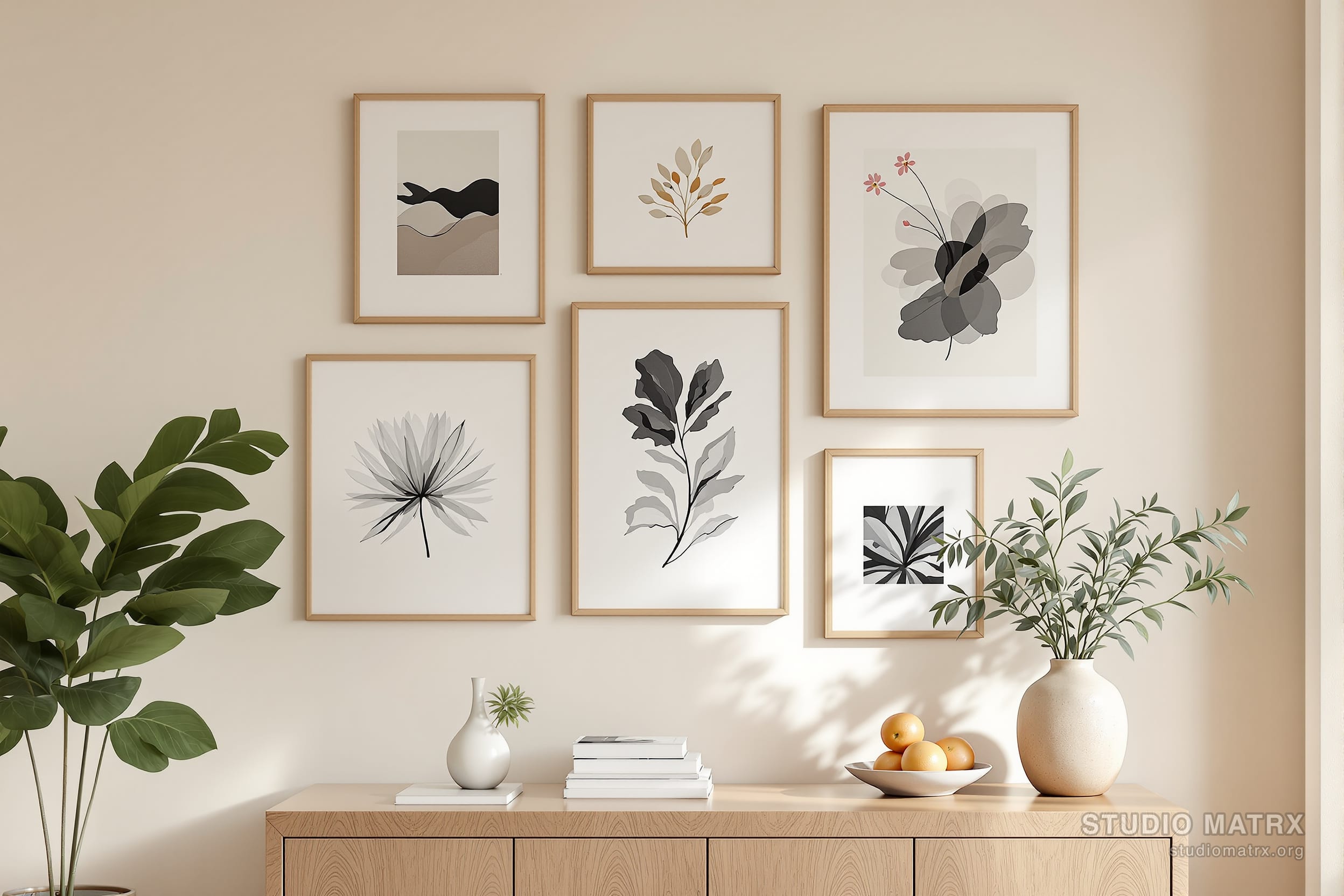
Gallery Wall Ideas: Layouts, Spacing & How to Arrange a Gallery Wall
Six layouts, spacing rules, the floor-plan method, mixing media and room-by-room — for Indian homes
A blank wall is one of the most underused assets in an Indian home. We hang one large frame dead-centre, or we scatter a few photos around a clock, and the wall ends up feeling random rather than considered. A gallery wall fixes that in the most satisfying way: it takes a collection of frames, prints, photographs and small objects and pulls them into a single, intentional composition. Done well, it reads as one piece of art made of many parts.
What makes the idea so appealing is the value. You do not need to repaint, replace furniture or call a contractor. With frames you already own, a few new prints and an afternoon of planning, you can transform the most-seen wall in your living room or stairwell. It is, rupee for rupee, the highest-impact and lowest-cost styling move available to a homeowner.
What makes a gallery wall work
The first mental shift is to stop seeing individual frames and start seeing one shape on the wall. A gallery wall succeeds when the whole arrangement reads as a single composition with a clear outer boundary, not as loose objects floating apart. Your eye should take in the group, then explore the parts.
Every strong gallery wall has a few things in common. There is a visual anchor, usually the largest or boldest piece, that gives the eye a place to land. There is balance, so that visual weight is shared across the centre rather than piling up on one side. There is breathing room, both inside the group as consistent gaps and around the group as clear wall. And there is a unifying thread that ties the pieces together: a repeated frame colour, a shared palette, a single subject, or one consistent style of matting. Get those four right and almost any mix of art will hold together.
It also helps to think about what the wall has to live with. A gallery wall does not exist in isolation; it sits above a sofa, beside a window, across from a curtain, under a particular quality of light. The most pleasing arrangements borrow a cue from their surroundings, a colour from the upholstery, a metal that matches the door handles or the light fittings, a warmth that echoes the wood in the room. When the wall and the room share a few notes, the gallery feels built-in rather than bolted on. This is why two identical sets of frames can look magazine-ready in one home and out of place in another; the difference is whether the composition was tuned to its room.
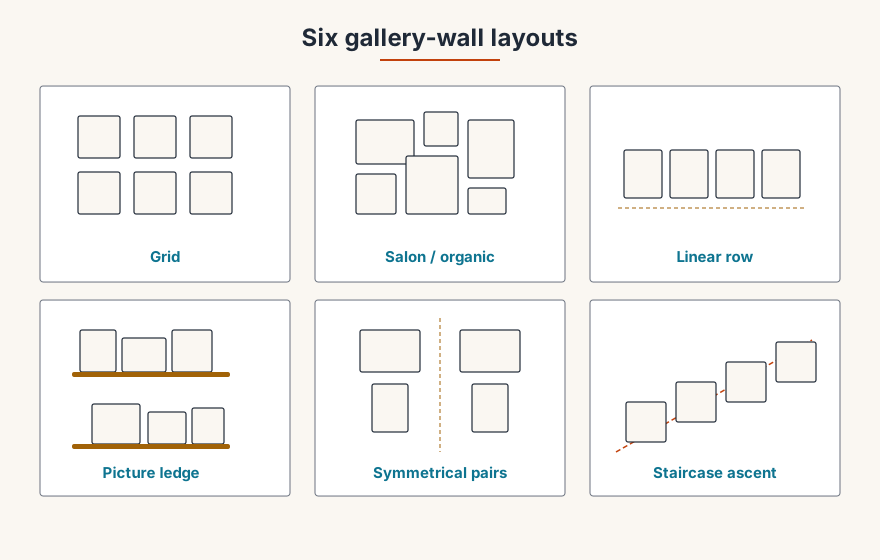
Six gallery-wall layouts
There is no single correct gallery wall. The layout you choose sets the entire mood, from disciplined and architectural to warm and collected-over-years. Here are six reliable formats, and how to pick the one that fits your wall and your home.
The tidy grid
A grid uses identical or near-identical frames arranged in even rows and columns with equal gaps all around. The look is calm, modern and orderly, almost like a contact sheet enlarged on the wall. It suits people who like symmetry and clean lines, and it is forgiving because the discipline does the work. In Indian homes a grid is brilliant for a set of black-and-white family portraits, a series of botanical prints, or a run of framed Madhubani or Pichwai cards. Buy frames in one finish and one size, and let the uniformity carry the wall.
The salon / organic cluster
The salon style is the dense, eclectic cluster you see climbing the walls of old havelis and European drawing rooms. Frames of different sizes, shapes and finishes are packed close, balanced by eye rather than by ruler. It feels collected, personal and rich, and it is the most flexible layout because almost anything can join. It rewards a clear unifying thread, so pick one, perhaps a shared warm palette or a repeated brass frame, to keep the abundance from tipping into clutter.
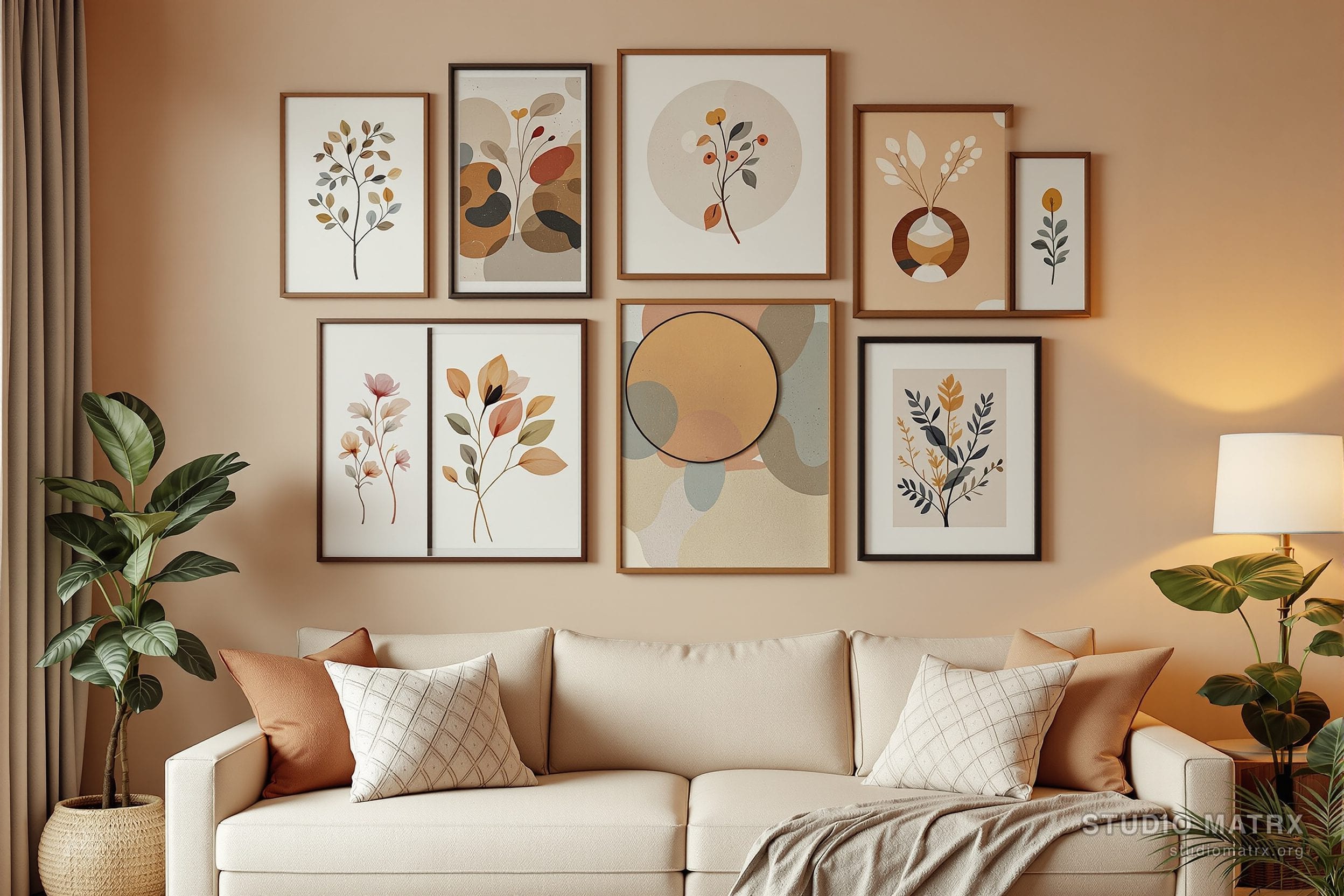
The single linear row
Here frames hang in one straight horizontal line, aligned along a common centre or a common top edge. The effect is quiet, gallery-like and very easy to get right because there is only one rule to follow. It suits narrow walls, long corridors and the space above a console or sideboard. In an Indian flat with a long passage to the bedrooms, a linear row of matched frames turns dead circulation space into a considered moment without crowding the walkway.
The picture ledge
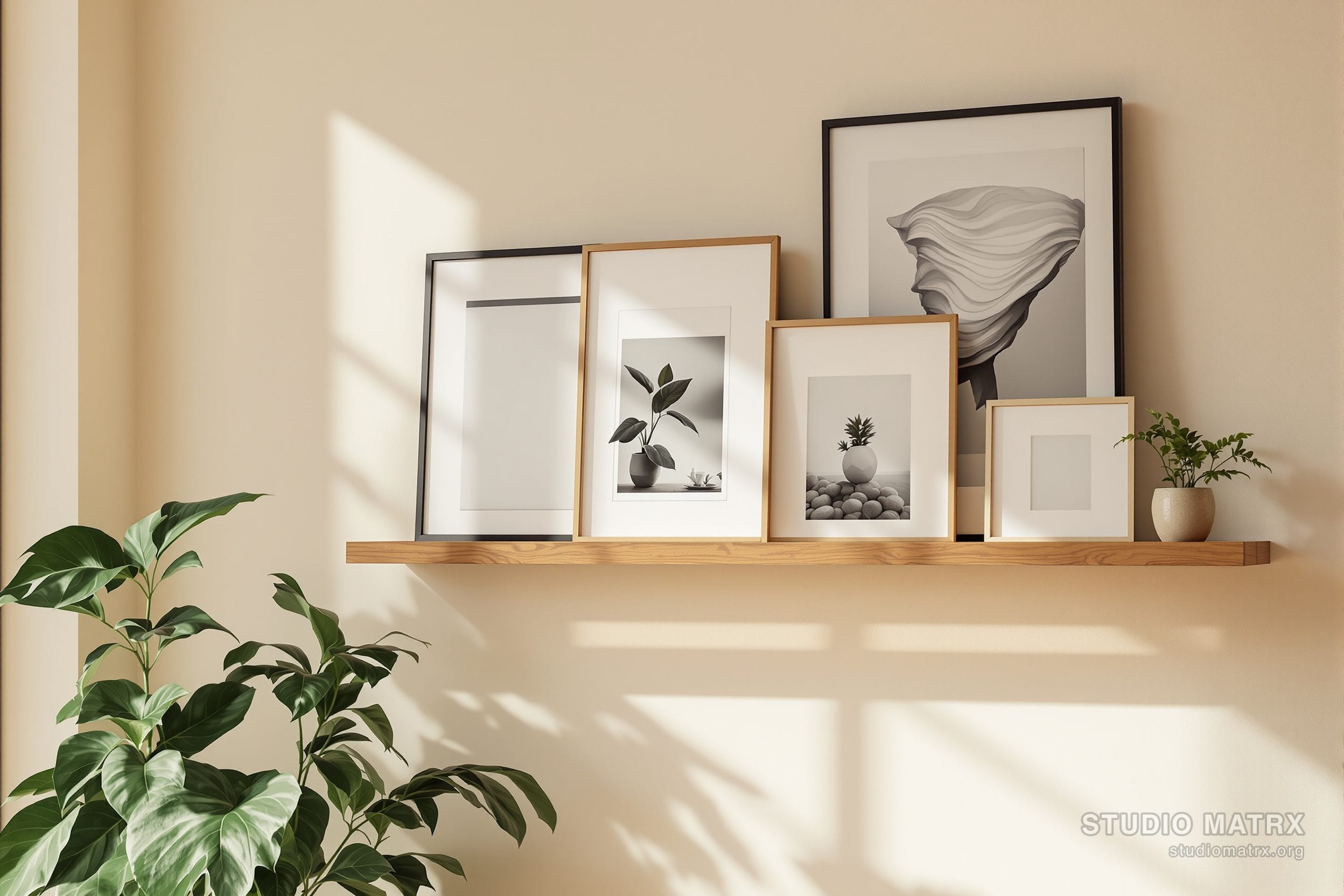
A picture ledge is a slim shelf fixed to the wall on which frames lean rather than hang. The big advantage is flexibility: you can swap, layer and rearrange art in seconds, with no fresh holes each time. It looks relaxed and editorial, and layering a small frame in front of a larger one adds depth. Ledges are ideal for renters and for anyone who likes to refresh their wall seasonally, perhaps rotating festival photographs in for Diwali and out again afterwards.
Symmetrical pairs and columns
This layout mirrors pieces around a central axis: two matched frames either side of a mirror, or vertical columns that balance each other. It reads as formal, restful and architectural, and it pairs beautifully with traditional furniture and panelled walls. It suits the space above a bed, a dining buffet, or a pooja-adjacent wall where you want order and calm. Because the eye expects balance, even modest art looks intentional when arranged in true symmetry.
The staircase ascent
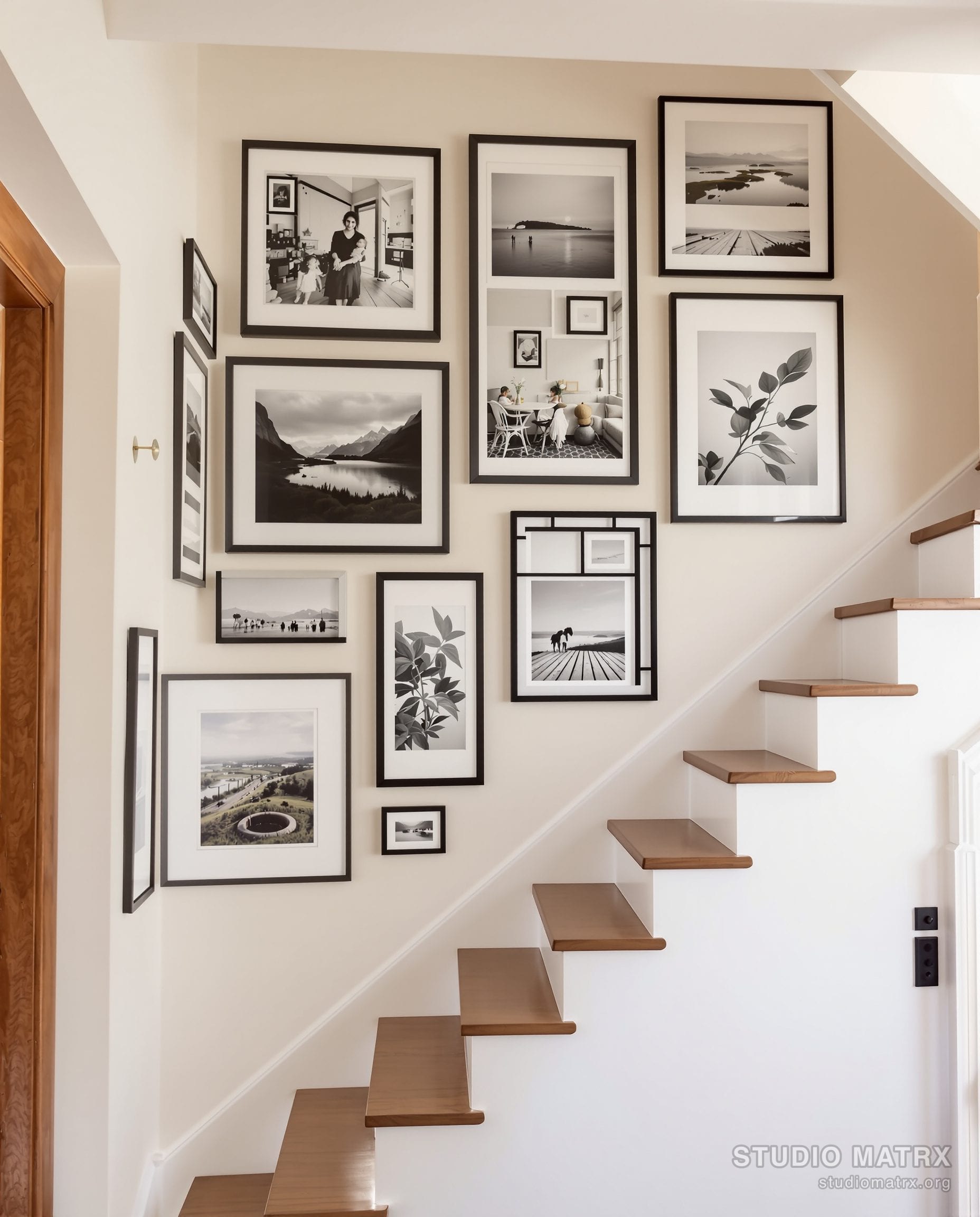
A staircase gallery follows the diagonal of the stairs, with frames stepping up in time with the treads. It turns an awkward, often-ignored stairwell into a feature you enjoy on every trip up and down. The trick is to keep a consistent gap from the stair nosing and let the arrangement climb at the angle of the stair. In Indian duplexes and row houses this is the perfect spot for a chronological family story, photos rising from oldest at the bottom to newest at the top.
Spacing, alignment and the anchor
This is the section that separates a gallery wall that looks designed from one that looks accidental. The rules are simple, but they must be applied consistently.
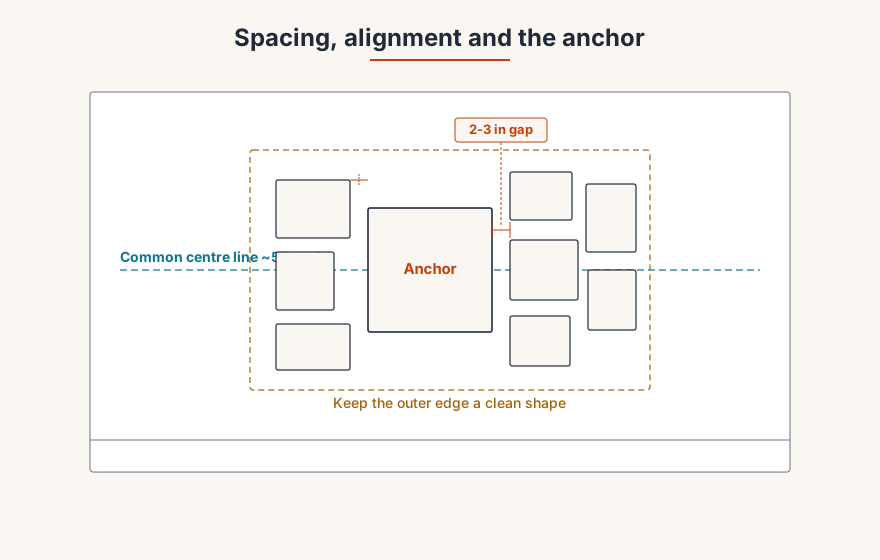
Start with the gaps. Keep a consistent space between every frame, usually 2 to 3 inches. The exact number matters less than the consistency; uneven gaps are the single most common reason a wall looks messy. Tighter gaps read as one tight cluster, wider gaps read as separate pieces, so pick a distance and hold it everywhere.
Next, choose your anchor. Identify the largest or boldest piece and place it first, slightly off the dead centre, then build the rest of the arrangement outward from it. The anchor stops the eye from wandering and gives the whole group gravity. For rows and linear arrangements, run everything along a common horizontal centre line. The museum convention is to centre art at about 57 to 60 inches from the floor, which is roughly average eye level; use the same centre line so the group feels deliberate.
Then think about the overall silhouette. Treat the outer edge of the whole arrangement as a clean shape, most often a rectangle, square or neat oval. Imagine a frame drawn around the entire group; the outer pieces should sit close to those imaginary lines so the boundary stays crisp. Within that boundary, odd numbers of frames tend to look more natural and dynamic than even ones. Finally, balance visual weight across the centre. A heavy dark frame on the left wants something of similar visual heft on the right, even if it is two smaller pieces rather than one large one. You are balancing weight, not matching sizes.
Plan it before you nail
Indian walls are mostly solid masonry, which means every hole is permanent. That alone is reason enough to plan thoroughly before you pick up the drill.
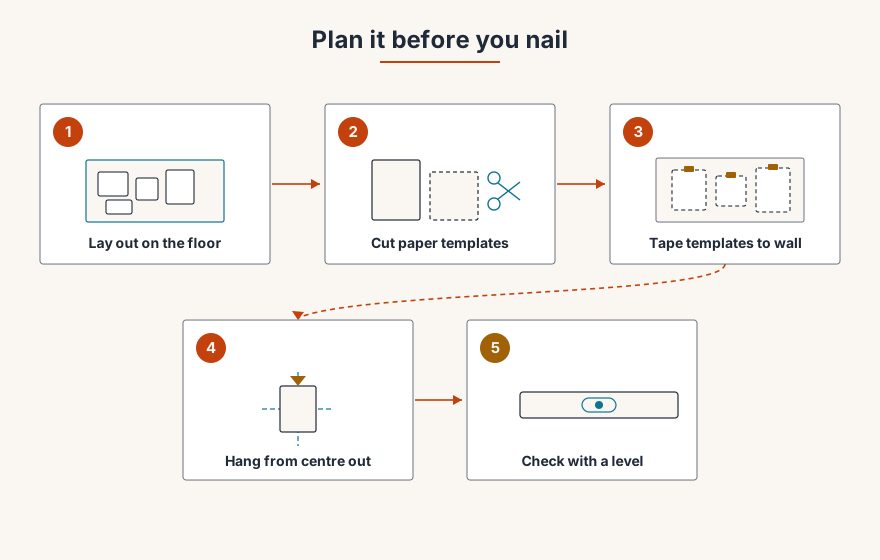
The proven method is to lay it out on the floor first. Clear a floor area the same size as your wall and arrange the frames there, shuffling until the composition, gaps and anchor all feel right. Photograph the final arrangement so you have a reference. Next, cut paper or old newspaper templates to the exact size of each frame, and write on each one where its hook or wire sits. Tape these templates to the wall with low-tack painter's tape, recreating your floor layout. Step back, live with it for a few hours, and adjust freely, since moving paper is free and moving nails is not.
When you are happy, mark the hook points through the paper, then remove the templates. Hang from the centre outward, starting with your anchor, and check each frame with a spirit level or a level app on your phone. For the fixings themselves, match the hardware to your wall. Solid concrete and RCC need a masonry drill bit and proper concrete wall plugs with screws; brick walls take standard nylon wall plugs; hollow drywall or gypsum partitions need toggle or butterfly anchors that grip behind the board, never a plain nail. Light frames on solid plaster can use simple hardwall picture hooks. Renters who cannot drill at all should look at adhesive hanging strips and hooks rated for the frame weight, which hold well on smooth, clean, painted walls and peel off without damage; test one first, because they do not love textured or distempered surfaces.
Mixing media and keeping unity
The most memorable gallery walls are not all framed prints. They mix media, and the mix is what makes them feel like yours. Combine paintings with framed photography, a few good digital prints, a small decorative mirror, a slim 3D or metal piece such as a brass motif or a tiny shelf, and even framed textile, a block-printed swatch or a fragment of an old sari border behind glass. That variety adds texture and depth that flat prints alone cannot.
The risk with mixing is incoherence, so impose a thread. Limit the palette to two or three colours that recur across the pieces. Repeat one frame colour through several frames so the eye reads a family even when the art differs. Keep your gaps consistent so the variety lives in the art, not in the spacing. And vary scale deliberately, mixing a few large pieces with several small ones rather than a jumble of mediums.
Indian homes have a natural advantage here, because our visual heritage is so rich. A single Tanjore painting with its gold leaf can sit happily beside black-and-white wedding photographs and a framed page of old Devanagari script, as long as a warm gold thread runs through the framing. A Warli or Gond print pairs beautifully with botanical line drawings if the palette stays earthy. The mistake is to treat traditional Indian art and modern prints as separate worlds; on a well-threaded wall they speak to each other, and the contrast between an ornate miniature and a clean minimalist photograph is exactly what makes the eye linger. If you want to go deeper on choosing and combining the art itself, read our companion guide on wall art and paintings, which covers picking subjects, sizes and styles that work together.
Gallery walls room by room
Different rooms call for different layouts and different content. Here is a quick map of what tends to work where in an Indian home.
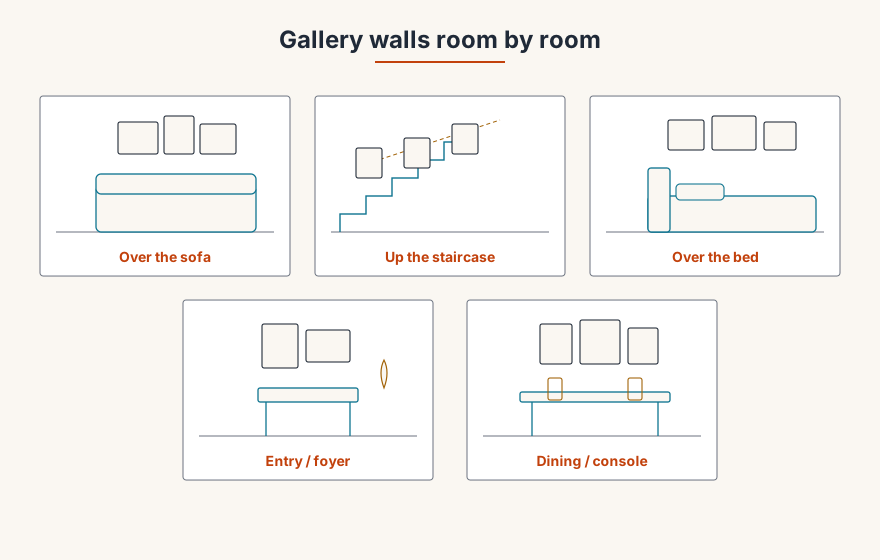
| Room | Best layout | What to hang | Tip |
|---|---|---|---|
| Living room / over sofa | Salon cluster or grid | Mixed art, travel photos, a statement piece | Keep the group within the sofa's width and start 8 to 10 inches above the backrest |
| Staircase | Staircase ascent | Family photos in chronological order | Hold a steady gap from the stair nosing and climb at the stair angle |
| Bedroom / over bed | Symmetrical pairs | Calm, soft-toned prints and personal photos | Centre the group on the bed and keep the lowest frame clear of headboard knocks |
| Foyer / entry | Single linear row | A welcoming mix, a mirror, house art | A horizontal mirror in the row brightens a dark entrance and adds depth |
| Dining / console | Grid or row | Botanical, food or regional art | Align the group to the console width, not the whole wall |
| Home office / study | Tidy grid | Framed certificates, maps, motivational prints | A disciplined grid reads as focused and professional on video calls |
Frames, mounts and printing in India
Frames carry the whole look, so decide your framing strategy early. The popular gallery finishes are slim black, clean white, natural wood, and warm brass or gold, each setting a different tone: black is graphic and modern, white is airy, natural wood is relaxed, brass is rich and traditional. You then choose between consistent framing, where every frame matches for a calm uniform wall, and eclectic framing, where frames vary for a collected salon feel. A reliable middle path is to vary the frames but repeat one finish across several pieces so there is still a thread.
Do not skip the mount, or matting, the border of card between the art and the frame. A generous mount makes even an inexpensive print look gallery-grade and gives small art presence on a big wall. White or off-white mounts are safest. For printing and framing, local options range from neighbourhood framers and photo studios to online services like printing portals and custom-frame websites that deliver ready-to-hang pieces. Get prints done on good matte or fine-art paper rather than glossy photo paper for a more artful finish.
| Item | Typical ₹ band | Note |
|---|---|---|
| A4 / A3 art print (matte) | ₹150 to ₹600 each | Online print services; fine-art paper costs more |
| Standard ready-made frame (A4 to A3) | ₹300 to ₹1,200 | Big-box and online; bulk sets are cheaper per frame |
| Custom frame with mount (local framer) | ₹800 to ₹3,000+ | Varies by size, moulding and glass; museum glass costs more |
| Picture ledge / wall shelf | ₹600 to ₹2,500 | Per shelf; solid wood and longer spans cost more |
| Adhesive hanging strips (renter-friendly) | ₹250 to ₹700 per pack | Match the weight rating to your frame |
A full eight-to-twelve-piece gallery wall built from a mix of owned frames, a few new ready-made frames and online prints can be done well for roughly ₹4,000 to ₹12,000, with custom framing pushing it higher.
Common mistakes
Most gallery-wall regrets come from a handful of avoidable errors.
- Spacing frames too far apart, so the group reads as scattered objects instead of one composition.
- Having no anchor, which leaves the eye with nowhere to settle and the wall feeling weightless.
- Hanging the whole arrangement too high; centre it around eye level, not up near the ceiling.
- Mixing wildly with no unifying thread, so variety tips into visual chaos.
- Ignoring the furniture below; a gallery should relate to the width of the sofa or console, not float free of it.
- Leaving one awkward large gap that breaks the silhouette; keep the outer edge of the group clean and the internal gaps even.
Related reading
- Wall Art & Paintings: How to Choose, Place and Combine Art
- Architectural Decorative Elements
- The 60-30-10 Rule for Interiors
- 2026 Interior Decor Trends in India
- Living Room Design (India)
- Browse Decor by Room - recolourable styling ideas
- Colour Palette Generator
References
- Smithsonian and major museum hanging standards, on the convention of centring artwork at about 57 to 60 inches from the floor to average eye level.
- The American Alliance of Museums, on installation and sightline conventions for hanging works in public galleries.
- Architectural Digest, design features on composing and balancing gallery walls and salon-style arrangements.
- Apartment Therapy, practical tutorials on the paper-template method and floor-layout planning for gallery walls.
- House Beautiful and Elle Decor, editorial guidance on frame mixing, matting and unifying threads for cohesive walls.
- Interaction Design and colour theory references on visual weight, balance and grouping (Gestalt principles of proximity and similarity) as they apply to arranging objects as a single composition.
- Manufacturer guidance from adhesive-hook makers on weight ratings and suitable surfaces for damage-free renter hanging.
- Indian custom-framing and art-print services, on paper choices, mount sizing and realistic price bands for prints and framing.
Export this guide
Related Guides — Deep-dive reading
Space Planning Mistakes That Make Homes Feel Smaller
The layout and planning errors that shrink your home — and the fixes that win back square feet
Home PlanningSymmetry vs. Asymmetry: Composing a Balanced Interior
Balance is the goal, and symmetry, asymmetry and radial arrangement are three routes to it — here is how to read visual weight and choose the right one for every room in an Indian home.
Design PrinciplesDecorative Mirrors — A 2026 Guide for Indian Homes
Space, light and a focal point in one move · Full-height to Venetian · Where to place them and why
Design StylesRelated Tools — Try Free
Interior Layout Planner — Printable Graph Grid
Printable graph grid to sketch room layouts to scale before committing to furniture placement.
Layout ToolApartment Furniture Size Chart
Standard furniture dimensions for Indian apartments — sofas, beds, tables, dining, storage.
Reference ChartApartment Interior Planning Checklist
51-item checklist across structural, ceiling, lighting, furniture, storage, electrical, kitchen, bathroom.
Checklist