
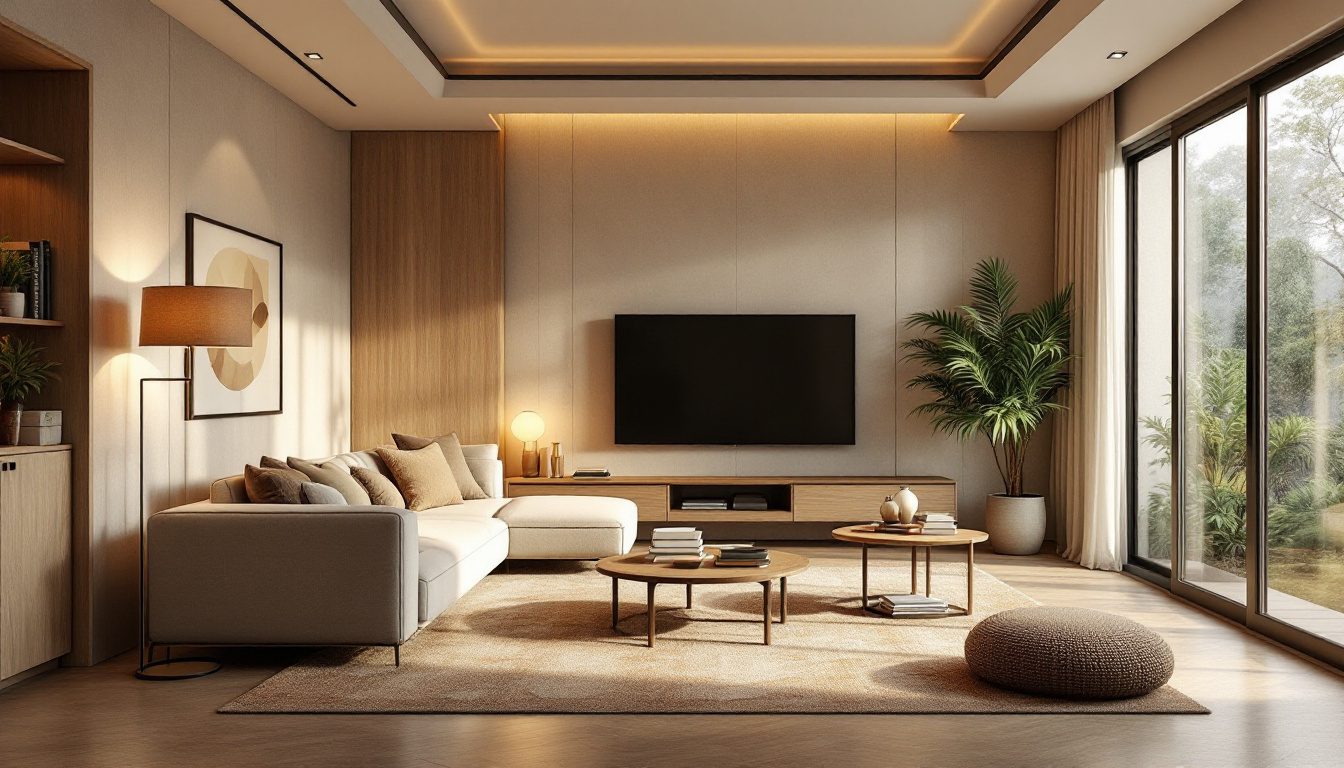
Living Room Design in India: Built Around How You Actually Live
Resolving the three competing focal points, sizing to people not floor area, the double-height trap, and the formal-vs-family living room question
The living room goes by many names in an Indian home — hall, drawing room, baithak, family room, the place where the TV lives. But its job never really changes. It is the room of the in-between: what we do after work and before sleep. Talking over chai, sprawling on the sofa during a Sunday-afternoon match, receiving a colleague who has come to drop off papers, hosting twenty relatives at Diwali, letting a child do homework on the floor while a serial plays in the background. No room in the house is asked to do more, and almost none is designed with less honesty about how it will really be used.
Most living rooms are designed for a photograph. The sofa is positioned for the camera, the TV is hidden so the wall looks like a magazine spread, and the proportions are stretched as large as the floor plate will allow because a big living room reads as a successful one. Then the family moves in and discovers that the showpiece is uncomfortable to actually watch a film in, the seating is too far apart for a conversation, and the formal drawing room near the door has quietly become a museum that nobody enters. This guide is about avoiding all of that. It is about designing the room around how you live, in real dimensions and real rupees.
The best living rooms are not the most photographed ones. They are the ones arranged around an honest answer to a single question: what do you actually do in here, between work and sleep?
The three competing focal points
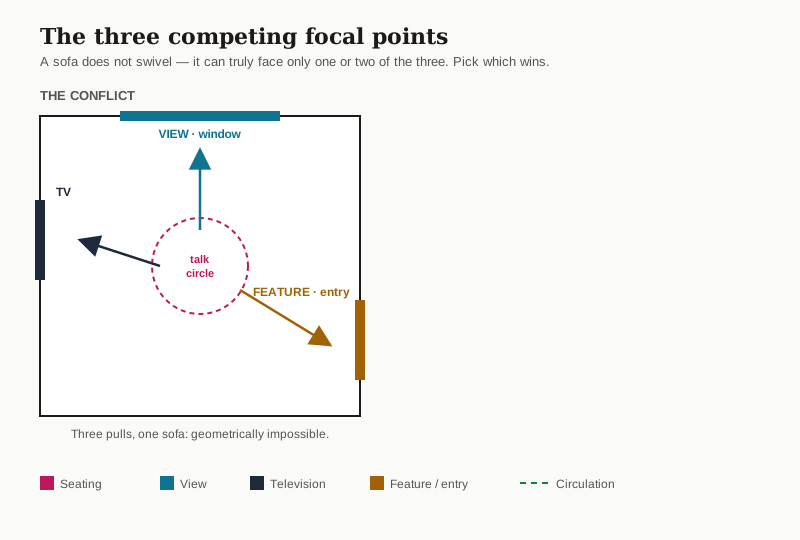
Here is the tension at the heart of every living room, and almost nobody names it out loud. The room usually has three different things fighting to be the centre of attention, and the seating can only ever truly face one or two of them.
The first is the view — the best window, the balcony that opens to a garden or a skyline, the morning light. The second is the television, which in most Indian homes is the single most-used object in the room whether we admit it or not. The third is a feature: in Western design this is classically the fireplace, but in our homes it is a statement TV-wall with stone cladding, a piece of art, a swing (the jhula), or the line of sight toward the pooja niche or the entry.
A sofa does not swivel. You arrange it once, and it faces what it faces for the next ten years. So the real design decision is not how to please all three focal points — that is geometrically impossible in most rooms — but which one wins, and how the seating can gracefully serve a second without fighting it.
Be honest about the television
The most useful sentence in living-room design is also the least flattering one: do not pretend you do not watch television when you know you do. A great many Indian living rooms are arranged as though the family spends its evenings in quiet conversation facing a tasteful artwork, when in fact everyone watches three hours of cricket, news and serials a night. The result is a primary sofa angled at the art, and a sad cluster of plastic chairs dragged in front of the screen every evening.
If the TV is the honest centre of your evenings, make it the focal point and design the room around comfortable viewing. There is no shame in it. A room that admits what it is used for is a room that works.
The TV-over-the-feature-wall trap
A popular and seductive move is mounting the television high up on a tall feature wall — above a stone-clad console, above a faux-fireplace, above a run of fluted panelling — so that when the screen is off the wall photographs beautifully. It does look lovely switched off. The problem appears the moment you switch it on.
For comfortable viewing, the centre of the screen should sit roughly at eye level when you are seated — about 1,000 to 1,100 mm above the floor. Mount the TV so its centre lands at 1,500 mm or higher (which is what happens when it floats above a tall unit) and you spend every evening craning your neck upward, tilting your head back for two hours at a stretch. It is the living-room equivalent of sitting in the front row of a cinema. Design for the watching, not the photograph.
The honest layout puts a low media unit beneath the screen — 450 to 550 mm tall — so the TV sits naturally at seated eye level. If you want the drama of a tall feature wall, build it around the TV, not above it.
| Focal-point situation | What usually wins | Resolution that actually works |
|---|---|---|
| Great view and you genuinely watch a lot of TV | Be honest — TV | Put the TV on the wall adjacent to the view, seating in an L so one run faces the screen and the other looks out |
| Strong view, light TV use | The view | Float seating toward the window; a slim, movable TV on a swivel or trolley for the rare match |
| TV-wall is the design feature | TV and feature combined | Make the TV part of the feature wall at correct height, not perched above it |
| Pooja or entry sightline matters (Vastu) | Cultural priority | Keep the seating from turning its back on the entry or pooja; orient the conversation circle, not the TV, to respect it |
| No real view, no strong feature | TV by default | Build the whole room as a comfortable, honest media-and-conversation space |
A quick way to find your own honest answer before you commit to furniture is to walk through how a typical evening and a typical hosting day actually unfold — our home lifestyle quiz is built around exactly those questions, and the design trade-off helper is useful when two focal points genuinely tie.
Size the room to the people, not the floor area
This is the single most expensive mistake in Indian living-room design, and it is invisible on a floor plan. We size living rooms by square feet — bigger is better, a 16 by 20 hall sounds more impressive than a 13 by 16 one — when we should be sizing them by how many people are usually in them and how those people need to sit to talk.
A living room is, at its core, a machine for conversation. People can only talk comfortably across a certain distance. Sit too close and it feels cramped and over-intimate; sit too far and you raise your voice, lose facial expression, and the group fractures into smaller huddles. The comfortable conversation distance — the gap between the faces of two seated people — is roughly 2.4 to 3 metres. That single number should drive the size of your seating zone more than the dimensions of the room.
Conversation distances and clearances
If the gap between facing sofas creeps beyond about 3 metres, the room stops feeling like a place to talk and starts feeling like a lobby. This is why an enormous living room used by three people every evening feels cold and cavernous rather than luxurious — the bodies are simply too far apart. The luxury is not the floor area; it is the comfort of the gathering.
Here are the working dimensions every living room layout should respect.
| Dimension | Comfortable range | Notes for Indian rooms |
|---|---|---|
| Face-to-face conversation gap | 2.4 to 3.0 m | Beyond 3 m the group fragments; below 2.1 m it feels crowded |
| Sofa front to coffee-table edge | 400 to 450 mm | Close enough to set down a cup without leaning; far enough to stretch legs |
| Coffee table to the next seat | 400 to 450 mm | Same logic on the far side |
| TV screen to primary seating | 2.0 to 3.0 m | Roughly 1.5 to 2.5 times the screen diagonal for a 55-inch panel |
| Main walkway (circulation) | 900 mm minimum | 750 mm is the absolute squeeze; 1,000 mm feels generous |
| Walkway behind a sofa | 600 to 750 mm | Enough to pass without turning sideways |
| Seat height of sofa | 400 to 430 mm | Lower lounge sofas suit longer evenings; firmer, higher seats suit older relatives |
Sizing the sofa to the number of people
The sofa is not a single product — it is a length per person. Reckon roughly 600 to 650 mm of seat width per adult, plus the arms. This is how you translate "we are usually six in the evening, ten when my parents visit, twenty at Diwali" into actual furniture.
| Who uses the room | Everyday seats needed | Sensible sofa configuration | Approximate seating-zone footprint |
|---|---|---|---|
| Couple, occasional guests | 3 to 4 | One 3-seater plus an accent chair | 3.0 m by 2.4 m |
| Small family of four | 4 to 5 | 3-seater plus 2-seater in an L | 3.6 m by 3.0 m |
| Family plus regular visitors | 6 to 7 | L-shaped sectional plus two chairs | 4.2 m by 3.6 m |
| Joint family, frequent hosting | 8 to 10 daily | U-shape: 3-seater plus two 2-seaters | 4.8 m by 4.2 m |
| Festival and function crowds | 15 to 25 | Core seating plus movable poufs, diwan, floor cushions | Plan clear floor to add seating |
That last row is the genuinely Indian one. Your living room will, several times a year, hold three times its everyday crowd. The answer is not to buy a sofa for twenty people who visit four times a year — it is to keep the everyday seating right-sized and keep flexible, movable seating (poufs, ottomans, a diwan, stackable stools, floor cushions on a good rug) that earns its keep when the relatives arrive. To pressure-test your sofa plan against your actual room dimensions, the scale and proportion calculator lets you check clearances before anything is ordered, and the room programming worksheet helps you list every activity the room must hold before you fix the furniture.
Seating layouts: L, U and parallel
There are three honest seating arrangements, and the right one follows from your focal-point decision and your crowd size.
The L-shape
An L-shaped layout — a longer run meeting a shorter one at a right angle — is the workhorse of the Indian apartment living room. It tucks neatly against two walls, leaves the room open, and crucially lets the seating serve two focal points at once: one arm can face the TV while the other looks toward the window or the entry. An L-shaped sectional is the single most flexible move for a 3.6 by 4.2 metre hall.
The U-shape
A U-shape — three runs of seating around an open fourth side — is the most sociable layout and the best for conversation, because everyone is angled inward toward a common centre. It needs more floor: budget at least 4.5 metres in the dimension across the open mouth of the U so the facing seats land in that 2.4 to 3 metre sweet spot. The open side typically faces the TV or the view. This is the layout for the joint family that genuinely gathers.
Parallel seating
Two sofas facing each other across a coffee table is the most formal arrangement, and the most conversational of all for a small group, because everyone faces everyone. It is the classic drawing-room layout. The risk is that the gap grows too wide in a big room — keep the facing sofas within 3 metres or the formality tips into coldness. Parallel seating with the TV on the short perpendicular wall is a clean, honest solution for a rectangular hall.
A sofa does not swivel. You arrange it once and live with it for ten years, so the decision deserves more than an afternoon and a showroom.
Circulation: through or around
How people walk through the room matters as much as how they sit in it. The cardinal rule is simple — circulation should pass around the seating, not through the conversation circle. If the path from the front door to the kitchen or the bedrooms cuts straight between the facing sofas, every person crossing the room interrupts the gathering and nobody can leave a coffee cup on the table in peace.
Plan a clear 900 mm route along the edge of the seating zone, against a wall or behind a sofa, so people can pass without walking through the middle. In open-plan flats where the living room is also the corridor to everything else, pulling the seating slightly away from the walls and letting circulation run behind it is what separates a calm room from a thoroughfare.
The double-height trap
A soaring double-height living room with a first-floor gallery looking down into it is the most requested render in Indian villa design. The volume is genuinely dramatic, and for a large room that gathers a real crowd, a tall ceiling is a true asset. But the drama comes with a tax that is paid everywhere in the house, every day, and it is worth knowing before you commit.

The first tax is sound. Noise from the living room reflects off the tall, hard walls and travels straight up into the gallery and the bedrooms that open off it. The TV at full volume during a night match, the doorbell, the conversation of late guests — all of it rises. If you build double-height, keep the bedroom doors well away from the gallery edge and treat the volume acoustically, or someone is lying awake every evening.
The second tax is thermal, and in Indian summers it is the one that bites the wallet. Warm air rises and pools in the upper volume, so the conditioned air you pay to cool drifts up and away from the people sitting below. A double-height living room is markedly harder and costlier to cool than a flat-ceilinged one of the same floor area; the air-conditioning runs longer and the tonnage required is higher. The Energy Conservation Building Code logic is unforgiving here — you are cooling cubic metres, not square metres, and a double-height room has far more of them.
| Double-height living room | The upside | The everyday tax |
|---|---|---|
| Drama and volume | Genuinely impressive; a real "wow" on entry | Only pays off if the room is large and well-used |
| Daylight | Tall windows flood the space with light | Same tall glass adds solar heat gain |
| Acoustics | — | Echo and reverberation; sound rises to bedrooms |
| Cooling | — | Higher AC tonnage and longer run-times; cooled air escapes upward |
| Cooking smells (open plan) | — | Kitchen odours rise and linger in the gallery |
| Cost | — | More wall finish, taller scaffolding, costlier maintenance and cleaning |
None of this means never build double-height. It means build it with eyes open: reserve it for a genuinely large, genuinely used great room, keep bedrooms acoustically buffered from the gallery, plan for the cooling load honestly, and do not buy the drama on credit you will repay every summer.
The two living rooms: formal drawing room versus family room
Here is a question that quietly defines the floor plan of a great many Indian homes: do you build one living room, or two? The dual-living-room culture runs deep here. The formal drawing room sits near the entrance, kept immaculate for guests — the good sofa, the showpiece cabinet, the framed photographs. The family living room sits deeper in the home, near the kitchen and the bedrooms, and it is where the family actually lives — feet up, TV on, children on the floor.
Will you actually use both?
The romance of two living rooms is real, but so is the trap. In a great many homes the formal drawing room becomes a museum — dusted weekly, sat in twice a year, lights off the rest of the time. It is floor area you paid for, furniture you bought, and a room you do not live in. At construction-and-finishing rates in metro India, a typical formal drawing room of around 14 square metres represents somewhere between several lakh rupees of built space plus its furniture — a serious sum to set aside for a room that hosts a few guests a year.
The honest test is your own front door. If guests genuinely arrive often, if you receive clients or community visitors and need to keep that separate from family chaos, two rooms make sense. If your visitors are mostly close family and friends who would rather sit where the life of the house is, one well-designed living room that does both jobs almost always beats two half-used ones — and frees that lakh of floor area for something you will use daily.
| Formal drawing room | Family living room | |
|---|---|---|
| Position | Near the entry, before the private zones | Deeper inside, near kitchen and bedrooms |
| Primary use | Receiving guests, formality, separation | Daily life, TV, lounging, children |
| Typical size | 12 to 16 sq m | 16 to 24 sq m |
| Seating mood | Parallel, formal, upright | L or U, soft, sink-in |
| Focal point | Feature wall, art, the entry | The television, honestly |
| Risk | Becomes an unused museum | Can feel cramped if it absorbs all hosting too |
| Build it if | Guests genuinely arrive often | Always — this is the non-negotiable one |
The second quiet room that changes everything
If you do have the space for a second living zone, consider making it not a formal drawing room but a quiet snug — a small study, library or reading room for the family member who wants away from the television. These rooms work best small, sized for just two to four people, with a normal 9 or 10-foot ceiling rather than a soaring one — coziness is the point. A wall of bookshelves, soft lighting, perhaps panelling (which is expensive, another reason to keep the room small).
Crucially, this room wants a door, because its whole reason to exist is quiet, and because it doubles beautifully as a home office. Pocket doors or French doors suit it — closed only occasionally, for a video call or an hour of reading in peace. Tuck it away from the main flow of the house so the noise of the living room never reaches it. A snug like this is consistently one of the most loved and least regretted rooms in any home that has one.
Rugs, lighting and acoustics: the three quiet layers
Once the seating is sized and placed, three layers turn a correct room into a comfortable one.
Anchor the seating with a rug
A rug is the single cheapest move that makes a living room feel composed. It draws a visual boundary around the seating zone, anchors the furniture into a deliberate group rather than pieces scattered against the walls, and warms the hard tile or stone floors common in Indian homes. The rule of thumb: the rug should be large enough that at least the front legs of every sofa and chair sit on it — ideally all legs. A rug that floats too small in the centre, with all the furniture marooned off it, does the opposite of anchoring; it makes the room look unfinished. For a typical L-shaped layout, a 6 by 8 foot or 8 by 10 foot rug is the working size; for a generous U-shape, go to 9 by 12.
Light in layers, never one tube
The most common lighting mistake is a single bright ceiling fixture — one tubelight or one flush panel — that flattens the entire room into an office-bright glare. A living room needs three layers: ambient (general fill, ideally indirect or cove light so it does not glare), task (a reading lamp beside the favourite chair, focused light over a games or work corner), and accent (a wash on the feature wall, an uplight behind a plant, picture lights on art). Put the layers on separate switches and dimmers so the room can be bright for cleaning and hosting, and soft and warm for an evening film. Warm-white (around 2,700 to 3,000 K) is right for the relaxing layers; reserve cooler light for task zones only.
Tame the echo
Hard Indian interiors — vitrified tile floors, plaster walls, large glass — bounce sound and make a room feel harsh and tiring, and the problem multiplies in double-height volumes. You do not need acoustic engineering; you need soft surfaces. The rug, full curtains rather than blinds, upholstered seating, a few cushions, books on open shelves, even plants all absorb sound and soften the room acoustically. A living room that sounds calm feels calm, and most people never realise the difference was the curtains and the rug doing quiet acoustic work.
Bring it to life with Studio Matrx
You now have the honest framework: pick your one true focal point and stop pretending you do not watch TV, size the seating to the people and the conversation distances rather than the square footage, choose the L, U or parallel layout that fits, route circulation around the gathering, weigh the double-height drama against its real cooling and acoustic tax, decide truthfully whether you will use one living room or two, and finish with a rug, layered light and soft surfaces.
Tell Studio Matrx how your family actually unwinds and how it hosts — the everyday crowd and the festival crowd, the view you have, the TV you really watch — and get living-room layouts arranged around your honest focal point, sized to your space and your gatherings, in real dimensions you can build. Design the room for how you live, and it will feel right every single evening, between work and sleep.
References
- Bureau of Indian Standards. National Building Code of India (NBC) 2016, Part 4 (Fire and Life Safety) and Part 8 (Building Services) — for circulation widths, room heights and habitable-space guidance.
- Panero, Julius, and Martin Zelnik. Human Dimension and Interior Space: A Source Book of Design Reference Standards. Whitney Library of Design — for conversation distances, seating clearances and anthropometric ranges.
- Bureau of Energy Efficiency, Government of India. Energy Conservation Building Code (ECBC) — for cooling-load and thermal-comfort implications of volume and glazing.
- Bureau of Indian Standards. IS 3646: Code of Practice for Interior Illumination — for layered lighting levels and recommended illuminance in living spaces.
- Indian Society of Heating, Refrigerating and Air Conditioning Engineers (ISHRAE). Thermal Comfort and HVAC design guidance for Indian conditions — for air-conditioning tonnage and double-height cooling behaviour.
- Ching, Francis D. K. Architecture: Form, Space, and Order. John Wiley and Sons — for principles of focal points, spatial proportion and circulation.
- De Chiara, Joseph, and Julius Panero. Time-Saver Standards for Interior Design and Space Planning. McGraw-Hill — for furniture layout dimensions and seating-group planning.
- Hirsch, William J. Jr. Designing Your Perfect House: Lessons from an Architect. Dalsimer Press. (A general inspiration for this series' approach to designing a living room around how you really live.)
Export this guide
Related Guides — Deep-dive reading
Why Scale Matters: Keeping Rooms Comfortable for Humans
How sizing furniture, art and lighting to the human body — not the showroom — keeps small Indian flats from feeling crushed and large halls from feeling empty.
Design PrinciplesHow You Really Live: The Questions to Ask Before Designing
The honest questions about your actual daily life to answer before any design decision, so your Indian home fits how you truly live, not a magazine image
Planning Your ProjectAngles, Curves and Breaking the Pattern Intentionally
Why an Indian home should mostly stay a grid of right angles — and how a single deliberate curve, angle or arch, placed where it eases circulation, resolves an awkward plot or breaks a rhythm, becomes the most powerful move in the room.
Design PrinciplesRelated Tools — Try Free
Cross-Ventilation Analyzer
Estimate airflow and air changes per hour (ACH) from room size, window areas, layout, and local wind — with NBC 2016 Part 8 compliance check.
Ventilation CalculatorCircadian Light Meter
Patient-centric circadian lighting visualizer for Indian healthcare design — time-of-day × intensity → CCT, melanopic lux (EML / mEDI), melatonin suppression, and an alertness curve. Calibrated against WELL v2 L03 Circadian Lighting Design, CIE S 026:2018, Brainard 2001, and Lucas et al. 2014.
Circadian ToolAcoustic Privacy (STC) Visualizer
Indian healthcare acoustic visualizer — compare wall assemblies and noise sources, see received SPL after STC attenuation, and check FGI 2018 / IS 1950 / NABH speech-privacy compliance with live dual-canvas waveform.
Acoustic Tool