
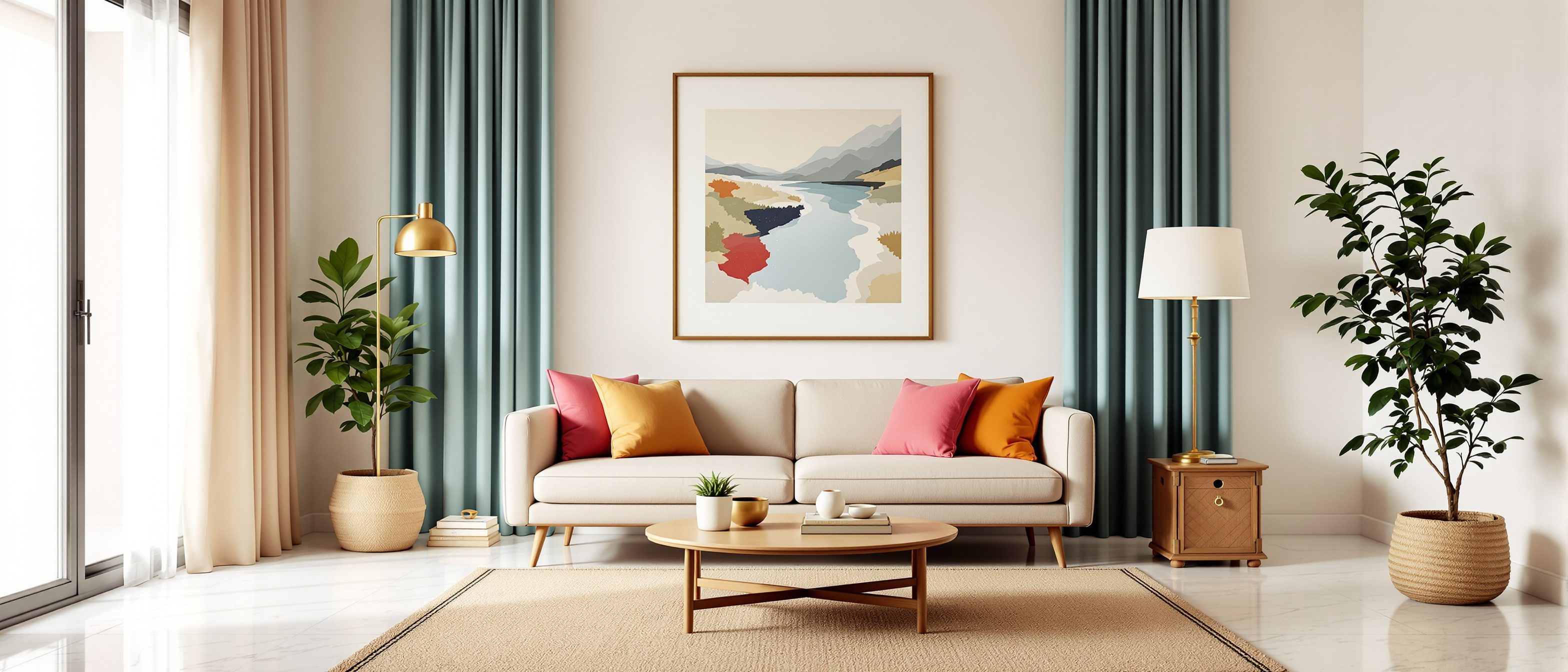
The 60-30-10 Rule: How to Balance Colour and Decor in Any Room
The single most useful decorating principle — 60% architecture and furniture, 30% textiles and finishes, 10% accent accessories. Why it works, how to apply it to an Indian living room, and when to break it.
You have done everything right. The sofa is the one you saved up for. The cushions are gorgeous. The rug was a steal. The painting your cousin brought back from Jaipur is genuinely beautiful. And yet, somehow, the room feels busy — like it is trying to say five things at once and none of them land. You walk in and your eye does not know where to rest. Nothing is technically wrong, but the room is exhausting.
This is one of the most common frustrations in home decor, and it almost never comes down to the individual pieces. It comes down to hierarchy — or rather, the lack of it. When every element in a room shouts at the same volume — a bold sofa, a patterned rug, bright walls, a gallery of art, ten cushions in ten colours — the eye has no resting place and no clear focal point. The room reads as clutter even though every single object in it is lovely. The problem is not your taste. It is the proportion.
The fix is one of the oldest, most reliable principles in interior design: the 60-30-10 rule. It is a way of distributing colour and visual weight across a room in three deliberate proportions — 60% to a dominant calm layer, 30% to a supporting secondary layer, and 10% to a small, vivid accent layer. It is not a trend or a hack; it descends from classical colour theory and the compositional instincts that have guided painters, decorators and tailors for centuries. Once you see a room through this lens, you cannot unsee it — and you can apply it to your own living room tonight.
What the rule actually says
In its simplest form, the 60-30-10 rule says a well-resolved room should divide roughly into three parts:
- 60% is your dominant layer — the calm, expansive backdrop. In practical terms, this is the architecture and the large furniture: walls, floor, ceiling, the sofa, the bed, big cabinetry. It sets the mood and gives the eye somewhere to rest.
- 30% is the secondary layer — supporting and contrasting. This is largely textiles and finishes: curtains, the rug, upholstery, bed linen, larger accent furniture, panelling and wall finishes.
- 10% is the accent layer — the spark, the personality. This is your decorative accessories: artwork, accent cushions, vases, lamps, metallics, plants, the little objects that make a room yours.
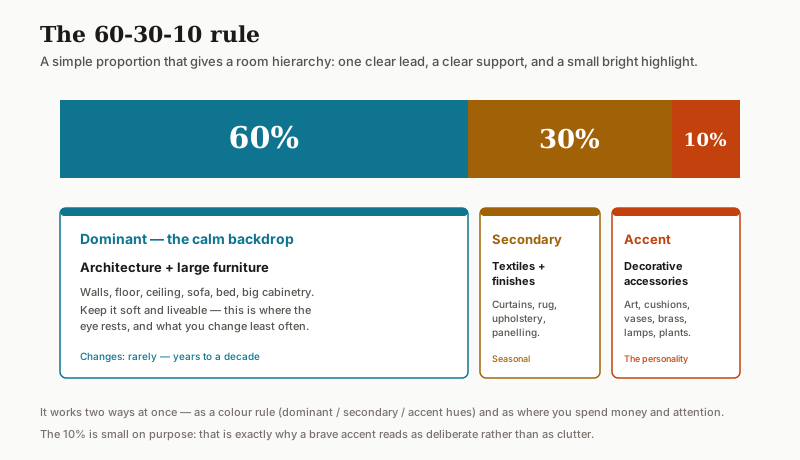
The genius of the ratio is that it builds in hierarchy. There is a clear lead, a clear support, and a clear highlight — exactly the structure that makes a piece of music, a photograph or a sari feel resolved rather than chaotic. The 60% gives the room calm and breathing space. The 30% adds depth and keeps it from being flat. The 10% delivers the jolt of life — and because it is small, it reads as deliberate, like a perfectly placed piece of jewellery rather than an accident.
The 60% is the room's quiet. The 10% is its voice. Get the proportion wrong and the room either whispers or shouts.
Crucially, these are approximate proportions, not measurements you take with a tape. Nobody calculates square footage of cushion fabric. You are training your eye to feel when a room is dominated by one calm idea, lifted by a supporting one, and sparked by a small bold one. Let us take each layer in turn.
The 60%: architecture and furniture
The dominant 60% is the layer most people underestimate, because it is the layer you are meant not to notice. It is the backdrop: the wall colour, the flooring, the ceiling, and the largest pieces of furniture — the sofa, the bed, the wardrobe, the TV unit, the dining table. Together these occupy the most visual real estate in the room, and they set its entire temperature.
The most important rule for the 60% is restraint. This is not where your boldest colour belongs. A dominant layer in a saturated jewel tone — emerald walls plus an emerald sofa plus emerald flooring — overwhelms the room and leaves no room to breathe. Far better to keep the 60% in a calm, liveable register: soft whites, warm greys, beiges, oatmeal, putty, gentle sage, muted terracotta. These are the shades you will live with longest and tire of slowest, which matters because the 60% is also the most expensive and least frequently changed layer. You repaint walls every several years; you buy a sofa once a decade.
In Indian homes there are a few specifics worth naming. First, the floor is rarely neutral the way it is in Western interiors — Indian flooring is often Kota stone, vitrified tiles, or, in better homes, marble, which carries warm cream-and-grey veining of its own. That veining is part of your 60%, so read it before you choose wall colour. Second, our walls take a beating from humidity, dust and harsh light, so a washable, slightly warm off-white is usually wiser than a stark gallery white. Third, in many homes one wall is given to a pooja corner or a feature niche — treat that as part of the architecture, and let it sit within the 60% calm rather than fighting it.
If you only get one thing right, get the 60% right. A calm, well-chosen dominant layer forgives a multitude of sins in the layers above it. You can browse settled, liveable backdrops in our living-room design ideas to calibrate your eye before committing to paint.
The 30%: textiles and finishes
If the 60% is the stage, the 30% is the set dressing — the layer that adds depth, contrast and softness. This is overwhelmingly the realm of textiles and finishes: curtains, the rug, upholstery and slipcovers, bed linen and throws, larger accent furniture (an armchair, an ottoman, a bench), and architectural finishes like wood panelling, a textured feature wall, or a fluted console.
The 30% is where you introduce your secondary colour — the one that supports and gently contrasts the dominant 60%. If your walls and sofa are warm oatmeal, your 30% might be a deeper, related tone: a clay-and-rust rug, curtains in a muted teal, an armchair in olive. The job of this layer is to create a relationship — close enough to feel harmonious, distinct enough to add interest. A useful instinct: the 30% should differ in value or temperature from the 60%, not just be a slightly different beige. Sameness here is what produces the flat, hotel-lobby blandness so many rooms fall into.
Texture does enormous work in the 30%, and India is rich with it. Jute rugs, cotton dhurries, block-printed curtains, raw silk cushions, cane and rattan, Kantha throws — these add tactile depth that flat paint never can. A room that is monochrome in colour can still feel layered and alive if the 30% brings genuine variety of texture. The 30% also changes more often than the 60% — you might re-cover a sofa, swap curtains seasonally, or roll out a different rug for the festive season — so it is a sensible place to express trend without overcommitting. For current directions worth folding in here, see our 2026 decor trends.
The 10%: accessories — the personality
Here is the paradox of the 10%: it is the smallest layer, and the one everyone wants to make bigger. Resist. The 10% is where the room finds its voice — its boldest colour, its shiniest metal, its most personal objects — and it works precisely because it is small. A little goes a long way; that is the entire point.
The 10% is your accent accessories: throw cushions in a punchy accent tone, artwork, vases, table lamps, a brass or metallic finish, candle holders, books, sculptural objects, and — never underrate them — plants. This is the layer where you can be brave. If your room is calm beige (60%) and muted teal-and-rust (30%), your 10% might be a few cushions in jewel-tone magenta or mustard, a brass lamp, a single large piece of art, and a trailing pothos. Those small hits of saturated colour and warm metal are what stop the room from being merely tasteful and make it feel collected.
The 10% is the only place in the room you are allowed to be loud — so make it count, and keep it small.
In Indian homes, the 10% is often where heritage and personality live most naturally: brass diyas and urli bowls, a carved wooden box, a piece of Channapatna or Dhokra craft, framed Pattachitra or Madhubani art, a vivid ikat cushion, fresh marigold or tuberose in a vase. These objects carry story, and because the 10% is the layer you change most freely — seasonally, for festivals, on a whim — it is the cheapest and most satisfying place to refresh a room. A ₹2,000 set of new cushion covers and a fresh plant can reset a living room more than a ₹40,000 sofa ever could. To build an accent palette that actually relates back to your 60% and 30%, our colour palette generator is a quick way to test combinations before you buy.
Two readings of 60-30-10
One reason the rule endures is that it works on two levels at once, and understanding both makes you far more fluent with it.
As a colour rule. The classic reading is purely chromatic: 60% of the room should carry the dominant colour, 30% the secondary colour, and 10% the accent colour. This is the version that descends directly from colour theory, and it is how a stylist thinks when assembling a palette. Get those three colours and their proportions right and the room is harmonious almost regardless of the specific objects.
As a decor-investment and attention rule. The second reading — and the one this guide foregrounds — maps the ratio onto the physical layers of a room and onto where you spend money and attention. Here, the 60% is architecture plus large furniture, the 30% is textiles and finishes, and the 10% is decorative accessories. This framing is enormously practical because it tells you where to invest: the bulk of your budget and your decisions belong in the calm, long-lived 60%; a meaningful but smaller share in the changeable 30%; and only a small, joyful slice in the 10%.
The two readings reinforce each other. The physical 60% layer naturally should carry the dominant colour; the accessory 10% layer is naturally where the accent colour lives. When colour proportion and physical-layer proportion line up, the room clicks.
| Layer | % | What goes here | Examples in an Indian home | How often you change it |
|---|---|---|---|---|
| Dominant | 60% | Architecture + large furniture | Walls, marble/Kota floor, ceiling, sofa, bed, wardrobe, TV unit | Rarely — years to a decade |
| Secondary | 30% | Textiles + finishes | Curtains, jute rug, upholstery, bed linen, panelling, accent armchair | Occasionally — seasonally to a few years |
| Accent | 10% | Decorative accessories | Jewel-tone cushions, brass diyas, art, vases, lamps, plants | Freely — festivals, seasons, whims |
Worked example: an Indian living room
Let us apply all of this to a real, ordinary room: a roughly 150 sq ft living room in a city apartment, with a marble-look vitrified floor, decent natural light, and a pooja niche on one wall.
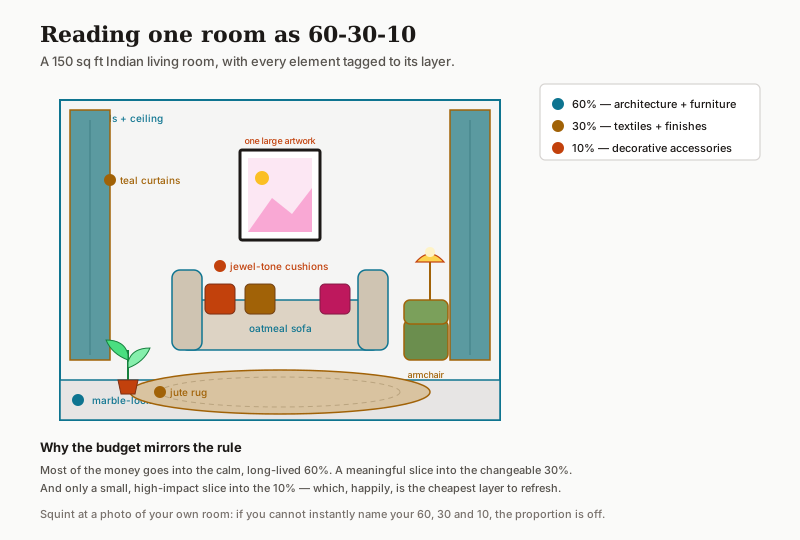
The 60% (dominant). We keep the architecture and big furniture calm and warm. Walls in a soft warm white (a washable emulsion), the existing cream-grey marble-look floor, and a generous fabric sofa in oatmeal-beige. The TV unit is in a light, warm-toned laminate that does not fight the wall. This layer is doing the most work and is deliberately the least exciting — that is correct. The pooja niche stays within this calm field, lifted only by its own brass and a single hanging toran.
The 30% (secondary). Now we add depth. A muted teal runs through the 30%: floor-length curtains in a teal-grey, picked up by a single accent armchair in the same family. On the floor, a large jute-and-cotton rug with a subtle clay-and-cream pattern adds texture and warms the marble underfoot. This layer is where the room stops being a blank canvas and starts having a point of view.
The 10% (accent). Finally, the spark. Three or four cushions in jewel-tone mustard and deep magenta, a pair of brass table lamps, one large framed Madhubani print as the room's single clear focal point, a brass urli with floating marigolds on the coffee table, and a trailing money plant in the corner. That is it. The 10% is small, brave and cohesive.
| Element | Layer | Colour role | Rough ₹ sense |
|---|---|---|---|
| Walls (warm-white emulsion) | 60% | Dominant | ₹12,000–18,000 |
| Oatmeal fabric sofa | 60% | Dominant | ₹35,000–60,000 |
| Teal curtains + accent armchair | 30% | Secondary | ₹15,000–25,000 |
| Jute-cotton rug | 30% | Secondary | ₹6,000–12,000 |
| Cushions, lamps, art, brass, plant | 10% | Accent | ₹6,000–10,000 |
Notice the budget mirrors the rule: the bulk goes into the calm, long-lived 60%, a meaningful chunk into the 30%, and a small, high-impact slice into the 10%. And notice that the 10% — the layer that gives the room all its personality — is the cheapest. That is the quiet good news of 60-30-10: a beautiful, characterful room does not require an extravagant accent budget. It requires the right proportion.
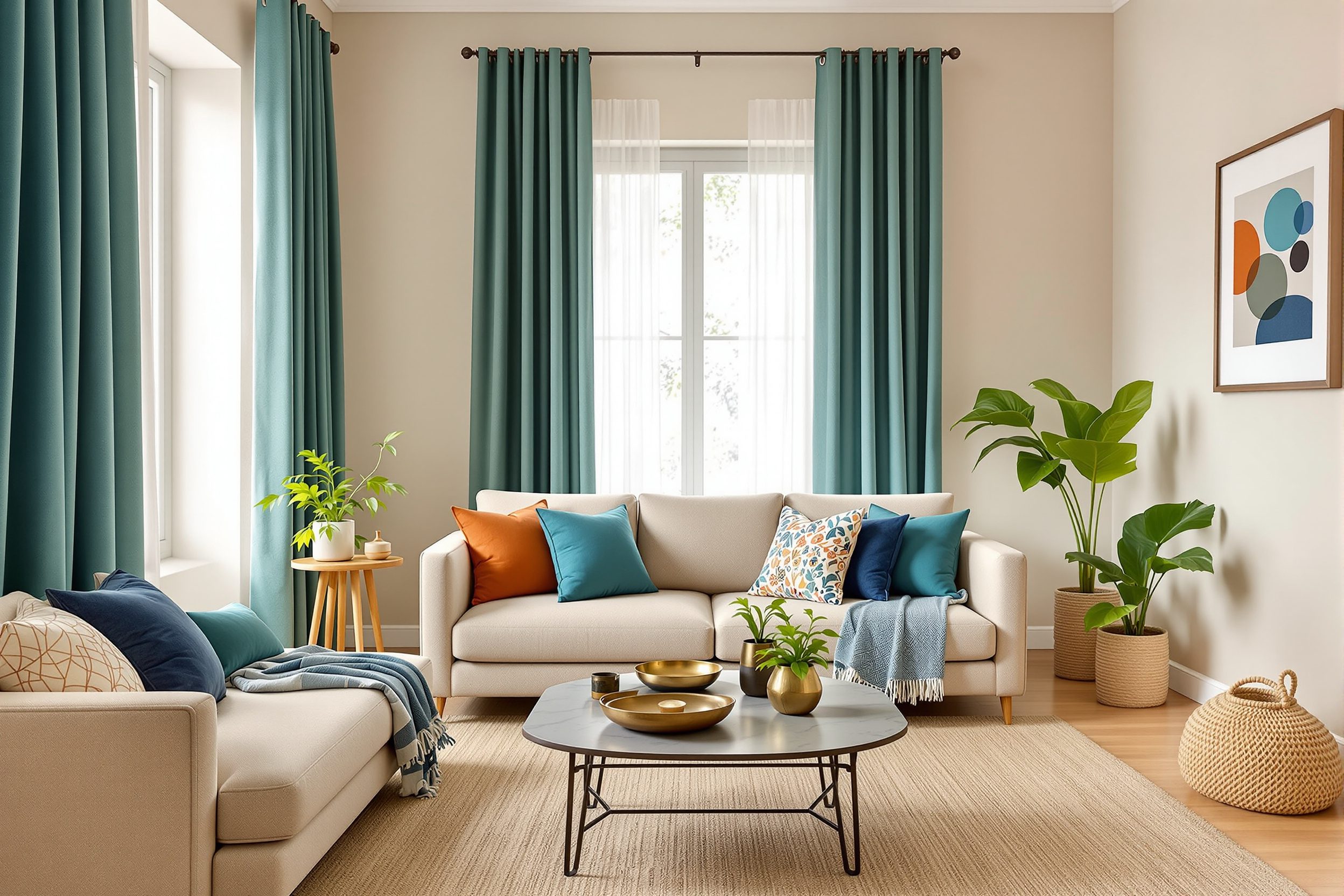
If you want to pressure-test your own room, photograph it, squint at the picture, and ask: what is my 60? My 30? My 10? If you cannot answer instantly, the proportion is probably off. For more rooms broken down this way, browse Design Ideas.
Common mistakes
The rule is simple, but there are a handful of predictable ways it goes wrong. Almost every cluttered or flat room you have ever seen is committing one of these.
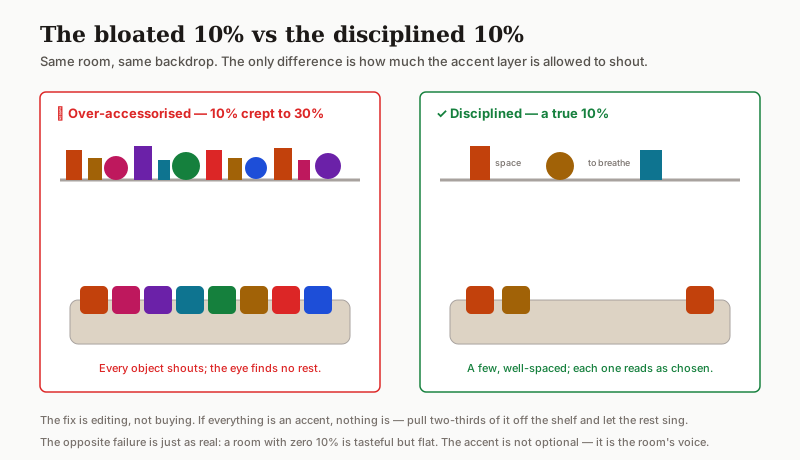
The bloated 10%. By far the most common error. The accent layer creeps from 10% to 25% — ten cushions instead of four, six picture frames, three vases, a riot of trinkets on every surface. Each object is fine; together they shout over one another and the room reads as clutter. The discipline of the 10% is editing. If everything is an accent, nothing is.
No accent at all. The opposite failure: a room that is all calm 60% and tasteful 30% with zero 10%. Beige walls, beige sofa, beige curtains, beige rug — technically harmonious, but flat, lifeless and forgettable, like a showroom nobody lives in. The 10% is not optional. The spark is what turns a tasteful room into a characterful one.
The 50-40-10 drift. A subtler error: the dominant layer is not dominant enough. When the 60% slips toward 50% and the 30% creeps up to 40%, the room loses its clear lead and starts to feel competitive rather than calm. Keep the 60% genuinely, comfortably in the majority.
Matching everything. Buying the matchy showroom set — sofa, curtains, cushions, rug all in the same fabric and colour — collapses all three layers into one. There is no hierarchy because there is no contrast. Co-ordination is good; identical is dead. Let the 30% and 10% relate to the 60%, not copy it.
Ignoring the architecture. Forgetting that walls, floor and ceiling are part of the 60%. People decorate as if the room is an empty white box, then wonder why their carefully chosen palette clashes — because the marble floor and the existing wall colour were always in the 60%, voting on every decision. Read the architecture first; decorate second.
When to break the rule
The 60-30-10 rule is a default, not a law — and once you understand why it works, you earn the right to bend it knowingly.
Maximalism. A deliberately maximalist room — layered patterns, saturated colour everywhere, a wall of art — abandons the ratio on purpose. But notice: the best maximalist rooms still have an underlying discipline, usually a repeating colour or tone that ties the chaos together. They break the proportion, not the principle of cohesion.
Monochrome schemes. An all-tonal room — every layer in graduated shades of one colour, say warm greys from charcoal to dove — can dispense with the 10% accent and rely entirely on value and texture for interest. Here the texture does the job the accent colour usually does.
Gallery-style and feature-led rooms. A room built around a single dramatic element — a bold patterned floor, a deep-jewel feature wall, a major piece of art — may intentionally let that one element dominate beyond its 10% share. The rule yields to the star.
The point is that breaking 60-30-10 should be a choice, made because you have something specific you want to achieve — not an accident of an unedited room. Learn the proportion until it is instinct; then you will know exactly when, and how much, to break it. For more principles to build on, explore our guides.
References & further reading
- Foundational colour-theory texts on harmony, dominance and accent — the source of the 60-30-10 proportion as a balance of dominant, secondary and accent hues.
- Classic interior-design principles references covering balance, proportion, scale and visual hierarchy in residential rooms.
- Professional decorating and styling manuals on layering a room — architecture, furniture, textiles and accessories as distinct decorative tiers.
- Writing on the psychology of colour and visual rest, explaining why a calm dominant field and a restrained accent reduce visual fatigue.
- Indian-context design references on regional materials and crafts — marble and Kota flooring, jute and cotton textiles, and brass and traditional art as accent objects.
- Practical home-styling guides on budgeting and editing accessories, including the discipline of the small accent layer.
Export this guide
Related Guides — Deep-dive reading
Bohemian Interiors — A 2026 Eclectic Style Guide for Indian Homes
Collected, layered, alive · Rust and jewel tones · Curated eclecticism, never clutter
Design StylesUsing Focal Points to Make Any Room Feel Intentional
Why every room needs one thing the eye lands on first — and how to choose, create and frame a focal point, from the mandir and the jharokha view to the television problem in Indian living rooms.
Design PrinciplesEarthy Interior Palette — A 2026 Style Guide for Indian Homes
Rooted · Regional · Biophilic · Indian craft-anchored
Design StylesRelated Tools — Try Free
Colour Palette Generator
5 harmonious colour palettes with hex codes, Asian Paints and Berger shade names — by room and mood.
PaletteApartment Furniture Size Chart
Standard furniture dimensions for Indian apartments — sofas, beds, tables, dining, storage.
Reference ChartMaterial Schedule Generator
Generate a room-wise finish schedule — walls, floors, ceilings, trim, and joinery by location.
Material Schedule