
Types of Home Lifts in India (2026): Complete Comparison and How to Choose
All seven home-lift options on one comparison table, plus a five-question decision framework to pick the right one
Choosing a home lift is really a sequence of small decisions: how many floors, new build or retrofit, how much civil work you can stomach, who will use it, and how it should look. This guide is the decision pillar for our entire "Types of Home Lifts" library. It lays out all seven home-lift options on one comparison table, then walks you through a plain-language decision framework, and finally points you to the dedicated deep-dive for whichever type fits your home.
If you only read one page before you start collecting quotes, make it this one. Bookmark it, then branch out to the type guide that matches your situation.
This pillar deliberately goes wider than our mechanism explainer, How Home Lifts Work in India. That guide is the quick walkthrough of the four core drive types (how the car actually moves). This page is the full buyer's comparison and decision matrix across all seven options — including form factors like capsule cabins and accessibility specs like platform and wheelchair lifts — and it links out to a separate deep-dive for each.
The seven options at a glance
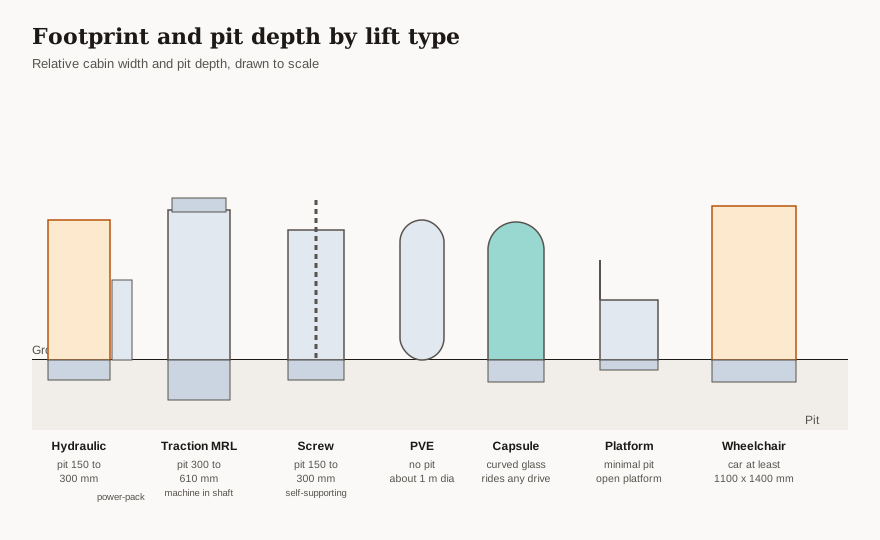
Indian homes today choose between four drive technologies (hydraulic, traction, screw, pneumatic vacuum) and three form-factor or accessibility variants (capsule/panoramic cabins, platform lifts, wheelchair-accessible cabins) that ride on those drives. Here is the whole field on one table.
| Type | Indicative cost (June 2026) | Space / pit needed | Maintenance | Speed | Floors suited | Best for |
|---|---|---|---|---|---|---|
| Hydraulic | ₹8–20 lakh | Shallow pit ~150–300 mm; power-pack cabinet alongside | Moderate; oil and seals | ~0.15–0.3 m/s (slow) | 2–4 floors | Lowest entry cost, tight headroom, low rise |
| Traction (gearless / MRL) | ₹10–25 lakh+ | Pit ~300–610 mm; machine inside the hoistway (no machine room) | Periodic rope inspection | Up to ~1 m/s (fastest) | 3+ floors, tall homes | Frequent use, premium ride, energy efficiency |
| Screw-driven | ₹14–30 lakh | Low pit ~150–300 mm; self-supporting, no machine room | Low; very few wear parts | Slow | 2–4 floors | Self-supporting with more load than PVE |
| Pneumatic vacuum (PVE) | ₹11–22 lakh | No pit, no shaft, no machine room; ~1 m diameter | Low; sealed tube | Slow | 2–5 floors | Easiest retrofit, no civil work, design statement |
| Capsule / panoramic | Premium (rides on any drive) | As per the drive it uses | As per drive | As per drive | 2+ floors | Villas, double-height voids, a glass centrepiece |
| Platform lift (VPL) | Lowest of all types | Minimal / low pit; small footprint | Low | ~0.15 m/s (slowest) | 1–2 floors, split levels | Senior mobility, short rise, tightest budget |
| Wheelchair-accessible cabin | Spec adds to any drive's base cost | Car ≥1100 × 1400 mm; lobby ~1800 × 1800 mm | As per drive | As per drive | Any | Full RPwD / barrier-free compliance |
All prices are indicative for June 2026 — confirm with itemised quotes from a licensed lift contractor. Add 18% GST, and budget separately for civil work (shaft, pit, electricals) and installation, which are almost always quoted on top. To model your own numbers, use our home lift cost calculator, and to lay these options side by side for your home, the home lift comparison tool.
Two of the seven are not strictly "drive types": a capsule is a glass cabin shape, and a wheelchair-accessible cabin is a set of specifications. Both can sit on a hydraulic, traction, screw or pneumatic drive — so you choose them in addition to, not instead of, a drive.
One standard governs them all: IS 17900
Whichever type you pick, the headline rule is the same. IS 17900 is the current mandatory standard since 22 December 2025 for all new lift installations, safety components and major modernisations. It is built on the European benchmark EN 81-20 / EN 81-50 and it supersedes the older IS 14665, IS 14671 and IS 15785 (you may still see those quoted — treat them as now superseded).
Two protections it makes compulsory matter for every home buyer:
- UCMP (Unintended Car Movement Protection) — the car must not move with the doors open.
- ACOP (Ascending Car Overspeed Protection) — it stops an upward overspeed if the controls fail.
Crucially, IS 17900 added special-lift parts covering home lifts, lifts for persons with disabilities and dumbwaiters, so residential lifts are now explicitly in scope. Non-compliance is not cosmetic: it risks penalties, a rejected occupancy certificate and invalidated insurance. On top of this, NBC 2016 Part 8, Section 5 governs lift installation, the RPwD Act 2016 and CPWD Harmonised Guidelines set the accessibility benchmark, and lifts are state-regulated — about ten states (Maharashtra, Karnataka, Tamil Nadu, Delhi and others) require an installation and operation licence plus periodic government inspection.
For India specifically, insist on an ARD (Automatic Rescue Device) on any type you choose — the battery brings the car to the nearest floor and opens the doors during a power cut. Given our outages, do not buy without it.
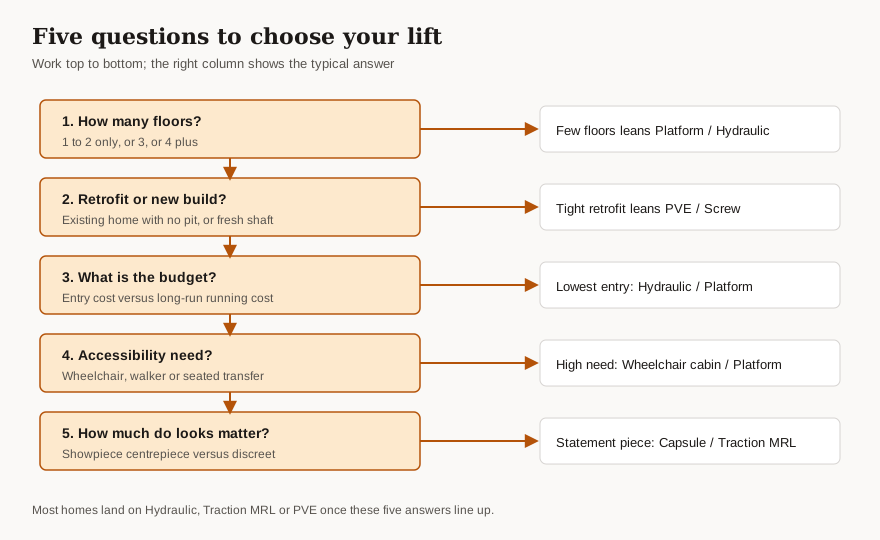
How to choose: five questions
1. Choose by number of floors
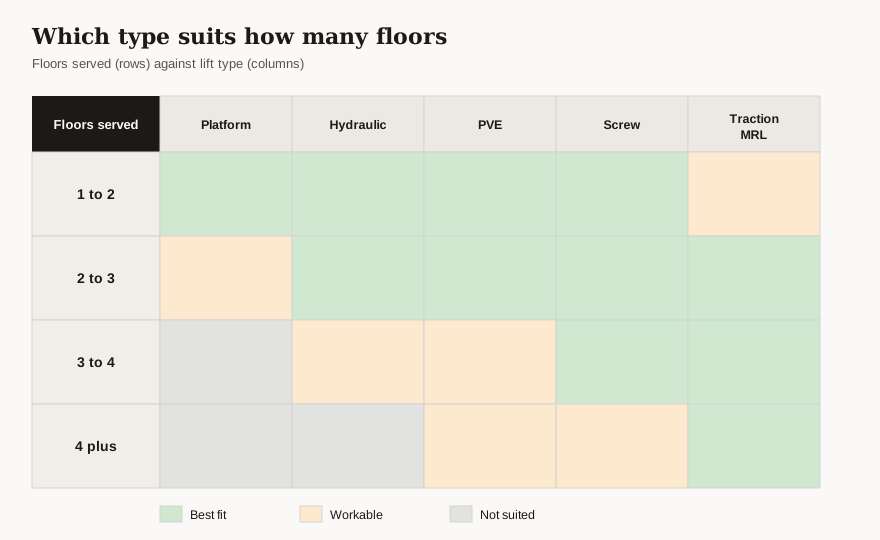
Travel height is the first filter. It quietly rules options in or out before budget or looks.
| Floors served | Comfortable choices | Why |
|---|---|---|
| 1–2 (G or G+1) | Platform lift, hydraulic, PVE | Short rise; lowest cost; minimal civil work |
| 2–3 (G+2) | Hydraulic, screw, PVE | Mid travel; PVE upper limit; smooth and quiet |
| 3–4 (G+3) | Traction (MRL), screw, hydraulic | Traction handles the height and frequency best |
| 4+ (tall homes) | Traction (gearless MRL) | Speed, long travel and efficiency win clearly |
PVE comfortably covers most two-to-three-storey Indian homes (some models stretch to about five floors), while traction is the only type that stays effortless as floors and trips add up.
2. Choose by retrofit versus new build
- Retrofitting into a finished home? A pneumatic vacuum lift needs no pit, no shaft and no machine room — it is the easiest drop-in, often installed in days. A screw-driven lift is the self-supporting alternative when you need more capacity or load than a PVE allows, and enclosed platform lifts also retrofit well.
- Building new, or doing a major renovation with a shaft? You have the full menu. A traction MRL gives the best long-term ride and efficiency once a hoistway exists; hydraulic keeps the entry cost lowest if your rise is low.
3. Choose by budget
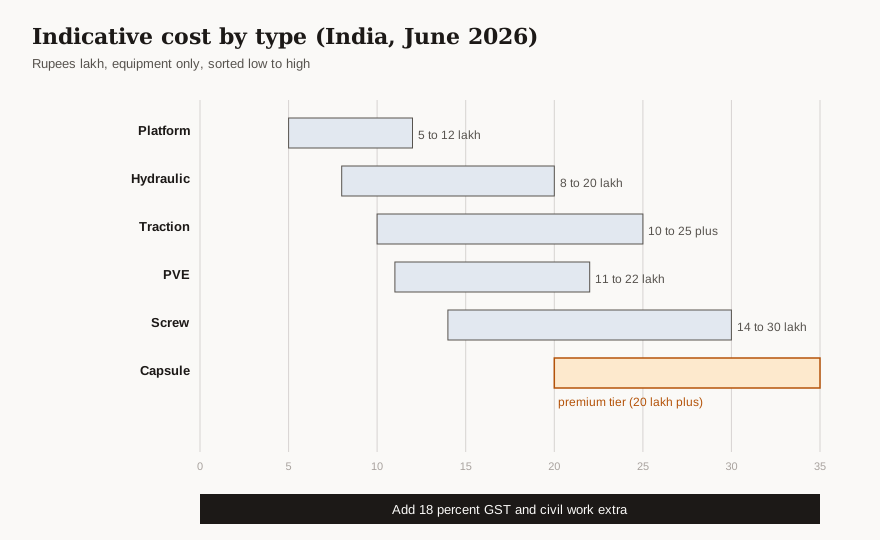
Roughly, from lowest entry point upward: platform lifts are the cheapest type, then hydraulic (₹8–20 lakh), traction (₹10–25 lakh+), pneumatic vacuum (₹11–22 lakh) and screw-driven (₹14–30 lakh), with capsule/panoramic cabins commanding a premium on top of whatever drive they use. Remember the three add-ons every quote should itemise:
- 18% GST on the equipment.
- Civil work — shaft, pit, electricals — for any pitted or shafted type.
- AMC — budget roughly ₹20,000–38,500 per year; a comprehensive contract costs about 60–70% more than a semi-comprehensive one but caps surprise bills.
The cheapest lift to buy is not always the cheapest to own. A shaftless PVE or screw lift can offset a higher sticker with near-zero civil work and low maintenance.
4. Choose by accessibility need
If a wheelchair user, a senior with limited mobility, or future ageing-in-place is the driver, the specification matters more than the drive. A wheelchair-accessible cabin can be built on any drive type, but it must meet: car ≥1100 × 1400 mm, automatic doors with clear width ≥900 mm (manual swing doors are not wheelchair-friendly), an auto-door dwell of ≥5 seconds, a handrail, Braille/tactile buttons, audio-plus-visual indicators, a rear mirror and a flush threshold. For short-rise senior mobility on a tight budget, a platform lift (VPL) is often the simplest and cheapest answer.
5. Choose by aesthetics
When the lift is also a design feature — a double-height villa void, a stair-well wrap, a glass statement — a capsule / panoramic cabin (curved laminated-tempered glass, stainless or aluminium frame) is the centrepiece choice, and it can ride on traction, hydraulic, screw or pneumatic drive. A PVE delivers a similar 360-degree glass look with the bonus of no civil work.
A quick cross-check before you commit
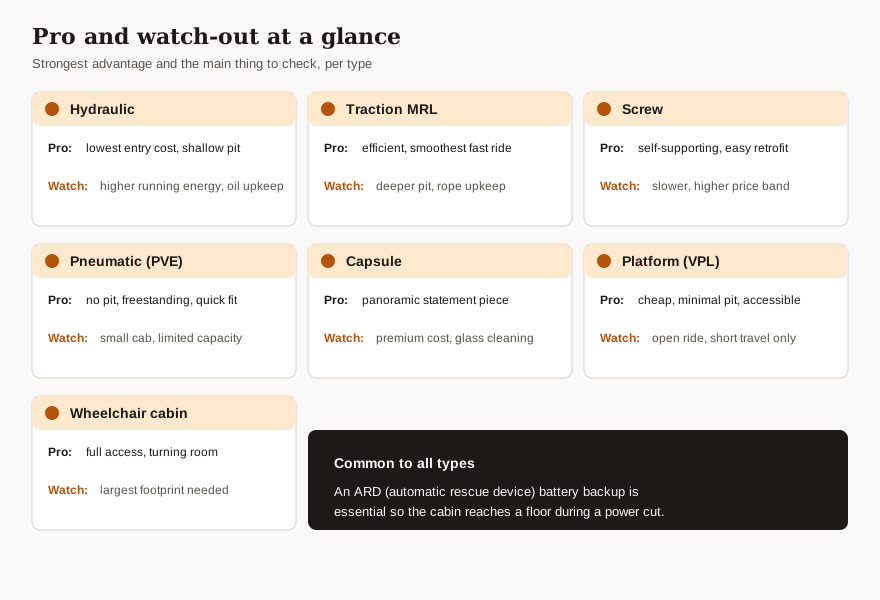
| Type | Strongest pro | Watch-out |
|---|---|---|
| Hydraulic | Lowest entry cost, smooth, quiet | Slow; higher ascent energy; oil sensitivity |
| Traction MRL | Fast, efficient, best ride at height | Needs pit/headroom; ropes need inspection |
| Screw | Self-supporting, low pit, very safe | Slower; can be a little noisier |
| PVE | No civil work, easy retrofit, panoramic | Limited capacity (~2–3) and travel; more power on ascent |
| Capsule | Design centrepiece | Premium pricing; glass needs cleaning |
| Platform (VPL) | Cheapest, smallest, easy retrofit | Slow; open units less weatherproof |
| Wheelchair cabin | Full barrier-free compliance | Larger car and lobby footprint required |
Which guide to read next
Once a type is on your shortlist, go deep with its dedicated guide:
- Hydraulic Home Lifts in India — the low-rise, low-entry-cost workhorse.
- Traction (Gearless MRL) Home Lifts in India — speed and efficiency for taller homes.
- Vacuum (Pneumatic) Home Elevators in India — the shaftless, no-civil-work retrofit.
- Screw-Driven Home Elevators in India — self-supporting with more load than a PVE.
- Capsule and Panoramic Elevators for Villas — the glass centrepiece form factor.
- Platform Lifts for Seniors — short-rise senior mobility and economy.
- Wheelchair-Accessible Home Lifts — full RPwD and CPWD compliance.
- Outdoor Residential Lifts — weatherising any drive against rain, salt and corrosion.
Want to pressure-test the numbers? Pair this comparison with our home lift comparison tool and home lift cost calculator before you call a single vendor. And if you are still planning the home around the lift, Studio Matrx's DesignAI can help you visualise where the cabin sits in your floor plan.
References
- IS 17900 mandatory since 22 Dec 2025 (EN 81-20/50, UCMP, ACOP) — Elevator World: https://elevatorworld.com/article/indias-elevator-revolution-why-is-17900-is-the-biggest-market-opportunity-since-eu-harmonization/
- IS 17515 energy performance of lifts — Elevator World: https://elevatorworld.com/article/new-indian-standard-is-17515-on-energy-performance-of-lifts-escalators-moving-walks/
- BIS National Building Code 2016 (Part 8): https://www.bis.gov.in/standards/technical-department/national-building-code/
- CPWD Harmonised Guidelines (barrier-free built environment): https://www.cpwd.gov.in/Publication/Harmonisedguidelinesdreleasedon23rdMarch2016.pdf
- RPwD Act 2016 (full text): https://ssepd.odisha.gov.in/sites/default/files/2024-01/RPWD%20ACT.pdf
- Lift regulations in India (overview): https://www.99acres.com/articles/know-all-about-the-lift-regulations-in-india.html
Export this guide
Related Guides — Deep-dive reading
How Home Lifts Work (India): Hydraulic, Traction, Screw and Vacuum Explained
A plain-language look inside the four drive types that lift a home elevator, plus the core components and safety systems every homeowner should be able to name.
Home Lifts & AccessibilityHydraulic Home Lifts Explained (India): How They Work, Costs, Pros and Cons
The piston-driven low-rise workhorse: shallow pit, lowest entry cost, smooth ride — and where gearless traction beats it.
Home Lifts & AccessibilityWheelchair Accessible Home Lifts (India): Cabin Size, Doors and RPwD Standards
The exact cabin, door, control and lobby spec that makes any home lift wheelchair-ready under RPwD and IS 17900.
Home Lifts & AccessibilityRelated Tools — Try Free
Accessibility Compliance Calculator
Check a planned lift against the CPWD and RPwD accessible-lift benchmarks for a score.
Lift CheckerHome Lift Cost Calculator
All-in home lift cost by floors, type, capacity and city — equipment, civil, GST and AMC, with a drive-type comparison.
Lift CalculatorHome Lift Comparison Tool
Compare hydraulic, traction, pneumatic vacuum and screw lifts side by side for your home.
Lift Comparison