
Traction Home Lifts Explained (India): Geared, Gearless and Machine-Room-Less (MRL)
How rope-and-counterweight traction lifts work, why gearless MRL is the 2026 default, and when this smoothest, most efficient type is the right choice for your Indian home.
If your home rises three floors or more and you want the smoothest, fastest, most energy-frugal ride money can sensibly buy, the traction lift is the type you keep coming back to. It is the same rope-and-counterweight principle that moves millions of people in office towers every day, now shrunk and made machine-room-less (MRL) for the Indian home. This guide is the buyer's deep-dive on traction as a lift type — how geared and gearless versions differ, why MRL has become the 2026 default, and when traction is the right call versus its rivals.
Two close cousins on Studio Matrx go narrower than this page. Read them alongside, not instead.
This guide ties the motor and the machine-room decision into the choose-a-type verdict. For the motor families in technical depth (induction, geared, gearless PMSM) see lift motor technologies. For the pure space arithmetic of dropping the machine room see lift machine-room requirements. Here, we treat traction as a complete lift you would actually buy.
How a traction lift works
A traction lift hangs the car from steel ropes (or flat coated belts) that loop over a grooved drive sheave at the top of the hoistway. On the other end of those ropes hangs a counterweight. When the motor turns the sheave, friction — traction — between rope and groove pulls the car up while the counterweight comes down, and vice versa. It is essentially a beautifully balanced see-saw.
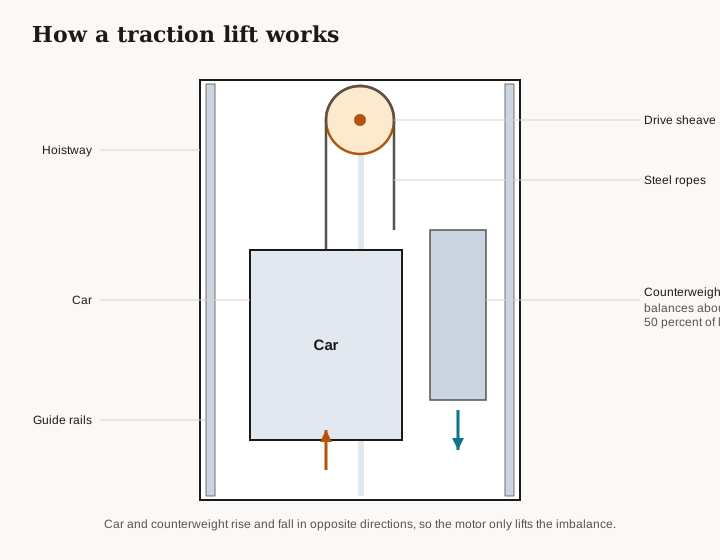
The clever part is that the counterweight is set to balance the empty car plus roughly 50% of the rated load. So the motor never has to lift the full weight of the car and passengers — only the imbalance. That is why traction lifts are dramatically more energy-efficient than a hydraulic lift, whose pump must shove the entire car weight up the shaft on every ascent.
Geared versus gearless
Two motor families drive traction lifts, and the difference matters for noise, efficiency and footprint.
| Geared traction | Gearless PMSM (the modern norm) | |
|---|---|---|
| How it drives | Motor turns through a reduction gearbox | Permanent-magnet synchronous motor turns the sheave directly |
| Efficiency | Good, but gearbox loses energy as heat | Highest — no gear losses |
| Ride quality | Smooth | Smoothest, near-silent |
| Maintenance | Gear oil changes, gearbox wear | Fewer moving parts, less upkeep |
| Footprint | Bulkier machine | Compact, flat — fits inside the hoistway (enables MRL) |
| Typical use today | Older or budget installs | Almost all new home traction lifts |
In 2026 the gearless permanent-magnet synchronous (PMSM) machine has all but won the home segment. It is compact and flat enough to bolt to the guide rail inside the shaft, which is precisely what makes the machine-room-less design possible.
Why MRL is the 2026 default
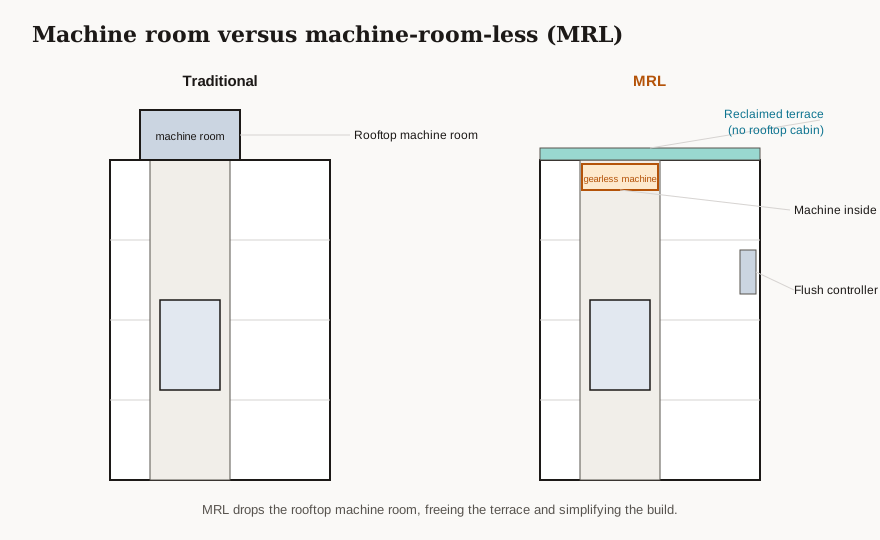
A traditional traction lift parked its motor, controller and sheave in a dedicated machine room — a small concrete cabin sitting on the roof directly above the shaft. That room ate built-up area, needed its own ventilation and waterproofing, and complicated terrace planning.
MRL (machine-room-less) puts the gearless machine and the slimline controller inside the hoistway — the machine at the top against a guide rail, the controller in a flush cabinet by the top landing door. No rooftop cabin at all.
What MRL saves you:
- The rooftop machine-room cabin entirely — you reclaim that terrace footprint and avoid its waterproofing and ventilation cost.
- Structural simplicity — no heavy machine slab to design and support over the shaft.
- Cleaner elevations — no box sticking out of your roofline.
The trade-off is that MRL still needs adequate overhead clearance (the machine lives up there, just inside the shaft), so headroom is not zero. The deeper space arithmetic is in our machine-room requirements guide.
Pit, headroom and shaft needs
This is where traction asks for more than hydraulic, screw or pneumatic lifts. The counterweight and the suspension system need room to travel.
| Requirement | Traction (MRL home) | Hydraulic | Screw / PVE |
|---|---|---|---|
| Pit depth | About 300–610 mm; some gearless 1200–1500 mm | About 150–300 mm | 150–300 mm / none (PVE) |
| Headroom / overhead | About 2600–3000 mm | About 2600 mm | Lower / minimal |
| Counterweight space in shaft | Yes — needs a counterweight run | None | None |
| Power | Often three-phase for larger cars | Single or three-phase | Single-phase common |
If your home cannot give a proper pit or headroom — a finished house with a tight terrace, say — a hydraulic home lift (the traction rival for low-rise homes) or a shaftless type will fit more easily. Traction earns its space demand only when the building is tall enough to use its strengths.
Performance: why traction rides best
Counterweight-balanced, gearless and rope-driven, a traction lift gives the smoothest start, the quietest run and the longest travel of any home lift type — up to about 1 m/s.
- Speed: up to about 1 m/s in homes — roughly two to six times faster than hydraulic, screw or pneumatic lifts (which run 0.15–0.5 m/s). Across four or five floors that difference is felt every single day.
- Smoothness: the gearless direct drive and rope suspension produce a near-imperceptible start and stop.
- Travel and floors: ropes scale to many floors with ease, so traction comfortably serves 3, 4, 5 or more levels where pneumatic and screw lifts run out of practical reach.
- Frequency: built for heavy daily cycling without the duty-cycle and oil-temperature limits of hydraulic systems.
Upkeep: the rope inspection reality
The one maintenance item unique to traction is the suspension ropes (or belts). They must be periodically inspected for wear, tension and corrosion, and eventually replaced over the lift's life. A competent annual maintenance contract handles this — but it is a recurring line item that pit-driven screw lifts (no ropes) do not have. Build it into your AMC conversation:
- Insist the AMC explicitly covers rope/belt inspection, tensioning and the safety governor and gear.
- Read whether ropes are included or excluded — some contracts exclude rope and pulley even in "comprehensive" cover.
- Pair the lift with an ARD (Automatic Rescue Device) so a power cut never strands the car between floors — non-negotiable in India.
Cost in India (2026)
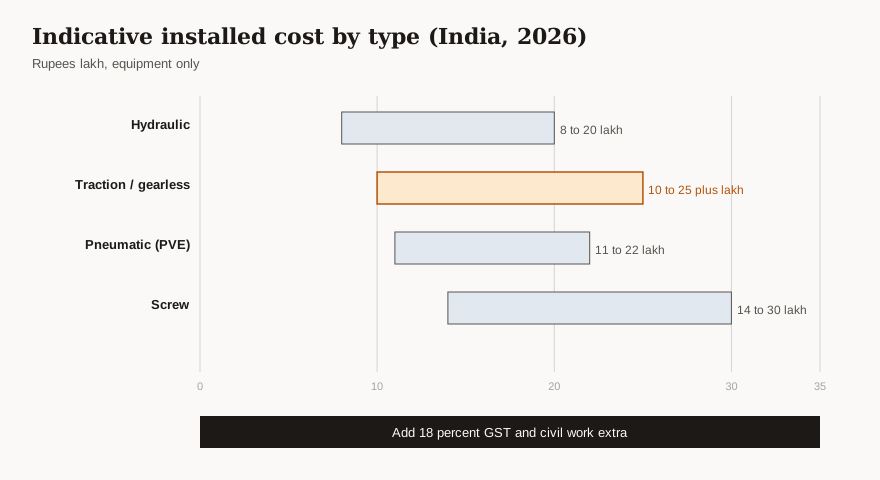
Traction lifts sit in the mid-to-upper band of home-lift pricing — more than hydraulic, generally below premium imported screw units.
| Lift type | Indicative installed cost (2026) |
|---|---|
| Hydraulic | ₹8–20 lakh |
| Traction / gearless | ₹10–25 lakh+ |
| Pneumatic vacuum (PVE) | ₹11–22 lakh |
| Screw / winding-drum | ₹14–30 lakh |
All figures are indicative (June 2026) — confirm with itemised quotes from a licensed lift contractor. Add 18% GST, and budget civil work (shaft, pit, electricals) and installation separately. The MRL design trims your civil bill by removing the rooftop machine room. Running cost is modest thanks to the balanced counterweight — among the lowest of any type per ride. For year-on-year ownership cost, plan an AMC of roughly ₹20,000–38,500 a year.
When to choose traction
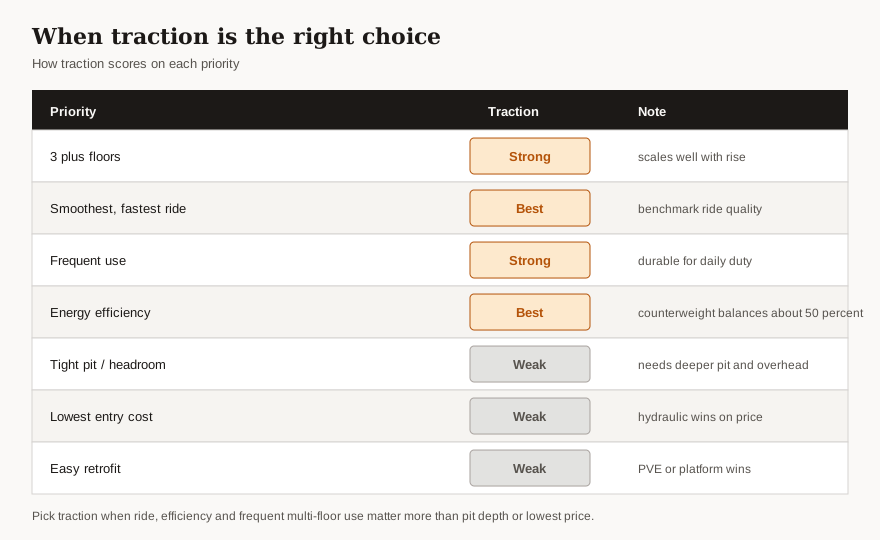
| Your situation | Traction fit |
|---|---|
| 3+ floors / tall home | Strong — built for long travel |
| Frequent, heavy daily use | Strong — high duty cycle |
| You want the smoothest, fastest ride | Best in class |
| Energy efficiency matters | Best — counterweight balances ~50% |
| Tight pit / no headroom | Weak — choose hydraulic or shaftless |
| Lowest possible entry cost | Hydraulic usually wins |
| Easy retrofit, no civil work | PVE or platform lift wins |
Choose traction when your home has three or more floors, the lift will be used often, and you value a premium, efficient, quiet ride enough to provide a proper pit and headroom. Look elsewhere when you are retrofitting a finished home, have only two floors, or cannot offer the shaft a counterweight run and overhead clearance.
Standards and compliance
Every new home lift in India — traction included — must now comply with IS 17900, the current mandatory standard since 22 December 2025. It is based on the world-benchmark EN 81-20 / EN 81-50 and supersedes the older IS 14665 (traction) and IS 14671 (lifts for persons with disabilities), which you may now treat as superseded. IS 17900 mandates two protections especially relevant to rope-driven lifts:
- UCMP (Unintended Car Movement Protection) — the car must not drift with its doors open.
- ACOP (Ascending Car Overspeed Protection) — upward overspeed is caught even if the control system fails.
Its special-lift parts explicitly bring home lifts into scope. Non-compliance can mean rejected occupancy certificates and invalidated insurance, so confirm your contractor delivers an IS 17900-compliant installation. Building-services placement also follows NBC 2016, Part 8, Section 5, and accessibility benchmarks come from the RPwD Act 2016 and CPWD Harmonised Guidelines. Lifts are state-regulated in roughly ten states (Maharashtra, Karnataka, Tamil Nadu, Delhi and others), where an installation licence, operation registration and periodic government inspection apply.
Where this fits the bigger picture
Traction is one of several home-lift types. To weigh it head-to-head against hydraulic, screw and pneumatic, start at the comparison pillar, types of home lifts compared. For the quick four-type mechanism overview, see how home lifts work — that page is the fast primer, whereas this guide goes deep on traction alone. And to put your own floor count, budget and space into the numbers, run the home lift comparison tool.
If you are still mapping the lift into a larger renovation or new build, Studio Matrx DesignAI can help you visualise where the shaft and landings sit before you commit to a contractor's drawing.
References
- IS 17900 mandatory 22 Dec 2025 / EN 81-20/50, UCMP, ACOP (Elevator World): https://elevatorworld.com/article/indias-elevator-revolution-why-is-17900-is-the-biggest-market-opportunity-since-eu-harmonization/
- IS 17515 energy performance of lifts (Elevator World): https://elevatorworld.com/article/new-indian-standard-is-17515-on-energy-performance-of-lifts-escalators-moving-walks/
- Revision of the Indian standards on passenger and goods lifts, Part 1 (Elevator World): https://elevatorworld.com/article/revision-of-the-indian-standards-on-passenger-and-goods-lifts-part-1/
- IS 14665 Part 1, outline dimensions (BIS): https://law.resource.org/pub/in/bis/S05/is.14665.1.2000.pdf
- BIS National Building Code 2016: https://www.bis.gov.in/standards/technical-department/national-building-code/
Export this guide
Related Guides — Deep-dive reading
Types of Home Lifts in India (2026): Complete Comparison and How to Choose
All seven home-lift options on one comparison table, plus a five-question decision framework to pick the right one
Home Lifts & AccessibilityHow Home Lifts Work (India): Hydraulic, Traction, Screw and Vacuum Explained
A plain-language look inside the four drive types that lift a home elevator, plus the core components and safety systems every homeowner should be able to name.
Home Lifts & AccessibilityResidential Elevator Buyer's Guide (India 2026): Types, Cost, Sizing, Regulation & How to Choose
Everything an Indian homeowner needs to choose, size, budget, license and maintain a home lift the right way.
Home Lifts & AccessibilityRelated Tools — Try Free
Home Lift Comparison Tool
Compare hydraulic, traction, pneumatic vacuum and screw lifts side by side for your home.
Lift ComparisonAccessibility Compliance Calculator
Check a planned lift against the CPWD and RPwD accessible-lift benchmarks for a score.
Lift CheckerHome Lift Cost Calculator
All-in home lift cost by floors, type, capacity and city — equipment, civil, GST and AMC, with a drive-type comparison.
Lift Calculator