
Capsule Elevators for Villas (India): Panoramic Glass Lifts as a Design Statement
The capsule is a cabin form, not a drive type — here is where the panoramic glass lift suits a villa, and how to choose the traction, hydraulic, screw or vacuum drive underneath it.
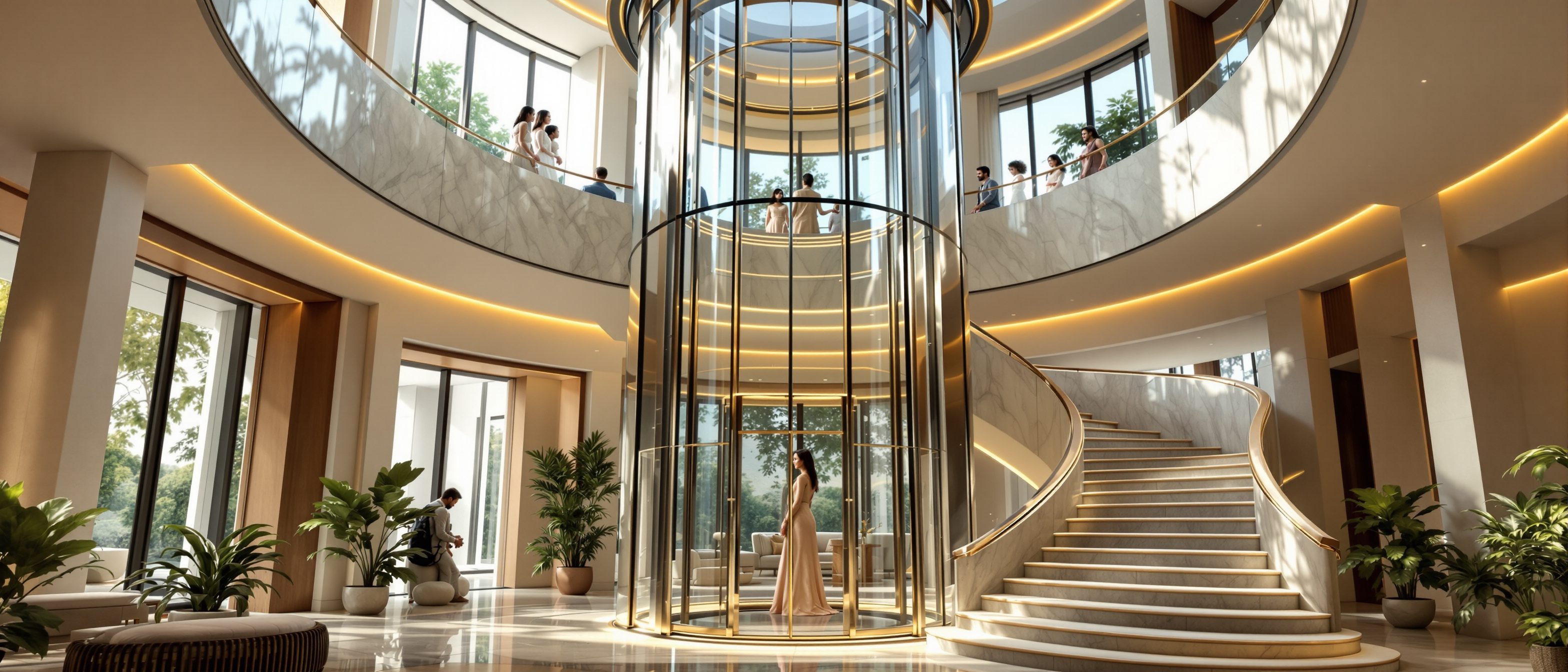
There is a moment, in a well-designed villa, when the lift stops being a utility and becomes the centrepiece. A curved wall of glass rises through a double-height void, the cabin glides past a chandelier, and the people inside seem to float between floors. That is the capsule elevator — and the single most important thing to understand about it is this:
"Capsule" describes the CABIN — a curved, panoramic glass shell — not the machine that moves it. A capsule can ride on traction ropes, a hydraulic ram, a screw column, or be a pneumatic vacuum unit. First you fall in love with the form; then you choose the drive underneath it.
That distinction is what this guide is about: the capsule form factor, where it earns its place in an Indian villa, and how to pick the drive that lives under the glass. If you want the full cabin-design palette (woods, mirrors, lighting moods), the rupee-by-rupee budgeting, or the structural planning of the shaft, those are separate guides we link below — here we stay on the panoramic form itself.
What "capsule" actually means
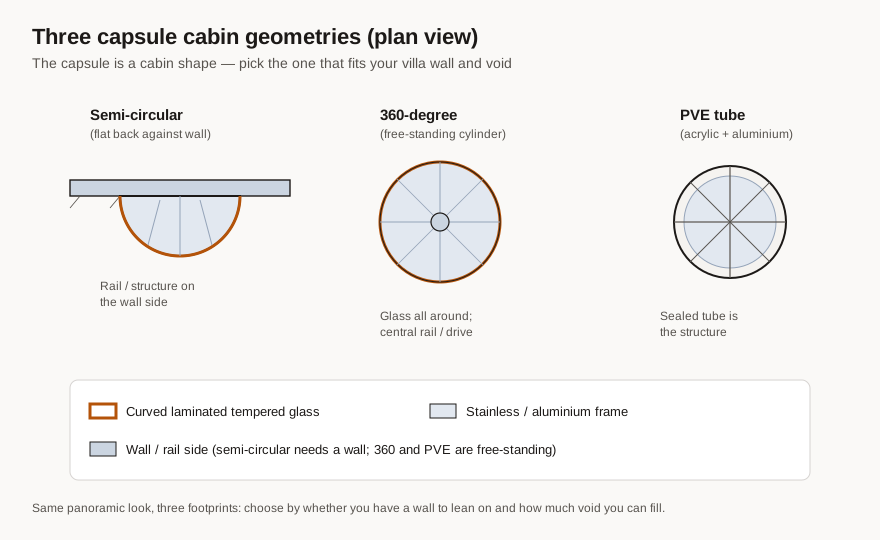
A capsule cabin is built from curved laminated tempered safety glass panels held in a stainless steel or aluminium frame. Two geometries dominate:
- Semi-circular (half-round): the glass wraps the front and sides in a D-shape; the flat back sits against a wall or the structural rail line. Most common in villas because it needs support on only one side.
- 360-degree (full-round): glass all the way around, the cabin standing free in a void like a glass cylinder. The dramatic option — and the one with the highest structural and cleaning demands.
Pneumatic vacuum elevators (PVE) are inherently capsule-shaped — the cylindrical acrylic-and-aluminium tube IS the form. But a capsule is not limited to PVE; a traction or hydraulic lift can be given a curved glass cabin just as easily, and at higher capacity.
Where a capsule belongs in a villa
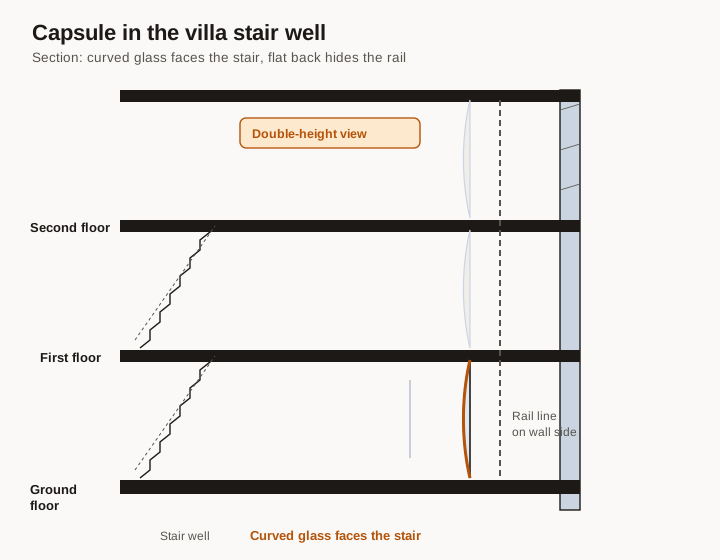
A capsule lift is wasted in a boxed-in masonry shaft — you would never see the glass. It pays for itself only where it is seen. Three positions work:
| Position | Why it works | Watch-outs |
|---|---|---|
| Double-height void / atrium | The full travel is visible; the cabin becomes kinetic sculpture | Needs a clear structural void; glass is exposed to dust from open volumes |
| Centre of the stair well | The lift and stair spiral together — a classic villa gesture | Tight clearances to the stair; cleaning access to the inner glass |
| Entrance / lobby feature | First thing guests see; strong arrival statement | Direct sun and dust near the door; needs solar-control glass |
A capsule is a sightline decision before it is an engineering one. Stand where your guests will stand, look up, and ask: will I actually see the glass travel? If the answer is no, spend the money on a better cabin finish instead.
Choosing the drive under the capsule
This is the real decision. The capsule glass costs roughly the same whatever moves it; the drive determines pit, headroom, capacity, ride quality, civil work and running cost. Here is how the four drives behave when wearing a capsule cabin.
| Drive under the capsule | Capacity | Pit / civil | Travel and feel | Indicative cost* | Best capsule use |
|---|---|---|---|---|---|
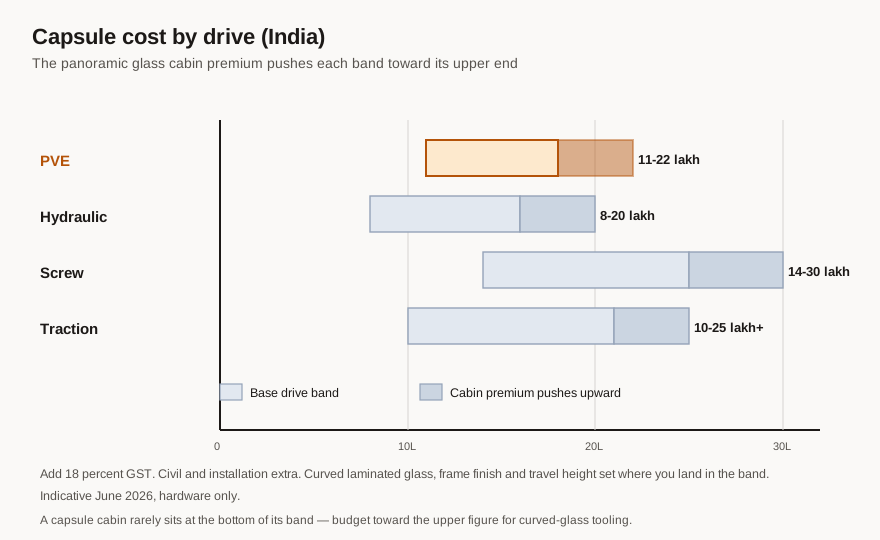
| PVE (vacuum) | 1–3 persons | None — no pit, no shaft, self-supporting | 3–5 floors; draws power on ascent, glides down on gravity | ₹11–22 lakh | Retrofit into a finished villa; instant 360 look, zero civil work |
| Hydraulic | 2–6 persons | Shallow pit ~150–300 mm; power pack in a cabinet | Smooth, quiet, 2–4 floors; slower (~0.15–0.3 m/s) | ₹8–20 lakh | New-build low-rise villa wanting a bigger capsule cabin cheaply |
| Screw / winding-drum | 2–5 persons | Low pit ~150–300 mm; self-supporting, no machine room | Compact, very safe (cannot free-fall); slower, can be noisier | ₹14–30 lakh | Want PVE-like self-support but more load behind the glass |
| Traction (gearless MRL) | 3–8 persons | More pit/headroom; machine inside the hoistway | Fastest (~up to 1 m/s), smoothest, longest travel | ₹10–25 lakh+ | 3+ floor villa, frequent use, the premium ride and biggest cabin |
*Indicative June 2026 — confirm with itemised quotes from a licensed lift contractor; add 18% GST, plus civil work and installation.
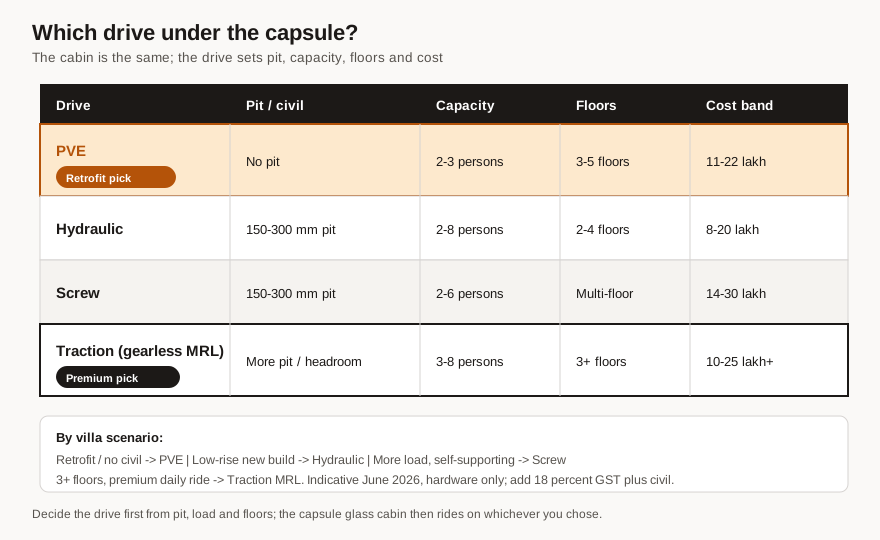
A quick way to land on the right one:
- Retrofitting into a villa you already live in, and you want the 360 glass with no demolition? A PVE capsule. It is self-supporting and needs no pit or shaft.
- Building new, two or three floors, want a generously sized capsule without paying traction money? A hydraulic capsule — the shallow pit and adjacent power pack keep civil work light.
- Want the self-supporting, low-pit simplicity of a PVE but need to carry more weight (say a couple plus luggage)? A screw-driven capsule.
- Three or more floors, the lift will be used many times a day, and you want the smoothest, fastest, largest cabin? A gearless MRL traction capsule.
For a side-by-side of the drives stripped of the glass, use our home lift comparison tool, and the home lift cost calculator to sanity-check the cabin-plus-drive total against your floors and finish level.
The glass: safety, sun and the India reality
The romance of all-glass meets the reality of Indian dust and monsoon. Plan for both up front.
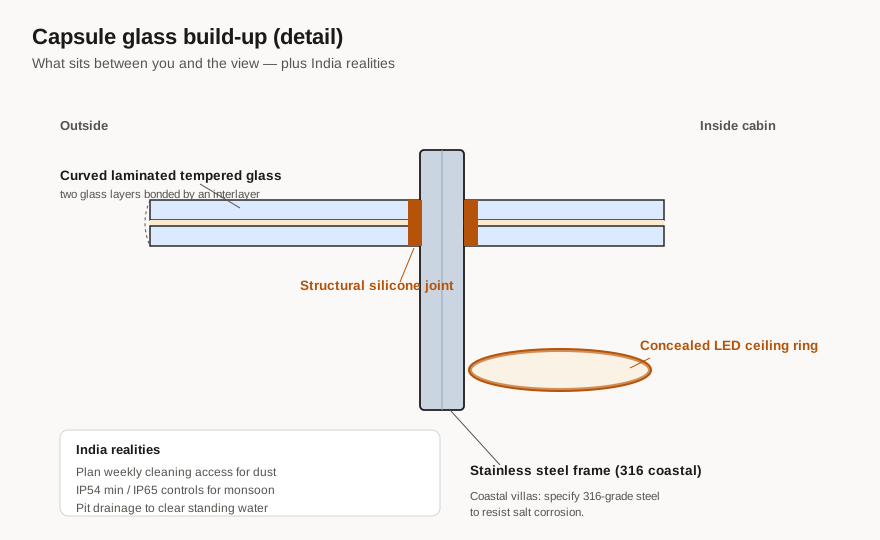
- Glass type: curved laminated tempered safety glass is non-negotiable — tempered for strength, laminated so it holds together if struck. Add a solar-control or low-E coating where the capsule faces direct sun (entrance and atrium positions), or the cabin becomes a greenhouse by noon.
- Frame and fixings: stainless steel (go 316 marine-grade in coastal cities like Mumbai, Chennai, Kochi, Goa) or anodised aluminium. Ordinary mild steel will weep rust streaks down the glass within a monsoon.
- Dust is the enemy of glamour. A panoramic cabin shows every fingerprint and every film of settled dust. In an open atrium it will need wiping weekly, and the outer curved faces and the inner shaft glass need a planned cleaning route — agree access with your contractor before installation, not after.
- Monsoon and water: if any part of the run is semi-outdoor or near a courtyard, specify IP54-rated controls (IP65 preferred), gasket sealing, pit drainage, and anti-condensation heaters for the controller. Pit flooding is an "act of God" most AMCs exclude.
- Lighting makes the capsule: concealed LED strips in the cabin ceiling ring and uplighting in the void turn the lift into the evening centrepiece. Budget for it as part of the cabin, not an afterthought.
Cost positioning — a premium, on purpose
A capsule cabin sits at the top of every drive's price band, because curved laminated glass and stainless framing cost more than a steel-and-laminate box. Expect the cabin premium to push your chosen drive toward the upper figure in the table above, and the dramatic 360 form to cost more than a semi-circular one. The detailed rupee breakdown — civil, finishes, AMC, floor-by-floor — lives in our cost cousin below; here, simply know that the capsule is a design indulgence you are choosing deliberately, not a default.
| What drives the premium | Effect on price |
|---|---|
| Curved vs flat glass | Curved laminated panels cost notably more to fabricate |
| 360 vs semi-circular | Full-round needs more glass and free-standing structure |
| Solar-control / low-E coating | Adds per-panel cost; essential in sunny positions |
| 316 marine-grade frame (coastal) | Premium over standard stainless |
| Feature lighting in cabin and void | Designed-in, not retrofitted |
Standards and licensing — the same rules apply
A glass capsule is held to exactly the same law as any other home lift. The headline is IS 17900, the current mandatory standard for all new lift installations, safety components and major modernisations since 22 December 2025. Built on EN 81-20 / EN 81-50, it mandates UCMP (Unintended Car Movement Protection — the cabin cannot drift with doors open) and ACOP (Ascending Car Overspeed Protection). It supersedes the older IS 14665 and IS 14671, which you may still see quoted but which are now superseded. Non-compliance can mean rejected occupancy certificates and invalidated insurance.
Also relevant:
- NBC 2016, Part 8, Section 5 governs lift installation in buildings.
- Lifts are state-regulated — about ten states (Maharashtra, Karnataka, Tamil Nadu, Delhi, Gujarat, Kerala and others) require an installation licence and periodic inspection by the State Lift Inspectorate.
- An Automatic Rescue Device (ARD) is essential in India: on a power cut it brings the cabin to the nearest floor and opens the doors. Never buy a capsule — especially a PVE that draws power on ascent — without it.
How this guide fits the rest
- Glass elevator design for Indian homes — that guide is the interior glass-cabin design palette (finishes, glass types, lighting moods); this one is about the panoramic capsule form and choosing its drive.
- Villa lift cost in India — the full rupee-by-rupee cost deep-dive; here we only position the capsule as a premium.
- Lift planning for villas in India — where and how to plan the shaft, pit and floors in a villa; this guide is the cabin form that goes in it.
- Types of home lifts compared (India) — the comparison pillar across all drive types.
- How home lifts work (India) — the quick four-type mechanism overview; this guide goes deeper on one form factor and the drive trade-offs beneath it.
Designing the void your capsule will rise through? Studio Matrx DesignAI can visualise the lift against your villa's atrium, stair and finishes before you commit to glass — so the centrepiece lands exactly where the eye expects it.
References
- IS 17900 mandatory since 22 Dec 2025 (EN 81-20/50, UCMP, ACOP) — Elevator World: https://elevatorworld.com/article/indias-elevator-revolution-why-is-17900-is-the-biggest-market-opportunity-since-eu-harmonization/
- IS 17515 energy performance of lifts — Elevator World: https://elevatorworld.com/article/new-indian-standard-is-17515-on-energy-performance-of-lifts-escalators-moving-walks/
- National Building Code 2016 (BIS): https://www.bis.gov.in/standards/technical-department/national-building-code/
- IS 14665 Part 1 (BIS, now superseded): https://law.resource.org/pub/in/bis/S05/is.14665.1.2000.pdf
- 99acres — lift regulations in India: https://www.99acres.com/articles/know-all-about-the-lift-regulations-in-india.html
Export this guide
Related Guides — Deep-dive reading
Types of Home Lifts in India (2026): Complete Comparison and How to Choose
All seven home-lift options on one comparison table, plus a five-question decision framework to pick the right one
Home Lifts & AccessibilityHydraulic Home Lifts Explained (India): How They Work, Costs, Pros and Cons
The piston-driven low-rise workhorse: shallow pit, lowest entry cost, smooth ride — and where gearless traction beats it.
Home Lifts & AccessibilityOutdoor Residential Lifts (India): Weatherproofing, IP Ratings and Materials
How to spec an external home lift that survives monsoon rain and coastal salt — IP ratings, metallurgy, seals and drainage.
Home Lifts & AccessibilityRelated Tools — Try Free
Home Lift Budget Planner
Full line-item budget for a home lift — equipment, finishes, civil, GST, AMC and contingency.
Lift PlannerHome Lift Comparison Tool
Compare hydraulic, traction, pneumatic vacuum and screw lifts side by side for your home.
Lift ComparisonHome Lift Cost Calculator
All-in home lift cost by floors, type, capacity and city — equipment, civil, GST and AMC, with a drive-type comparison.
Lift Calculator