

Platform Lifts for Senior Citizens (India): Low-Rise, Low-Cost Vertical Mobility
How the vertical platform lift gives ageing parents one or two floors back — for the lowest cost and the easiest retrofit of any home lift.
When ageing parents start avoiding the staircase, the family does not always need a full elevator with a shaft, a pit and a ten-lakh budget. Often the real problem is small: one flight to the first floor, a split-level landing, or three awkward steps at the entrance porch. For exactly this, India's home-lift market has a quietly practical answer — the vertical platform lift (VPL), the slowest, smallest and lowest-cost member of the home-lift family.
This guide is a buyer's deep-dive into the platform lift as a type: how the open and enclosed versions differ, where each belongs, how it is kept safe, and why it is the easiest, cheapest way to give a senior citizen back the run of their own home.
A platform lift is not a budget version of a passenger elevator. It is a different machine built for short, slow, occasional vertical travel — and for that job, nothing else is cheaper or simpler to fit.
What a platform lift actually is
A VPL carries a person — very often a wheelchair user — on a sturdy load-bearing platform rather than inside a sealed passenger car. It moves slowly (around 0.15 m/s, roughly one-third the speed of a hydraulic home lift) and runs on constant-pressure, hold-to-run controls: the platform moves only while you keep the button (or joystick) pressed, and stops the instant you let go. That single design choice removes a whole class of risk and is what makes the machine legal to fit in places a normal lift cannot go.
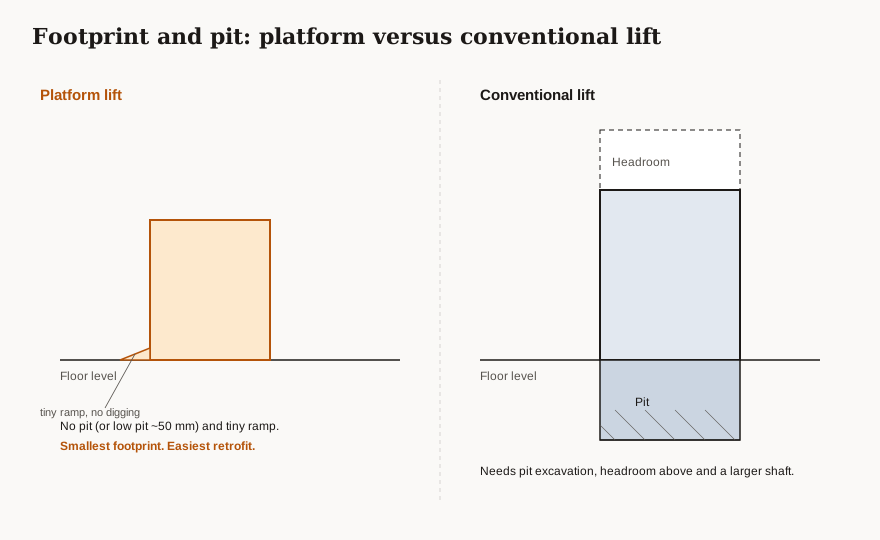
Because the travel is short and slow, a VPL needs little or no pit, no separate machine room and the smallest footprint of any home lift. That is why it is the lowest-cost type and the easiest retrofit into a finished home.
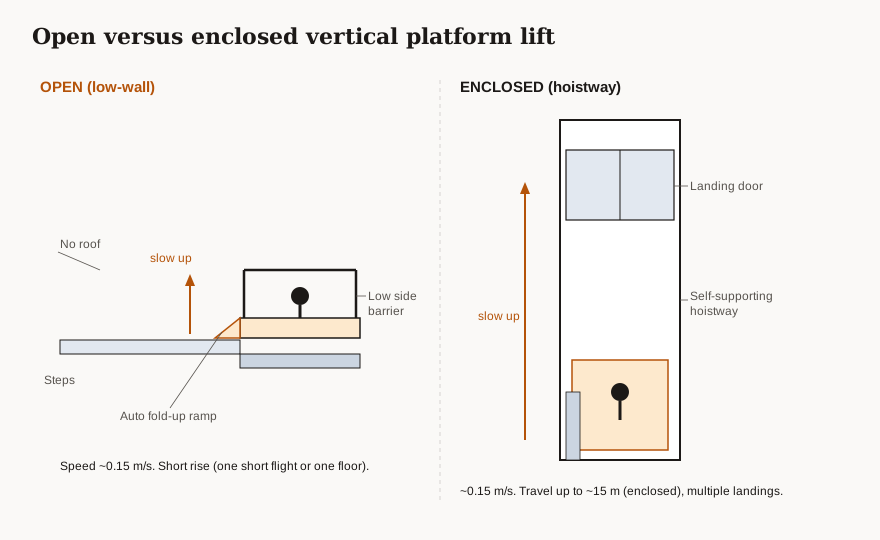
Open vs enclosed: the one decision that drives everything
Almost every platform-lift choice comes down to open or enclosed. They use the same slow drive and the same hold-to-run safety logic; what differs is the wall around you.
| Open (low-wall) VPL | Enclosed (hoistway) VPL | |
|---|---|---|
| Cabin | Low side walls + safety barrier; no roof | Full hoistway with door at each landing |
| Typical travel | A few steps up to ~1 floor (≈3 m) | Up to ~15 m / several floors |
| Pit | None or a tiny ramp | Minimal / low pit |
| Footprint | Smallest | Small, but needs a wall structure |
| Weatherproof | Limited — best indoors | Good — suits indoor and outdoor |
| Feel | Like a moving platform | Closer to a small lift |
| Relative cost | Lowest | Low–moderate |
- Open VPLs are the cheapest and least intrusive. With low walls and an automatic ramp instead of a pit, they suit a single short rise — porch steps, a split level, garden-to-veranda — and are happiest indoors or under a porch where rain is not an issue.
- Enclosed VPLs wrap the platform in a self-supporting hoistway with landing doors. They travel higher (manufacturers quote up to about 15 m), keep weather out, and feel more like a conventional lift — the right pick when the senior user wants a door to close, or the lift runs between two full floors.
Where the platform lift fits best
A VPL is purpose-built for the low-rise, low-frequency job — not the all-day, multi-floor traffic of a family elevator.
| Situation | Platform lift fit |
|---|---|
| Wheelchair user, ground to first floor (G+1) | Excellent |
| Three to six entrance / porch steps | Excellent (open VPL) |
| Split-level living room or mezzanine | Excellent |
| Elderly couple, occasional one-floor trips | Excellent |
| 3+ floors, frequent all-day use | Poor — choose a traction/MRL lift |
| Fast, smooth, "real lift" ride wanted | Poor — choose hydraulic or traction |
Rule of thumb: if the rise is one or two floors and the user is a senior or wheelchair user making a handful of trips a day, the platform lift is almost always the smartest-value answer.
For a side-by-side of every drive type and where each wins, see our comparison pillar on home-lift types. For the quick four-type mechanism overview, the how home lifts work guide is the place to start — this guide goes deeper on the platform-lift type specifically, where that one summarises all four.
Platform lift vs "wheelchair-accessible lift" — not the same thing
These two get confused constantly, so be precise:
- A platform lift is a type of lift — defined by its open/low-wall platform, slow speed and hold-to-run controls. It is the type, and it is the lowest-cost one.
- A wheelchair-accessible lift is a compliance spec — a set of requirements (≥900 mm clear door, ≥1100 × 1400 mm car, automatic doors, tactile buttons, 5-second door dwell) that any full-cabin lift can be built to meet.
So a hydraulic or traction lift can be wheelchair-accessible; a platform lift is its own type that happens to suit wheelchair users well. If you want the full accessibility specification for a proper full-cabin lift, read wheelchair-accessible lifts in India — that covers the RPwD compliance spec, whereas this guide is about the platform-lift type for senior low-rise economy.
Cost: the lowest of any home lift
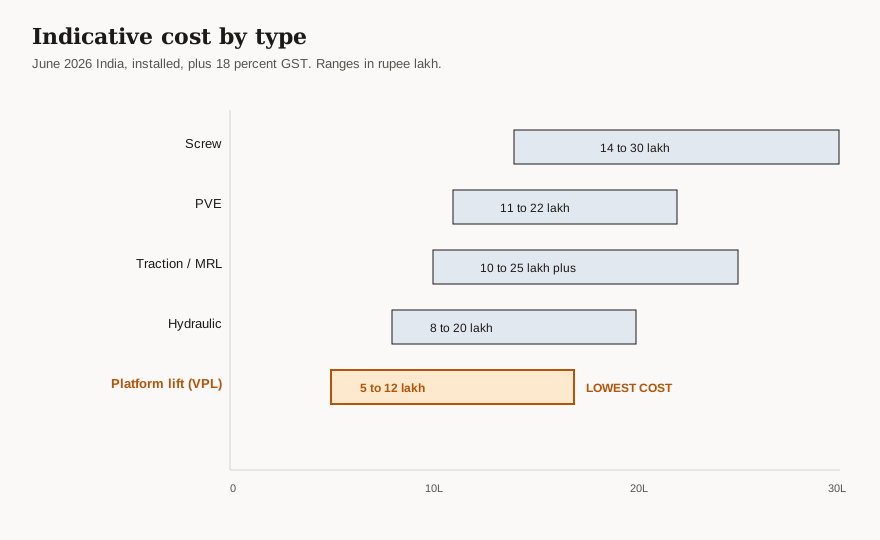
Platform lifts undercut every other home-lift type because they avoid the expensive parts — deep pit, machine room, high-speed drive, long hoistway.
| Lift type | Indicative price (June 2026) |
|---|---|
| Platform lift (VPL) | From ~₹5–9 lakh (open) to ~₹8–12 lakh (enclosed) |
| Hydraulic | ₹8–20 lakh |
| Traction / gearless (MRL) | ₹10–25 lakh+ |
| Pneumatic vacuum (PVE) | ₹11–22 lakh |
| Screw / winding-drum | ₹14–30 lakh |
All figures are indicative June 2026 — confirm with itemised quotes from a licensed lift contractor. Add 18% GST, and remember that civil work (the ramp, any low pit, electricals) and installation are usually extra — though on a VPL these are far smaller than on a shafted lift. Most small home VPLs run on ordinary single-phase power.
Put your own numbers in with our home-lift cost calculator, and weigh the platform lift against the alternatives in the home-lift comparison tool.
Safety: small and slow is also safe
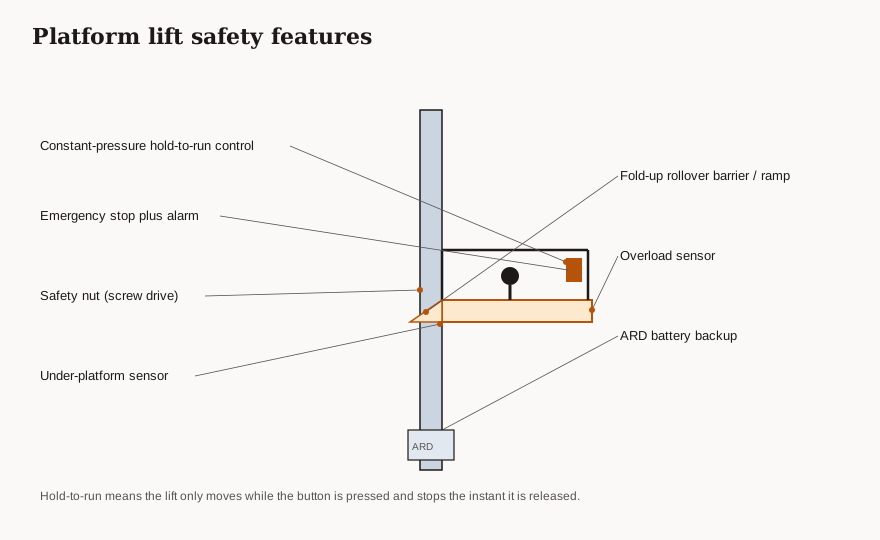
Slow speed and hold-to-run controls already make a VPL inherently low-risk, but a well-specified unit layers on more.
- Constant-pressure controls — the platform stops the moment the button is released, so it can never run away.
- Ramp and rollover barrier — an automatic ramp lets a wheelchair roll on flush, then folds up to become a barrier that stops it rolling off.
- Under-platform safety sensors / pressure edges — stop the platform if anything (a foot, a pet, an object) is beneath it as it descends.
- Safety nut on screw-driven VPLs — the platform is mechanically held by the screw thread and cannot free-fall.
- Emergency stop, alarm and manual lowering, plus an ARD (automatic rescue device) battery so a power cut does not strand the user mid-travel — essential given Indian outages.
- Slack-chain / overspeed protection and an overload sensor.
Indoor vs outdoor
Plenty of senior-mobility VPLs live outdoors — at the porch, between garden levels, or up to a raised veranda.
- Indoors: open VPLs shine; minimal weather worry, lowest cost, smallest disruption.
- Outdoors: specify weatherised, corrosion-protected components — IP54 minimum (IP65 preferred), hot-dip galvanized and powder-coated steel, and marine-grade 316 stainless in coastal or salt-air locations. Add drip rails, pit drainage and a canopy. Enclosed VPLs handle exposure better than open ones, so they are the usual outdoor pick.
Standards and the senior-citizen context
Since 22 December 2025, IS 17900 is the current mandatory standard for all new lift installations, safety components and major modernisations in India. It is based on EN 81-20 / EN 81-50 and mandates modern protection such as UCMP (unintended car movement protection) and ACOP (ascending car overspeed protection). Crucially, its special-lift parts explicitly cover home lifts and lifts for persons with disabilities — so a platform lift is squarely in scope. The older IS 14665 and IS 14671 (lifts for persons with disabilities) are now superseded but echoed within IS 17900's special-lift parts. Non-compliance can mean rejected occupancy certificates and invalidated insurance, so insist your contractor certifies to IS 17900.
For the why — designing a home around an ageing or disabled resident — the RPwD Act 2016 sets the accessibility benchmark (it legally binds public buildings; for private homes it is simply best practice), and the CPWD / MoHUA Harmonised Guidelines give the dimensional standards: ≥900 mm clear door width, handrails at 800–1000 mm, tactile controls, and a flush threshold so a wheelchair rolls on level. A platform lift that meets these is genuinely senior- and wheelchair-ready. You can pressure-test your layout against these norms with our home-lift comparison tool.
The short version
If the brief is "help my parents reach the first floor (or clear those porch steps) without a big civil project or a big bill," the vertical platform lift is the answer. Open VPLs are the cheapest and least intrusive for a single short indoor rise; enclosed VPLs add a hoistway, weather protection and more travel for two full floors or outdoor use. Spec it to IS 17900, insist on an ARD, build it to CPWD accessibility dimensions, and you have the lowest-cost, smallest-footprint, easiest-retrofit way to keep a senior citizen mobile and independent at home.
When you are ready to plan the exact placement, threshold and finish, Studio Matrx's DesignAI can help you visualise a platform lift dropped into your real floor plan before you call a single contractor.
References
- IS 17900 mandatory since 22 Dec 2025; EN 81-20/50, UCMP, ACOP (Elevator World): https://elevatorworld.com/article/indias-elevator-revolution-why-is-17900-is-the-biggest-market-opportunity-since-eu-harmonization/
- IS 14671 (1999), lifts for persons with disabilities (BIS): https://law.resource.org/pub/in/bis/S05/is.14671.1999.pdf
- CPWD Harmonised Guidelines for a Barrier-Free Built Environment (CPWD): https://www.cpwd.gov.in/Publication/Harmonisedguidelinesdreleasedon23rdMarch2016.pdf
- RPwD Act 2016, full text (Odisha SSEPD): https://ssepd.odisha.gov.in/sites/default/files/2024-01/RPWD%20ACT.pdf
- BIS National Building Code 2016 (Part 8, Section 5 — lifts): https://www.bis.gov.in/standards/technical-department/national-building-code/
Export this guide
Related Guides — Deep-dive reading
Types of Home Lifts in India (2026): Complete Comparison and How to Choose
All seven home-lift options on one comparison table, plus a five-question decision framework to pick the right one
Home Lifts & AccessibilityDesigning Adaptable & Universal-Design Homes
Accessibility, Aging-in-Place, and the Multi-Stage Family — Code, Anthropometrics, and Plan-Stage Discipline for Indian Residential Architects
Room PlanningWheelchair Accessible Home Lifts (India): Cabin Size, Doors and RPwD Standards
The exact cabin, door, control and lobby spec that makes any home lift wheelchair-ready under RPwD and IS 17900.
Home Lifts & AccessibilityRelated Tools — Try Free
Accessibility Compliance Calculator
Check a planned lift against the CPWD and RPwD accessible-lift benchmarks for a score.
Lift CheckerHome Lift Comparison Tool
Compare hydraulic, traction, pneumatic vacuum and screw lifts side by side for your home.
Lift ComparisonHome Lift Cost Calculator
All-in home lift cost by floors, type, capacity and city — equipment, civil, GST and AMC, with a drive-type comparison.
Lift Calculator