

Screw-Driven Home Elevators (India): The Self-Supporting, Low-Pit Lift Explained
How a threaded-screw lift carries more than a vacuum lift while sparing your walls, your pit and your machine room
If you love the idea of a vacuum lift — no machine room, almost no pit, nothing bolted into your house walls — but you need to carry more weight, more people, or climb more floors than a slim air-tube can manage, the screw-driven home elevator is the type built for exactly that gap. It is the quiet workhorse of the self-supporting world: a car that literally winds itself up a giant threaded rod, held mechanically at every instant so it physically cannot free-fall.
This is the dedicated deep-dive on the screw (or "winding-drum screw") drive. The four-type mechanism overview at how home lifts work in India introduces it in a paragraph; here we go all the way down to the thread, the pit slab, the noise, and the rupee.
How a screw-driven lift actually works
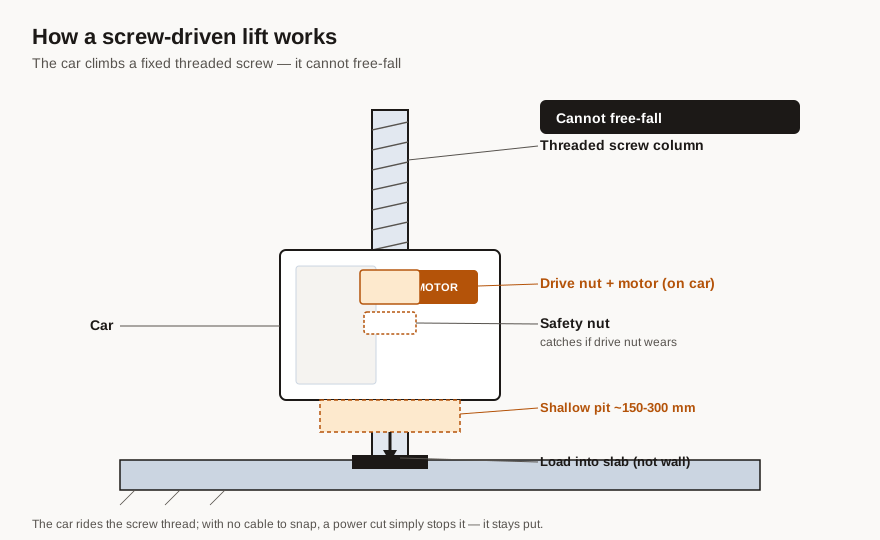
Picture a single thick vertical steel column with a coarse spiral thread cut along its length — like a giant bolt standing floor-to-ceiling. The car carries a matching threaded nut (the drive nut) that wraps around that column. A motor on the car spins the nut. As the nut rotates, it walks up or down the stationary thread, carrying the car with it. There is no counterweight, no rope, no hydraulic oil, and no piston buried under the floor.
Two things follow directly from that geometry, and they are the whole reason this type exists:
- It is self-supporting. The screw column and the car frame form a rigid mast that stands on its own base and carries all the load straight down into the floor slab. Your house walls hold nothing. That makes it ideal where you cannot — or do not want to — cut load-bearing structure into existing masonry.
- It cannot free-fall. The car is mechanically engaged with the thread at every height. If the motor loses power, the nut simply stops on the thread and the car stays put. A second "safety nut" sits just below the drive nut to take over if the main nut ever wears. There is no scenario where gravity wins.
A screw lift does not "hold" the car with brakes and ropes — it threads the car onto the building like a nut on a bolt. Power-off means stop, not drop.
The headline advantages
| Feature | What it means for your home |
|---|---|
| Self-supporting mast | No structural load on house walls; sits in a corner, a void, or a stair-well |
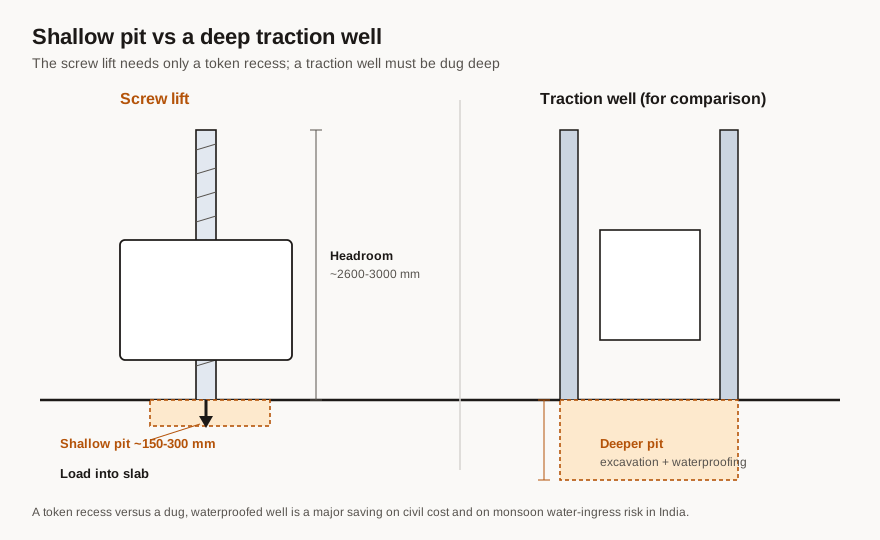
| Low pit (~150–300 mm) | A shallow 6–12 inch recess, often achievable without deep excavation |
| No machine room | Drive is on the car; nothing to find space or ventilation for upstairs |
| Compact footprint | Tight shaft works for 2–6 person cars; suits retrofits |
| Inherently fail-safe | Mechanically held by the screw; cannot free-fall |
| Low maintenance | No oil, no ropes to inspect or re-tension; mostly lubrication of the thread |
The low pit and no-machine-room story is what makes this type so attractive in Indian homes where the civil work is the painful part. You are not digging a deep pit, you are not surrendering a terrace water-tank room, and you are not knocking pockets into a wall that may be doing structural duty.
Screw vs PVE vs hydraulic — the low-pit, low-civil shortlist
If you have got this far, you are almost certainly comparing the screw lift against the two other "easy on the building" choices. Here is the head-to-head that matters most.
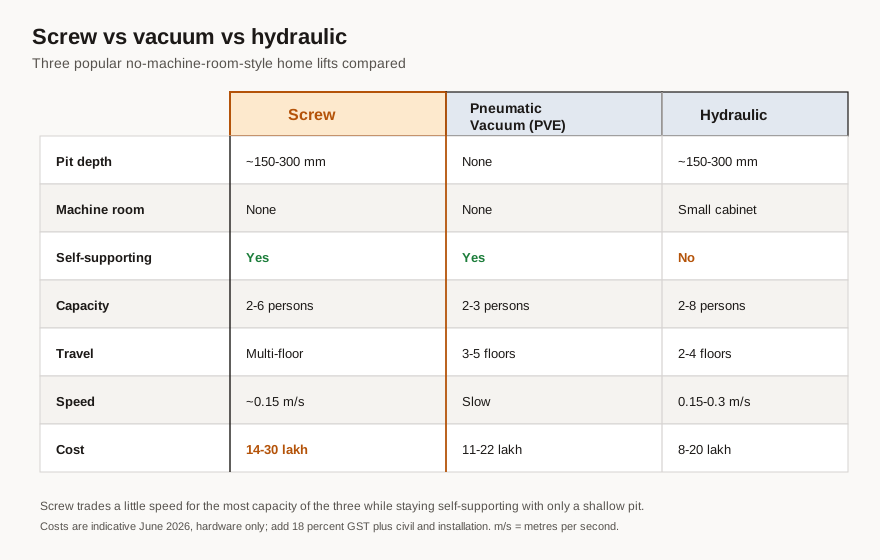
| Screw / winding-drum | Pneumatic Vacuum (PVE) | Hydraulic | |
|---|---|---|---|
| Pit depth | ~150–300 mm | None | ~150–300 mm |
| Machine room | None (drive on car) | None | Small adjacent cabinet |
| Self-supporting | Yes | Yes | No (loads into pit/well) |
| Capacity | ~2–6 persons | ~2–3 persons | Higher, 2–8 persons |
| Travel (floors) | Multi-floor, more than PVE | ~3–5 floors | Low rise 2–4 floors |
| Speed | Slower (~0.15 m/s) | Slow | ~0.15–0.3 m/s |
| Footprint | Compact shaft | Smallest (~1 m tube) | Needs well + power pack |
| Cost (indicative) | ₹14–30 lakh | ₹11–22 lakh | ₹8–20 lakh |
The plain-language read: the vacuum lift (deep-dive here) is the easiest retrofit of all — zero pit, a one-metre tube, a panoramic glass look — but it tops out at two or three people and a few floors. The screw lift keeps almost all of that self-supporting, low-civil benefit while letting you carry more load and reach more floors. So the screw type is the answer when the vacuum lift is almost right but just too small.
Hydraulic is cheaper still, but it is not self-supporting in the same way and is happiest in a true low-rise of two to four floors. To weigh all four drive types side by side, use the comparison pillar, Types of home lifts compared for India, and the interactive home lift comparison tool.
The trade-offs — be honest with yourself
No type is free of compromise, and the screw lift's are real:
- It is slower. Around 0.15 m/s, in the same band as a vacuum or hydraulic lift, well below a geared/gearless traction lift. For a two- or three-storey home this is barely noticeable; for a tall villa with frequent trips it can feel leisurely.
- It can be slightly noisier. The motor rides on the car and the nut turns on the thread, so you may hear a steady mechanical hum that a rope-and-counterweight traction lift hides better. Quality units damp this well; budget imports less so.
- Top speed and very long travel are limited. The thread length and drive style cap how high and how fast it sensibly goes. It is a low-to-mid-rise solution, not a high-traffic apartment-tower machine.
- Premium imported units cost more. The ₹14–30 lakh band is wide for a reason; Swedish and European screw lifts sit at the top of it.
When to choose a screw-driven lift
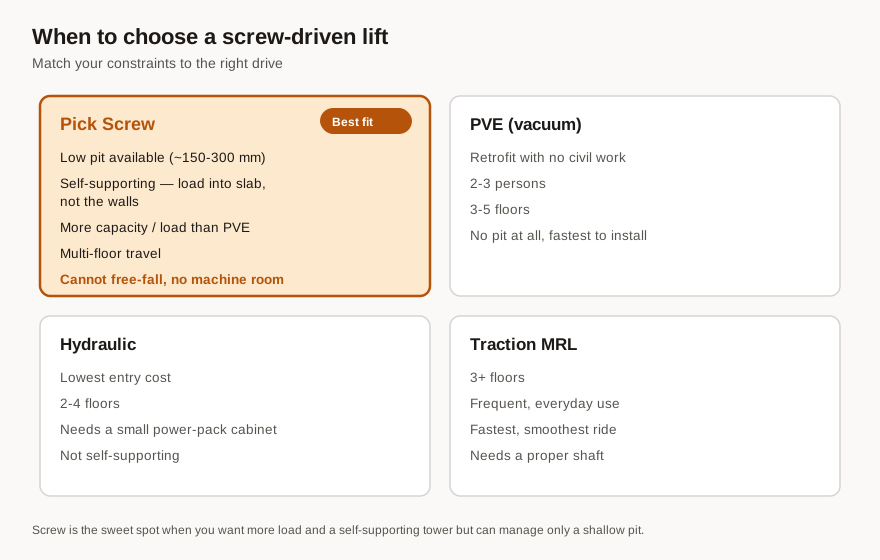
Choose the screw type when several of these are true:
- You want the PVE-style benefits — low pit, self-supporting, no machine room — but need more capacity or load than a vacuum cabin allows.
- Your home is already built and cutting structure into the walls is hard, undesirable, or would need approvals.
- You are serving multiple floors and a vacuum lift's travel limit is a problem.
- You value a low-maintenance, fail-safe mechanism and are happy to trade outright speed for it.
If instead you have three or more floors with heavy daily use and want the smoothest, fastest ride, a gearless MRL traction lift is the better fit — and if budget is the single driver on a two-storey home, hydraulic wins. The comparison pillar lays out those forks in detail.
Specs to confirm before you sign
| Item | Typical home figure (confirm with your contractor) |
|---|---|
| Pit depth | ~150–300 mm |
| Headroom / overhead | ~2600–3000 mm |
| Car capacity | ~2–6 persons (150 kg single, up to ~450 kg) |
| Speed | ~0.15 m/s |
| Power | Single-phase for small cars; three-phase for larger |
| Doors | Automatic telescopic/sliding for accessibility (not manual swing) |
| ARD | Battery rescue device — essential in India for power cuts |
Two specs deserve a hard stop. First, insist on automatic sliding doors, not a manual swing door — manual doors block wheelchairs and are the most common regret. Second, never buy without an Automatic Rescue Device (ARD): in an Indian power cut, the ARD battery walks the car to the nearest floor and opens the doors. A screw lift will not free-fall, but without an ARD it simply stops where it is until power returns.
Standards and compliance — the 2026 reality
Since 22 December 2025, IS 17900 is the mandatory standard for all new lift installations, safety components and major modernisations in India. It is aligned to the European benchmark EN 81-20 / EN 81-50 and it supersedes the older IS 14665 and IS 14671 (you may still see those quoted in old brochures — they are now superseded). Crucially, IS 17900 added special-lift parts that explicitly cover home lifts, so a screw-driven domestic lift is squarely in scope.
Two protections it now mandates apply even to a fail-safe screw lift's control system:
- UCMP (Unintended Car Movement Protection) — the car must not move with the doors open.
- ACOP (Ascending Car Overspeed Protection) — protection against the car running away upward on a control failure.
Buying a non-compliant unit is not just risky, it can mean rejected occupancy certificates and invalidated insurance. On top of IS 17900, NBC 2016 Part 8 Section 5 governs lift installation in buildings, and lifts are state-regulated — around ten states (Maharashtra, Karnataka, Tamil Nadu, Delhi and others) require an installation licence, an operation registration, and periodic inspection by a government-appointed inspector. Confirm your obligations with a licensed lift contractor and your State Lift Inspectorate before you commission.
Prices here are indicative for June 2026 — always confirm with itemised quotes from a licensed lift contractor. Expect 18% GST, and civil work and installation on top of the equipment price.
The bottom line
A screw-driven home elevator is the answer to a very specific question: I want the low-pit, no-machine-room, self-supporting ease of a vacuum lift, but I need to carry more. It trades speed for safety and simplicity, it spares your house walls, and it is one of the hardest types in the world to make fail dangerously. For a built home where civil work is the obstacle and capacity matters, it is often the most sensible compromise on the board.
When you are ready to size the car, weigh it against the other types, and pressure-test a quote, run your numbers through the home lift comparison tool, and if you want a second opinion on where it fits your floor plan, Studio Matrx's DesignAI can sketch the shaft into your home before you call a vendor.
References
- IS 17900 mandatory since 22 Dec 2025; EN 81-20/50, UCMP, ACOP (Elevator World): https://elevatorworld.com/article/indias-elevator-revolution-why-is-17900-is-the-biggest-market-opportunity-since-eu-harmonization/
- IS 17515 energy performance of lifts (Elevator World): https://elevatorworld.com/article/new-indian-standard-is-17515-on-energy-performance-of-lifts-escalators-moving-walks/
- BIS National Building Code 2016 (Part 8, Section 5): https://www.bis.gov.in/standards/technical-department/national-building-code/
- Lift regulations and state licensing in India (99acres): https://www.99acres.com/articles/know-all-about-the-lift-regulations-in-india.html
- Maharashtra licence to operate a lift (National Govt Services Portal): https://services.india.gov.in/service/detail/maharashtra-license-to-operate-lift
Export this guide
Related Guides — Deep-dive reading
Hydraulic Home Lifts Explained (India): How They Work, Costs, Pros and Cons
The piston-driven low-rise workhorse: shallow pit, lowest entry cost, smooth ride — and where gearless traction beats it.
Home Lifts & AccessibilityLift Safety Standards Every Homeowner Should Know (India)
The plain-language homeowner digest of what IS 17900, mandatory since 22 December 2025, actually requires on your new home lift, and the four pieces of compliance proof you can verify or ask your vendor for.
Home Lifts & AccessibilityHome Lift Planning Questionnaire (India): Answer These Before You Call a Vendor
A fillable eight-part brief that turns a vague lift idea into a spec a vendor can actually quote against.
Home Lifts & AccessibilityRelated Tools — Try Free
Home Lift Comparison Tool
Compare hydraulic, traction, pneumatic vacuum and screw lifts side by side for your home.
Lift ComparisonAccessibility Compliance Calculator
Check a planned lift against the CPWD and RPwD accessible-lift benchmarks for a score.
Lift CheckerElevator Capacity Calculator
Pick the right home-lift capacity — 2 to 8 person — with car size and wheelchair fit.
Lift Calculator