

Vacuum (Pneumatic) Home Elevators in India: How PVE Lifts Work, Costs and Limits
The air-driven, no-pit, no-shaft lift that retrofits into a finished home in days
If you have already finished your house and the thought of breaking floors for a lift pit makes you wince, the pneumatic vacuum elevator (PVE) is the one type built for exactly that moment. It needs no pit, no concrete shaft and no machine room. It bolts to your floor, rises in a slim transparent tube, and turns a corner of the living room into a piece of moving sculpture.
First, a clarification that saves a lot of confusion: "vacuum lift" and "pneumatic lift" are the same machine. "Pneumatic" describes the air it runs on; "vacuum" describes the low-pressure zone it creates above the cabin. Vendors use the terms interchangeably, and so does this guide.
The PVE's killer advantage is not speed or capacity. It is that it can walk into a finished home with almost no civil work.
This is the dedicated deep-dive on how a PVE actually works and where it fits. The four-type overview in How Home Lifts Work in India covers PVE in a single paragraph; here we open up the air-pressure mechanism, the no-pit retrofit story and the real limits in full.
How a vacuum (pneumatic) elevator actually works
A PVE is, at heart, a sealed acrylic-and-aluminium tube with a cylindrical cabin inside it. The physics is the same as a drinking straw: change the air pressure above the cabin and the cabin moves.
- Going up: turbines mounted in the head unit at the top of the tube pull air out of the space above the cabin, creating a partial vacuum. Normal atmospheric pressure underneath then pushes the cabin upward. The cabin is effectively floated up on the pressure difference.
- Going down: the turbines simply release air back into the top of the tube in a slow, controlled way. The cabin descends gently under its own weight. This is why a PVE uses near-zero energy on descent and draws most of its power on the ascent.
- Holding a floor: mechanical latches lock the cabin at each landing, so it does not depend on the turbines to stay put.
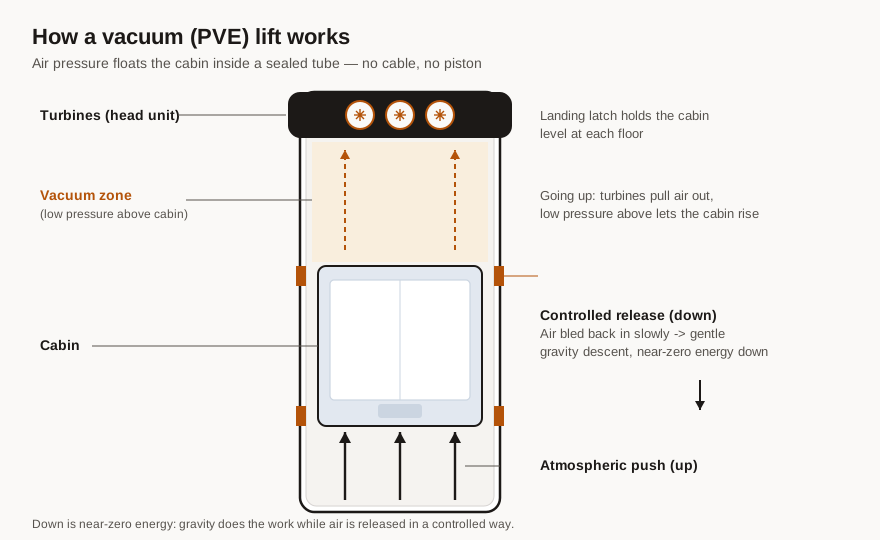
Because the tube is self-supporting and the cabin rides on air rather than ropes or a piston, there is no counterweight, no hydraulic oil and no overhead lifting machinery. The whole assembly stands on your finished floor.
The no-pit, no-shaft retrofit advantage
This is where the PVE earns its premium. Every other home lift wants something from your building structure: hydraulic and screw want at least a shallow 150–300 mm pit; traction wants a deeper pit plus headroom and a built hoistway. The PVE wants none of that.
| What the lift needs | Hydraulic | Traction (MRL) | Screw | PVE (vacuum) |
|---|---|---|---|---|
| Pit | 150–300 mm | 300–610 mm+ | 150–300 mm | None |
| Masonry shaft | Yes | Yes | Self-supporting | None (own tube) |
| Machine room | Cabinet | None (in hoistway) | None | None |
| Footprint (small unit) | Shaft-sized | Shaft-sized | Compact | ~1 m diameter |
| Civil work for retrofit | Heavy | Heavy | Moderate | Minimal |
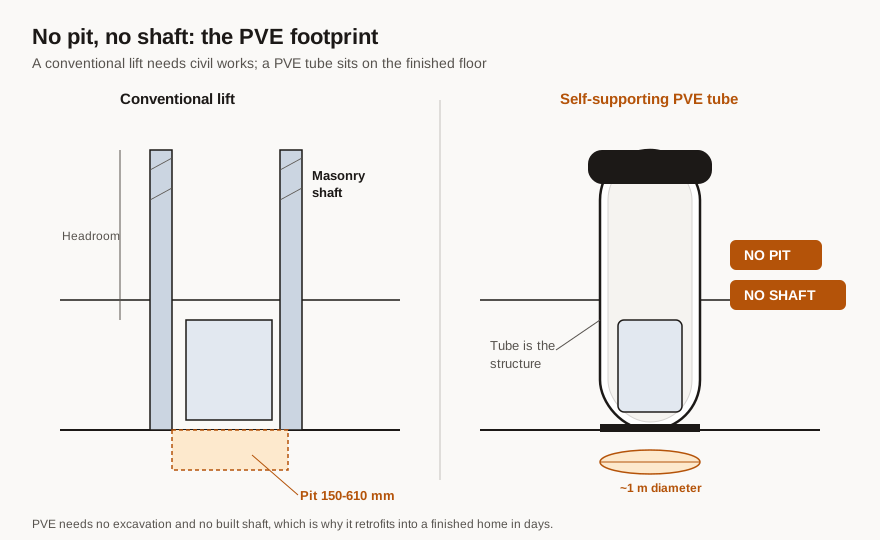
For a single-person unit the tube can be as slim as about 1 metre in diameter, dropped into a stairwell void, a corner, or a punched circular opening in the slabs. Installation is largely a mechanical assembly job measured in days, not the weeks of wet civil work a shaft demands. If your home is already built and you do not want to live on a construction site, this is the strongest argument any lift type can make.
The other genuinely shaftless-feeling option is the screw-driven lift, which is self-supporting and needs only a shallow pit. We compare them below; see also Screw-Driven Home Elevators in India — that is the choice when you want PVE-like low civil work but more capacity and load.
The limits you must accept
A PVE buys you easy installation by giving up capacity, travel and load. Be honest with yourself about these before you fall for the looks.
| Model class | Typical capacity | Best use |
|---|---|---|
| G1 | ~1 person | Single user, tightest footprint |
| G2 | ~2 persons | Couple, light luggage |
| G3 | ~3 persons | Small family; near the PVE ceiling |
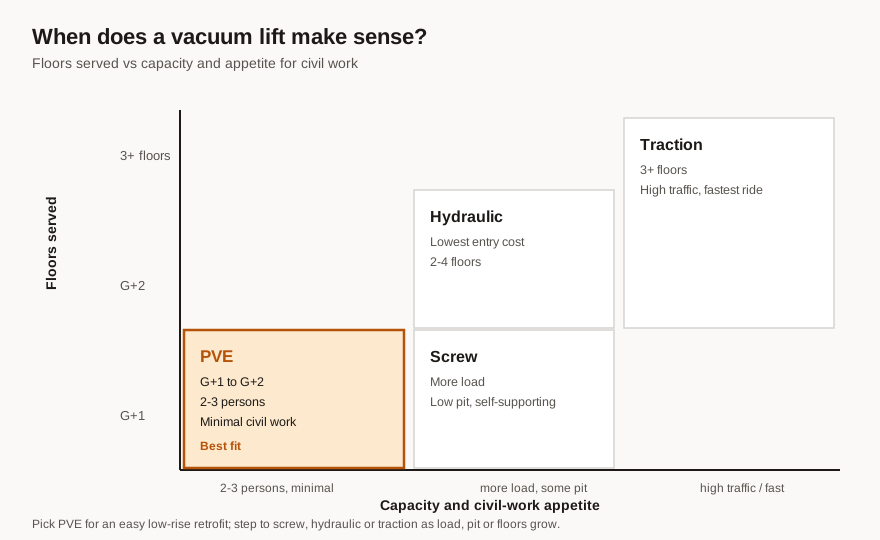
- Capacity caps out at roughly 2–3 persons. It is not a wheelchair-plus-attendant lift in the way a 1100 by 1400 mm full-cabin car is. If full RPwD wheelchair accessibility is the goal, a PVE is usually the wrong type.
- Travel is short, typically 3–5 floors. It suits a G+1 or G+2 home, not a tall stack.
- Power on ascent is higher than a counterweighted traction lift, though descent is almost free. Net running cost is modest for a low-rise home.
- Acrylic tube maintenance: the transparent panels need gentle, scratch-aware cleaning, and the air seals are wear items to service.
Choose a PVE for what it is brilliant at — effortless retrofit, a small footprint and a 360-degree panoramic ride — not as a substitute for a high-capacity traction lift.
The panoramic look
The cylindrical transparent tube gives a true 360-degree panoramic view as you ride. Many homeowners buy the PVE as much for this as for the engineering: it reads as a glass capsule floating between floors and becomes a centrepiece in a double-height living space. If your interest is mainly the look rather than the air-drive mechanism, the glass-cabin design guides cover the aesthetic choices in depth — this guide stays focused on the PVE machine itself.
What it costs in India (June 2026)
| Item | Indicative range |
|---|---|
| PVE unit (G1–G3) | ₹11–22 lakh |
| GST | +18% |
| Installation / minor civil | Extra (modest vs other types) |
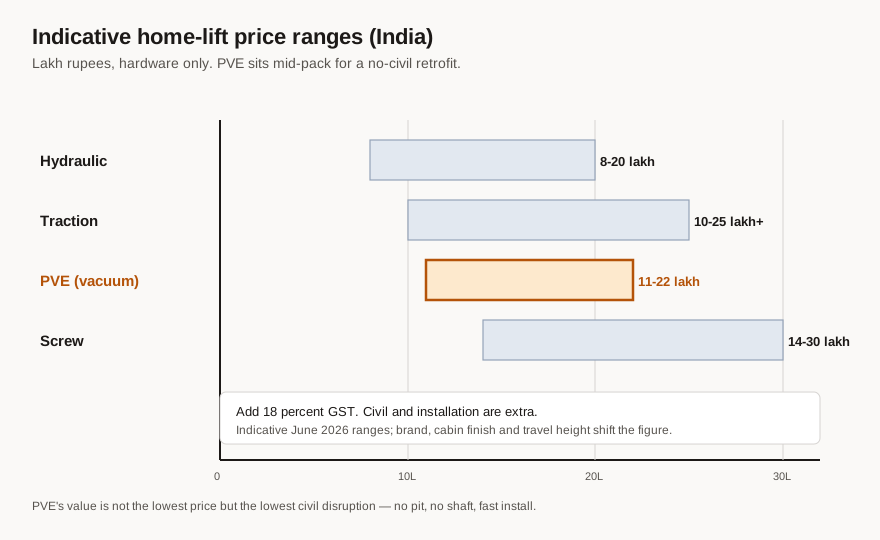
All figures are indicative for June 2026 — confirm with itemised quotes from a licensed lift contractor. A genuine PVE saving over other types is the near-absence of civil work: no pit excavation, no shaft masonry, no machine-room build. The trade-off is that the unit price per person carried is high, because you are paying for the engineering, not the cabin size.
In India the best-known home-grown PVE brand is Nibav; Elite Elevators and several others also sell vacuum lifts. We deliberately do not quote any single brand's model specifications here — get them in writing on your quote. To price your specific scenario, use the Home Lift Cost Calculator, and to weigh PVE against the alternatives see the comparison pillar, Types of Home Lifts Compared (India).
Standards, safety and licensing
Since 22 December 2025, IS 17900 is the mandatory standard for all new lift installations, safety components and major modernisations in India — and its special-lift parts explicitly bring home lifts into scope, so a PVE is covered. IS 17900 is based on the European EN 81-20 / EN 81-50 benchmark and supersedes the older IS 14665 and IS 14671 (now superseded). It mandates modern protection including UCMP (Unintended Car Movement Protection — the car must not move with doors open) and ACOP (Ascending Car Overspeed Protection). Non-compliance risks penalties, rejected occupancy certificates and invalidated insurance, so insist your installer certifies to IS 17900.
A few PVE-specific safety notes:
- A pneumatic lift fails safe by physics: if power is lost, the controlled valve simply lets the cabin descend gently to the lowest landing rather than dropping. Still, confirm the brake and landing-latch behaviour in your model.
- In India's outage-prone reality, ask how the unit lands and opens on a power cut — the equivalent of an Automatic Rescue Device (ARD) behaviour.
- Lifts are state-regulated: roughly ten states (Maharashtra, Karnataka, Tamil Nadu, Delhi, Gujarat, Kerala and others) require an installation licence, operation registration and periodic inspection by the State Lift Inspectorate. Check your state's Act before commissioning.
NBC 2016 Part 8, Section 5 governs lift installation in buildings, and for any home where an ageing or disabled family member is the reason for the lift, weigh PVE capacity against the RPwD Act 2016 and CPWD Harmonised Guidelines accessibility benchmarks — a PVE often will not meet the full wheelchair-plus-attendant car size.
Verdict: when a PVE is the right call
Pick a vacuum (pneumatic) elevator when your home is already built, you want minimal civil work, you have a G+1 or G+2 layout, two or three riders is enough, and you want a panoramic design statement. If you need more capacity, full wheelchair accessibility, or to climb four-plus floors with heavy daily traffic, look at traction or screw-driven instead.
Studio Matrx's DesignAI can help you visualise where a slim transparent PVE tube would sit in your actual room before you ever call a vendor.
References
- IS 17900 mandatory since 22 Dec 2025, EN 81-20/50, UCMP, ACOP (Elevator World): https://elevatorworld.com/article/indias-elevator-revolution-why-is-17900-is-the-biggest-market-opportunity-since-eu-harmonization/
- IS 17515 energy performance of lifts (Elevator World): https://elevatorworld.com/article/new-indian-standard-is-17515-on-energy-performance-of-lifts-escalators-moving-walks/
- BIS National Building Code 2016: https://www.bis.gov.in/standards/technical-department/national-building-code/
- Lift regulations in India (99acres): https://www.99acres.com/articles/know-all-about-the-lift-regulations-in-india.html
- Maharashtra licence to operate a lift (National Govt Services Portal): https://services.india.gov.in/service/detail/maharashtra-license-to-operate-lift
Export this guide
Related Guides — Deep-dive reading
Types of Home Lifts in India (2026): Complete Comparison and How to Choose
All seven home-lift options on one comparison table, plus a five-question decision framework to pick the right one
Home Lifts & AccessibilityResidential Elevator Standards in India (2026): IS 17900, NBC and What Governs a Home Lift
The consolidated standards map for a home lift — IS 17900 (mandatory since 22 December 2025), IS 17515, NBC 2016 Part 8 Section 5, the RPwD/CPWD accessibility rules, the state Lift Acts and the EN 81-20/50 / ISO 8100 lineage, and which one governs what.
Home Lifts & AccessibilityHome Lift Planning Checklist (India): Everything to Decide Before You Buy
A printable, ten-stage checklist that takes you from the first family conversation to a signed handover.
Home Lifts & AccessibilityRelated Tools — Try Free
Accessibility Compliance Calculator
Check a planned lift against the CPWD and RPwD accessible-lift benchmarks for a score.
Lift CheckerHome Lift Cost Calculator
All-in home lift cost by floors, type, capacity and city — equipment, civil, GST and AMC, with a drive-type comparison.
Lift CalculatorHome Lift Comparison Tool
Compare hydraulic, traction, pneumatic vacuum and screw lifts side by side for your home.
Lift Comparison