
Outdoor Residential Lifts (India): Weatherproofing, IP Ratings and Materials
How to spec an external home lift that survives monsoon rain and coastal salt — IP ratings, metallurgy, seals and drainage.
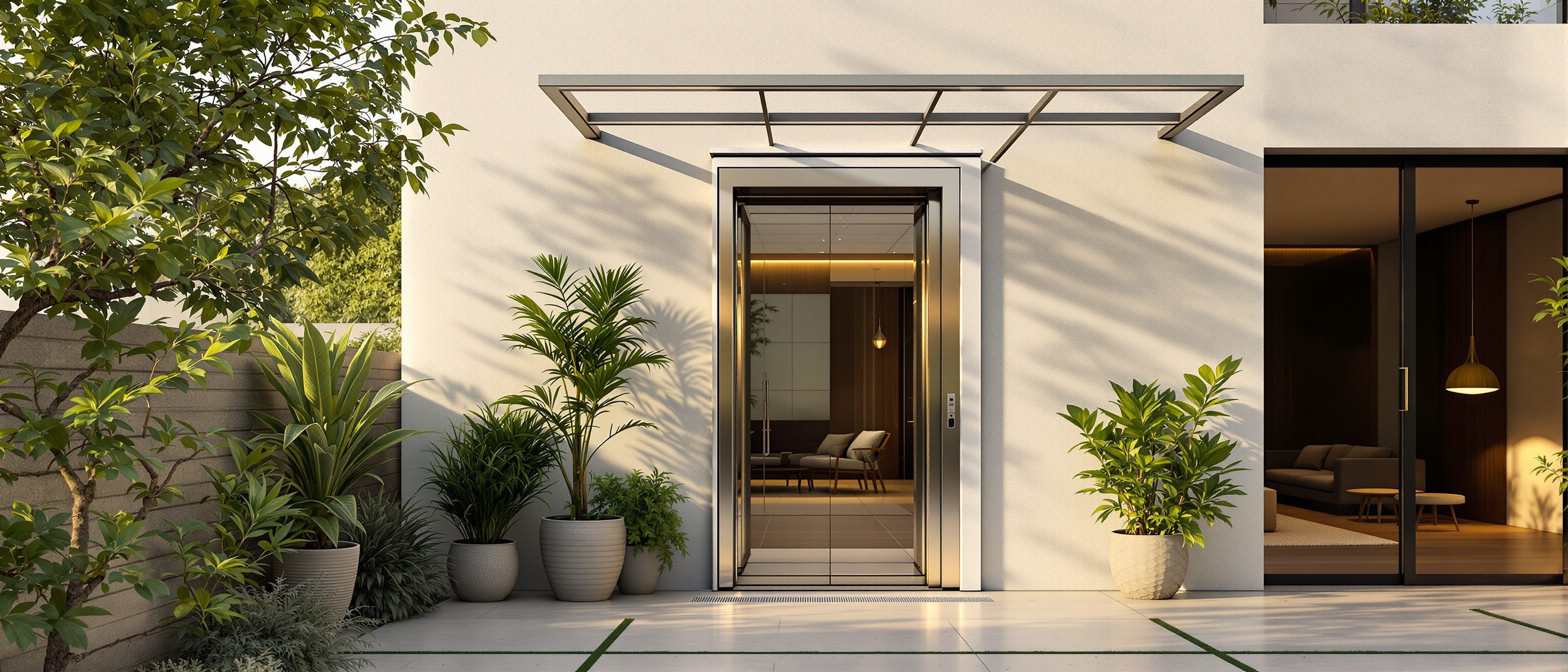
A home lift mounted outdoors solves the problems no indoor shaft can: reaching a terrace garden when the staircase stops at the last bedroom, retrofitting access onto a finished house with no room to carve out a hoistway, or linking the split levels of a hillside plot where the front door and the kitchen sit a full storey apart. Park it on the rear elevation, beside a deck, or in a side-yard, and you gain a floor without losing a single square foot of living space.
But the moment a lift leaves the conditioned interior, a new adversary takes over. Not gravity, not load — water and salt. India's monsoon dumps months of driving rain; coastal air carries chloride that eats ordinary mild steel; condensation forms inside control boxes overnight. An outdoor lift is, at heart, an indoor lift that has been engineered to keep all of that out. This guide is about exactly that engineering: the IP ratings, the metallurgy, the seals and drains and heaters that decide whether your outdoor lift lasts twenty years or rusts in three.
The enemy outdoors is not the climb. It is corrosion and water ingress. Specify for those two threats and everything else follows.
For how the four drive types actually move a car, read the mechanism overview at How Home Lifts Work in India; to weigh drive types side by side, see the Types of Home Lifts comparison pillar. This guide goes deeper on one axis only — surviving the weather — which those guides do not cover.
Why put a lift outdoors at all?
| Scenario | Why outdoors wins |
|---|---|
| Terrace / rooftop access | Stair often ends at the top floor; an external lift carries to the roof slab or garden |
| Retrofit into a finished home | No need to demolish interior floors for a shaft — mount against an external wall |
| Split-level / hillside plot | Connects a lower drive court to an upper living level directly |
| Garden-to-deck or basement-to-garden | Short rise, awkward grade, no indoor route |
| Heritage or compact homes | Interior is too precious or too tight to lose to a hoistway |
The trade-off is exposure. Everything below is the price of admission.
IP ratings: the single number that matters most
Ingress Protection (IP) ratings tell you how well an enclosure resists solids (first digit) and water (second digit). For an outdoor lift, the second digit is everything.
| IP rating | Water protection | Use outdoors? |
|---|---|---|
| IP54 | Protected against splashing water from any direction | Minimum — acceptable under a canopy, inland |
| IP55 | Protected against low-pressure water jets | Good for monsoon-exposed inland sites |
| IP65 | Dust-tight and protected against water jets | Preferred — controllers, junction boxes, exposed coastal sites |
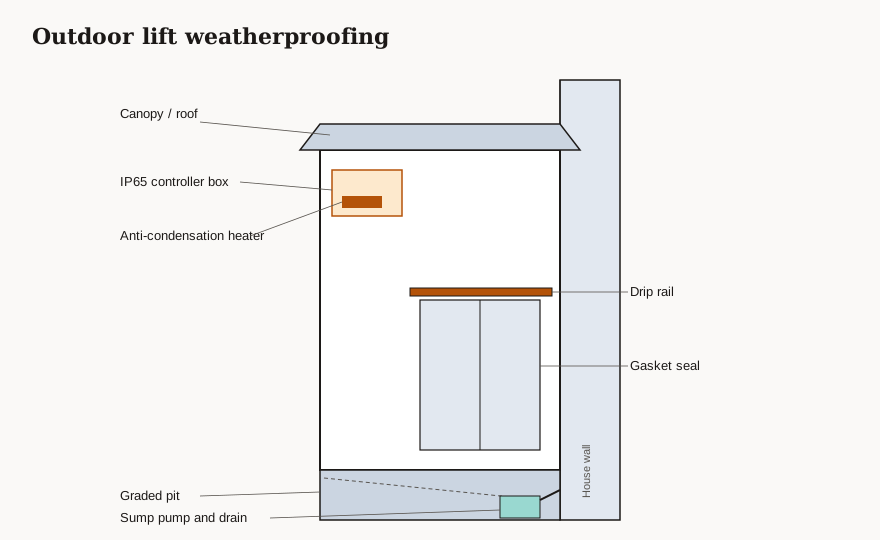
Specify IP54 as the floor and IP65 wherever water can pool, jet or wind-drive — that means the controller cabinet, every junction box, the door operator and the call/landing stations. A glass cabin that looks beautiful is worthless if the controller behind it is only splash-rated and sits in the path of a monsoon gust.
Materials by climate: the metallurgy decides the lifespan
Indoors, mild steel with a coat of paint lasts indefinitely. Outdoors it does not. Match the metal to the air.
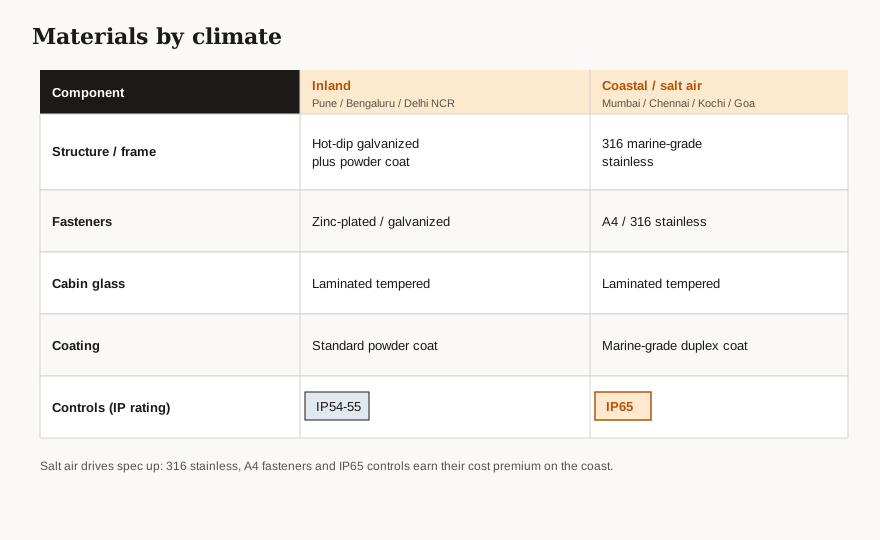
| Component | Inland (Pune, Bengaluru, Delhi NCR) | Coastal / salt air (Mumbai, Chennai, Kochi, Goa) |
|---|---|---|
| Structure / frame | Hot-dip galvanized steel + epoxy or polyester powder coat | Hot-dip galvanized steel plus marine-grade 316 stainless at exposed fixings |
| Fasteners and trim | Stainless 304 acceptable | 316 stainless mandatory (304 pits in chloride air) |
| Cabin glass | Laminated tempered safety glass | Laminated tempered safety glass (same) |
| Coating | Powder coat over galvanizing | Marine-grade powder coat; re-inspect coating annually |
| Controls | IP54–IP55 | IP65, sealed, with anti-condensation heater |
Two rules carry most of the weight:
- Hot-dip galvanized steel + epoxy/polyester powder coat is the baseline structural spec everywhere outdoors. Galvanizing protects the steel; the powder coat protects the galvanizing and gives you colour.
- In coastal or salt-laden air, step exposed steel and all fasteners up to marine-grade 316 stainless. Chloride finds every scratch in a coating; 316 resists it where 304 will not.
Cabin glazing is laminated tempered safety glass in both cases — tempered for strength, laminated so it holds together if struck.
Keeping water out: seals, drip rails, drainage and a roof
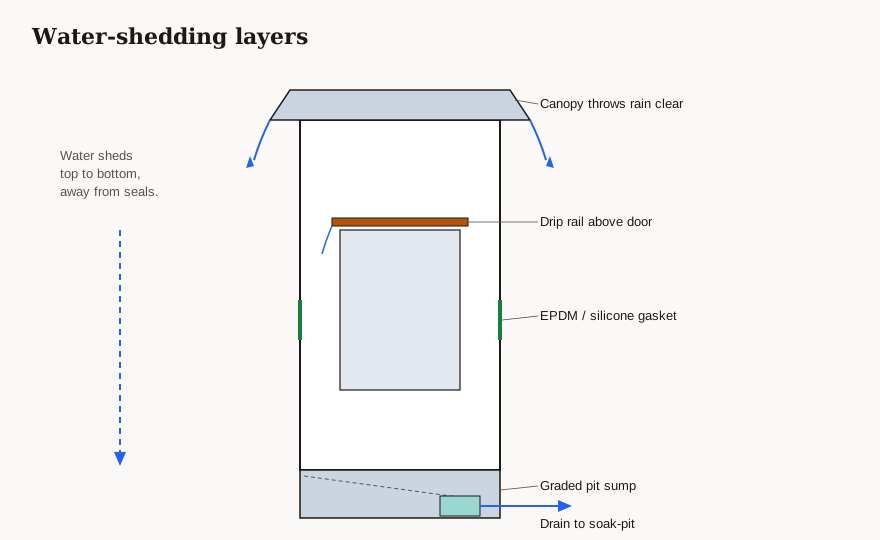
A rated enclosure is only half the battle; the structure has to shed water before it ever reaches a seal.
- Gaskets seal every door, panel and cabinet joint — EPDM or silicone, not foam that crushes flat in a year.
- Drip rails are the unsung hero: a small projecting lip above doors, cabinet lids and the cabin roof line that throws run-off clear of the seal below instead of letting it track in.
- Pit drainage is non-negotiable. An outdoor pit will take water — design a graded sump with a drain or a float-switched sump pump so the pit never floods. Pit flooding is also a classic "act of God" exclusion in maintenance contracts (see below), so prevention is on you.
- A canopy or roof over the top landing and the machinery is the cheapest weatherproofing you can buy. It keeps direct rain off the doors and lets you safely run lighter IP ratings on sheltered components.
Anti-condensation heaters
In damp and monsoon climates the threat is not only the rain you can see. Overnight, warm humid air cools inside a sealed controller cabinet and condenses on the electronics — corrosion and faults follow. A small anti-condensation (trickle) heater inside the controller and motor enclosures keeps the internal air a few degrees above dew point and dry. On the Konkan coast, in Kerala, across the monsoon belt, treat it as standard, not optional.
Which drive types suit the outdoors?
The honest answer: any drive type can go outdoors if it is properly weatherised. That said, two are natural fits because they are shaftless and self-supporting, so there is less civil structure to waterproof.
| Drive type | Outdoor fit | Notes |
|---|---|---|
| Pneumatic vacuum (PVE) | Excellent — common pick | Sealed tube, no pit, no shaft, self-supporting; easiest retrofit; 2–3 persons, ~3–5 floors |
| Enclosed platform lift (VPL) | Excellent — common pick | Full hoistway, minimal pit, slow, low cost; weatherise the enclosure |
| Screw / winding-drum | Good | Self-supporting, low pit, compact; weatherise structure and controller |
| Hydraulic | Workable | Watch oil-temperature swings outdoors; protect the power pack |
| Traction (MRL) | Workable | More pit and headroom; ropes need protection from rain and salt |
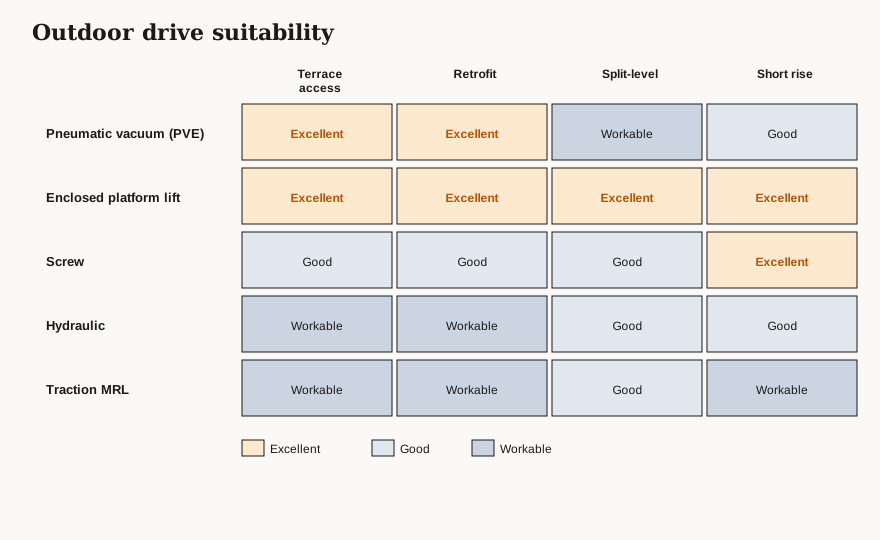
The pneumatic vacuum elevator is the most common shaftless outdoor pick — its sealed acrylic-and-aluminium tube is already weather-resistant and it needs no pit or shaft to waterproof. For a deep dive on that technology, see Vacuum (Pneumatic) Elevators for the Home; here we cover only what changes when you take one outdoors. Enclosed platform lifts are the budget shaftless choice for a short rise.
Standards still apply outdoors
Going outdoors does not exempt you from the rulebook. IS 17900 is the current mandatory standard for all new lift installations, safety components and major modernisations in India since 22 December 2025. Built on the EN 81-20 / EN 81-50 benchmark, it folds in the older IS 14665 (traction) and IS 14671 (lifts for persons with disabilities), now superseded, and adds UCMP (Unintended Car Movement Protection) and ACOP (Ascending Car Overspeed Protection). Its special-lift parts explicitly cover home lifts. Non-compliance can mean penalties, a rejected occupancy certificate and invalidated insurance — so insist your installer certifies to IS 17900.
Layered on top: NBC 2016 Part 8 Section 5 for lift installation, and — in roughly ten states with lift Acts (Maharashtra, Karnataka, Tamil Nadu, Delhi and others) — an installation licence, operation registration and periodic inspection by the State Lift Inspectorate. And do not skip the ARD (Automatic Rescue Device): an outdoor lift on the Indian grid will see outages, and the battery that brings the car to the nearest floor and opens the doors is essential everywhere.
The cost premium
An outdoor lift costs more than the same unit indoors — the weatherproofing is real engineering, not a sticker.
| Drive type | Indicative cost (indoor base) |
|---|---|
| Hydraulic | ₹8–20 lakh |
| Traction / gearless | ₹10–25 lakh+ |
| Pneumatic vacuum (PVE) | ₹11–22 lakh |
| Screw / winding-drum | ₹14–30 lakh |
Budget a weatherproofing premium over the equivalent indoor unit for IP65 controls, galvanizing-plus-powder-coat, 316 stainless in coastal air, canopy, drip rails, pit drainage and anti-condensation heaters.
All figures are indicative June 2026 — confirm with itemised quotes from a licensed lift contractor. GST at 18% applies; civil work (any foundation, pit, drainage and electricals) and installation are extra. Model your numbers, weatherproofing premium included, with the Home Lift Cost Calculator.
Maintenance in monsoon and coastal India
Outdoor exposure shortens service intervals and lengthens the checklist.
- Inspect coatings and seals every monsoon — touch up any galvanizing scratch or powder-coat chip before it rusts; replace any gasket that has gone hard.
- Test the pit drain and sump pump before the rains, not during them.
- Verify the anti-condensation heater works at each visit through the wet months.
- In coastal sites, freshwater-rinse exposed stainless and structure periodically to wash off chloride deposits.
- Read your AMC fine print: pit flooding is a common "act of God" exclusion even in comprehensive contracts (typically ₹20,000–38,500/year for a small residential lift), so the drainage you install is your real insurance.
The bottom line
An outdoor home lift is an indoor lift dressed for the weather. Get three things right and it will last: IP65 controls, galvanized-and-powder-coated steel (316 stainless on the coast), and a water-shedding envelope of drip rails, gaskets, pit drainage and a canopy — with anti-condensation heaters wherever the air is damp. Choose a shaftless drive like a vacuum or enclosed platform lift to minimise the civil structure you have to waterproof, certify the whole thing to IS 17900, and budget the weatherproofing premium honestly.
Planning where an external lift lands on your elevation, and how it reads against your facade, is exactly the kind of question Studio Matrx's DesignAI can sketch through with you before you call a contractor.
References
- IS 17900 mandatory since 22 Dec 2025 / EN 81-20/50, UCMP, ACOP (Elevator World): https://elevatorworld.com/article/indias-elevator-revolution-why-is-17900-is-the-biggest-market-opportunity-since-eu-harmonization/
- IS 17515 energy performance of lifts (Elevator World): https://elevatorworld.com/article/new-indian-standard-is-17515-on-energy-performance-of-lifts-escalators-moving-walks/
- BIS National Building Code 2016: https://www.bis.gov.in/standards/technical-department/national-building-code/
- CPWD Harmonised Guidelines (barrier-free environment): https://www.cpwd.gov.in/Publication/Harmonisedguidelinesdreleasedon23rdMarch2016.pdf
- Lift regulations in India (99acres): https://www.99acres.com/articles/know-all-about-the-lift-regulations-in-india.html
Export this guide
Related Guides — Deep-dive reading
Types of Home Lifts in India (2026): Complete Comparison and How to Choose
All seven home-lift options on one comparison table, plus a five-question decision framework to pick the right one
Home Lifts & AccessibilityHome Lift Planning Checklist (India): Everything to Decide Before You Buy
A printable, ten-stage checklist that takes you from the first family conversation to a signed handover.
Home Lifts & AccessibilityLift Safety Standards Every Homeowner Should Know (India)
The plain-language homeowner digest of what IS 17900, mandatory since 22 December 2025, actually requires on your new home lift, and the four pieces of compliance proof you can verify or ask your vendor for.
Home Lifts & AccessibilityRelated Tools — Try Free
Home Lift Comparison Tool
Compare hydraulic, traction, pneumatic vacuum and screw lifts side by side for your home.
Lift ComparisonHome Lift Cost Calculator
All-in home lift cost by floors, type, capacity and city — equipment, civil, GST and AMC, with a drive-type comparison.
Lift CalculatorLift Safety Audit Checklist
Interactive checklist that scores your home lift on safety devices, compliance and upkeep.
Checklist