
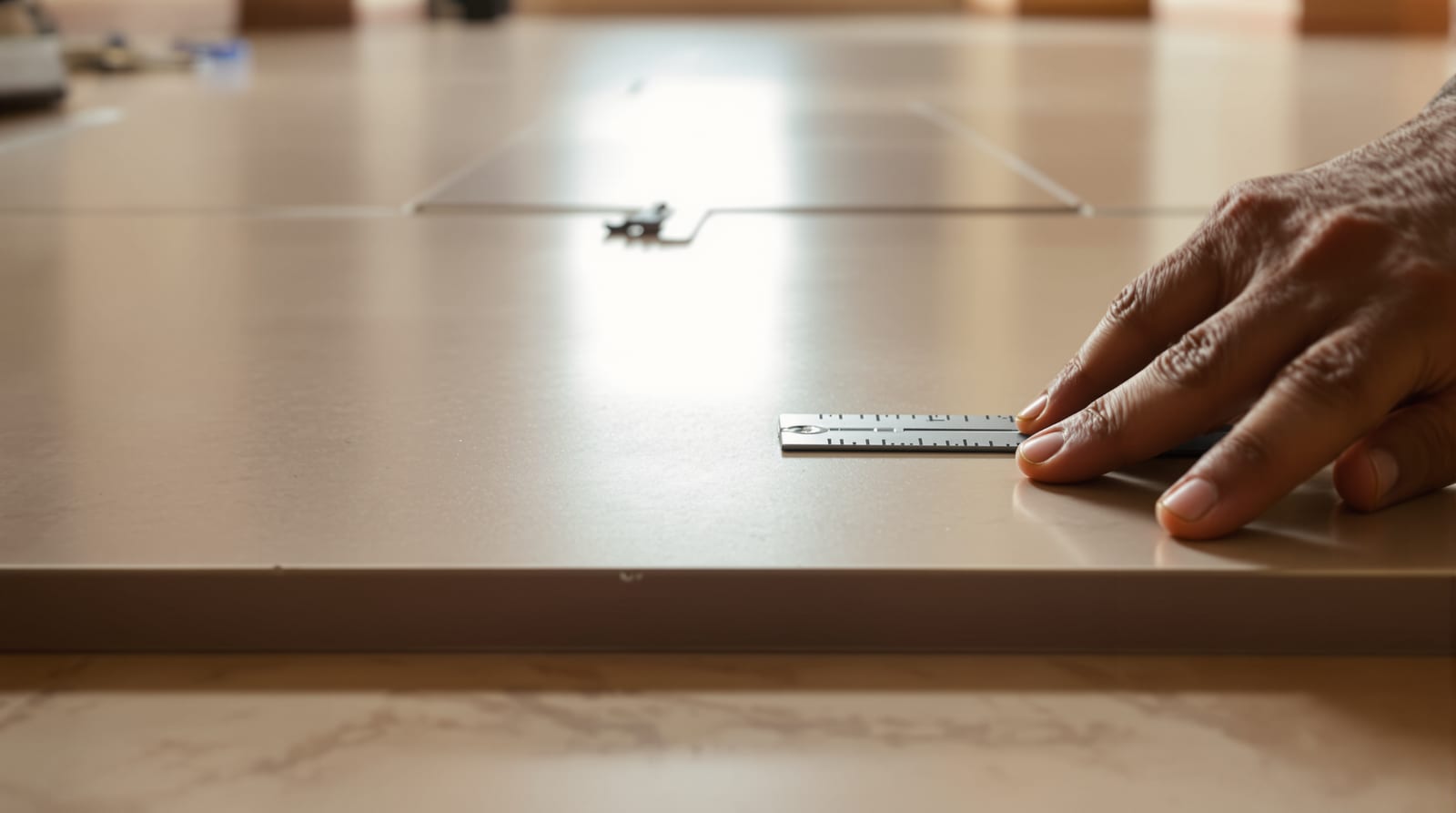
Tile Quality Test Guide: Lab Tests & On-Site Checks (India)
How tiles are tested under IS 13630 and how a buyer can judge quality on site before laying.
A good tile and a poor one can look identical in a showroom. The difference shows up only under load, water and wear, which is exactly what laboratory testing measures and what you can partly mimic on site. This guide explains how tile quality is actually tested in India under IS 13630, what each test proves, and the quick checks you can run on a box of tiles before a single one is laid.
Knowing even the headlines of these tests changes how you shop. Instead of trusting a salesperson's word, you can ask for the right number, then verify it crudely yourself with a tap, a sight-line and a drop of water.
How tiles are tested: the IS 13630 family
In India, pressed ceramic and vitrified tiles are specified by IS 15622, which sets the pass/fail limits, while the physical and chemical tests themselves are defined in the multi-part standard IS 13630 (aligned with the ISO 10545 series). When a manufacturer prints a spec sheet or a test certificate, every number on it traces back to one of these test methods. Genuine, BIS-certified tiles carry the ISI mark because ceramic and vitrified tiles fall under a Quality Control Order, so the first quality signal is simply the presence of that mark.
The tests below are run on samples in a lab. You will rarely repeat them at home, but understanding what each one proves lets you read a spec sheet and choose the right buyer proxy.
Water absorption: the master property
Water absorption is the single most important tile number because it predicts density, strength, stain resistance and frost resistance all at once. The lab boils or vacuum-saturates dried tiles, then weighs the water taken up as a percentage of dry weight. Lower is denser and tougher. IS 15622 (per ISO 13006) sorts tiles into groups by this figure: Group BIa at 0.5 percent or less (fully vitrified porcelain, best for floors), BIb at 0.5 to 3 percent, BIIa at 3 to 6 percent, BIIb at 6 to 10 percent, and BIII above 10 percent, which is wall-tile territory only.
For a home floor, insist on BIa or BIb. The buyer proxy is the back-of-tile water-drop test described later: a drop that vanishes into the biscuit signals high absorption.
Breaking strength and modulus of rupture
These two tests measure how much load a tile takes before it snaps. Breaking strength is the force in newtons applied across the tile on a three-point rig; modulus of rupture (MOR) converts that force into stress in N/mm2, normalising for thickness. Dense floor tiles routinely show breaking strength well above the minimums and MOR figures of 35 N/mm2 and up for vitrified. A higher number means a tile survives point loads, a dropped vessel or an uneven sub-floor better. On site you cannot test this, but the ring test below catches tiles already cracked from rough handling.
Surface abrasion: PEI for glazed, mm3 for full-body
Wear resistance decides how long a floor keeps its finish. Glazed tiles are rated by the PEI scale (ISO 10545-7), which spins an abrasive load across the glaze and grades the visible wear: PEI 0 and I for walls, PEI II for light foot traffic, PEI III for normal homes, PEI IV for heavy domestic and light commercial, PEI V for shops and offices. Choose PEI III or higher for living areas and PEI IV to V for entrances, kitchens and commercial floors. Full-body and double-charged vitrified tiles, where the colour runs through, are not given a PEI grade; their wear is measured as deep-abrasion volume loss in mm3 (lower is better).
Slip resistance
Slip data matters most in bathrooms, balconies, kitchens and outdoor areas. The common methods are the DIN 51130 ramp test, which grades shod slip from R9 to R13, and DIN 51097 for barefoot wet areas graded A, B and C, plus the wet pendulum (PTV) used in some specs. For Indian homes, aim for R10 or higher in wet rooms and R11 to R12 for terraces and pool surrounds. NBC 2016 and the accessibility guidelines also push anti-slip, level floors for safety.
Chemical, stain and crazing resistance
Chemical resistance (IS 13630 / ISO 10545-13) checks whether acids, alkalis and household cleaners attack the surface; stain resistance (ISO 10545-14) checks whether common stains wipe off. Crazing resistance (ISO 10545-11) is a thermal-shock test on glazed tiles: samples are autoclaved and inspected for the fine hairline cracks in the glaze called crazing. A tile that crazes will show spidery cracks over time even without impact. Dimensional checks (ISO 10545-2) round out the set, measuring length, width, thickness, straightness of edges, rectangularity and surface flatness (warpage and centre curvature).
Lab test to buyer proxy: the quick-reference table
The value of all this is being able to translate a lab test into a check you can do, or a question you can ask the dealer, before you buy.
| Lab test (IS 13630 / ISO) | What it proves | Buyer proxy on site or at the counter |
|---|---|---|
| Water absorption (group BIa to BIII) | Density, strength, stain and water resistance | Ask the absorption group; drop water on the unglazed back, fast soak = porous |
| Breaking strength / MOR | Load and impact resistance | Ask for N or N/mm2 on spec sheet; ring test rejects pre-cracked pieces |
| PEI abrasion (glazed) | Surface wear life | Ask for PEI III+ for floors; check glaze for visible scuffing |
| Deep abrasion mm3 (full-body) | Wear of through-body vitrified | Ask for mm3 figure; lower is better |
| Slip resistance (R / A-B-C / PTV) | Safety when wet | Ask for R10+ wet areas; feel the texture, run a wet finger |
| Chemical and stain resistance | Cleanability, acid and cleaner attack | Rub a sample with lemon or mild acid on a spare tile; wipe a marker |
| Crazing / thermal shock | Glaze hairline cracking over time | Inspect glaze under angled light for spider cracks |
| Dimensional, warpage, calibre | Flat, square, same-size lay | Sight along the surface; stack two face-to-face; check calibre on box |
On-site checks any buyer can do
You do not need a laboratory to weed out bad tiles. A handful of two-minute checks, done in daylight on the actual lot you are buying, catch most defects.
The ring or tap test
Hold a tile by one corner, let it hang free, and tap the centre with a coin or knuckle. A dense, sound tile gives a clear, bright ring. A dull, flat thud means a hairline crack, a lamination flaw or a low-fired biscuit, so reject it. Spot-check several tiles from each box; transport cracks are common.
Sight-along for warpage and bowing
Lift a tile to eye level and look across the glazed face along its length, then its diagonal, against a window or a straight edge. A flat tile shows an even surface; a warped one will dip or hump in the middle, which causes lippage (uneven edges) after laying. You can also place two tiles face-to-face: flat ones sit flush with no rocking; bowed ones gap at the centre or rock at the corners.
Water-drop on the back
Turn a tile over and put a few drops of water on the unglazed biscuit. On a dense vitrified tile the water beads and sits; on a porous, high-absorption tile it soaks in and darkens the surface within seconds. This is a rough field version of the lab absorption test and quickly separates floor-grade from cheap, thirsty tiles.
Edge straightness and squareness
Stack four tiles into a square on a flat surface. Edges should meet cleanly with no gaps, and the four-tile block should have square corners. Rectified tiles, with mechanically ground edges, give the tightest joints. Bowed or out-of-square tiles leave triangular gaps that no grout line can hide.
Shade and lot across boxes
Open more than one box and lay six to eight tiles together in daylight, not under shop tubelights. Tiles are fired in batches, so colour and pattern shift between dye-lots. Confirm every box carries the same shade code and calibre (size batch) printed on the carton, buy from a single lot, and keep 5 to 10 percent spare for breakage and future repairs. Mixing calibres is a leading cause of lippage.
Calibre, thickness and the ISI mark
Read the carton. It should state the size, calibre, shade, thickness and the BIS ISI mark with the IS number (IS 15622 for ceramic and vitrified). Reject unmarked tiles and "seconds" or factory-defect lots for main living areas; keep those only for utility or hidden spaces if at all.
Putting it together before you commit
Run these checks on the actual lot, not a polished display piece. A short routine works well: confirm the ISI mark and absorption group, ring-test a few tiles per box, sight along for warpage, drop water on the back, square up four tiles, and compare shade across boxes in daylight. Note any defect rate; more than the odd cracked tile per box is a quality red flag worth raising before payment. To track all of this on the day, use the Studio Matrx flooring quality checklist, and pair it with the tile water absorption classifier and tile PEI grade selector to match the spec to your room.
For the standards and grading behind these tests, see the deep dives on the IS 15622 tile standard, tile water-absorption groups, PEI ratings and BIS marking for flooring. For the buying side, read tile grades and sorting, how to spot fake tiles and the broader flooring quality inspection guide.
Frequently asked questions
What is the single most important tile quality test for a home floor?
Water absorption. It predicts density, strength, stain resistance and durability in one figure. For floors choose Group BIa (0.5 percent or less) or BIb (0.5 to 3 percent). You can roughly verify it by dropping water on the unglazed back: dense tiles bead, porous tiles soak it up fast.
How does the ring or tap test work and what does it catch?
Hold a tile by a corner so it hangs free and tap the centre with a coin. A clear bright ring means the tile is sound and dense; a dull thud means a hidden hairline crack, a lamination flaw or a low-fired biscuit. It is the fastest way to reject damaged or weak tiles before laying.
What PEI rating should I buy for my rooms?
PEI grades glazed-tile surface wear. Use PEI III for normal living areas and bedrooms, and PEI IV to V for entrances, kitchens, balconies and any commercial floor. Walls can use PEI 0 to II. Full-body and double-charged vitrified tiles are rated by deep-abrasion mm3 instead, where a lower number is better.
How do I check tiles for warping on site?
Lift a tile to eye level and sight along its surface against a window or straight edge; a flat tile looks even, a warped one dips or humps in the middle. Or place two tiles face-to-face: flat ones sit flush, bowed ones rock or gap at the centre. Warping causes lippage and uneven joints after laying.
Why do tiles from different boxes look slightly different?
Tiles are fired in batches, so colour and pattern vary between dye-lots and calibres. Always check the shade and calibre codes on each carton, buy from a single lot, lay several tiles from different boxes together in daylight before committing, and keep 5 to 10 percent spare for repairs.
Export this guide
Related Guides — Deep-dive reading
How to Choose Bathroom Tiles India: A Buyer's Spec-by-Spec Guide (2026)
A buying decision guide for bathroom tiles — floor vs wall selection, the specs to check before you pay (water absorption, PEI, R-rating, shade batch, thickness), good/better/best rupee tiers, how much to buy, and how to spot seconds and off-shade lots.
BathroomsCeramic Tile IS Standards India: IS 15622, IS 13630, IS 13712 & BIS Marking Explained
A professional reference to the Indian Standards that govern bathroom ceramic and vitrified tiles — IS 15622 water-absorption groups, IS 13630 test methods, IS 13712 classification, ISO 13006 alignment, the ISI/BIS mark, and PEI abrasion and slip-resistance parameters your spec should quote.
BathroomsHow to Buy Floor Tiles in India: The Complete Buyer's Playbook for Size, Spec, Grade, Quote & Delivery (2026)
From deciding size, finish, PEI and water-absorption group for each room to reading the box spec and ISI mark, matching calibre and lot, spotting seconds, and getting an honest all-in quote.
Flooring & SurfacesRelated Tools — Try Free
Cross-Ventilation Analyzer
Estimate airflow and air changes per hour (ACH) from room size, window areas, layout, and local wind — with NBC 2016 Part 8 compliance check.
Ventilation CalculatorTile Water Absorption Classifier
Classify a tile by its water-absorption percentage into its IS 15622 group and see where it can be used.
Flooring ToolFull-Room BOQ — Living, Bedroom, Kitchen, Bath
Room-wise BOQ across living, bedrooms, kitchen, utility, and bathrooms with line-item pricing.
Full-Room BOQ