
Tile Water Absorption Groups Explained: The One Spec That Predicts Strength & Where a Tile Can Go (India 2026)
Why a single percentage — BIa to BIII — tells you a tile's strength, stain and water resistance, and whether it belongs on a floor, a wet area or only a wall.
If you learn only one tile spec before you buy, make it water absorption. That single percentage — how much water the tile body soaks up by weight — quietly decides the tile's strength, its stain and water resistance, and whether it belongs on your living-room floor, in a wet bathroom, on an open terrace, or only on a wall. A dealer can charm you with shade and size; the absorption number tells you the truth about the tile underneath the glaze.
This guide explains the official groups — BIa, BIb, BIIa, BIIb and BIII — in plain language, shows you a thirty-second test you can do on the showroom floor, and tells you exactly which group to demand for each part of an Indian home.
What "water absorption" actually means
Every tile has a body (the clay-and-mineral biscuit) and usually a surface (a glaze or polished layer). When a tile is fired in the kiln, its body becomes more or less dense depending on the raw mix and the firing temperature. The denser it is, the fewer tiny pores remain inside — and pores are where water, dirt and stains hide.
Water absorption is measured by drying a tile, weighing it, soaking it (typically boiling or vacuum-saturating it), weighing it again, and expressing the weight gained as a percentage of the dry weight. A tile that gains 0.4% is almost glass-dense. A tile that gains 12% is a thirsty sponge by comparison. That is the whole idea: low number equals dense, strong, water- and stain-resistant; high number equals porous, weaker, thirstier — and therefore wall-only.
This matters in India for a very practical reason. Our floors meet mop water, monsoon damp, masala-tinted splashes, terrace rain and bathroom flooding. A porous tile in the wrong place crazes, stains, weakens and pops; the right group simply shrugs it all off for decades.
The groups: BIa to BIII
Tiles are classified by water absorption under ISO 13006, which India adopts through IS 15622 (the standard for pressed ceramic and vitrified floor and wall tiles). The pressed-tile "B" groups you will meet in any showroom are:
| Group | Water absorption (E) | Density / type | Strength & resistance | Best use |
|---|---|---|---|---|
| BIa | E ≤ 0.5% | Fully vitrified / porcelain (GVT, PGVT, double-charged) | Highest strength, frost and stain resistant, lowest porosity | Heavy-traffic floors, wet areas, balconies, terraces, outdoors, commercial |
| BIb | 0.5% < E ≤ 3% | Vitrified | Very strong, water and stain resistant | General home and light-commercial floors, wet areas |
| BIIa | 3% < E ≤ 6% | Stoneware-grade ceramic | Moderate strength, moderate water resistance | Indoor floors with normal foot traffic, walls |
| BIIb | 6% < E ≤ 10% | Earthenware-grade ceramic | Lower strength, more porous | Light-duty indoor floors, walls |
| BIII | E > 10% | Wall tile (monocottura/monoporosa) | Lowest strength, highly porous body | Walls only — never floors |
Two simple rules fall straight out of this table. First, lower absorption tracks higher strength: the same dense, low-pore body that refuses water also resists breaking and chipping, which is why BIa and BIb dominate floors. Second, the body is sealed by density, not by the glaze on top: a glaze can hide a porous body for a while, but once it chips or crazes, a BIII body drinks water and fails — which is exactly why high-absorption tiles are restricted to walls where nothing heavy ever lands on them.
Why low absorption suits floors, wet and outdoor areas
A floor takes pressure, mop water, dragged furniture and, outdoors, the freeze-and-bake of seasons. Water that soaks into a porous body expands when it warms or (in hill stations) freezes, and that internal stress cracks and pops tiles. A BIa porcelain body holds almost no water, so it stays dimensionally stable, resists frost in Shimla or Manali, ignores bathroom flooding, and does not stain when chai or turmeric sits on it. That is why every wet area, balcony, terrace and outdoor path should be BIa, and general home floors BIa or BIb.
Why high absorption suits walls
A BIII wall tile is deliberately porous. That sounds like a flaw until you realise a wall tile carries no foot load, never meets standing water on its face, and benefits from a lighter, thinner body that is easy to fix vertically and quick to fire cheaply. Its porous biscuit also grips tile adhesive beautifully on a vertical surface. Put that same tile on a floor and it cracks within a season — but on a kitchen backsplash or bathroom wall it lasts indefinitely.
The water-drop test you can do in the showroom
You do not need a lab to sort dense tiles from thirsty ones. Turn any unglazed-back tile over and try this:
1. Pour a tablespoon of water onto the raw (unglazed) back of the tile and wait two to three minutes.
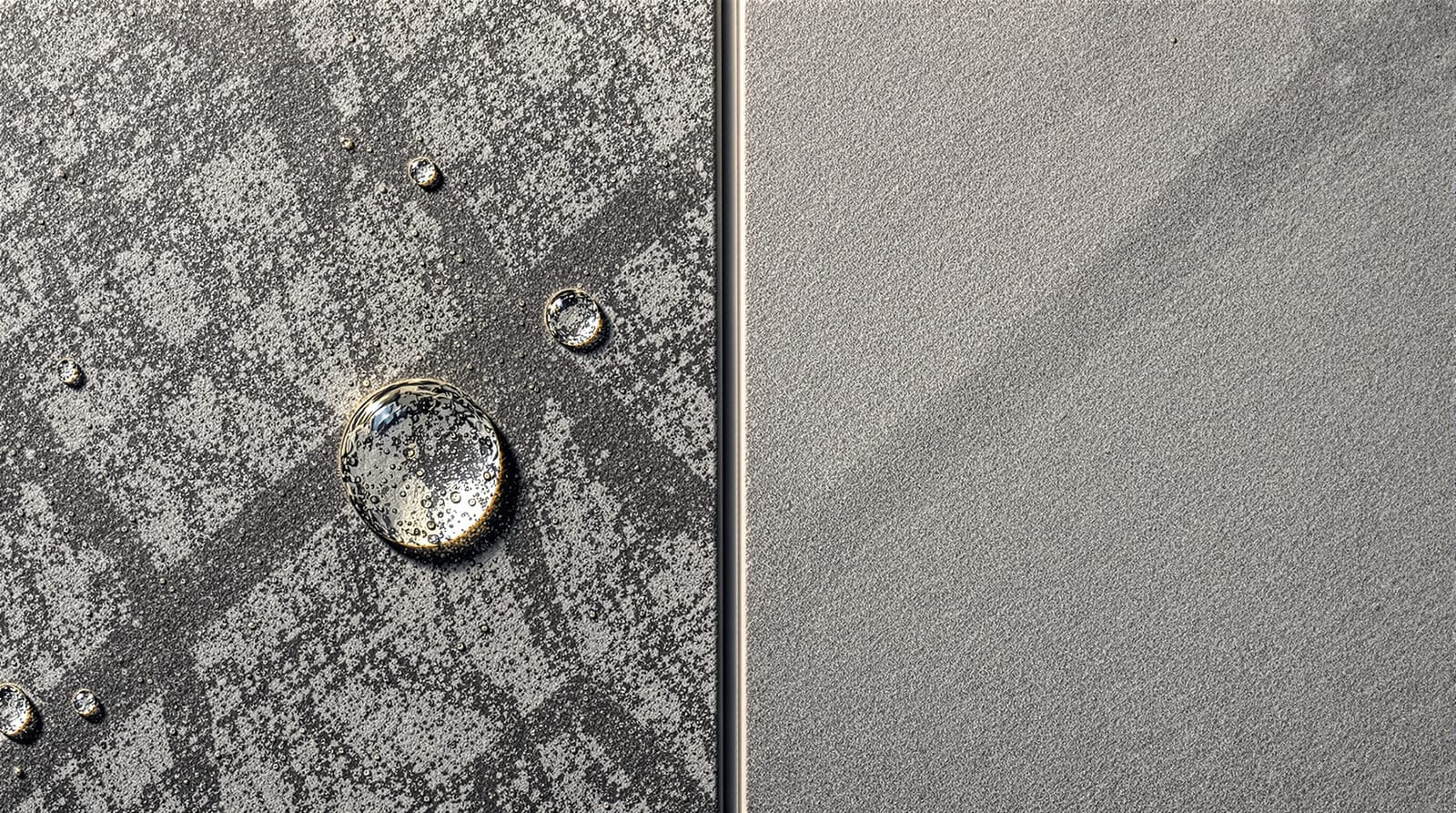
2. Wipe it off and look. On a BIa/BIb body the water beads and leaves the back almost unchanged — the surface stays dry-looking, the patch vanishes fast. On a porous BII/BIII body the water soaks in, leaving a dark damp patch that lingers.
3. For a sharper read, mark the dry weight idea mentally: a fully vitrified tile feels heavier and rings with a clear, high "ting" when tapped; a porous tile sounds duller and weighs less for its size.
This is a sorting test, not a certified measurement — but it instantly exposes a "vitrified" tile that is really a cheaper porous body. For the actual number, ask the dealer for the spec sheet and look for the water-absorption value and group.
How absorption relates to vitrified vs ceramic
People treat "vitrified" and "ceramic" as a quality ladder, but the real difference is water absorption. The word vitrified literally means glass-like: the body is fired hot enough to partly fuse into a near-glass, dense mass, landing it in BIa or BIb. Ordinary glazed ceramic is fired cooler with a more porous body, landing in BIIa, BIIb or BIII. Porcelain is simply the international name for the densest tier — BIa, E ≤ 0.5% — and includes India's GVT, PGVT and double-charged tiles.
So the marketing names map cleanly onto groups:
| Common name | Typical group | Typical absorption | Where it fits |
|---|---|---|---|
| Porcelain / full-body / double-charged | BIa | ≤ 0.5% | Any floor, wet, outdoor, commercial |
| GVT / PGVT (glazed vitrified) | BIa | ≤ 0.5% | Home floors, walls, wet areas |
| Vitrified (soluble-salt) | BIa–BIb | 0.5–3% | General home floors |
| Glazed ceramic floor tile | BIIa–BIIb | 3–10% | Indoor floors, walls |
| Glazed ceramic wall tile | BIII | > 10% | Walls only |
If you want the full comparison of these families, see our guides on ceramic vs porcelain tiles in India and vitrified tile flooring in India, plus the dedicated porcelain tile flooring guide. To check that a tile's claimed group is backed by a real standard and the mandatory BIS mark, read the IS 15622 tile standard explained and the broader flooring standards in India overview.
Which group for which room
A quick mapping for an Indian home, from wettest and busiest to driest and lightest:
| Area | Recommended group | Why |
|---|---|---|
| Bathroom / wet area floor | BIa | Constant water; needs lowest absorption + anti-slip surface |
| Balcony, terrace, outdoor | BIa | Rain, sun, monsoon; frost in hill stations |
| Living / dining / passage | BIa or BIb | High traffic; strength and stain resistance |
| Bedroom | BIb (BIa fine) | Lighter traffic but still a floor |
| Kitchen floor | BIa | Spills, grease, dropped utensils |
| Bathroom / kitchen wall | BIII (or any) | No load, vertical; porous body grips adhesive |
Notice the floor always wants BIa or BIb. Spend the difference on the floor groups; the wall is the one place you can safely use a cheaper, more porous tile. To turn a spec sheet into an instant verdict, our tile water absorption classifier lets you enter the absorption percentage and returns the group and safe uses.
Frequently asked questions
What water absorption is good for floor tiles in India?
For floors, choose BIa (≤ 0.5%) or at most BIb (0.5–3%). For bathrooms, balconies, terraces and outdoor areas, insist on BIa. Anything above 3% (BIIa and up) is best kept to indoor walls or very light-traffic rooms.
Is lower water absorption always better?
For floors, wet areas and outdoors, yes — lower absorption means denser, stronger, more stain- and frost-resistant tiles. For walls it does not matter much, so a porous BIII wall tile is perfectly fine there and usually cheaper. Match the group to the location rather than buying the lowest number everywhere.
How can I check water absorption without a lab?
Pour water on the unglazed back of the tile and wait a few minutes: a dense BIa/BIb tile stays dry-looking while a porous tile shows a lingering dark patch. Dense tiles also feel heavier and ring with a clear, high note when tapped. For the certified value, ask for the spec sheet and the IS 15622 / BIS marking.
Does vitrified mean the same as low water absorption?
Largely, yes. Vitrified tiles are fired to a near-glass density and fall in BIa or BIb (≤ 3%, often ≤ 0.5% for porcelain, GVT and double-charged). Plain glazed ceramic is more porous (BIIa to BIII). Always confirm the actual percentage, because some tiles are marketed as vitrified without meeting the BIa/BIb absorption limits.
Why are wall tiles allowed to absorb so much water?
Wall tiles carry no foot load and never have standing water sitting on their face, so a porous BIII body is no problem there — and its porosity actually helps adhesive grip the vertical surface. The same tile on a floor would soak up mop water, weaken and crack, which is why high-absorption tiles are restricted to walls.
Export this guide
Related Guides — Deep-dive reading
Ceramic vs Porcelain Tiles: Which Is Better? (India, 2026)
A fair, India-first head-to-head between glazed ceramic and porcelain (vitrified) tiles for bathrooms — water absorption, hardness and PEI, where each belongs on walls versus floors and wet versus dry zones, rupee costs, looks, availability and an honest verdict.
BathroomsIS 15622 Tile Standard Explained for Indian Buyers (2026)
What India's core ceramic and vitrified tile standard actually specifies — and how to read it off the box and spec sheet before you buy.
Flooring & SurfacesCeramic Tile IS Standards India: IS 15622, IS 13630, IS 13712 & BIS Marking Explained
A professional reference to the Indian Standards that govern bathroom ceramic and vitrified tiles — IS 15622 water-absorption groups, IS 13630 test methods, IS 13712 classification, ISO 13006 alignment, the ISI/BIS mark, and PEI abrasion and slip-resistance parameters your spec should quote.
BathroomsRelated Tools — Try Free
Tile Water Absorption Classifier
Classify a tile by its water-absorption percentage into its IS 15622 group and see where it can be used.
Flooring ToolApartment Furniture Size Chart
Standard furniture dimensions for Indian apartments — sofas, beds, tables, dining, storage.
Reference ChartFull-Room BOQ — Living, Bedroom, Kitchen, Bath
Room-wise BOQ across living, bedrooms, kitchen, utility, and bathrooms with line-item pricing.
Full-Room BOQ