
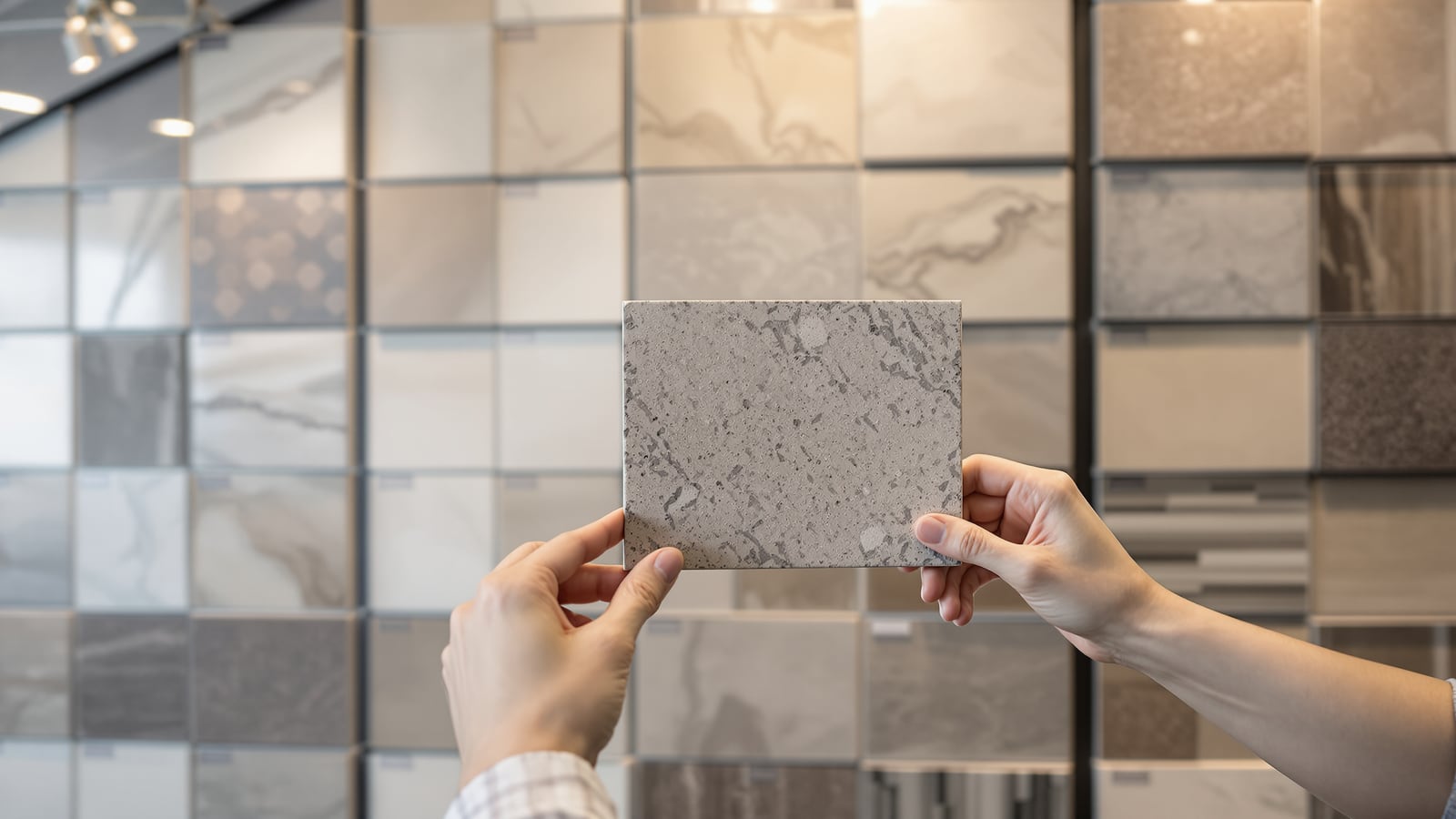
How to Choose Bathroom Tiles India: A Buyer's Spec-by-Spec Guide (2026)
A buying decision guide for bathroom tiles — floor vs wall selection, the specs to check before you pay (water absorption, PEI, R-rating, shade batch, thickness), good/better/best rupee tiers, how much to buy, and how to spot seconds and off-shade lots.
Tiles are the one bathroom purchase you buy by the box, live with for fifteen years, and cannot quietly swap out later the way you can a tap or a mirror. A showroom will happily sell you on colour, gloss and the picture on the sample board — none of which tell you whether the tile will survive a wet Indian bathroom. This is a buying guide, not a materials lecture: it walks you through the handful of specs that actually decide the purchase, what each rupee tier really gets you, how many boxes to order, and how to catch the seconds and off-shade lots that get mixed into cheap deals.
For the deep technical detail behind each spec, read this alongside Studio Matrx's component guides — the bathroom shopping guide for India for the whole-bathroom budget, the bathroom wall tiles guide and bathroom flooring guide for material choices, and the anti-skid bathroom tiles guide for slip ratings. This page is where you turn all of that into a purchase order.
The tile that looks identical on two sample boards can differ by a whole water-absorption class and two PEI grades. You are buying the printed spec, not the picture — so read the box before you read the mood board.
Step one: floor tile or wall tile? They are not interchangeable
The single most common buyer mistake is treating "bathroom tile" as one product. Floor and wall tiles are engineered for opposite jobs, and using one where the other belongs is how people end up with cracked floors or slippery deathtraps.
- Floor tiles must be dense, low-absorption and abrasion-resistant, and — critically in a wet bathroom — slip-resistant. They are thicker and heavier and are almost always vitrified/porcelain or a good full-body ceramic.
- Wall tiles carry no foot traffic, so they are thinner, lighter and usually glazed ceramic with higher water absorption. They can be glossy, because a wall never has to be walked on wet.
The classic Indian detail is therefore glossy easy-clean wall tiles above, matte or textured grippy floor tiles below. Never buy a glossy floor tile for a wet bathroom, however good it looks — and never assume a wall tile is rated to take the floor. If a salesperson offers you "one tile for everywhere," that is a convenience for their stock, not a spec for your bathroom.
The five specs to check before you pay
Learn to read these five numbers off the box and you buy like a professional. Everything else is aesthetics.
1. Water absorption group — the durability backbone
How much water the fired body soaks up decides frost resistance, strength and staining. Indian and ISO grades run from Group BIa (≤ 0.5 %, fully vitrified/porcelain) through BIb (0.5–3 %), BIIa/BIIb (3–10 %, standard glazed ceramic) to BIII (> 10 %, wall tiles only). For a bathroom floor, insist on BIa or BIb — a dense body will not drink up standing water and hard-water salts. A wall tile can be BIII quite happily. Low absorption is the number that most separates a tile that lasts from one that crazes and stains in three monsoons.
2. PEI / abrasion rating — for floors only
PEI (I to V) grades how well a glaze resists surface wear from foot traffic. A bathroom floor needs PEI III minimum; PEI IV is the safe home choice. PEI I–II are wall or light-decor tiles. It is meaningless for walls, so do not let a vendor upsell "PEI V" wall tiles — you are paying for a floor property you will never use on a wall.
3. Anti-slip R-rating — non-negotiable on floors
A wet bathroom floor is the most predictable fall hazard in the home. Ask for the R-rating (R9–R13 ramp) or DCOF (≥ 0.42) in writing: general floor R10 / DCOF ≥ 0.42, shower and health-faucet zone R11 / barefoot class B–C. No number means treat the tile as glossy and unsafe. The anti-skid bathroom tiles guide explains all three scales.
4. Size, and shade/lot batch matching
Tiles are fired in batches, and colour shifts subtly from batch to batch. Every box is printed with a shade code and a size/calibre code (the actual fired dimension, since a "600 mm" tile may measure 598 or 602). Buy your whole room in one shade batch and one calibre, bought in a single order — a top-up box six months later will almost never match. Bigger tiles mean fewer grout lines but need a flatter substrate and lose a little floor grip, so keep floor tiles moderate (300–600 mm) and use smaller formats in the shower.
5. Thickness
Thickness signals grade. Floor porcelain is typically 8–10 mm; wall ceramic 6–8 mm. Suspiciously thin, light "floor" tiles are usually wall stock or seconds being passed off — heft the tile and check the printed thickness.
| Spec on the box | Floor tile target | Wall tile target | Why it matters |
|---|---|---|---|
| Water absorption group | BIa / BIb (≤ 3 %) | up to BIII (> 10 %) OK | Density, staining, hard-water resistance |
| PEI / abrasion | III–IV | Not required | Foot-traffic wear resistance |
| Slip R-rating / DCOF | R10–R11 / ≥ 0.42 | Not required | Fall safety when wet |
| Thickness | 8–10 mm | 6–8 mm | Strength; spotting mislabelled stock |
| Shade + calibre code | One batch, one lot | One batch, one lot | Colour and size uniformity |
Good, better, best — what each rupee tier really buys
Prices are 2026 India retail per square foot for the tile alone (adhesive, grout and labour are separate). Brands such as Kajaria, Somany, Nitco, Orient Bell, Johnson and Simpolo span all three tiers; the tier is set by body, finish and spec, not just the badge.
| Tier | Floor tile ₹/sq ft | Wall tile ₹/sq ft | Typical spec | Best for |
|---|---|---|---|---|
| Good (value) | ₹40–₹70 | ₹35–₹60 | Glazed ceramic, BIIa–BIII, R9–R10, PEI III | Rental, budget refresh, guest bath |
| Better (recommended) | ₹80–₹150 | ₹60–₹120 | Glazed vitrified/porcelain, BIb, R10–R11, PEI IV | Most family bathrooms |
| Best (premium) | ₹160–₹400+ | ₹130–₹350+ | Full-body/GVT porcelain, BIa, R11, large-format, rectified | Master baths, resale-grade finish |
A practical rule: spend up on the floor, where density, PEI and slip really pay back, and you can save on the wall, where a mid glazed ceramic performs as well as a premium one. Don't over-buy R12 grit or PEI V for a home — that is showroom upselling, not need.
How much to buy — and why over-ordering is cheaper than under-ordering
Boxes are sold by coverage (e.g. "1.44 sq m per box"). Measure the floor and each wall run in square feet, subtract nothing for doors on the floor, then add a wastage margin: 10 % for a straight-lay, plain floor; 12–15 % for diagonal, herringbone, patterned or heavily cut small rooms. The cuts around the WC, drain and corners eat more tile than people expect.
Order the full quantity including wastage in one lot so every box shares a shade batch, and keep two or three spare tiles from that batch after laying — the day one cracks, a matching replacement is priceless and an off-batch top-up is obvious. Running short mid-job and buying a fresh batch is the number-one cause of a visibly two-tone floor.
A short order forces a second batch that will not match. Over-ordering by 10–15 % and keeping spares is the cheapest insurance in the whole bathroom.
Red flags: spotting seconds, off-shade lots and mis-sold stock
Discounted "deals" are often seconds (second-quality) — tiles with warpage, pinholes, glaze specks or size variation that failed first-quality sorting. They are legal to sell if marked, but should be priced far lower and never used on a feature floor. Watch for:
- No IS 15622 mark, no shade/calibre code, or a smudged box — first-quality tiles are clearly stamped.
- Mixed shade codes across boxes of the "same" tile, or a vendor reluctant to show you the codes.
- Lippage and rocking — lay four tiles on a flat floor; good calibrated tiles sit flush, seconds see-saw.
- Warped or bowed tiles — sight down the surface; a wet-floor tile that isn't flat traps water.
- Glaze pinholes, cracks, chipped edges, uneven size across the box, not just the top tile.
- "Floor and wall, same tile" pitches, or a glossy tile pushed for a wet floor.
- Vitrified sold as premium at ceramic spec — always cross-check the printed absorption group and PEI against the price.
Open and inspect boxes from the middle of the pallet, not just the display piece, and confirm in writing that you are buying first quality.
Certifications, warranty and what to ask the showroom
Insist on the IS 15622 mark (pressed ceramic tiles specification) — the umbrella standard that fixes water absorption, dimensions and surface quality — backed by the IS 13630 test methods for abrasion, absorption and friction. A tile carrying a genuine BIS/IS 15622 mark has been made to a measured spec, not just a colour.
Most manufacturers offer a glaze/wear warranty (often 10–15 years or "lifetime" on the fired body), but it typically covers manufacturing defects, not chipping from impact or bad laying — read what is actually covered. Good questions for the showroom:
- What is the water absorption group, PEI grade and R-rating of this exact tile?
- Is this first quality, and will you print the shade and calibre code on my bill?
- Can you supply the full quantity plus wastage from one shade batch today?
- What does the warranty cover, and who handles a defect claim — you or the maker?
- Is laying included, and who owns breakage during transit and fixing?
Online can beat showroom prices, but you cannot inspect boxes or verify a shade batch on a screen — for tiles, a physical showroom check before payment is worth the small premium.
References
- IS 15622 — Pressed ceramic tiles: specification (classification by water absorption groups BIa–BIII, dimensions, surface quality).
- IS 13630 — Ceramic tiles: methods of test (water absorption, surface abrasion/PEI, and friction methods).
- IS 15622 / ISO 13006 & ISO 10545 family — vitrified and porcelain classification and test methods referenced by Indian manufacturers.
- Bureau of Indian Standards (BIS) — certification and product marking scheme behind the IS mark on tile boxes.
- National Building Code of India (NBC 2016) — Part 3 and accessibility provisions relevant to safe, slip-resistant floor finishes.
Export this guide
Related Guides — Deep-dive reading
How to Buy Floor Tiles in India: The Complete Buyer's Playbook for Size, Spec, Grade, Quote & Delivery (2026)
From deciding size, finish, PEI and water-absorption group for each room to reading the box spec and ISI mark, matching calibre and lot, spotting seconds, and getting an honest all-in quote.
Flooring & SurfacesAnti Skid Bathroom Tiles India: R-Rating, DCOF & Where to Use Them (2026)
How slip resistance is really measured — the R9–R13 ramp scale, DCOF ≥ 0.42, and the wet barefoot A/B/C test — plus matte vs glossy, textured surfaces, grout and maintenance, rupee ranges and the Indian standards that back it all.
BathroomsCeramic Bathroom Tiles India: Water Absorption, Cost & Where They Suit (2026)
What ceramic tiles actually are (glazed earthenware), how water absorption groups under IS 13630 and IS 15622 decide where they belong, why they are the smart choice for bathroom walls and low-traffic floors, glazes, finishes, sizes, PEI ratings, rupee costs, and an honest comparison with porcelain and vitrified.
BathroomsRelated Tools — Try Free
Tile Water Absorption Classifier
Classify a tile by its water-absorption percentage into its IS 15622 group and see where it can be used.
Flooring ToolBathroom Tile Calculator
Tiles and boxes for a whole bathroom — floor plus wall (dado or full-height), separate tile sizes, opening deductions and wastage.
Bathroom CalculatorFlooring Cost Calculator
Estimate the all-in cost of a floor — material, laying, wastage, skirting and GST — by area and material.
Flooring Calculator