
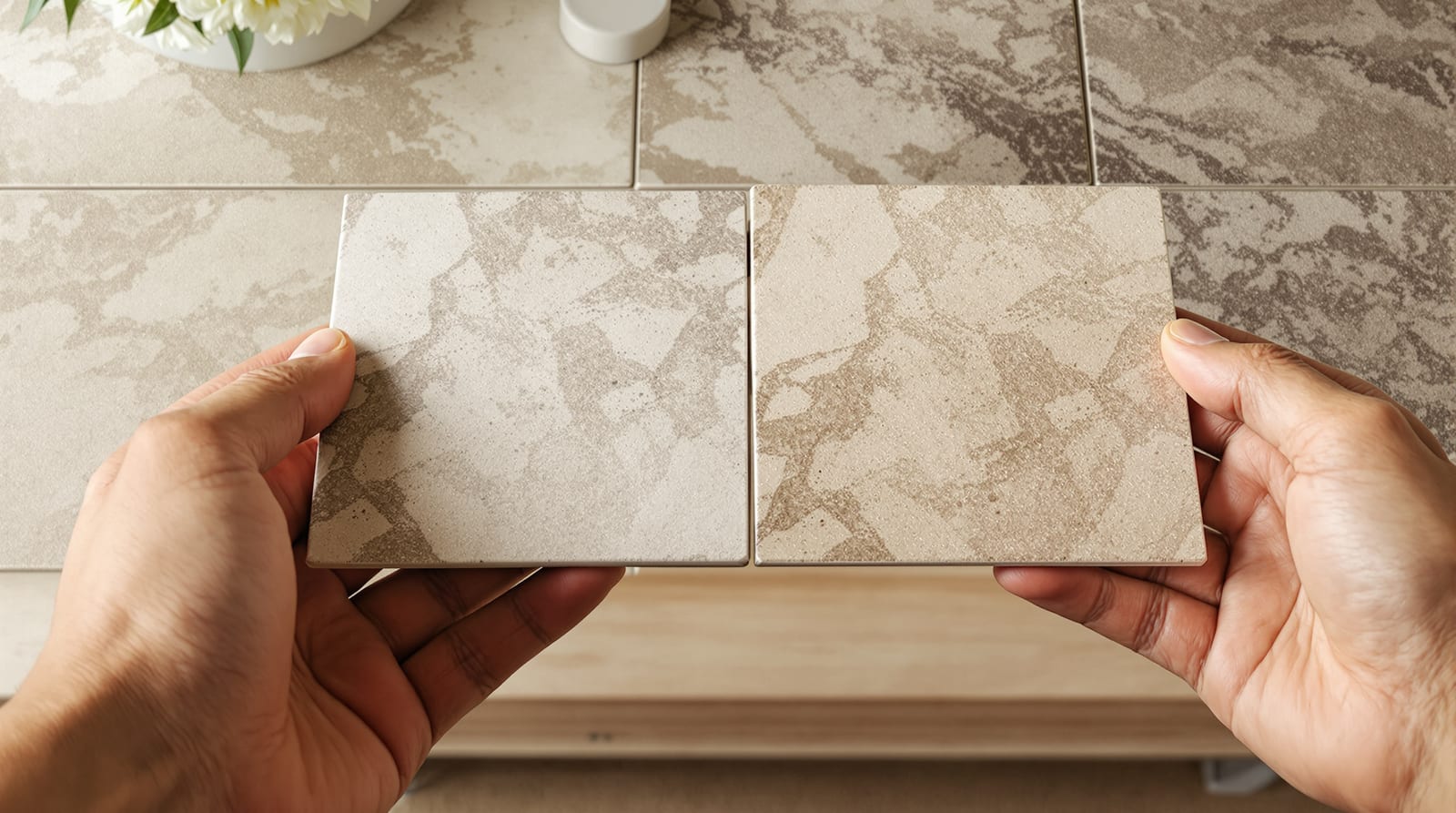
Spotting Fake Tiles in India: How to Catch Seconds, Fake ISI Marks, Misrepresented Stone and Under-Spec Tiles Before You Buy (2026)
The trader's tricks and the buyer's counter-tests: seconds sold as first quality, fake or absent ISI marks, branded-look unbranded tiles, mislabelled water-absorption and PEI, resin-filled marble, dyed granite and relabelled imported stone.
A tile showroom is a stage. Bright spotlights, a polished display panel, a confident salesperson and a price that feels like a steal all work together to hide the one thing that matters: whether the box you carry home matches the sample you fell for. Across India's tile and stone trade there is a thriving grey market of seconds dressed as first quality, porous bodies sold as vitrified, fake or photocopied ISI marks, dyed granite, resin-filled marble and "imported Italian" stone that never left Kishangarh. This guide names each trick and gives you the two-minute counter-test that catches it before money changes hands.
None of these checks need a lab. They need daylight, a coin, a drop of water, your phone and a habit of looking at the back of the tile, not just the face. Learn the dozen tricks below and you will out-inspect most dealers in the room.
Why fakes and misrepresentation are so common
Tiles and stone are bought rarely, in bulk, under time pressure, and judged almost entirely on a glossy face. That is the perfect environment for misrepresentation. A homeowner who tiles a house once a decade cannot tell a Group BIa porcelain from a thirsty BIIb ceramic by eye, cannot read a calibre code, and rarely asks for the spec sheet. The margin between a genuine first-quality lot and a defective or lower-grade one can be 30 to 50 percent, so the temptation to relabel is constant.
The trade has its own vocabulary for the lower rungs. "Seconds" are factory-rejected tiles with size, shade, warp or surface defects, sold cheap and legitimately as long as they are disclosed. The fraud is not that seconds exist; it is selling them as first quality, or mixing a few boxes of seconds into a first-quality order so the lippage and shade variation only appear after laying, when you have already paid. The same logic drives fake ISI marks, inflated PEI claims and stone relabelling. Your defence is to treat every claim as a question you can verify on the spot.
The trick-to-detection table
Here is the core of this guide: the common deceptions in the Indian tile and stone trade, and the specific check that exposes each one. Keep this list on your phone when you shop.
| The trick | How it is done | How to detect it on the spot |
|---|---|---|
| Seconds sold as first quality | Defective/reject lot relabelled or mixed into a first-quality order | Ask grade in writing on the bill; sight-along for warp; check shade and calibre across several boxes |
| Fake or absent ISI mark | No ISI mark, or a copied/photocopied IS 15622 mark with a bogus licence number | Find the ISI mark + CM/L licence number; verify it in the BIS Care app or BIS website |
| Porous body sold as "vitrified" | Cheaper ceramic body marketed as vitrified/porcelain | Water-drop test on the raw back; dense tile beads, porous tile soaks; dense tile rings, porous thuds |
| Branded-look unbranded tiles | Local tile printed to mimic a Kajaria/Somany design and box | Check brand, model and batch printed on the box; demand a GST invoice naming the brand |
| Mislabelled water-absorption / PEI | Spec sheet claims BIa or PEI IV that the tile cannot meet | Ask for the actual spec sheet and absorption group; back-water-drop proxy; ask for PEI for glazed |
| Under-spec thin tiles | 8 to 9 mm tile sold as standard floor thickness | Measure thickness with a vernier or against a known tile; thin tiles flex and crack |
| Colour-enhanced / dyed cheap granite | Pale or patchy granite dyed/treated to mimic premium black | Acetone/thinner on a hidden corner lifts dye; check cut edge colour matches the face |
| Resin-filled "marble" | Cracks and pits filled with tinted resin, sold as sound | Inspect full slab in daylight; tap for dull spots; look for glossy resin lines, off-tone fills |
| Reconstituted sold as natural | Engineered/agglomerated stone passed off as natural marble | Look for too-perfect, repeating veining; uniform colour; ask for natural-stone origin |
| Relabelled "imported Italian" | Indian or Vietnamese stone sold as Italian Carrara/Statuario | Ask for import documents/origin; verify veining character; price too low for true Italian |
| Mixed calibre / lot | Two size batches or dye-lots delivered as one | Check calibre code and shade/lot number on every box; insist on one lot plus spare |
| Short or wastage-padded quantity | Boxes short-counted, or area inflated on the quote | Count boxes, check coverage per box, measure your own area before ordering |
Spotting fake or misrepresented tiles
Ceramic and vitrified floor tiles fall under a Quality Control Order, which makes BIS (ISI) certification and marking mandatory for IS 15622, IS 13753, IS 13755 and IS 13756. That single fact gives you your strongest weapon: a genuine, legally-saleable floor tile must carry the ISI mark with a licence number, and you can check that number against the official register.
Verify the ISI mark with the BIS Care app
Do not accept the mere presence of an ISI logo. Counterfeiters print convincing logos all the time. The mark must be accompanied by the IS number (for floor tiles, IS 15622) and a CM/L licence number. Open the free BIS Care app, or the BIS portal, and enter the licence or CM/L number to confirm the manufacturer is actually licensed for that product. If the number does not resolve, is missing, or the seller gets defensive when you ask, treat the lot as unverified. Imports must comply too, so an "imported" tile with no Indian conformity is a red flag, not a premium.
The water-drop and ring tests for a fake "vitrified" tile
The most common tile lie is selling a cheap porous ceramic body as vitrified or porcelain. The physics gives it away in two minutes. Turn a tile over and pour a tablespoon of water on the raw, unglazed back. Wait two to three minutes, wipe it, and look: a genuine Group BIa or BIb body beads the water and the patch vanishes, while a thirsty body soaks it into a lingering dark stain. Then hold a tile by one corner, let it hang free, and tap the centre with a coin. A dense, sound tile gives a bright, clear ring; a porous, low-fired or hairline-cracked tile gives a dull thud. The water-drop separates dense from porous; the ring test rejects pre-cracked pieces. Neither is a certified measurement, but together they expose a porous body masquerading as vitrified.
Sight-along, thickness and the back of the tile
Lift a tile to eye level and look across the glazed face along its length and diagonal against a window. Flat tiles read even; warped tiles dip or hump in the centre, which becomes lippage after laying and is the classic signature of seconds. Stack two tiles face-to-face: flat ones sit flush, bowed ones rock. Measure thickness against a tile you trust or with a vernier; under-spec 8 to 9 mm tiles flex and crack on an imperfect bed. Finally, read the back. Genuine branded tiles carry the manufacturer name, logo, country and often a batch code moulded or printed on the reverse. A blank or crudely stamped back, or a box whose printed brand does not match the back-of-tile marking, points to a branded-look counterfeit. Insist on a GST invoice that names the brand, model and quantity; it is your proof of genuineness, warranty and input credit, and most counterfeiters will not issue one.
Spotting misrepresented marble and granite
Stone fraud is subtler than tile fraud because every natural slab is genuinely unique, which gives a dishonest dealer cover. The defence is to inspect full slabs in daylight, never a polished off-cut under a spotlight, and to know what each manipulation looks like up close.
Resin-filled "marble" and hidden cracks
Soft or fractured marble is routinely netted and flooded with tinted resin or epoxy to fill cracks and pits, then polished to hide the repair. A little resin treatment is normal and acceptable in modern processing; the fraud is selling a heavily filled, structurally weak slab as sound first quality. In daylight, hold the slab at an angle: resin lines catch the light differently from stone and often sit slightly proud or read as a faint off-tone seam following an old crack. Tap across the face; filled zones sound duller. A slab that is more filler than stone will crack again during cutting or after a few years of foot traffic, so reject heavily-resined pieces for floors.
Dyed and colour-enhanced granite
Pale, patchy or low-grade granite is sometimes dyed or chemically enhanced to mimic a premium uniform black or deep colour, so a cheap stone is sold at Absolute Black prices. The tell is the cut edge: on dyed stone, the sawn edge or an unpolished underside often shows the true, paler base colour that does not match the deep-dyed face. A cotton swab dipped in acetone or thinner, rubbed on a hidden corner, lifts surface dye and stains the swab. Genuine through-colour granite shows the same tone on face, edge and back. Ask to see the back and a fresh cut, not just the buffed display face.
Reconstituted and relabelled "imported Italian"
Two related stone lies are worth naming. The first is reconstituted or engineered stone, made from crushed marble chips bound in resin, sold as natural marble. Its tell is that the veining looks too perfect, too uniform and repeats from slab to slab, because it is manufactured; natural marble veining is irregular and never repeats. The second is the relabelled import: Indian, Vietnamese or Turkish stone sold as "imported Italian" Carrara or Statuario at a premium, when Kishangarh in Rajasthan, Asia's largest marble market, processes both genuine imports and Indian stone side by side. Ask for import documentation and origin; a true Italian slab carries a paper trail and a price that genuinely-cheap "Italian" never matches. If the veining character, the documents and the price do not line up, you are buying domestic stone at an import markup. Studio Matrx always recommends getting origin in writing on the quote.
Grades, calibre and the "mixed lot" trap
Even genuine, branded, ISI-marked tiles can disappoint if the lot is mismanaged. Tiles are sold as Premium, Standard, Commercial and Economy, with seconds below that. Two batch codes decide whether your floor lays flat and matches: calibre (the exact size batch) and shade or dye-lot. Mixing calibres causes lippage; mixing shade-lots gives a patchy floor under daylight. A dishonest or careless supplier delivers two calibres or two lots as one order, and the defect only appears after laying. Check the calibre code and shade-lot number printed on every single box, insist on one calibre and one lot, and buy 5 to 10 percent extra from the same lot as spare. Count the boxes against the coverage per box and your own measured area so you are neither short-counted nor billed for inflated wastage.
| Grade | What it really means | Safe use |
|---|---|---|
| Premium / first quality | Within spec on size, shade, warp, surface | Main living areas, anywhere visible |
| Standard | Minor cosmetic tolerance, still first quality | General home floors |
| Commercial / economy | Wider tolerance, budget body | Utility, store, low-visibility areas |
| Seconds | Disclosed factory rejects: warp, shade, surface defects | Only if disclosed and cheap; never main floors |
| Undisclosed seconds | Rejects sold or mixed in as first quality | The fraud this guide defends against |
Putting it together: a buyer's anti-fake routine
Before you pay, run a fixed routine. Find and verify the ISI mark and licence in the BIS Care app. Open several boxes from across the pallet, not just the top one, and check that brand, model, calibre and shade-lot match on every box and against the back of the tile. Run the water-drop and ring tests on a tile from a random box. Sight along three or four tiles for warp and measure thickness. For stone, inspect full slabs in daylight for resin lines, dyed edges, repeating veining and hairline cracks, and get origin in writing. Finally, take a written, GST-invoiced quote that names the brand, grade, quantity with spare, and a breakage and replacement policy. A seller who passes all of this is selling you what they claim; one who resists any step is telling you which trick they were counting on.
For the deeper version of any single step here, the companion guides go further: the full lab-and-site testing logic in our tile testing and quality guide, how the BIS marking on flooring works and how to verify it, the trade meaning of tile grades and sorting, slab-by-slab inspection in how to buy marble in India, the relabelling problem in detail in imported versus Indian flooring, and the end-to-end purchase in how to buy floor tiles in India. To turn this into a checklist you can carry, use the flooring quality checklist tool.
Frequently asked questions
How can I check if an ISI mark on a tile is genuine?
Look for the ISI mark printed with the IS number (IS 15622 for floor tiles) and a CM/L licence number on the box or tile. Then open the free BIS Care app or the BIS website and enter the licence or CM/L number; a genuine licence resolves to the named manufacturer and product. If the number is missing, will not verify, or the seller avoids the question, treat the lot as unverified and walk away.
Are "seconds" tiles always a bad buy?
No. Seconds are factory rejects sold cheap, and for a low-visibility utility area, a temporary floor or a small budget job they can be perfectly fine if disclosed. The fraud is selling seconds as first quality, or mixing a few boxes of seconds into a first-quality order so the warp, shade variation and lippage only appear after laying. Buy seconds knowingly, at a seconds price, never unknowingly at a first-quality price.
How do I tell dyed granite from genuine through-colour granite?
Check the cut edge and the unpolished back, not just the buffed face. Genuine granite shows the same colour through the whole stone, so face, edge and back match. Dyed or colour-enhanced granite often shows a paler true base colour on the sawn edge. A cotton swab with a little acetone or thinner, rubbed on a hidden corner, lifts surface dye and stains the swab on a treated stone.
Is "Italian marble" sold in India often fake?
Often it is relabelled rather than fake stone. Kishangarh in Rajasthan processes both genuine imports and Indian marble side by side, so Indian, Vietnamese or Turkish stone is sometimes sold as premium Italian Carrara or Statuario at an import markup. Ask for import documents and origin in writing, study the veining character, and be suspicious of "Italian" priced far below the real import range.
What is the single fastest test to catch a fake vitrified tile?
The back-of-tile water-drop test. Pour a tablespoon of water on the raw, unglazed back and wait two to three minutes. A genuine vitrified or porcelain body (Group BIa or BIb) beads the water and stays dry, while a cheap porous body soaks it into a lingering dark patch. Pair it with the ring test, where a dense tile rings bright and a porous or cracked one thuds dull.
Export this guide
Related Guides — Deep-dive reading
How to Buy Marble in India Without Getting Cheated (2026 Buyer's Guide)
Inspect full slabs in daylight, spot resin fills and the 'Italian marble' relabelling scam, read grades and thickness, and price a job all-in — from Makrana and Kishangarh to your floor.
Flooring & SurfacesHow to Buy Floor Tiles in India: The Complete Buyer's Playbook for Size, Spec, Grade, Quote & Delivery (2026)
From deciding size, finish, PEI and water-absorption group for each room to reading the box spec and ISI mark, matching calibre and lot, spotting seconds, and getting an honest all-in quote.
Flooring & SurfacesFlooring Buying Mistakes in India: 12 Costly Purchase Errors and How to Avoid Them (2026)
From ordering the exact area with no spare and losing the dye-lot, to mixing calibre, buying seconds for living rooms, skipping the ISI mark, paying full advance and ignoring transport and loading charges, here are the purchase mistakes that quietly inflate a floor's true cost.
Flooring & SurfacesRelated Tools — Try Free
Cross-Ventilation Analyzer
Estimate airflow and air changes per hour (ACH) from room size, window areas, layout, and local wind — with NBC 2016 Part 8 compliance check.
Ventilation CalculatorFlooring Cost Calculator
Estimate the all-in cost of a floor — material, laying, wastage, skirting and GST — by area and material.
Flooring CalculatorTile Water Absorption Classifier
Classify a tile by its water-absorption percentage into its IS 15622 group and see where it can be used.
Flooring Tool