

Tamil Nadu STP Rules & TNPCB Norms: The 2026 Compliance Guide
When a sewage treatment plant is mandatory in Tamil Nadu, how the TNPCB consent process (CTE and CTO) works, the discharge and reuse standards your treated water must meet, and what apartment owners and RWAs in Chennai, Coimbatore and beyond must actually do to stay compliant.
Tamil Nadu is one of India's most water-stressed states. Chennai's 2019 "Day Zero", when the city's four main reservoirs ran dry, is still fresh memory, and towns from Coimbatore to Madurai ration supply every summer. Against that backdrop, the state's regulator — the Tamil Nadu Pollution Control Board (TNPCB) — treats on-site sewage treatment not as red tape but as a survival tool. For most new apartment complexes, IT parks, hotels, hospitals and commercial buildings, a working Sewage Treatment Plant (STP) is now a hard condition of being allowed to build and operate.
This guide explains the Tamil Nadu STP rules in plain language: when an STP is mandatory, how the TNPCB consent process works, what standards your treated water must meet, and what owners and resident welfare associations (RWAs) actually have to do to stay on the right side of the law.
In Tamil Nadu, an STP is where three pressures meet: a regulator that must protect dying lakes, a state that cannot afford to waste a drop of water, and a building owner who cannot get an Occupancy Certificate without one.
Is an STP mandatory in Tamil Nadu?
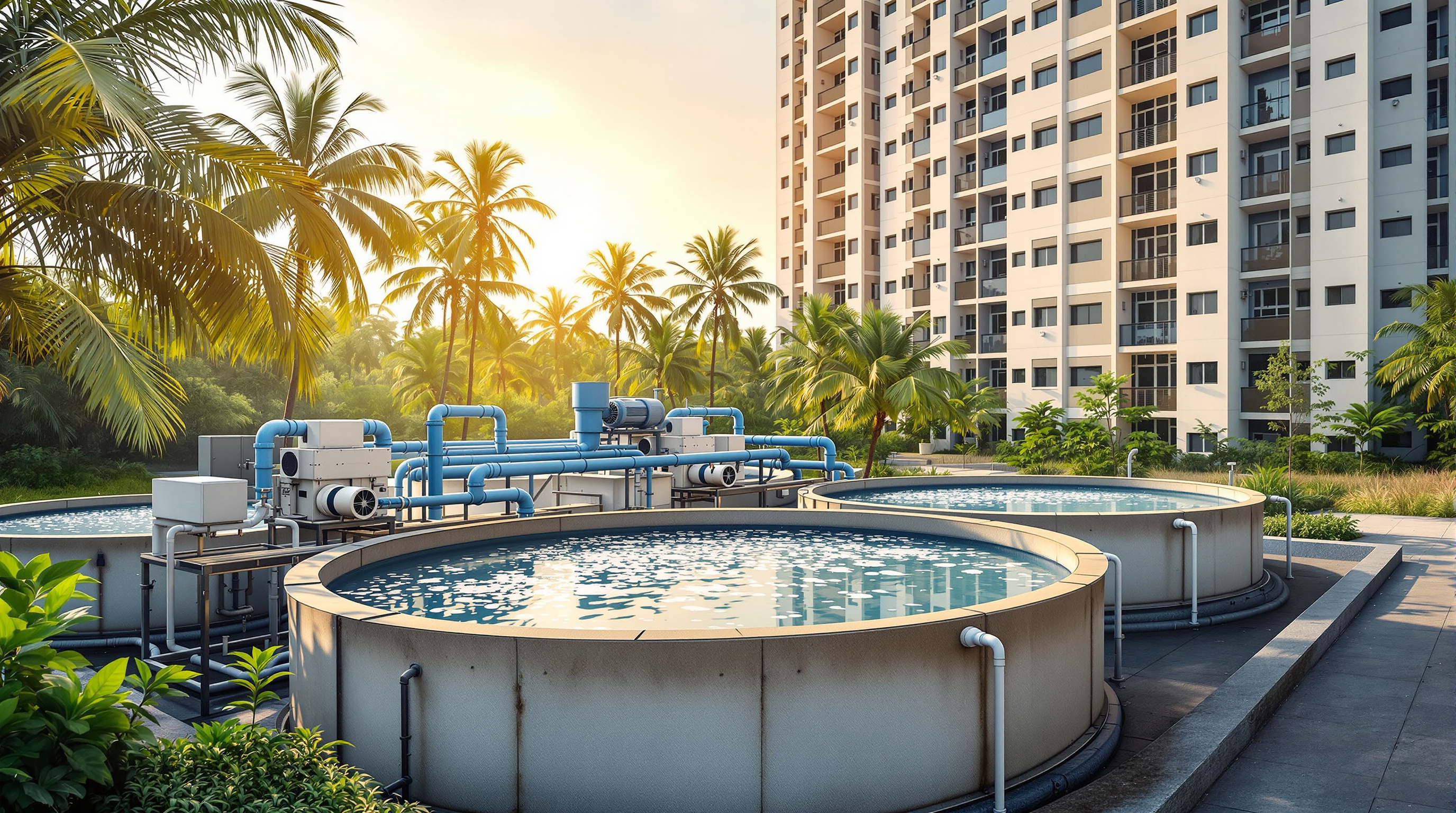
Yes — for most developments above a modest size. Tamil Nadu does not run a wholly separate rulebook from the national framework; it applies the Central Pollution Control Board (CPCB) baseline through TNPCB, layered with local building byelaws. The practical triggers are:
- Apartment and residential complexes — building rules mandate an STP for multi-storeyed and larger group-housing projects. In the Chennai Metropolitan Development Authority (CMDA) area, builders must demonstrate a working sewage connection or an STP, along with rainwater harvesting, to obtain the Occupancy Certificate (OC) — the document without which flats cannot be legally occupied (Citizen Matters).
- Commercial, institutional and IT buildings — TNPCB effectively requires STP installation for all commercial buildings generating sewage that is not fully absorbed by a public sewer.
- Large projects (built-up area of 20,000 sq.m and above) — these attract the heaviest scrutiny, including mandatory TNPCB consent, online monitoring, and prior Environmental Clearance under the national EIA framework (DT Next). For a deeper look at that route, see our guide on environmental clearance for STPs.
The safest reading: if your project generates sewage and is not fully served by a functioning municipal sewer, assume you need an STP and confirm the exact threshold with TNPCB and your local planning authority. For the national picture that sits underneath all of this, see STP regulations in India and the CPCB guidelines for STPs.
The TNPCB consent process: CTE and CTO
Every STP in Tamil Nadu needs two statutory consents from TNPCB, granted under the Water Act, 1974 and the Air Act, 1981. This two-stage structure is the heart of the state pollution control board approval system.
| Stage | What it is | When you need it |
|---|---|---|
| Consent to Establish (CTE) | A "No Objection" clearance granted after TNPCB reviews the site, the design and the pollution-control plan | Before any construction of the project or STP begins |
| Consent to Operate (CTO) | Confirmation that the STP was built as approved and can actually meet discharge standards | After installation, before the plant is put into regular use |
Our dedicated walkthroughs cover each in detail: Consent to Establish (CTE) and Consent to Operate (CTO).
Two Tamil Nadu specifics matter here:
- Category and renewal. TNPCB classifies projects by pollution potential (Red, Orange, Green, White). The consent is time-bound and must be renewed — Red category annually, and lower categories typically once every two years. Miss a renewal and your STP is technically operating without valid consent.
- The RWA carries the duty. For residential complexes, TNPCB has made clear that the owners' association must apply for, hold and renew the consent once the builder hands over. This is the single most common gap we see: the STP exists, but the RWA never took over the CTO. Our guide on apartment association STP compliance covers the handover checklist.
For an at-a-glance sense of how Tamil Nadu compares with its neighbours, the state-wise STP approval comparison sets it beside Karnataka, Kerala, Andhra Pradesh and Telangana.
Local byelaws and the authorities involved
An STP in Tamil Nadu is rarely a single-agency affair. In and around Chennai, a project owner typically deals with:
- CMDA / DTCP — the planning authority that ties STP provision to building-plan and Occupancy Certificate approval. Building byelaws set the physical requirement; see building byelaws and STP rules.
- TNPCB — consent (CTE/CTO), effluent standards and monitoring.
- CMWSSB (Chennai Metrowater) — sewer connection, and increasingly the recipient or regulator of any surplus treated water.
- Greater Chennai Corporation (GCC) and the local municipality/panchayat — local sanitation and enforcement.
Outside Chennai — in Coimbatore, Madurai, Tiruchirappalli, Salem and the fast-growing Tier-2 corridors — the Directorate of Town and Country Planning (DTCP) and the local corporation play the CMDA/GCC role, but the TNPCB consent requirement is identical statewide.
Discharge and reuse standards

Tamil Nadu applies the CPCB effluent standards for STPs. Treated water must consistently meet quality limits before it is reused or discharged. The commonly enforced parameters are:
| Parameter | Typical limit | Why it matters |
|---|---|---|
| pH | 5.5 – 9.0 | Keeps the water chemically safe for reuse and receiving bodies |
| BOD | < 10 mg/l | The headline measure of organic pollution — low BOD means well-treated water |
| COD | < 50 mg/l | Flags harder-to-digest and chemical load |
| TSS | < 20 mg/l | Controls cloudiness and settleable solids |
| Total Nitrogen | < 10 mg/l | Prevents nutrient pollution and algae blooms in lakes |
| Faecal Coliform | < 1,000 MPN/100 ml | Confirms pathogens have been killed |
These figures follow the national norms; the definitive, current numbers live in our treated-water quality standards guide and in TNPCB's own orders. Always verify the exact limits that apply to your category and receiving environment.
Reuse is strongly pushed in Tamil Nadu. Given the water scarcity, TNPCB and CMWSSB encourage — and for large complexes effectively expect — that treated water is recycled on site for toilet flushing, landscape and tree irrigation, common-area washing and groundwater recharge, rather than discharged. A well-run STP recovers 80–85% of a building's water consumption, which in a large Chennai complex can mean lakhs of litres reclaimed every month. To size a plant for your headcount, the STP capacity calculator turns occupancy into a required capacity in litres per day (CPCB assumes roughly 135–150 litres per person per day of sewage).
Monitoring, enforcement and the Tamil Nadu reality
Compliance does not end at commissioning. TNPCB requires periodic effluent testing — at least monthly for most STPs, more often for larger plants — and for big projects (notably those at or above 20,000 sq.m built-up area), an Online Continuous Effluent/Emission Monitoring System (OCEMS) that streams live data to the Board.
Enforcement in Tamil Nadu has sharpened, driven heavily by the National Green Tribunal (NGT) Southern Bench, which sits in Chennai. Recent actions show the direction of travel:
- The NGT warned Tambaram Corporation of penalties over sewage entering Madambakkam Lake, and has repeatedly pulled up civic bodies for treatment gaps (DT Next).
- The Tribunal ordered a freeze on building approvals around the Pallikaranai Marshland after reports of dumping and encroachment (Down To Earth).
- Chennai's own municipal STP network still runs a treatment deficit against demand, which keeps pressure on private developments to treat and reuse their own sewage rather than load the public system.
The message for owners and RWAs is simple: a non-functional or bypassed STP is now a real financial and legal risk, not a dormant one.
Practical compliance tips for owners and RWAs
- Confirm consent status first. Check that your complex holds a valid, current TNPCB CTO — and that it was transferred from the builder to the association. Renew before it lapses.
- Keep the STP genuinely running. Regulators and the NGT increasingly inspect for STPs that exist on paper but sit idle. Budget for power, operator wages and desludging.
- Test and keep records. Maintain monthly (or as-mandated) effluent test reports, and ensure OCEMS is live if your project size requires it.
- Maximise reuse. Plumb treated water back for flushing and gardening — it cuts your tanker bills and demonstrates compliance intent.
- Follow the checklist. Work through our STP compliance checklist annually.
- Know what an STP is and does before you sign contracts — start with what is a sewage treatment plant.
A note on staying current
Regulatory thresholds, effluent limits, fees and categorisation change — TNPCB and CPCB revise norms periodically, and local byelaws differ across CMDA, DTCP and municipal jurisdictions. Treat the figures here as an orientation, not a legal citation, and confirm the current requirements directly with the Tamil Nadu Pollution Control Board and your local planning authority before you act.
To go wider, browse the full Sewage Treatment Plants guide library, and to size your own plant, spend a minute with the STP capacity calculator.
Export this guide
Related Guides — Deep-dive reading
Apartment Association STP Compliance Guide: CTO, Monitoring, Records & Penalties
A practical, honest compliance playbook for RWAs and facility managers running a sewage treatment plant — how to keep your Consent to Operate valid, what to monitor and record, the notices that catch associations out, and how to stay on the right side of the CPCB, your SPCB and the NGT.
Sewage Treatment PlantsState-Wise STP Approval Process Comparison: How Consent Rules Differ Across India
Every Indian state runs the same national CTE/CTO consent framework under the Water Act — but the board names, portals, thresholds and effluent limits change as you cross state lines. Here is how the STP approval process actually compares, state by state, and how to find the rule that binds your project.
Sewage Treatment PlantsCPCB Guidelines for STPs Explained: Discharge Standards & the 2017/2019 History
What the Central Pollution Control Board actually prescribes for sewage treatment plants — the effluent parameters, the contested 2015–2017–2019 notification history, the NGT interventions, and which numbers your plant is really held to today.
Sewage Treatment PlantsRelated Tools — Try Free
STP Building Approval Checklist
An interactive checklist that tracks every sewage-treatment-plant requirement from building-plan sanction through Consent to Establish/Operate to occupancy, showing live completion and readiness.
ChecklistCPCB Compliance Checklist for STPs
Tick off CPCB/SPCB outlet standards, monitoring duties and record-keeping to score your sewage treatment plant's compliance readiness.
ChecklistSTP Compliance Checklist Tool
Interactive self-audit that ticks off STP consents, discharge norms, reuse metering, online monitoring and O&M records to give a live compliance readiness score.
Checklist