
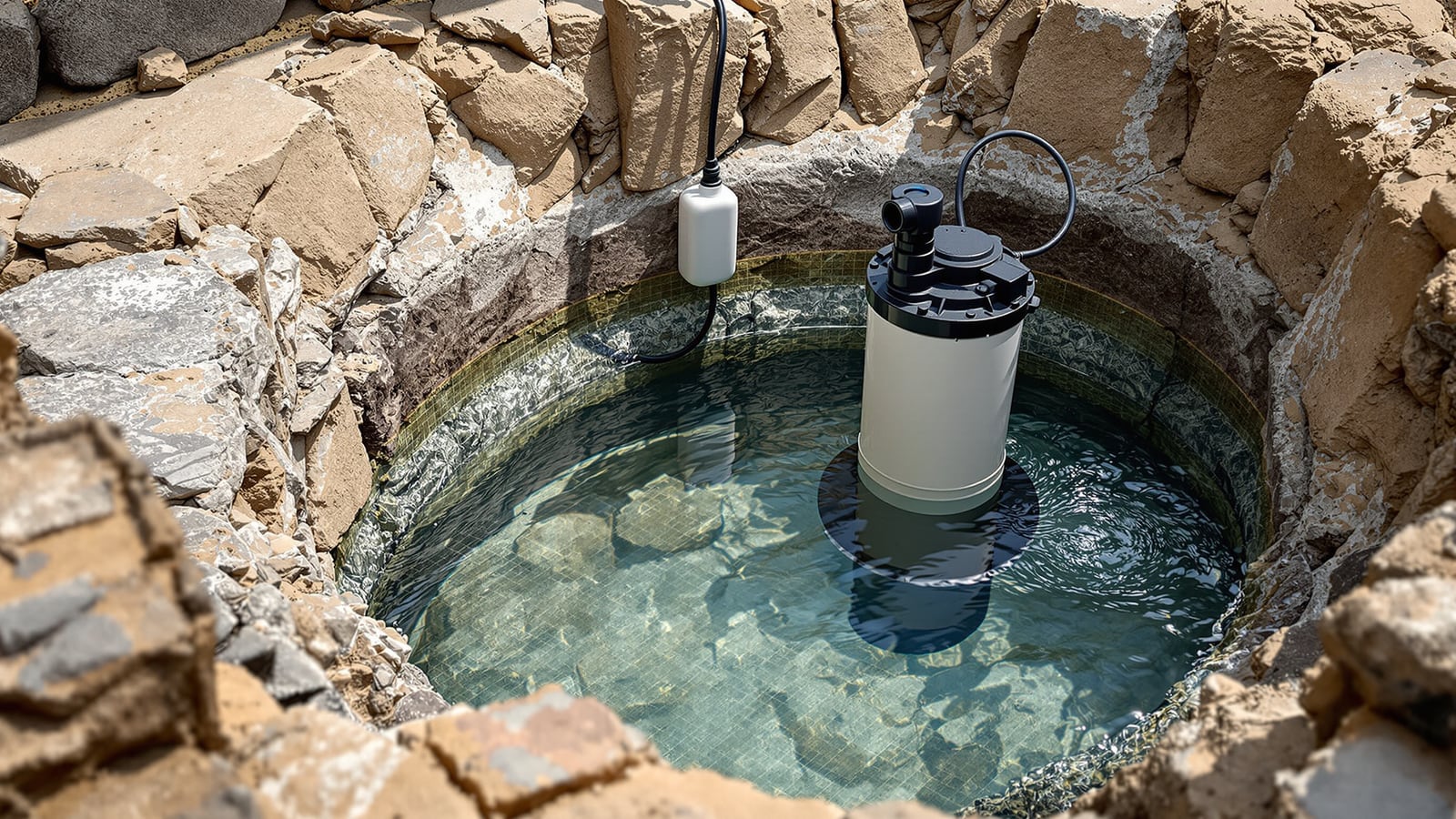
Sump & Dewatering Pumps in India: How to Choose One to Keep Your Basement Dry
The pump that lifts collected water out of a pit, sump or basement — submersible vs pedestal, how the float switch turns it on and off automatically, clear-water vs light-solids handling, why critical pits need a standby pump and a non-return valve, and indicative prices for an Indian home.
A sump pump does the opposite of the pumps that supply your taps: instead of pushing clean water up to a tank, it lifts unwanted water out of a low point before it floods a room. Rainwater, ground seepage, a lift pit filling up, an overflowing drain — the water collects in a pit called a sump, and the pump empties it. In a country where the monsoon can dump a month of rain in a day, this is the quiet machine that decides whether your basement stays dry or turns into a swimming pool.
This guide sits under the Studio Matrx water pumps pillar. It is the companion to the guide on submersible pumps — many sump pumps are submersibles, but the job here is drainage, not supply. If you are dealing with a wet basement at a deeper level, read it alongside foundation drainage, which explains how water is collected and routed to the sump in the first place.
What a sump pump does and where it is used
A sump pump lives at the lowest point of a drainage arrangement. Water flows or seeps toward the pit under gravity, collects, and when it reaches a set level the pump switches on, empties the pit, and switches off. You rarely see it work — which is exactly the point.
Typical Indian uses:
- Basement dewatering — cellars, home theatres and parking basements sit below the water table in the monsoon; seepage through the raft and walls collects in a sump.
- Lift pit dewatering — every lift shaft has a pit at the bottom that must stay dry to protect the lift machinery; a small automatic pump handles this.
- Car-park and ramp drainage — a stilt or basement car park catches rain blown in off the ramp; a sump at the ramp foot pumps it to the storm drain.
- Drainage sumps — kitchen yard, utility area or a low courtyard that cannot drain to the road by gravity.
- Monsoon flood backup — a sump pump on standby is the difference between a wet floor and a ruined room during a cloudburst.
- Waterproofing backup — even a well-waterproofed basement benefits from a sump as insurance; membranes fail, and a pump buys you time.
A sump pump is a last line of defence, not a substitute for waterproofing and good drainage. Fix the water ingress first; size the pump to handle what still gets through.
Submersible vs pedestal sump pumps
There are two body styles, and the choice mostly comes down to how deep the pit is and how much you mind the noise.
- Submersible sump pump — the whole unit, motor included, sits inside the pit, underwater. It is quiet, out of sight, self-cooling (the surrounding water cools the motor) and handles deeper pits well. This is the default for most Indian basement and lift-pit installations.
- Pedestal sump pump — the motor sits on a column above the pit on a shaft, with only the intake down in the water. It is easier to service without getting wet, and cheaper to repair, but noisier and more exposed. You see these on shallow pits and older installations.
For almost every home basement or lift pit, a submersible is the right answer. Keep a pedestal in mind only where the pit is very shallow or where easy dry servicing matters more than silence.
The float switch: how it runs itself
The single most important feature of a domestic sump pump is that it is automatic. You cannot stand watch over a pit during a storm, so the pump watches the water level for you using a float switch.
A float switch is a sealed, buoyant bulb tethered to the pump. As water rises, the float rises with it; at a set height it tips and closes the electrical contact, and the pump starts. As the pump empties the pit and the level falls, the float drops, tips back, and the pump stops. Two levels matter:
- Cut-in level — where the float turns the pump ON as water rises.
- Cut-out level — where it turns the pump OFF, kept above the pump intake so the pump never runs dry.
Getting the tether length and pit size right prevents short cycling — the pump snapping on and off every few seconds, which burns out motors. A slightly larger pit and a longer float travel mean fewer, longer, gentler runs. For critical pits, an integrated float (built into the pump) plus a separate backup high-level float and alarm is a sensible belt-and-braces setup.
Clear-water vs light-solids: solids handling
Not all collected water is clean, and pushing gritty water through a clear-water pump wrecks it. Match the pump to what it will swallow:
- Clear-water sump pumps — for rain, seepage and ground water with fine silt only. Small passage sizes; cheapest; ideal for lift pits and basement seepage.
- Light-solids / dirty-water pumps — larger free passage (typically able to pass soft solids of a few mm to ~10 mm), for yard drains and car-park sumps that catch leaves, grit and mud.
- Sewage / effluent pumps — a different class again, built to pass soft solids and handle foul water. If your pit is taking anything from a toilet or a soil stack, that is a sewage-pumping job, not a sump-pump job — see what is a sewage treatment plant and STP pumps and instrumentation. Do not run sewage through a clear-water sump pump.
Head, flow and sizing — keep it indicative
Two numbers decide whether a pump is up to the job:
- Head — the vertical height (in metres) the pump must lift water, from the pit up to the discharge point, plus friction losses in the pipe. A basement three floors below the storm drain is a high-head job.
- Flow — how fast it moves water, in litres per minute (LPM) or litres per hour, measured at that head. Every pump moves less as head increases, so read the flow figure at your actual lift, not the headline "max flow".
You do not need to hand-calculate this. Feed your lift height and expected inflow into the Studio Matrx pump size calculator to get a starting spec, then confirm with a pump dealer who knows local conditions. As a rule of thumb, a domestic sump pump wants enough flow to empty the worst realistic inflow (a monsoon downpour plus seepage) faster than the pit fills.
Indicative selection guide
| Duty | Type | Rating | Head (m) | Flow (LPM) | Phase | Indicative ₹ |
|---|---|---|---|---|---|---|
| Lift-pit / small basement seepage | Submersible, clear-water | 0.5 HP (0.37 kW) | up to 8 | 100-150 | 1φ | ₹4,000-9,000 |
| Home basement dewatering | Submersible, clear/light-solids | 0.5-1 HP | 8-12 | 150-300 | 1φ | ₹8,000-18,000 |
| Car-park / yard drainage sump | Submersible, dirty-water | 1-2 HP | 10-15 | 300-600 | 1φ / 3φ | ₹15,000-35,000 |
| Deep basement, high lift | Submersible, high-head | 2-3 HP | 15-25 | 400-800 | 3φ | ₹30,000-70,000 |
| Critical pit (duty + standby) | 2× submersible + controller | as above ×2 | as duty | as duty | 3φ | ₹60,000-1,50,000 |
Figures are indicative for planning only; confirm with a supplier for your site.
Single vs three phase
- Single phase (1φ, 230 V) covers most homes — pumps up to roughly 1-2 HP run happily on a normal domestic connection.
- Three phase (3φ, 415 V) suits larger pumps (2-3 HP and up), deep high-lift basements and duty/standby pairs in apartment blocks. It runs motors more efficiently and starts big pumps more smoothly, but needs a three-phase connection and a proper starter panel.
If your building already has a three-phase supply, a 3φ pump for a large or critical pit is usually the better long-term choice.
Duty and standby for critical pits
For a pit you cannot afford to let overflow — a lift pit, a basement housing an electrical panel, a home theatre — a single pump is a single point of failure. The standard answer is duty and standby:
- Two pumps sit in the same pit sharing the load.
- A small controller runs the duty pump normally, alternates them to even out wear, and starts the standby automatically if the duty pump fails or the water rises too fast.
- A high-level alarm warns you before an overflow.
This costs more, but for a critical pit it is cheap insurance against the one night the only pump chooses to die.
Non-return valve on the discharge — non-negotiable
Every sump pump discharge needs a non-return valve (check valve) on the outlet pipe. When the pump stops, the column of water standing in the discharge pipe wants to run straight back down into the pit. Without a check valve it does exactly that — refilling the pit, forcing the pump to re-pump the same water, causing short cycling and premature failure.
Fit the check valve on the vertical discharge just above the pump, with its flow arrow pointing away from the pit. In a duty/standby pit, each pump gets its own check valve so a stopped pump cannot let the running pump's water leak back through it. The full mechanics — swing vs spring, valve slam and water hammer — are covered in the guide on check valves.
Power backup matters most of all
A sump pump is useless during the exact event it exists for — a storm — if the power is out. Cloudbursts and grid failures arrive together. For any pit protecting a basement or lift, the pump must be on the backup supply:
- Wire critical sump pumps to the building DG (diesel generator) or inverter/UPS circuit, not just the mains.
- Larger 3φ pumps need generator capacity to match their starting current — size the DG accordingly.
- A battery-backed high-level alarm should keep working even when everything else is dark.
Without backup power, all the pump sizing in the world protects nothing on the worst night.
Common problems and running cost
- Short cycling — pit too small, float tether too short, or a leaking check valve letting water run back. Fix the cause; do not just replace the pump.
- Clogging — grit and leaves jam a clear-water pump; fit a light-solids pump or a pit screen where debris is expected.
- Stuck float — the float fouls the pit wall or the cable and cannot rise or fall. Give it clear travel room.
- Dry running — if the cut-out level is set too low the pump runs dry and overheats; keep it above the intake, and prefer pumps with dry-run protection.
- Seized after a dry spell — a pump that sits unused for months can stick. Test it before every monsoon by pouring water into the pit.
Running cost is modest because a sump pump only runs when there is water to move — often minutes a day, heavy only during storms. A 1 HP pump draws roughly 0.75 kW; at ₹8 per unit, an hour of running costs about ₹6. Choosing an efficient pump matters more for reliability and longevity than for the electricity bill.
Quick buying checklist
| Decision | What to pick | Why |
|---|---|---|
| Body style | Submersible (default) | Quiet, self-cooling, handles deep pits |
| Water quality | Clear-water for seepage; dirty-water for grit | Wrong pump clogs or wears out fast |
| Automation | Built-in float + backup high-level alarm | Runs itself, warns before overflow |
| Head & flow | Size at your actual lift via the calculator | Headline flow figures mislead |
| Redundancy | Duty + standby for critical pits | One pump is a single point of failure |
| Discharge | Own non-return valve per pump | Stops backflow and short cycling |
| Power | On DG / inverter backup | Storms and outages arrive together |
Get those seven right and your sump pump will do its silent, unglamorous, house-saving job for a decade.
References
- Bureau of Indian Standards (BIS) — Indian Standards for submersible and drainage pump sets; ask your supplier for the current IS marking on the pump you buy rather than relying on a quoted number.
- Bureau of Energy Efficiency (BEE) — star-rating framework for pumps and motors; use it to compare efficiency between models.
- Central Public Health and Environmental Engineering Organisation (CPHEEO) — Manual on Sewerage and Sewage Treatment, and Manual on Storm Water Drainage, for how sumps sit within building drainage design.
Always verify local specifics — pit sizing, discharge routing and pump ratings — with a licensed plumber or pump dealer familiar with your site and municipal drainage rules.
Export this guide
Related Guides — Deep-dive reading
Water Pumps Guide for India: Types, How to Choose & Size (Head, Flow, Phase)
The master overview of domestic and building water pumps — what a pump actually does (lift plus pressure), the two numbers that decide everything (HEAD in metres and FLOW in LPM), a pump-type-to-use table, single vs three phase, priming, foot valve and NRV needs, dry-run protection, and BEE star rating with running cost at a glance for an Indian home.
PlumbingCollection Tank (Raw Sewage Sump) in an STP: The First Sump Explained
The raw sewage sump is where a building's drains empty and treatment begins. Here is what the collection tank does, how its float switches and submersible transfer pumps work, and why it is not the same thing as the equalisation tank.
Sewage Treatment PlantsBorewell Pumps in India: How to Size HP by Depth, V3/V4/V6 Types, Stages and Running Cost
The deep-well submersible pump is the heart of a private borewell — a slim multi-stage unit that sits underwater and pushes your supply up to the tank. This guide explains how to pick horsepower by borewell depth, water level and yield, which body diameter (V3/V4/V6) fits your bore, why more stages mean more head, and how oversizing wastes electricity and can dewater the bore.
PlumbingRelated Tools — Try Free
Rainwater Tank Sizer
How big should your rainwater tank be? Computes annual harvest, recommended tank capacity in litres, water-bill savings, and payback — for 10 Indian cities.
RWH CalculatorLift Power Requirement Calculator
Connected load, single vs three phase, MCB and cable guidance for a home lift.
Lift CalculatorMonsoon-Readiness Checklist
Pre-rain home audit across 9 categories — terrace, drains, waterproofing, electrical, HVAC, pest, vehicles, documents.
Seasonal Audit