
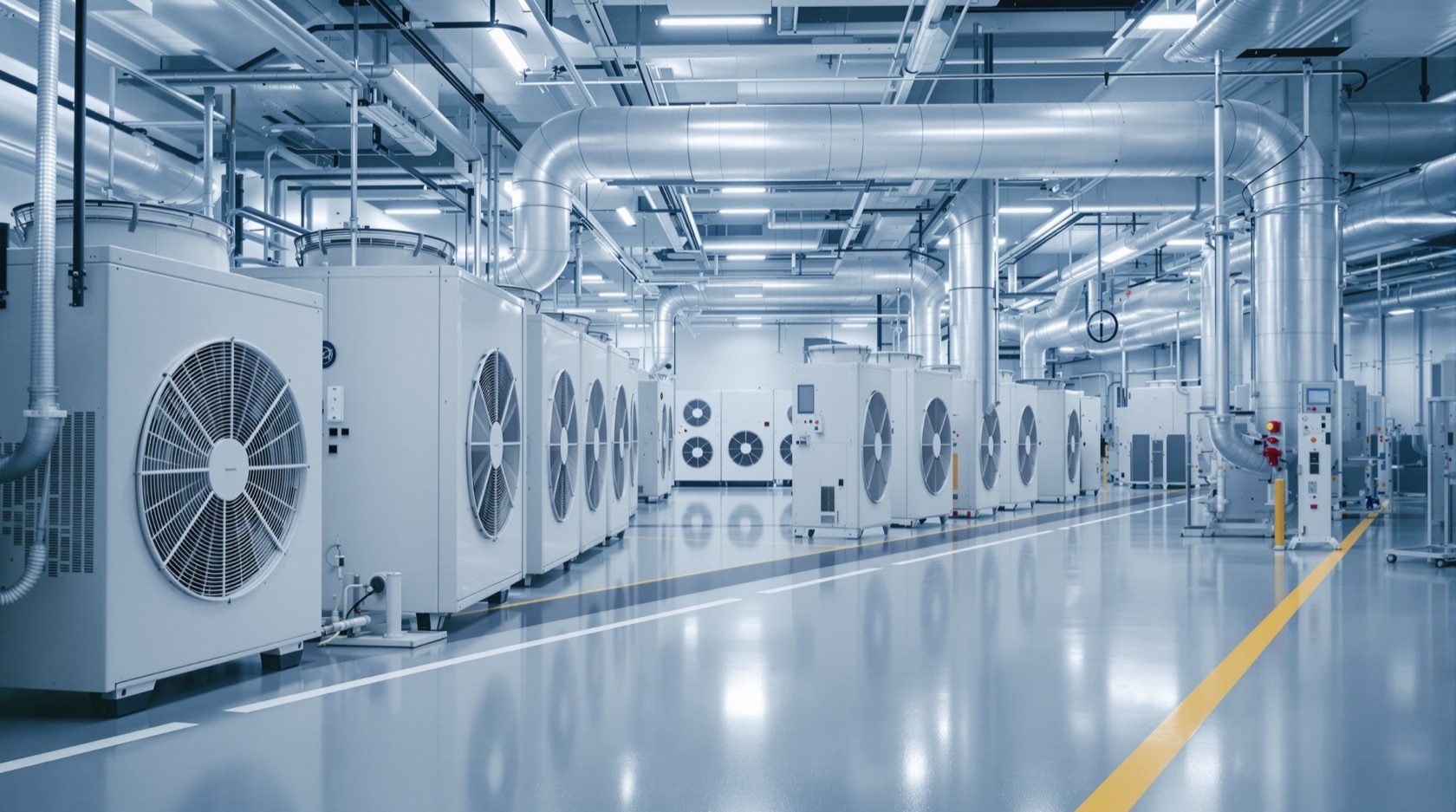
HVAC for Special Buildings: When Comfort Isn't the Point
Hospitals, data centres, cleanrooms, kitchens and cold stores need HVAC that does far more than keep people comfortable — it controls infection, protects equipment, ensures sterility or preserves goods. An overview of what makes special-building HVAC different, and why.
In a home or office, HVAC has one job: keep people comfortable. But in a hospital operating theatre, a data centre, a pharmaceutical cleanroom, a commercial kitchen or a cold store, comfort is almost beside the point — the HVAC is there to stop infections spreading, keep servers from cooking, guarantee sterility, extract grease and heat, or preserve perishable goods. These are the "special buildings," where HVAC becomes mission-critical, tightly regulated, and engineered to a completely different brief. This guide is the overview: what makes special-building HVAC different, and why each type demands its own approach.
It's the anchor of the special-buildings thread in the HVAC Knowledge Hub, and builds on Building HVAC Design.
Scope. This is a conceptual overview to inform understanding and briefing. Special-building HVAC is specialist, regulated engineering — each type is designed and validated by qualified MEP/HVAC engineers to the relevant codes.
What makes special-building HVAC different
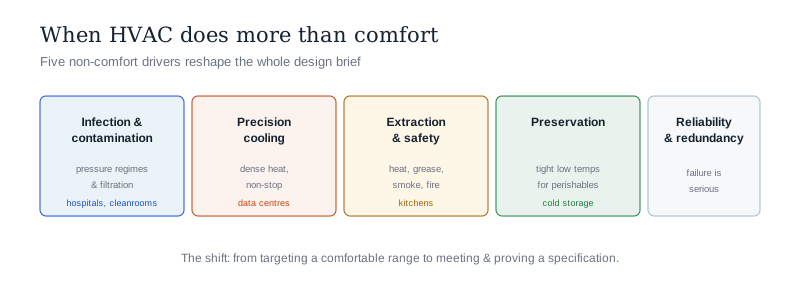
Across these building types, a handful of non-comfort drivers reshape the HVAC:
- Infection & contamination control — controlling where air flows (pressure regimes) and how clean it is (filtration) to protect people or products. Central to hospitals and cleanrooms.
- Precision cooling of high heat density — removing huge, concentrated heat loads reliably and continuously, as in a data centre, where a failure means downtime, not just discomfort.
- Extraction & safety — removing heat, grease, smoke or fumes and managing fire risk, as in a commercial kitchen.
- Preservation — holding tight low temperatures and humidity to protect perishable goods, as in cold storage.
- Reliability & redundancy — because failure has serious consequences (patient safety, data loss, spoiled stock), these systems need backup and continuous operation that a comfort system never does.
Where comfort HVAC targets a pleasant range, special-building HVAC targets a specification that must be met and often proven — with far tighter tolerances and much higher stakes.
The five special buildings, at a glance
- Hospitals & healthcare — HVAC as infection control: pressure regimes (positive-pressure operating theatres, negative-pressure isolation), high air-change rates, HEPA filtration. Governed by standards like ASHRAE 170 and NABH requirements.
- Data centres — precision cooling of dense IT heat: CRAC/CRAH units, hot-aisle/cold-aisle containment, redundancy, and efficiency measured by PUE. A booming sector in India.
- Cleanrooms — engineered cleanliness for pharma and electronics: ISO 14644 particle classes, HEPA/ULPA filtration, laminar flow and pressure cascades. Vital to India's large pharmaceutical industry.
- Commercial kitchens — heavy extraction of heat, grease and smoke, balanced make-up air, and fire safety. Essential to restaurants, hotels and institutions.
- Cold storage — refrigeration and insulation to hold perishables at tight temperatures; central to India's growing cold chain for food and pharma.
Each is a discipline in itself, with its own codes, tolerances and failure consequences.
The common threads
Despite their differences, special buildings share design principles:
- Design to a spec, then validate — conditions are defined by code/standard and must be achieved and often verified, not just aimed at.
- Controls & monitoring are critical — continuous monitoring, alarms and BAS integration matter more when a drift is dangerous.
- Redundancy — N+1 (or more) so a single failure doesn't stop the critical function.
- Filtration & air distribution — where and how clean the air is, is engineered deliberately, not left to chance.
- Energy is still huge — these systems run continuously and hard, so efficiency (PUE, heat recovery) matters enormously even when comfort doesn't.
The one-line answer
In special buildings, HVAC does far more than comfort — it controls infection, cools dense equipment, guarantees cleanliness, extracts hazards, or preserves goods, with failure consequences (patient safety, downtime, spoiled product) that a comfort system never carries. Five non-comfort drivers reshape the design: infection/contamination control (pressure regimes and filtration in hospitals and cleanrooms), precision cooling of high heat density (data centres), extraction and fire safety (commercial kitchens), preservation (cold storage), and the reliability and redundancy that critical functions demand. Each is its own regulated discipline — ASHRAE 170 and NABH for hospitals, PUE and containment for data centres, ISO 14644 for cleanrooms, extraction and fire codes for kitchens, refrigeration and insulation for cold stores — but all share the same shift: from targeting a comfortable range to meeting (and often proving) a specification, with continuous monitoring, redundancy, deliberate filtration, and efficiency that still matters because these systems run hard and non-stop. All specialist, regulated MEP/HVAC engineering.
Where to go next
- HVAC as infection control: Hospital HVAC Guide.
- Cooling the cloud: Data Centre HVAC Guide.
- Engineered cleanliness: Cleanroom HVAC Guide.
- Kitchens & cold chain: Commercial Kitchen Ventilation · Cold Storage HVAC.
References
- ASHRAE Standard 170 (Ventilation of Health Care Facilities); ISO 14644 (Cleanrooms); ASHRAE TC 9.9 & Standard 90.4 (data centres); NFPA 96 (commercial kitchen ventilation).
- National Building Code of India, SP 7 (Part 8 — Building Services, Part 9 — special occupancies; verify current edition), BIS; NABH & MoHFW (healthcare); ISHRAE application guidance.
- Bureau of Energy Efficiency (BEE) — efficiency for continuously-operating systems: https://beeindia.gov.in/
A conceptual overview. Special-building HVAC is specialist, regulated engineering, designed and validated by qualified MEP/HVAC engineers. Verify any standard's current status via the BIS catalogue before relying on it.
Export this guide
Related Guides — Deep-dive reading
Hospital HVAC: Air as Infection Control
In a hospital, HVAC is a clinical instrument — controlling which way air flows and how clean it is to protect patients and staff. How pressure regimes, air-change rates and HEPA filtration work in operating theatres, isolation rooms and wards, to the standards that govern them.
HVAC & CoolingBuilding HVAC Design Guide: From Apartments to Hospitals
How HVAC scales and changes across building types — the systems, loads and priorities for apartments, villas, offices, hotels, hospitals, schools and industrial buildings, and why a hospital's air is designed on utterly different principles from an office's.
HVAC & CoolingCleanroom HVAC: Engineering Air to a Particle Count
In pharma and electronics, the air must be cleaner than anywhere else on earth — how cleanroom HVAC achieves it with HEPA/ULPA filtration, very high air changes, laminar flow, and pressure cascades, classified to ISO 14644, and why it matters so much to Indian pharma.
HVAC & CoolingRelated Tools — Try Free
Healing View Impact Calculator
Evidence-Based Design dashboard quantifying the recovery impact of nature view + daylight factor on analgesic use, length of stay, and HCAHPS patient-experience uplift. Calibrated against Ulrich 1984 (Science), Park & Mattson 2008, and the CHD EBD evidence base.
EBD CalculatorAcoustic Privacy (STC) Visualizer
Indian healthcare acoustic visualizer — compare wall assemblies and noise sources, see received SPL after STC attenuation, and check FGI 2018 / IS 1950 / NABH speech-privacy compliance with live dual-canvas waveform.
Acoustic ToolData Centre Cooling Calculator
The cooling a data centre needs in tons, its total facility power, and the annual cooling-overhead energy and cost — estimated from the IT load and a target PUE.
HVAC