

Data Centre Cooling: Keeping the Cloud from Overheating
Servers turn nearly all their power into heat, so a data centre is really a giant cooling problem — how precision cooling, hot-aisle/cold-aisle containment, CRAC/CRAH units and free cooling remove concentrated heat reliably, and why PUE is the number that matters.
A data centre looks like rows of computers, but from an engineering view it's a giant heat problem: servers convert nearly all the electricity they draw into heat, packed into dense racks that run 24/7. If the cooling stops for even minutes, temperatures spike and equipment fails — so data-centre HVAC is precision cooling that must be reliable, continuous and efficient at a scale few other buildings see. With India's data-centre sector booming, this is one of the fastest-growing HVAC specialisms in the country. This guide explains how data-centre cooling works and why PUE rules it.
It builds on the Special Buildings HVAC Guide, part of the HVAC Knowledge Hub.
Scope. This explains data-centre cooling concepts to inform understanding. Mission-critical cooling design is specialist engineering with strict redundancy and validation. Use our data centre cooling calculator for a planning estimate only.
The core problem: concentrated, continuous heat
What makes data-centre cooling unlike anything else:
- Nearly all IT power becomes heat. A rack drawing 5–20+ kW turns almost all of it into heat that must be removed continuously — a heat density far beyond any office.
- Failure is catastrophic — no comfort tolerance; a cooling outage means overheating, throttling and hardware damage within minutes, so reliability and redundancy are paramount.
- It runs 24/7/365 — so efficiency (the cooling energy per unit of IT) is a massive, permanent operating cost.
The whole design is about removing concentrated heat reliably and efficiently, without interruption.
Hot-aisle / cold-aisle containment
The foundational layout that makes data-centre cooling work:
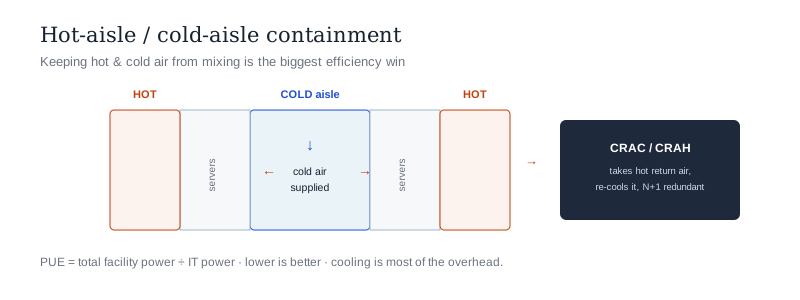
- Arrange racks in alternating aisles — server fronts (air intakes) face each other across a cold aisle; server backs (hot exhaust) face each other across a hot aisle.
- Supply cold air to the cold aisle, where servers draw it in; collect hot exhaust from the hot aisle and return it to be re-cooled.
- Contain the aisles — physical barriers (doors, roofs) stop hot and cold air mixing, which is the single biggest efficiency win: the cooling only has to handle genuinely hot return air, not a lukewarm mix.
- The result — predictable airflow, no hot spots, and far less wasted cooling.
Containment turned data-centre cooling from brute-force over-cooling into an engineered airflow problem.
The cooling equipment
- CRAC / CRAH units — Computer Room Air Conditioners (direct-expansion) or Air Handlers (chilled-water); the workhorses that cool and circulate the air.
- Chilled-water plant — chillers, pumps and cooling towers for larger facilities.
- In-row / rear-door cooling — cooling brought close to the racks for high densities.
- Liquid cooling — direct-to-chip or immersion cooling for the highest-density (AI/HPC) racks, where air alone can't cope — an emerging frontier.
- Free cooling — using cool outdoor air or water to cool without running compressors when ambient conditions allow; a big efficiency gain (harder in much of hot India, but valuable in cooler seasons/locations).
- Redundancy — N+1 or greater, so any single unit can fail without losing cooling.
PUE — the number that rules data centres
The defining efficiency metric:
- PUE (Power Usage Effectiveness) = total facility power ÷ IT power. A PUE of 1.0 would mean all power goes to IT and none to overhead; real data centres are higher because cooling and losses add overhead.
- Lower is better — a PUE of 2.0 means as much power for cooling/overhead as for the IT itself; efficient modern facilities push toward 1.3–1.5 or lower.
- Cooling dominates the overhead, so cooling efficiency is most of PUE — which is why containment, free cooling, higher supply temperatures and efficient chillers matter so much (see efficiency).
- In India — warm ambient temperatures make low PUE harder, so efficient cooling design is both an environmental and a serious cost lever. See the cooling calculator.
The one-line answer
A data centre is really a giant, concentrated heat problem: servers turn nearly all their power into heat, packed into dense 24/7 racks where a cooling outage means overheating and hardware failure within minutes — so its HVAC is precision cooling that must be reliable, continuous and efficient. The foundational layout is hot-aisle/cold-aisle containment: racks are arranged so server intakes face a cold aisle (fed cold air) and exhausts face a contained hot aisle (returned to be re-cooled), with barriers stopping hot and cold air mixing — the biggest efficiency win. The equipment runs from CRAC/CRAH units and chilled-water plant to in-row, liquid and free cooling, always with N+1 redundancy so no single failure stops the cooling. And the number that rules it all is PUE (total facility power ÷ IT power — lower is better, efficient facilities near 1.3–1.5), of which cooling is most of the overhead — making cooling efficiency the central lever, and a harder, costlier one in warm India. All specialist, mission-critical engineering.
Where to go next
- Size a planning estimate: Data Centre Cooling Calculator.
- The overview: Special Buildings HVAC Guide.
- The plant behind it: Chiller Guide · Central Air Conditioning Guide.
- The efficiency lens: HVAC Energy Efficiency Guide.
References
- ASHRAE Technical Committee 9.9 (Thermal Guidelines for Data Processing Environments) & ASHRAE Standard 90.4 (Energy Standard for Data Centers).
- The Green Grid — PUE (Power Usage Effectiveness) metric; Uptime Institute — data-centre tier & redundancy standards.
- ISHRAE data-centre HVAC guidance; Bureau of Energy Efficiency (BEE) — data-centre energy efficiency: https://beeindia.gov.in/
This guide informs understanding; the calculator is a planning estimate only. Mission-critical cooling design is specialist engineering with strict redundancy and validation.
Export this guide
Related Guides — Deep-dive reading
Central Air Conditioning & Chilled Water Systems: Cooling at Building Scale
How the biggest buildings are cooled — the chilled-water plant of chillers, air-handling units, cooling towers and pumps that air-conditions malls, hotels, hospitals and towers, how it differs from unitary and VRF systems, and when a building needs it.
HVAC & CoolingHeat Pumps: The Efficient Way to Heat (and Cool) with Electricity
The single most efficient electric heating technology — how a heat pump moves heat instead of making it to deliver 3×+ the warmth per unit of electricity, why your reversible AC already is one, air-source vs other types, COP, and where heat pumps make sense in India.
HVAC & CoolingHVAC for Special Buildings: When Comfort Isn't the Point
Hospitals, data centres, cleanrooms, kitchens and cold stores need HVAC that does far more than keep people comfortable — it controls infection, protects equipment, ensures sterility or preserves goods. An overview of what makes special-building HVAC different, and why.
HVAC & CoolingRelated Tools — Try Free
Interior Layout Planner — Printable Graph Grid
Printable graph grid to sketch room layouts to scale before committing to furniture placement.
Layout ToolData Centre Cooling Calculator
The cooling a data centre needs in tons, its total facility power, and the annual cooling-overhead energy and cost — estimated from the IT load and a target PUE.
HVACCurtain Thermal Calculator
Estimate the solar heat-gain a curtain or blind cuts by orientation, glass and treatment — and the cooling saving.
Thermal Tool