
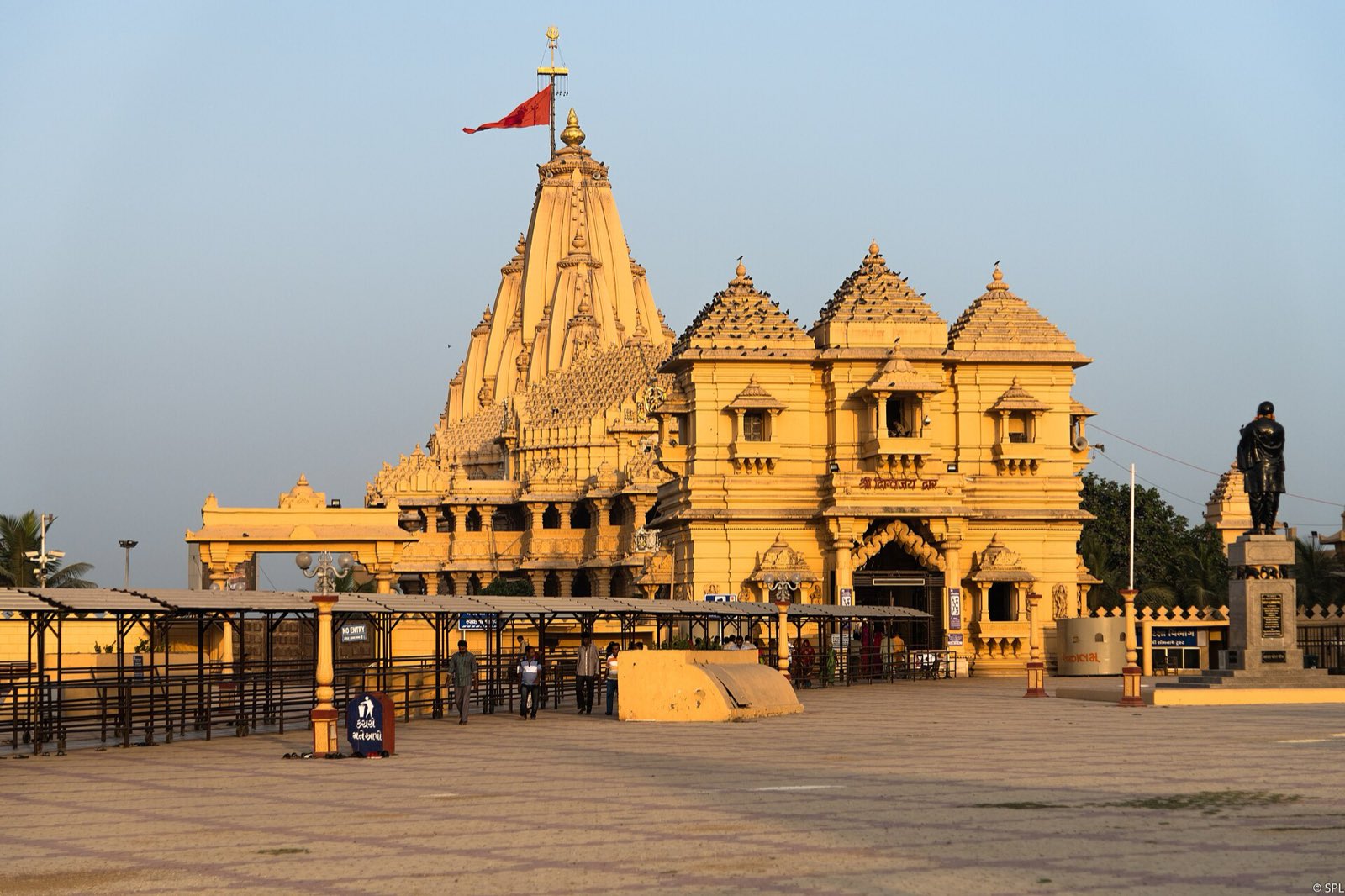
Somnath: The Temple That Would Not Stay Destroyed
How a shrine on the Gujarat coast was sacked and demolished again and again across a thousand years, and rebuilt every time — its present tower a twentieth-century revival of the medieval Gujarati temple, raised on the shore as a symbol of endurance
Every other building in this series survives, more or less, as its builders left it — weathered, sometimes ruined, but essentially the same stones. Somnath is different. The temple that stands today on the Arabian Sea coast of Gujarat was completed in 1951, and it is at least the latest in a long line of temples raised on this spot, because for a thousand years Somnath was destroyed and rebuilt, over and over, in one of the most extraordinary cycles of demolition and renewal in the history of any building anywhere. Its architecture cannot be understood apart from that cycle. Somnath is not simply a temple; it is the act of rebuilding a temple, repeated across a millennium — the architecture of resilience itself.
It belongs near the end of this collection as the counterpart to another ruined shrine we have visited. The Martand Sun Temple of Kashmir was destroyed and left a magnificent ruin, a monument to what was lost. Somnath was destroyed and rebuilt, again and again, a monument to what refuses to be lost. Between them they mark the two possible fates of a broken temple: to become a beautiful memory, or to be raised once more.
One of the great shrines, on the edge of the sea
Somnath is one of the twelve Jyotirlingas, the supreme shrines of Shiva — traditionally reckoned the first among them — and it stands at Prabhas Patan on the Saurashtra coast, at the very edge of the ocean. Its wealth in the medieval period was legendary: pilgrims and kings endowed it with gold, jewels and lands, and its fame as a rich and holy place spread far beyond India. That fame was also its curse. In 1026 the temple was famously sacked by Mahmud of Ghazni, who is said to have carried off an immense treasure; and over the following centuries it was demolished and rebuilt repeatedly, as successive rulers and invaders destroyed it and successive Hindu kings — notably the Chaulukya (Solanki) rulers of Gujarat — raised it again.
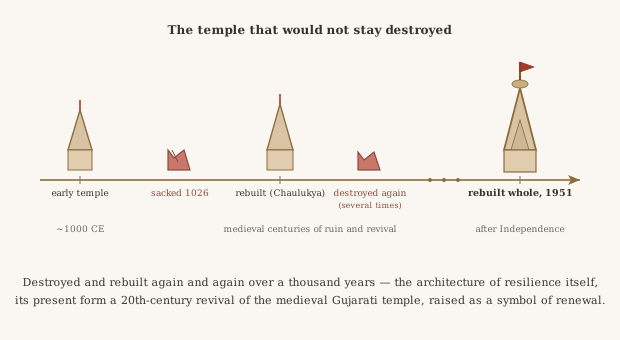
The rhythm of Somnath's history is this pulse of ruin and revival: built, sacked, rebuilt, demolished, raised again — through the eleventh, twelfth, thirteenth and later centuries, so that no single Somnath ever stood for very long, and each new temple rose from the rubble of the last. In this the building becomes almost a symbol in stone of cultural persistence: a shrine that could be broken but not, finally, erased, because every generation that lost it built it once more.
The temple made new
That long cycle reached its latest turn after India became independent. In 1947, at the initiative of Sardar Vallabhbhai Patel, it was decided to rebuild Somnath in full, and the new temple — completed in 1951, its inner shrine consecrated with the participation of the President of the new republic — was raised as a deliberate act of national and cultural renewal, the reconstruction of a shrine that had come to stand for the endurance of Indian civilisation through a thousand years of turbulence.
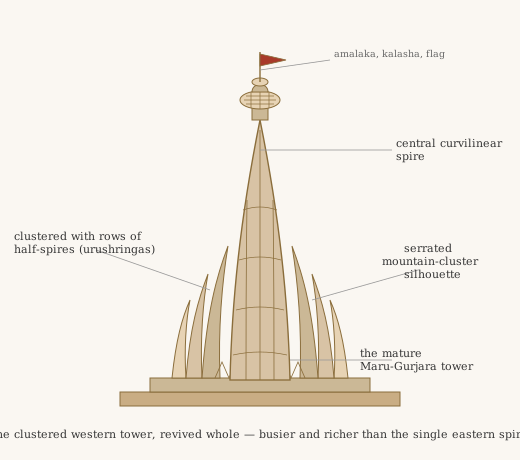
Crucially, the builders did not raise a modern building. They rebuilt Somnath in the Maru-Gurjara style — the medieval temple architecture of Gujarat and Rajasthan, the same tradition that produced the Sun Temple at Modhera, the stepwell at Rani ki Vav and the marble of Dilwara and Ranakpur. So the present temple is a scholarly, full-scale revival of the classical Gujarati temple form, and it lets us see, standing whole and new, what a great medieval Maru-Gurjara temple actually looked like when it was complete.
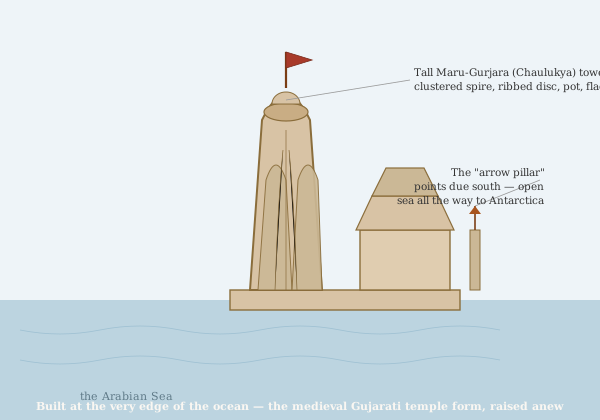
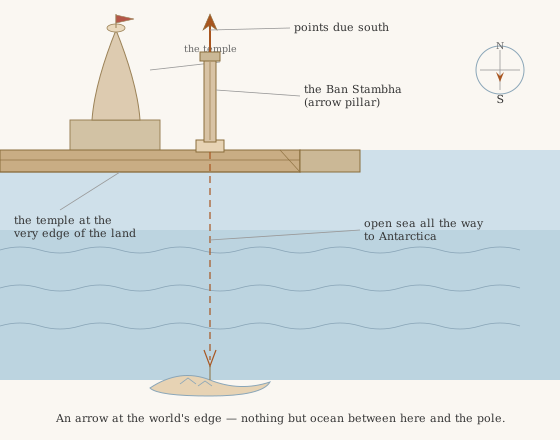
The form is the north Indian Nagara temple in its western, Maru-Gurjara version: a tall curvilinear tower (shikhara) rising over the sanctum, but here clustered — its central spire surrounded and buttressed by rows of smaller half-spires (urushringas) climbing its flanks, giving the tower the serrated, mountain-cluster silhouette characteristic of the mature western style, richer and busier than the single taut spire of Odisha. It is crowned by the ribbed disc (amalaka), the pot finial (kalasha) and a flag, and it rises over a sequence of pillared halls. Every surface carries the fine carving of the Maru-Gurjara tradition. And it stands, dramatically, right at the edge of the Arabian Sea — so close that the waves break almost at its plinth. Before it stands the Ban Stambha, the "arrow pillar," bearing an inscription claiming that from this point the ocean runs unobstructed due south all the way to Antarctica — a poetic assertion of the temple's place at the very edge of the land.
A different kind of authenticity
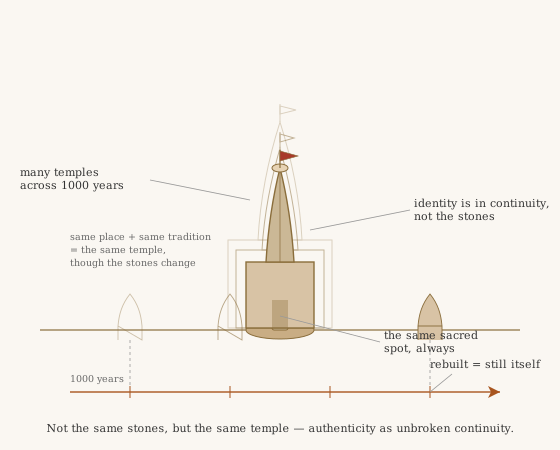
Somnath raises an honest and interesting question that most of this series does not: what makes a building "authentic"? The stones of the present Somnath are less than a century old. It is, in the strict material sense, a modern temple. And yet it is unmistakably Somnath — the same shrine, on the same sacred spot, in the same architectural tradition, carrying the same thousand-year identity, rebuilt as its predecessors were rebuilt. Somnath teaches that a building's identity can lie not in its particular stones but in its continuity — in the unbroken decision, across a hundred generations, that this place shall hold a temple, whatever befalls the fabric. In a civilisation where temples were living things, continuously repaired, rebuilt and renewed — as we saw at Srirangam and the temple-towns of the south, forever being added to — Somnath is the extreme case: a temple rebuilt not once but many times, from the ground up, and none the less itself for it.
Why Somnath matters
Somnath earns its place in this series, and its place near its close, as the monument of endurance and renewal. It is the clearest statement in Indian architecture of the idea that a building can be broken and yet not defeated, that a form can be destroyed in stone and preserved in memory and raised again. Its present incarnation gives us, as a bonus, a rare thing: a complete, unruined example of the great medieval Maru-Gurjara temple, standing new and whole on the shore where its ancestors stood, letting us see the tradition of Modhera and Rani ki Vav not as fragments but as a finished, living temple.
Stand at its plinth with the Arabian Sea breaking almost at your feet and the clustered tower rising against the sky, and remember that this same spot has held a temple, lost a temple, and held one again, over and over, for a thousand years — and you understand that Somnath's true architecture is not any single tower of stone, but the unbreakable will, renewed generation after generation, to build the temple once more.
Part of the Architectural Wonders series. For the medieval Maru-Gurjara tradition its present form revives, read the Sun Temple at Modhera, the stepwell at Rani ki Vav and the marble temples of Dilwara; and for the opposite fate of a broken temple, the ruined Martand Sun Temple of Kashmir.
Hero photograph: “Somnath Temple, Gujarat” by Narendralohiya, via Wikimedia Commons, licensed under CC BY-SA 4.0.
Export this guide
Related Guides — Deep-dive reading
The Lingaraja Temple, Bhubaneswar: The Odishan Temple Perfected
How the temple-builders of Odisha brought their curvilinear tower to its most complete and majestic form — four halls climbing in a straight line to a fifty-five-metre spire — in the greatest of a city of a thousand temples
Architectural WondersKhajuraho: The Temple Built to Be a Mountain
How the Chandela masons of 10th-century central India made the northern temple rise like a Himalayan peak — and why its sculpture, its engineering and its improbable survival still instruct the modern architect.
Architectural WondersThe Sun Temple at Modhera: A Temple Built to Catch the Dawn
How the Solanki kings of Gujarat aligned a whole complex — a stepped tank, a pillared hall and a sanctum — so that the rising equinox sun would run straight down its spine and light the face of the sun god
Architectural WondersRelated Tools — Try Free
Before & After Studio
Generate AI before-and-after renders to preview how your redesign could look.
DesignAIWindow Orientation Planner
Pick the best window type, glass and shading by wall direction — north, east, south and west.
Window ToolArchitect Fee Calculator
Estimate architect fees based on COA guidelines, project scope, and city.
ArchitectAI