
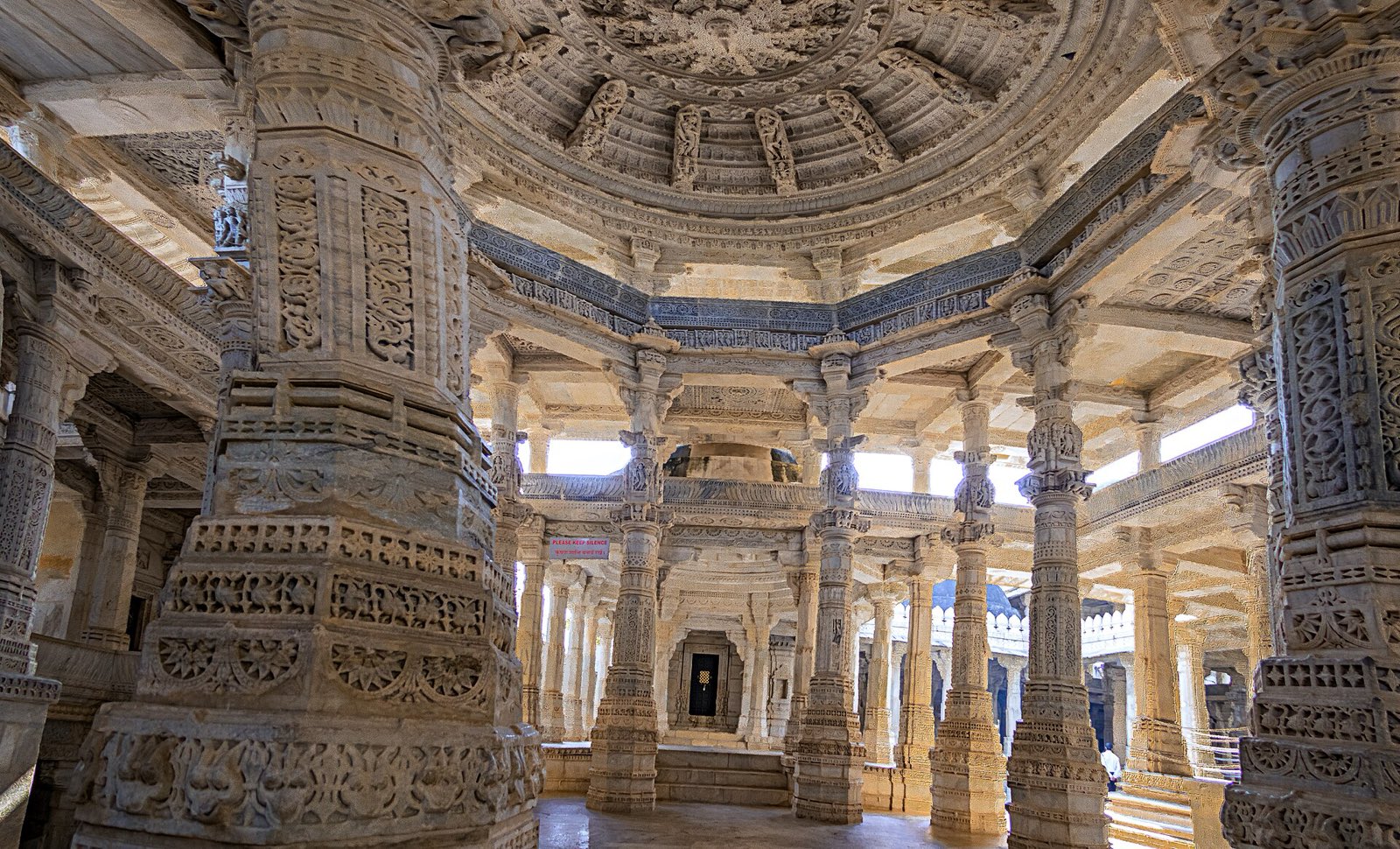
The Ranakpur Jain Temple: A Forest of 1,444 Marble Pillars, No Two Alike
How a fifteenth-century Jain merchant raised a four-faced temple of white marble in the Aravalli hills — a hall of a thousand-odd columns and eighty domes, built with perfect symmetry around a god who faces all four directions at once
The Dilwara temples at Mount Abu concentrate their miracle in a handful of ceilings — small, jewel-like chambers where marble is carved into lace. Ranakpur takes the same Jain love of white marble and the same fanatical craftsmanship and does the opposite: it spreads them across an enormous hall until you are standing inside a whole forest of carved marble, columns receding in every direction further than you can count. Where Dilwara is an intense point, Ranakpur is a vast field. Both are among the supreme achievements of Indian marble carving, and seeing them as a pair teaches you how much range a single tradition could contain.
Ranakpur stands in a secluded valley of the Aravalli hills in Rajasthan, and it is dedicated to Adinatha, the first of the twenty-four tirthankaras, the enlightened teachers of the Jain faith. It is famous above all for a single, staggering number: 1,444 pillars, and by tradition no two of them are carved exactly alike.
A merchant's dream in marble
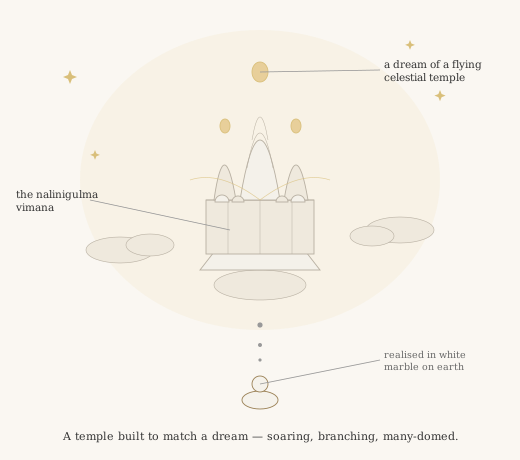
Like Dilwara, Ranakpur is the gift of a wealthy Jain layman, for the same reason we met before — in a faith that forbade violence and prized the pious use of wealth, the building of temples was among the highest expressions of both devotion and status. The patron was Dharna Shah, a Jain businessman and minister, and the temple was built in the fifteenth century (around 1439) during the reign of Rana Kumbha, the powerful Rajput ruler of Mewar who gave the site its name and protection. Tradition holds that Dharna Shah built it to realise a vision he had seen in a dream of a celestial flying chariot-temple, the nalinigulma vimana — which may be why the finished building has its extraordinary, upward-branching, many-domed complexity, less like an ordinary temple than like a marble machine for ascending.
Chaumukha: a god who faces four ways
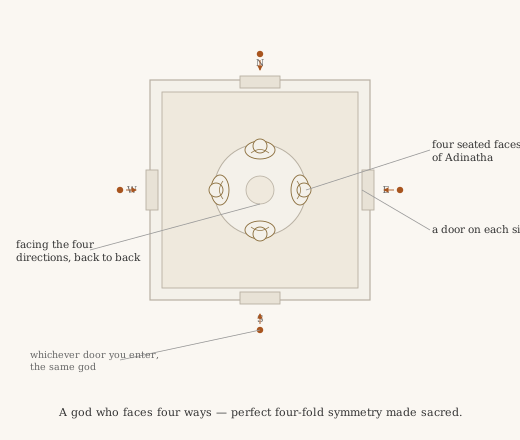
The organising idea of Ranakpur is announced in its other name — the Chaumukha, or "four-faced" temple — and it is worth pausing on, because it shapes everything.
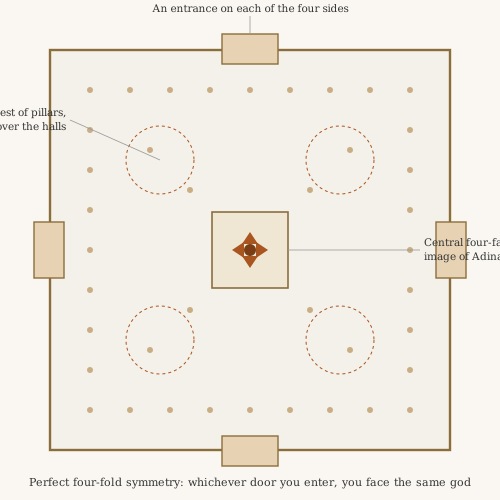
At the centre of the temple stands an image of Adinatha with four faces, looking outward in the four cardinal directions. The whole building is arranged around this four-fold figure with perfect four-fold symmetry: there is an entrance on each of the four sides, and whichever door you enter, you walk inward along an axis and arrive at the same central sanctum, facing one of the four identical faces of the god. There is no single front, no privileged approach — the temple, like the nine-sided Lotus Temple built five centuries later, is designed so that all directions are equal. The four-faced image expresses a Jain idea of the tirthankara's presence radiating equally to all the quarters of the world, and the architecture makes that idea walkable.
Around and between the four axes, the space is filled with a dense grid of pillared halls, and over them rise the domes — some eighty of them, at several different levels, carried on the tops of the columns. The result is a plan of great intellectual clarity — rigid four-fold symmetry — filled with an almost overwhelming richness of parts.
The forest of pillars
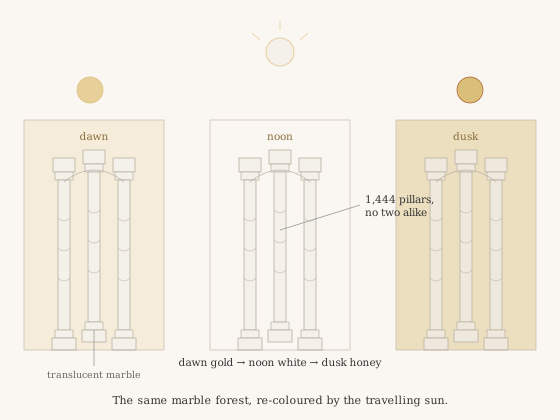
Step inside and the plan dissolves into sensation, because what you actually experience is the columns.
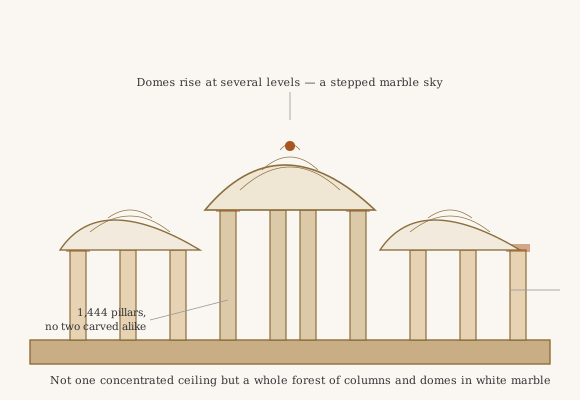
The 1,444 pillars are not uniform. They vary in height, in girth and above all in their carving — every one worked with its own pattern of bands, brackets, figures and foliage, so that walking among them is like walking through a wood in which every tree is a different species. Because the pillars carry domes at several different levels, the roofscape overhead is not a single flat ceiling but a stepped, branching marble sky, opening upward here into a high corbelled dome ringed with dancers and musicians, dropping there to a lower vault, letting light fall unevenly between the columns. The famous claim that no two pillars are identical may be a pious exaggeration, but it captures a real truth: the temple was conceived as an inexhaustible field of individual invention rather than a repetition of a single module.
There is a further magic the guides love to point out: the marble is subtly translucent and the columns are said to change colour through the day — pale gold at dawn, white at noon, honeyed at dusk — as the changing light works through the stone. Whether or not you catch the effect, it points to the same property of fine Rajasthani marble that made Dilwara glow: a stone that takes an impossibly fine edge and holds a living light.
The Maru-Gurjara tradition at its height
Ranakpur belongs to the mature western Indian temple style that art historians call Maru-Gurjara — the tradition of Rajasthan and Gujarat that also produced Dilwara and, in a different key, the stepwell at Rani ki Vav and the Sun Temple at Modhera. Its hallmarks are all here: the deeply undercut marble carving; the corbelled domes built up in concentric rings closing on a hanging lotus pendant; the octagonal arrangement of pillars linked by scalloped torana brackets; the raised plinth; the profusion of figure sculpture. What Ranakpur adds is scale and multiplication. Dilwara perfected the individual carved ceiling; Ranakpur asked what would happen if you built dozens of such halls and domes together into one enormous, four-square, symmetrical whole. The answer is one of the most spatially complex interiors in all of Indian architecture — a building you cannot take in from any single viewpoint, only wander through.
Why Ranakpur matters
Ranakpur completes the story of Indian marble that runs through this series. Its lesson is about abundance. Many of the greatest Indian buildings achieve their power through a single dominant idea — the one soaring tower of Brihadeeswara, the one perfect dome of the Taj, the one colossal vault of the Gol Gumbaz. Ranakpur does the reverse: it overwhelms not by singularity but by multiplicity, by the sheer accumulated labour of 1,444 individually imagined pillars and eighty domes, held in perfect order by an unbending four-fold symmetry. It is the marble equivalent of a fugue — a strict structure filled with endless variation.
And, like Srirangam and unlike a ruin, it remains a living place of worship, quiet and secluded in its valley, where Jain pilgrims still circle the four-faced god at the still centre of the marble wood. Stand among its columns as the light shifts through the translucent stone and the domes branch overhead, and you understand the particular Jain genius one last time: to turn immense wealth, not into gold or scale for its own sake, but into pure, patient, near-infinite craftsmanship — an offering measured in the carving of a thousand and more pillars, each one made, deliberately, unlike any other.
Part of the Architectural Wonders series. For the Jain marble tradition at its most concentrated, read the Dilwara temples at Mount Abu; for the wider western Indian school, the stepwell at Rani ki Vav and the Sun Temple at Modhera.
Hero photograph: “Pillars of the Ranakpur Jain Temple” by Banerjeedebasis, via Wikimedia Commons, licensed under CC BY-SA 4.0.
Export this guide
Related Guides — Deep-dive reading
The Sun Temple at Modhera: A Temple Built to Catch the Dawn
How the Solanki kings of Gujarat aligned a whole complex — a stepped tank, a pillared hall and a sanctum — so that the rising equinox sun would run straight down its spine and light the face of the sun god
Architectural WondersBrihadeeswara: The Chola Tower That Never Fell
How an 11th-century Tamil emperor raised a 216-foot tower of solid granite — with no mortar, no iron and no machine — and why this colossal corbelled mountain has stood for over a thousand years where Konark's fell. The engineering, the 80-tonne capstone, and the lesson.
Architectural WondersBadami: The Cradle of the South Indian Temple
How 6th-century Chalukya carvers, still working into a red sandstone cliff like the cave-makers before them, designed the porch, hall and sanctum that every later South Indian temple would copy — and shared one cliff between Shiva, Vishnu and the Jain Tirthankaras. The rock-cut laboratory where Dravidian architecture was born.
Architectural WondersRelated Tools — Try Free
Circadian Light Meter
Patient-centric circadian lighting visualizer for Indian healthcare design — time-of-day × intensity → CCT, melanopic lux (EML / mEDI), melatonin suppression, and an alertness curve. Calibrated against WELL v2 L03 Circadian Lighting Design, CIE S 026:2018, Brainard 2001, and Lucas et al. 2014.
Circadian ToolAI BOQ Generator
AI generates detailed Bill of Quantities with city-specific rates and labour breakdown.
ArchitectAIDesign Style Finder Quiz
Answer 10 visual questions to discover your Indian interior style profile with materials and colours.
Interactive Quiz