
Meenakshi Temple, Madurai: The City That Is a Temple, the Temple That Is a City
How the Nayakas turned a South Indian shrine into a walled metropolis of gateways, where the tallest towers guard the edges and the holiest room is the smallest and darkest
Stand in the middle of Madurai and try to find the temple, and you will fail — because you are already inside it. The old city is laid out as a set of rectangular streets wrapped one around another like the rings of a tree, and at their centre sits not a single building but an entire walled precinct six hectares in extent. The Meenakshi-Sundareshvara temple is not a monument you approach from outside and admire as an object. It is a place you enter, and keep entering, court after court, until you arrive at two rooms so small and so dark that you could walk past their doorways without noticing them.
That inversion — the largest structures on the outside, the holiest space tiny and hidden at the core — is the single most important thing to understand about this temple, and about the whole tradition of the South Indian temple-city that reaches its most theatrical form here. To see why it happened, we have to watch the Dravidian temple grow up.
From a single tower to a walled town
When the Cholas built Brihadeeswara at Thanjavur around 1010 CE, the drama of the temple was concentrated in one place: the sanctuary tower, the vimana, rising more than sixty metres over the god. Everything pointed inward and upward to that one soaring mass. The gateway in the enclosure wall was a modest thing, lower than the tower it guarded. The hierarchy was obvious in stone — the god's own tower was the tallest thing on the site.
Over the following five centuries that hierarchy turned itself inside out. As temples grew richer and more crowded, they added enclosure walls, and then walls outside those walls, each with a gateway. And the gateways — the gopurams — kept getting taller, until they overtook and then dwarfed the central sanctuary tower. By the time the Nayaka rulers of Madurai rebuilt this temple in the sixteenth and seventeenth centuries, the logic had completely reversed: the tallest towers were on the outermost wall, marking the boundary between the sacred precinct and the ordinary city, and the sanctum at the centre kept its low, ancient, deliberately humble roof.
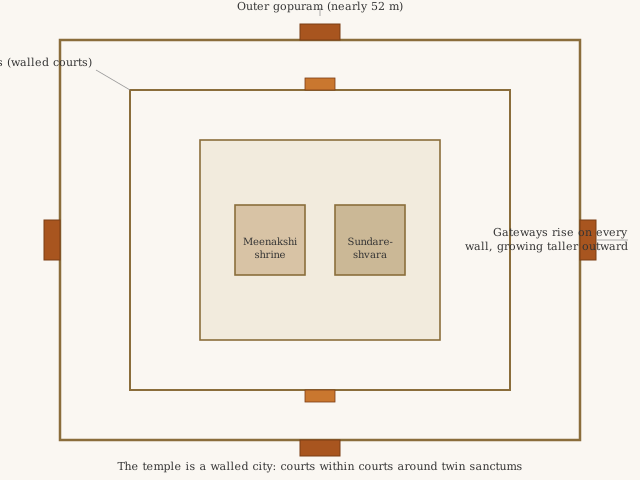
The plan above shows the idea stripped to its bones. Concentric rectangular walls — prakaras — enclose courts within courts. On the main axes of each wall stands a gopuram, and the gopurams grow taller the further out they are. At the very centre are two shrines, close together but distinct: one for the goddess Meenakshi, the "fish-eyed" form of Parvati who is the true sovereign of this temple, and one for her consort Sundareshvara, a form of Shiva. Almost everywhere else in India the god's shrine dominates and the goddess is an attendant. At Madurai the goddess came first, has the busier shrine, and gives the temple its name — a genuine peculiarity worth pausing on.
Why the gateway grew taller than the god
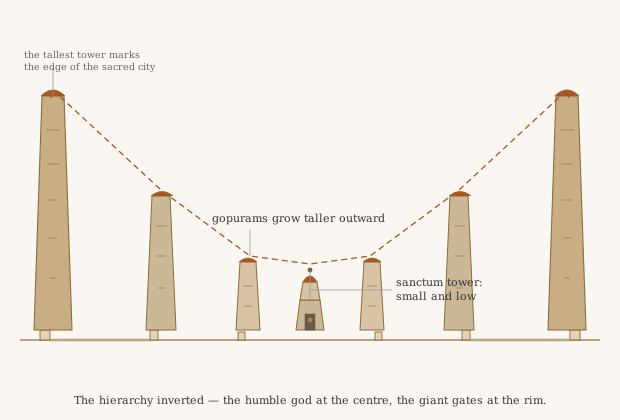
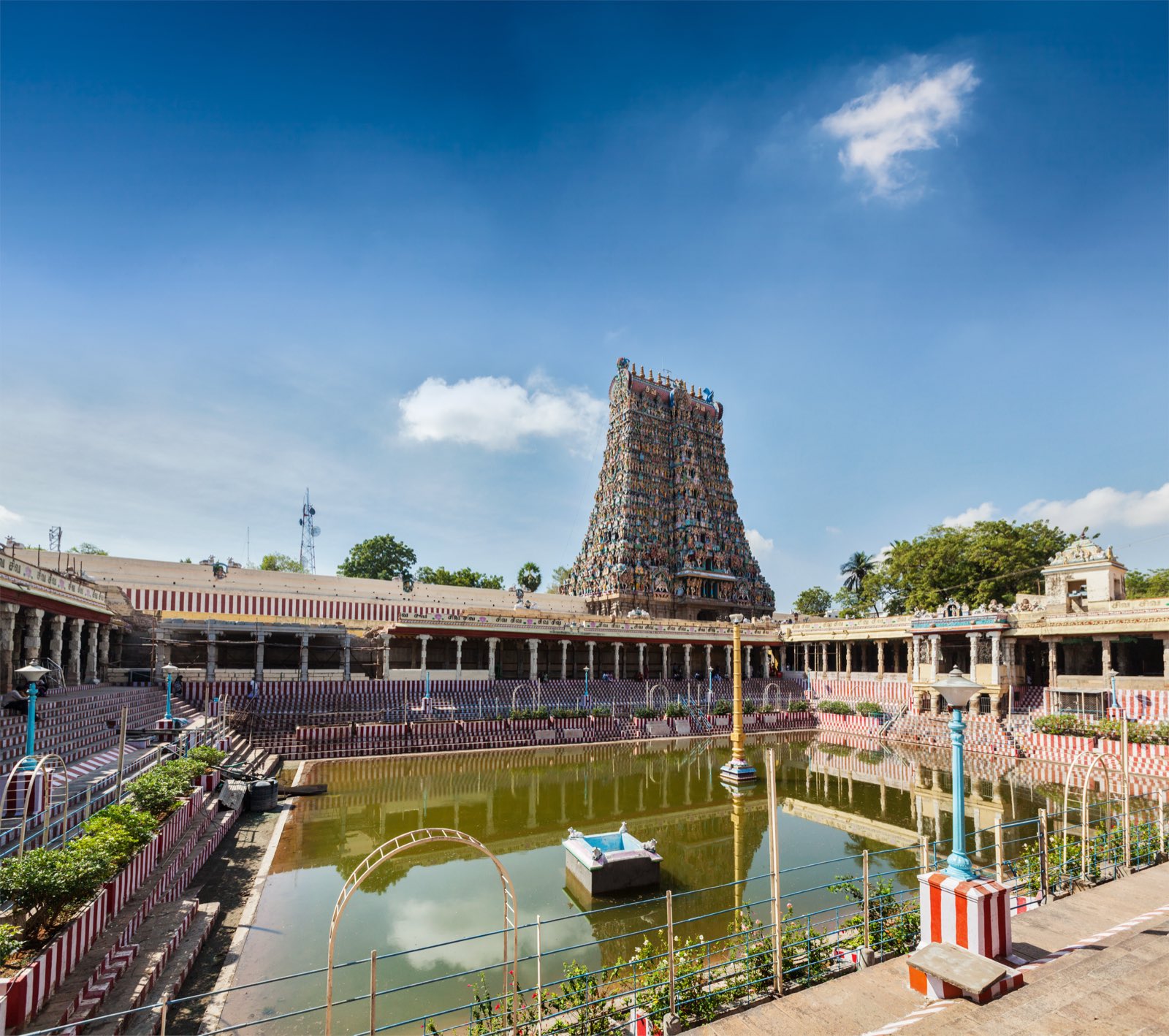
The gopuram is the emblem of the whole South Indian landscape — the thing you see first, from kilometres away, telling you a temple town lies ahead. At Madurai there are fourteen of them, the tallest rising close to fifty-two metres, roughly a seventeen-storey building. Understanding how they are built explains a great deal about the strange economy of this architecture.
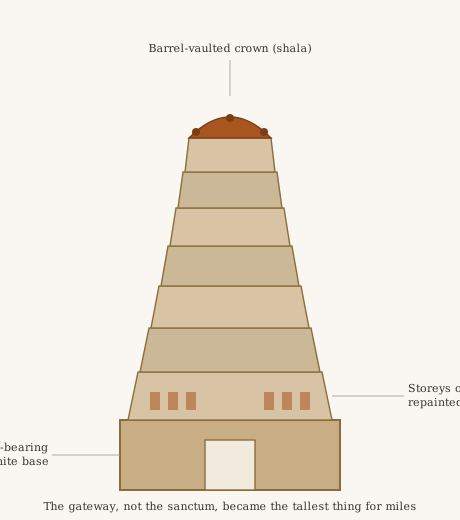
A gopuram has two halves that do two different jobs. The lower part is a rectangular base of solid granite, pierced by a single tall doorway — this is the load-bearing masonry, cut and fitted in the old South Indian way, and it is the part that survives from earlier centuries even when the tower above has been rebuilt. Above the stone base rises a steep, hollow pyramid of many diminishing storeys, built not of heavy stone but of brick and timber faced with lime plaster. That lighter construction is the secret of the gopuram's height: you could never pile fifty metres of solid granite on a single gateway, but you can raise a tapering brick shell that carries almost no load but its own weight.
Every one of those diminishing storeys is covered in sculpture — a teeming vertical field of gods, demons, dancers, kings, animals and guardians, arranged in horizontal rows so that the whole tower reads like a stacked comic strip of the entire Hindu cosmos. At Madurai these figures are vividly painted, and by tradition repainted and renewed roughly every twelve years in a great ceremony, which is why the towers look startlingly fresh — the plasterwork is not a ruin to be preserved but a living surface remade by each generation. Crowning the pyramid is a long barrel-vaulted roof, the shala, its curved ridge studded with finials — the same wagon-vault form the Pallavas were already experimenting with at Mamallapuram nearly a thousand years earlier, now blown up to enormous size and set floating in the sky.
There is a deep architectural point buried in this. The gopuram is essentially a screen — a two-dimensional billboard of sculpture stretched over a hollow frame. The Dravidian temple, which began as a solid mass of stone celebrating the weight and permanence of the god's tower, ended by becoming a set of thin, tall, gorgeously decorated surfaces facing outward at the city. The building had turned into theatre.
The journey inward
The genius of the plan is that it choreographs a journey. Enter through a great outer gopuram and you are in a broad court, bright and noisy, full of shops and pilgrims and the ordinary business of a temple town. Pass through the next gopuram in the next wall and the court is smaller, quieter, dimmer. Each wall you cross takes you into a more enclosed, more shaded, more sacred zone, the light dropping and the ceilings lowering, until you reach the innermost sanctums where a single oil lamp shows the image of the deity in near-total darkness.
This is the exact opposite of a Gothic cathedral, which pulls you toward an ever-brighter, ever-taller climax of light at the altar. The South Indian temple pulls you toward darkness and compression — the holiest space is the garbhagriha, the "womb-chamber", and it is meant to feel like a womb: small, dark, deep inside the body of the building. The towering gateways you passed on the way in were not the destination; they were the announcement. The destination is a cave at the centre, and everything about the plan is designed to make you feel the difference between the bright public edge and the dark secret core.
The halls between the walls
Between the sanctums and the outer walls, the Nayakas filled the courts with some of the most impressive interior spaces in Indian architecture, and two of them deserve particular attention.
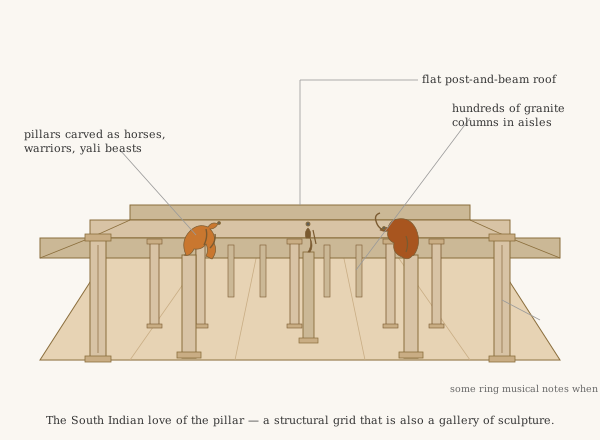
The first is the great pillared hall the guidebooks call the "thousand-pillared hall" (the real count is a little under a thousand). It is a vast flat-roofed forest of carved granite columns, and it demonstrates the other structural principle of this tradition: where north Indian architecture loved the load-bearing wall and the corbelled tower, the South Indian temple loved the pillar — the post-and-beam grid that can be extended indefinitely across a courtyard. Many of the pillars are carved into near-life-size figures — rearing horses, warriors, mythical yali beasts — so that the structural grid doubles as a gallery of sculpture. A famous set of columns here rings musical notes when struck, tuned by the thickness and length of the stone.
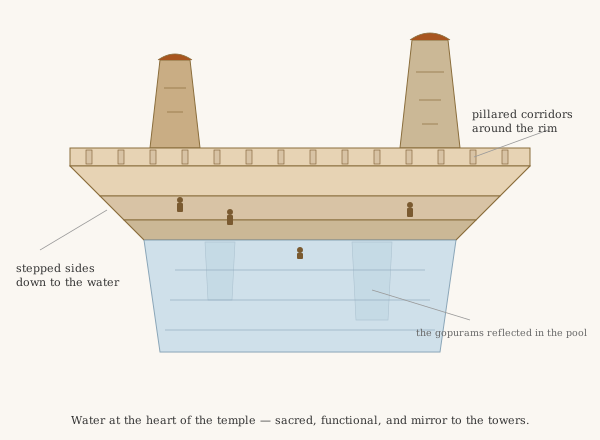
The second is the great tank, the Golden Lily pool — a broad stepped rectangle of water inside the walls, ringed by pillared corridors, where pilgrims bathe and the towers are reflected. Water is not decoration in a South Indian temple; it is functional and sacred at once, needed for ritual bathing and for the daily life of a precinct that housed thousands. The tank is the temple-town's version of the stepwell logic we saw at Rani ki Vav — architecture organised around descent to water — here made public and rectangular and monumental.
Who built it, and when
It is easy to assume a place this coherent was built all at once. It was not. There has been a temple to Sundareshvara and Meenakshi at Madurai for well over a thousand years — the city was a Pandya capital deep in antiquity, and a sacred site long before the present buildings. But the temple as we see it is overwhelmingly the work of the Nayaka dynasty, the governors-turned-kings who ruled Madurai after the fall of the Vijayanagara empire whose ruined capital we walked through at Hampi. The Nayakas inherited Vijayanagara's architectural language — the tall gopuram, the pillared hall, the composite yali column — and deployed it here at enormous scale in the sixteenth and seventeenth centuries.
The greatest single patron was Tirumala Nayaka in the seventeenth century, under whom much of the present layout, the great halls and several of the towering gopurams took their final form. The point to hold onto is that a South Indian temple is never finished. It is an accretion: each dynasty, each pious ruler, each wealthy merchant guild added another hall, another gateway, another ring of wall, always outward. The concentric plan is not a single architect's diagram but the fossil record of a thousand years of donations, growing like a coral reef around a fixed sacred point.
What Madurai teaches
Set beside the other South Indian temples in this series, Meenakshi completes a story. At Mamallapuram in the seventh century the Pallavas were still inventing the basic vocabulary — trying out roof forms on monolithic model shrines. At Brihadeeswara in the eleventh the Cholas perfected the single soaring sanctuary tower. At Pattadakal the earlier Chalukyas had already been testing how northern and southern tower-forms could sit side by side. By the time we reach Nayaka Madurai, the tradition has turned itself inside out and outward: the sanctuary tower has shrunk into humility while the boundary gateways have exploded into the tallest, most sculpted, most public structures in the land.
That trajectory — from a solid holy tower at the centre to a ring of gorgeous hollow screens at the edge — is one of the great arcs in the history of architecture, and Madurai is where you can read it whole. It is also a reminder that a temple in South India is not a building in the Western sense at all. It is a bounded piece of the city, a machine for organising a journey from the ordinary world to the dark centre, and a surface — endlessly, brilliantly, freshly painted — on which an entire civilisation drew its picture of the cosmos, facing outward, for everyone to see.
Part of the Architectural Wonders series. To follow the South Indian temple from its beginnings, read about Mamallapuram, the Brihadeeswara temple at Thanjavur, and the imperial capital at Hampi.
Export this guide
Related Guides — Deep-dive reading
Somapura Mahavihara: The Buddhist University Hidden Inside a Hill
Twelve hundred years ago in Bengal, a Pala emperor built one of the largest monasteries the Buddhist world had ever seen — a walled quadrangle a fifth of a mile across, ringed by 177 monks' cells, with a great cross-shaped, terraced temple rising from its courtyard. For four centuries scholars came from as far as Tibet to study here; then it was abandoned, and slowly buried, until villagers knew it only as Paharpur — 'the hill-town.'
Architectural WondersSrirangam: The Largest Working Temple in the World, a Town Built in Seven Rings
How a temple on an island between two rivers grew into a sacred city of seven concentric walls — the outer rings a living town, the innermost a dark chamber where Vishnu lies asleep — and became the greatest of all the South Indian temple-towns
Architectural WondersBrihadeeswara: The Chola Tower That Never Fell
How an 11th-century Tamil emperor raised a 216-foot tower of solid granite — with no mortar, no iron and no machine — and why this colossal corbelled mountain has stood for over a thousand years where Konark's fell. The engineering, the 80-tonne capstone, and the lesson.
Architectural WondersRelated Tools — Try Free
Interior Layout Planner — Printable Graph Grid
Printable graph grid to sketch room layouts to scale before committing to furniture placement.
Layout ToolBefore & After Studio
Generate AI before-and-after renders to preview how your redesign could look.
DesignAIHome Building & Interior Cost Calculator — 20 Cities
Construction + interior costs for 20 Indian cities across kitchen, wardrobes, flooring, painting, ceiling.
Cost Calculator