
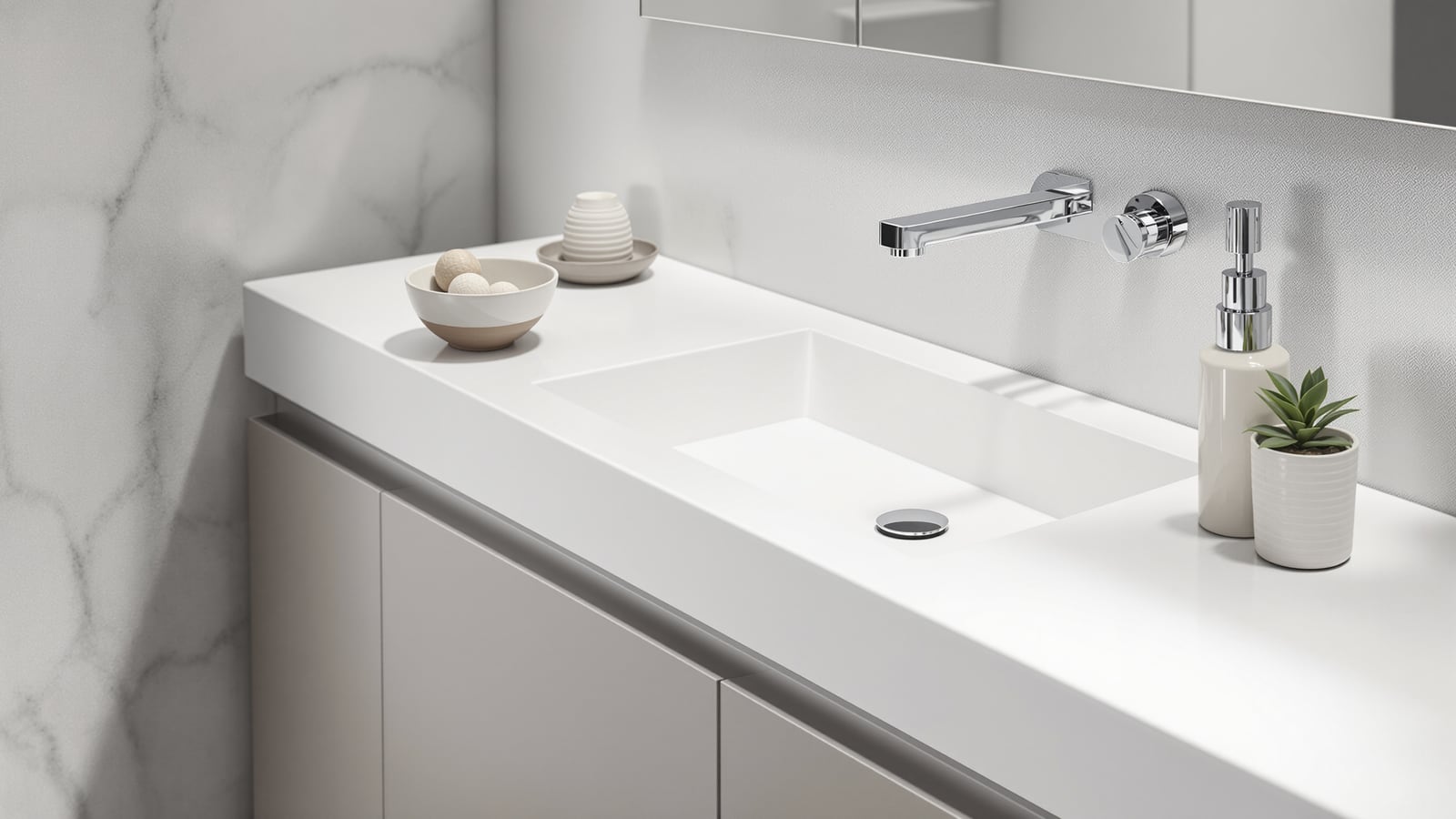
Solid Surface Bathroom India: Seamless Corian-Type Basins, Counters & Wet-Room Seats (2026)
How solid surface (Corian-type acrylic-mineral composite) makes a seamless integrated basin-and-counter with no joint to leak or harbour grime, why it thermoforms into curves, its non-porous hygiene and sandable repairability, the real heat caution, and honest 2026 rupee costs against quartz and granite.
Solid surface is the material that lets a vanity counter and its wash basin be a single, jointless piece — the bowl flows out of the countertop with no rim, no silicone bead and no seam for water or grime to sit in. Sold most famously as Corian (a DuPont brand, now Corian Design) but made by many manufacturers, it is an acrylic or polyester resin blended with natural mineral fillers — roughly two-thirds ground alumina trihydrate and one-third binder — cast into sheets and shapes. The result is a non-porous, homogeneous solid whose colour runs all the way through, unlike a laminate or a coating.
For an Indian bathroom that means one thing above all: the joint you usually clean under and eventually leak at simply is not there. This guide sits under the bathroom vanity guide for India; here we go deep on the solid-surface option — where it wins, where it does not, and what it costs in 2026 rupees.
Solid surface is not chosen for hardness — quartz beats it there. It is chosen for seamlessness and repairability: one moulded piece with no joint to fail, and a scratch you sand out instead of living with.
What solid surface actually is
Think of it as a dense, workable plastic-mineral composite that behaves more like a very hard hardwood than like stone. It can be cut, routed and drilled with normal woodworking tools, and — critically — two pieces can be chemically bonded with a colour-matched adhesive into a joint that is sanded flush and effectively disappears. That invisible seam is why a 3-metre wash counter can look like one continuous slab, and why the basin can be an integrated moulded bowl rather than a separate fitting dropped in.
- Composition: ~60–70% mineral filler (alumina trihydrate), 30–40% acrylic/polyester resin, plus pigments.
- Non-porous: water absorption is negligible, so it does not soak up hard-water minerals, dyes (turmeric, hair colour) or bacteria the way a natural stone can at its pores.
- Homogeneous: colour and pattern go right through the 6–12 mm sheet, so a scratch never exposes a different-coloured core.
- Warm, matte, soft-touch: it sits at room temperature (unlike cold granite) and is usually finished to a matte or satin sheen rather than a mirror polish.
Thermoforming — the curve trick
Heat a solid-surface sheet to about 150–160 °C and it goes pliable; press it into a mould, let it cool, and it holds the shape permanently. This thermoforming is what no stone or quartz can do. It lets a fabricator make coved (radiused) upstands where the counter meets the wall — no grout line to blacken — curved vanity fronts, rounded wet-room bench seats and flowing organic basins. A moulded solid-surface shower seat with a coved junction to the wall is far easier to keep hygienic than a tiled bench with dozens of grout joints.
Where solid surface shines in an Indian bathroom
- Integrated basin-and-counter vanities: one seamless moulded piece; nothing to leak at the basin rim, nothing to re-silicone every monsoon.
- Long wash counters (shared/family bathrooms): invisible seams let you run 2.5–3 m counters with twin integrated basins.
- Wet rooms: thermoformed bench seats, coved skirtings and curbless detailing — see wet room design for India.
- Hygiene-critical spaces: the non-porous, jointless surface wipes clean and resists the black mildew that colonises grout in humid, monsoon-season bathrooms.
- Homes with children or elderly users: warm to touch, no sharp polished stone arris, and a rounded coved front is gentler on a hip or elbow.
The honest downsides — heat, scratch and cost
No material is free. Solid surface trades away hardness and heat tolerance for its seamlessness.
- Heat is the real caution. The acrylic binder softens with heat. A hair straightener, a curling iron or a hot pot left directly on the surface can scorch, blister or leave a white mark. Rated continuous use is roughly up to 100 °C; brief contact with a styling tool at 180–230 °C is enough to damage it. Always use a rest or trivet — this matters more in a bathroom with grooming appliances than most buyers expect.
- It scratches more easily than quartz — but this is also its superpower. Because colour runs through, fine scratches, cigarette scorches, even a stain are sanded out with fine abrasive pads and the surface restored to as-new, on site, by hand. Quartz or granite damage cannot be repaired this way.
- Not as hard as quartz/granite. Sharp knocks and dragging grit can dull a matte finish over years.
- Cost is mid-to-premium, roughly between a good granite and a branded quartz — and genuine branded material (Corian, LG Hausys HI-MACS, Staron) costs well above unbranded acrylic "solid surface" sheets, whose quality varies widely in the Indian market.
Solid surface vs quartz vs granite
| Property | Solid surface (Corian-type) | Quartz (engineered) | Granite (natural) |
|---|---|---|---|
| Seamless integrated basin | Yes — moulded as one piece | No — separate basin | No — separate basin |
| Joints / seams | Invisible, chemically bonded | Visible epoxy seams | Visible epoxy seams |
| Porosity | Non-porous | Non-porous | Porous — needs sealing |
| Repairable scratches | Yes — sand out on site | No | No |
| Thermoformable curves | Yes | No | No |
| Scratch hardness | Moderate | High | High |
| Heat tolerance | Low — use a trivet | High | Very high |
| Feel | Warm, matte, soft | Cool, polished | Cold, polished |
| Typical 2026 cost | ₹1,200–₹3,500 / sq ft | ₹250–₹900 / sq ft | ₹150–₹600 / sq ft |
Costs above are indicative supply-only for the material; an integrated solid-surface vanity top with a moulded basin and coved upstand, fabricated and installed, typically runs ₹28,000–₹75,000+ depending on brand, size and detailing. Unbranded acrylic sheet sits at the lower end; branded Corian/HI-MACS at the top.
Choosing and detailing solid surface
Detailing tips for India:
- Specify a coved upstand at the wall to kill the grout line — the single biggest hygiene win.
- Insist on an integrated moulded basin rather than an undermount bonded bowl if seamlessness is the goal.
- For a countertop-basin look on solid surface, or to compare, see countertop basins for India and the flush under-counter basin option.
- Keep a matt/satin finish — high-gloss solid surface shows swirl marks and every water film from hard water; matt hides both and buffs back easily.
- Ask the fabricator for offcuts and the repair-pad kit so scratches can be sanded out later.
- Weighing this against engineered stone or exploring the broader composite family? Read quartz vanity tops for India and composite bathroom materials for India.
Care and cleaning
- Everyday: mild soap and a soft cloth or a non-scratch pad; wipe hard-water film before it dries.
- Stubborn marks / matt finish: an abrasive cream cleaner and a white pad restore the even sheen.
- Never place hot appliances or pots directly — always a trivet or heat pad.
- Avoid paint strippers, oven cleaners, strong acids and acetone; rinse any spill promptly.
Solid surface is the right call when the joint is your enemy — where a seamless, warm, repairable, hygienic counter-and-basin matters more than raw hardness, and where someone in the house will remember to reach for a trivet.
References
- National Building Code of India (NBC) 2016, Part 9 (Plumbing Services) — sanitary fittings and bathroom detailing.
- IS 2556 (series) — Vitreous sanitary appliances (specification and quality benchmarks for wash basins and fittings).
- IS 4020 — Methods of test for door shutters (finish/abrasion test conventions referenced for surface durability comparisons).
- Bureau of Indian Standards (BIS) — material specification and testing framework, bis.gov.in.
- IGBC / GRIHA — green-building material-selection and low-VOC / hygiene criteria for interior surfaces.
- Manufacturer technical data — Corian Design, LG Hausys HI-MACS and Lotte/Staron solid-surface fabrication and care guides (heat and repair limits).
Export this guide
Related Guides — Deep-dive reading
Quartz Bathroom Countertop India: Engineered Quartz Vanity Tops, Cost & vs Granite/Marble
A practical, India-first guide to engineered quartz vanity tops for bathrooms — why the non-porous, no-seal surface beats granite and marble on a wet counter, plus thickness, seams, heat caution, brand quality and honest ₹ per sq ft costs.
BathroomsHow to Choose a Wash Basin in India: Mount Type, Size, Tap Holes & Budget (2026 Buyer's Guide)
A buyer's decision guide to picking the right wash basin — matching the mount type to your vanity and space, sizing it to the room, getting the tap-hole config right for your faucet, judging material and durability, checking what's in the box, good/better/best rupee tiers, the IS 2556 vitreous-china mark, and how to spot seconds, hairline cracks and warranty traps.
BathroomsCast Iron Bathtub India: The Heirloom Tub, Weight & Slab Load, Enamel Care & Cost (2026)
Why an enamelled cast-iron bathtub is the heirloom tub — unbeatable heat retention, a quiet soak and a vitreous-enamel surface that shrugs off scratches and stains for decades — set against the one thing India buyers must plan for: the sheer weight on the slab, the crew it takes to carry it up, chip repair, the cost premium, and an honest verdict versus acrylic.
BathroomsRelated Tools — Try Free
Material Comparison Sheet
India's interior material cheatsheet — plywood, finishes, hardware, countertops, paints, waterproofing.
Reference GuideMaterial Compare — Side by Side
Compare materials side-by-side: granite vs quartz vs marble, laminate vs acrylic vs PU, and more.
ComparisonMaterial Decision Framework (M-Score)
Score 30+ Indian construction materials across cost, durability, climate fit, maintenance, and sustainability.
Materials