
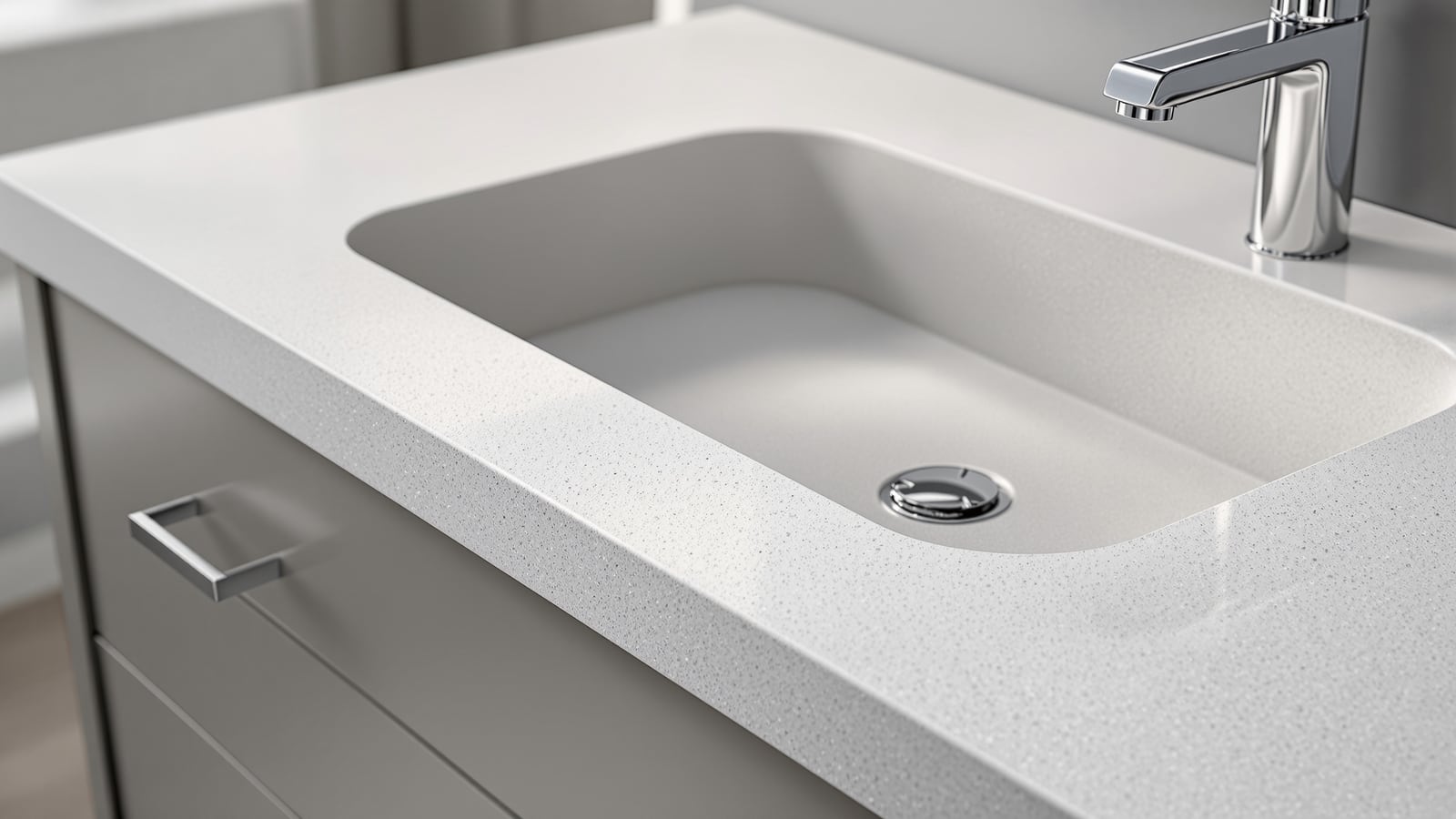
Quartz Bathroom Countertop India: Engineered Quartz Vanity Tops, Cost & vs Granite/Marble
A practical, India-first guide to engineered quartz vanity tops for bathrooms — why the non-porous, no-seal surface beats granite and marble on a wet counter, plus thickness, seams, heat caution, brand quality and honest ₹ per sq ft costs.
Engineered quartz has quietly become the default premium vanity top in Indian bathrooms, and for a good reason: it is the one common counter material that is genuinely non-porous. A bathroom counter takes a beating that a kitchen slab rarely sees — constant hard-water splash, toothpaste, cosmetics, hair dye, the residue of every soap and serum in the house — and it stays wet far longer. On granite or marble that means sealing, re-sealing and watching for the slow etch and stain. On quartz it means a wipe with a cloth. This is a materials-and-components guide in the Studio Matrx bathroom hub, written for the homeowner choosing a vanity surface and the fabricator who has to cut and seam it.
Read this alongside the bathroom vanity guide for India for how the top sits on the cabinet, and the sibling surface guides it competes with: the granite bathroom countertop guide, the marble bathroom guide and the solid surface (Corian-type) bathroom guide. If you are pairing this top with a basin fixed underneath it, the under-counter basin guide covers the cut-out and rim seal in detail — that guide links here because the quartz you choose decides how clean that seam stays.
Quartz is not a slab of natural stone. It is roughly 90–93% crushed quartz mineral bound in about 7–10% polymer resin and pigment, cured under vacuum and pressure. The resin is what makes it non-porous — and also what makes heat its one real weakness.
What "engineered quartz" actually is
Natural stone (granite, marble) is quarried in one piece and its porosity, veining and weak spots are whatever nature gave it. Engineered quartz is manufactured: ground natural quartz — one of the hardest common minerals — is mixed with polyester resin and pigments, then compacted into slabs under a patented vacuum-vibro-compression process (the Bretonstone process most brands license). Because the mineral and colour are dosed by machine, you get two things natural stone cannot promise:
- A truly non-porous surface. The resin fills the space between grains, so there are no capillaries for water, dye or bacteria to soak into. Water resistant, stain resistant, hygienic — and it never needs sealing.
- Consistent colour and pattern. The slab you approve is the slab you get. Two slabs of the same code will match across a long twin-vanity run, which two granite slabs almost never do.
For a bathroom — a wet, splashy, hard-water room — that non-porosity is the whole argument. It is why quartz so often wins here even when a homeowner would happily use granite in the kitchen.
Why quartz usually wins on a bathroom counter
The table below is the honest comparison. All three materials look good on day one; the difference shows up after a year of Indian bathroom use.
| Property | Engineered quartz | Granite | Marble |
|---|---|---|---|
| Porosity | Non-porous, no sealing ever | Porous — seal every 1–2 yrs | Porous — seal often, still etches |
| Hard-water stain | Wipes off, no permanent mark | Rings if unsealed | Dulls and etches |
| Cosmetic / dye stain | Resistant, non-absorbent | Can absorb if unsealed | Absorbs and stains |
| Acid (toilet cleaner, lime) | Resistant | Mostly resistant | Etches badly |
| Scratch / hardness | Very hard (~7 Mohs quartz) | Hard (6–7) | Soft (3–4), scratches |
| Colour consistency | Machine-consistent, repeatable | Every slab differs | Every slab differs |
| Heat tolerance | Weak — resin can scorch/discolour | Excellent | Good |
| Needs sealing | No | Yes | Yes |
| Typical bathroom verdict | Best all-round wet-counter surface | Great budget workhorse | Beautiful but high-maintenance |
The pattern is clear. In a dry-zone bathroom or a low-use guest counter, granite is a perfectly good, cheaper choice. Marble is for the homeowner who wants the veined look and accepts the maintenance. But for a busy family or master bathroom with hard water, quartz's no-seal, stain-proof, wipe-clean behaviour is worth the premium — you buy the counter once and stop thinking about it.
The one real caution: heat
The resin that makes quartz non-porous softens and can discolour or scorch above roughly 150 °C. In a bathroom this almost never matters — but a hot styling tool (straightener, curling iron, waxing pot) or a just-boiled kettle set straight on the surface can leave a dull mark or a faint yellow scorch that will not polish out. The rule is simple: rest hot appliances on a stand or trivet, never directly on quartz. Everything else a bathroom throws at it, quartz shrugs off.
Thickness, seams and the fabrication that matters
A quartz vanity top is a fabrication, not just a slab. Three decisions decide whether it looks and lasts like the showroom sample.
Thickness. Slabs come in 12, 18 and 20 mm. For a vanity that must carry a basin and take daily leaning weight, use 18 or 20 mm. A thin 12 mm slab needs full plywood/MDF backing to avoid flex and cracking around the cut-out, and MDF in a wet bathroom is a bad idea unless it is a moisture-resistant grade. A visually thicker "chunky" edge is made by mitring two pieces to a fake 40 mm front — a fabrication detail, not solid material.
Seams. Quartz slabs are large (a common Indian jumbo is about 3200 × 1600 mm), so most single vanities are seamless. Seams appear on long runs or L-shapes and are glued with colour-matched resin. On a consistent quartz they can be made nearly invisible — one more point over granite, where a seam always shows a colour break. Keep seams away from the basin cut-out, where water and stress concentrate.
The basin cut-out. If you are fitting an under-counter basin, the cut-out edge must be polished and the rim silicone-sealed; quartz takes a clean machine-polished edge that resists the hard-water grime that collects at a basin rim.
The two figures below show the make-up of an engineered quartz slab, and a simple decision path for choosing your bathroom surface.
Brands and quality: how to read the market
The engineered-quartz market in India runs from imported premium names to domestic value slabs. The material science is broadly similar; what varies is quartz content, resin quality, colour range and warranty.
- Premium / imported — brands like Caesarstone (the category originator) and other imported labels sit at the top for colour depth, consistency and long warranties. You pay for the finish and the guarantee.
- Domestic premium — Indian makers such as Kalinga Stone, Pokarna Quantra and similar produce large slabs to international process standards at a lower price, and are the practical sweet spot for most Indian bathrooms.
- Value slabs — cheaper local quartz can cut the quartz percentage and lean on more resin and filler. These stain and scorch more easily and the colour is less stable. Ask for the quartz content and a written warranty.
When comparing, the questions that matter are: quartz content (aim for 90%+), slab size (bigger = fewer seams), the finish (polished vs honed vs matt — honed and matt show hard-water marks less but need a touch more wiping), and the warranty term.
Honest costs — quartz vanity top in India
Prices are indicative material-plus-fabrication ranges for a bathroom vanity top and move with slab size, brand, edge profile and city. Fabrication (cutting, edge polishing, basin cut-out, transport, installation) typically adds ₹150–₹400 per running foot on top of the slab rate.
| Item | Typical range (₹) | Notes |
|---|---|---|
| Value domestic quartz | ₹110–₹180 / sq ft | Higher resin/filler; check warranty |
| Mid domestic premium (Kalinga/Quantra type) | ₹180–₹320 / sq ft | Best value sweet spot |
| Imported premium (Caesarstone type) | ₹350–₹900+ / sq ft | Colour depth, long warranty |
| Granite (for comparison) | ₹80–₹250 / sq ft | Cheaper, but needs sealing |
| Marble (for comparison) | ₹150–₹1000+ / sq ft | Beautiful, high maintenance |
| Fabrication + fitting | ₹150–₹400 / running ft | Cut-out, edge polish, install |
| Mitred 40 mm chunky edge | +₹250–₹600 / running ft | Optional thick-edge look |
For a standard single vanity (about 6–8 sq ft of top) in mid-premium domestic quartz, budget roughly ₹3,000–₹6,000 for the finished, fitted top including a basin cut-out — often only a modest premium over granite, and you never buy a bottle of sealer again.
Living with a quartz vanity top
- Daily — wipe with a damp cloth and mild soap. No sealing, no special polish, no acid-based descaler needed.
- Hard-water film — the surface does not absorb it, so it wipes off; a little dish soap or a 50:50 vinegar-water wipe clears cloudy film (occasional vinegar is fine, but do not leave acids sitting).
- Never — abrasive scouring pads, bleach left to sit, harsh drain-cleaner spills, or hot appliances placed directly on the top.
- Repairs — a rare chip on an edge can be filled with colour-matched resin by a fabricator; the consistent colour makes the repair blend better than on natural stone.
Choose quartz when you want a bathroom counter you fit once and forget. Choose granite from the granite guide to save money on a lower-use or dry-zone counter, marble from the marble guide when the veined look is the point, or a warm seamless solid surface top when you want an integrated moulded basin. Whatever the surface, pair it with the right cabinet from the bathroom vanity guide.
References
- NBC 2016 (National Building Code of India), Part 9 — plumbing and sanitation, for sanitary appliance and vanity fixture guidance.
- IS 2556 — Vitreous sanitary appliances (specification for the ceramic basins fitted into vanity tops).
- IS 15622 — Pressed ceramic tiles (reference for engineered/pressed surface quality expectations).
- BIS (Bureau of Indian Standards) — for material specifications and testing references on engineered stone and surfaces.
- IGBC / GRIHA — green-building material and indoor-environment guidance where low-VOC, hygienic surfaces are credited.
Export this guide
Related Guides — Deep-dive reading
Granite Bathroom Countertop India: Vanity Tops, Sealing, Finishes & Cost
A practical, India-first guide to granite vanity countertops for the bathroom — why granite is the durable, heat- and scratch-resistant budget favourite, how to seal a porous stone against hard water and staining, polished versus leather and honed finishes, edge profiles, basin cut-outs, thickness, and honest ₹ per sq ft versus quartz, marble and solid surface.
BathroomsUnder Counter Wash Basin India: Undermount Basins, Cut-outs & Sealing
A practical, India-first guide to under-counter (undermount) wash basins fixed below a granite or quartz vanity top — the clean wipe-down counter, the deck-mounted tap, the cut-out and rim seal that keeps water out, and honest ₹ costs versus a countertop basin.
BathroomsHow to Choose a Wash Basin in India: Mount Type, Size, Tap Holes & Budget (2026 Buyer's Guide)
A buyer's decision guide to picking the right wash basin — matching the mount type to your vanity and space, sizing it to the room, getting the tap-hole config right for your faucet, judging material and durability, checking what's in the box, good/better/best rupee tiers, the IS 2556 vitreous-china mark, and how to spot seconds, hairline cracks and warranty traps.
BathroomsRelated Tools — Try Free
Material Comparison Sheet
India's interior material cheatsheet — plywood, finishes, hardware, countertops, paints, waterproofing.
Reference GuideMaterial Compare — Side by Side
Compare materials side-by-side: granite vs quartz vs marble, laminate vs acrylic vs PU, and more.
ComparisonBefore vs After — Cost Reality Check
Compare what you expected to pay vs what you actually paid, category by category.
Reality Check