

Low-E Glass Guide (India): The Single Biggest Energy Upgrade for Your Windows
How a microscopic metallic-oxide coating reflects radiant heat while passing daylight, soft-coat versus hard-coat, the metrics it moves, and what it costs on top of your frame.
If you change only one thing about your windows for energy, change the glass coating. A microscopically thin layer of metallic oxide, called Low-E (low-emissivity), is the single biggest lever you have on a window's energy performance in India. It costs a fraction of a curtain wall or smart glass, yet it is the difference between a west room that bakes by 3 pm and one that stays workable on the same AC setting.
This guide explains what Low-E actually does, the soft-coat versus hard-coat split, the four metrics it moves, and what it costs on top of your frame in June 2026.
What Low-E glass actually does
Sunlight is not one thing. It arrives as visible light (the daylight you want), shortwave near-infrared (heat that comes straight from the sun), and the glass and walls then re-radiate longwave infrared (the radiant heat a hot surface throws back). A clear pane lets nearly all of it through and re-radiates heat freely in both directions.
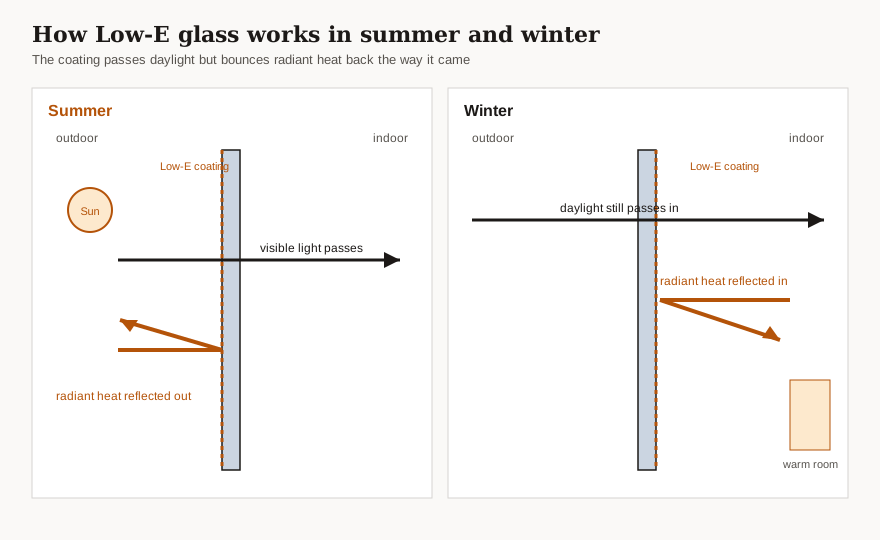
A Low-E coating is engineered to be spectrally selective: it passes most visible light while reflecting longwave infrared. So daylight gets in, but radiant heat is bounced back to where it came from.
Keep the heat where you want it: a Low-E coating reflects radiant heat back outdoors in summer, and reflects your room's heat back indoors in winter. The same coating works both ways.
That two-way behaviour is why Low-E is sold from Leh to Kochi. In hot India it keeps the 45-degree-C summer load out; in a Himachal or Kashmir winter it keeps your heating in.
Soft-coat versus hard-coat
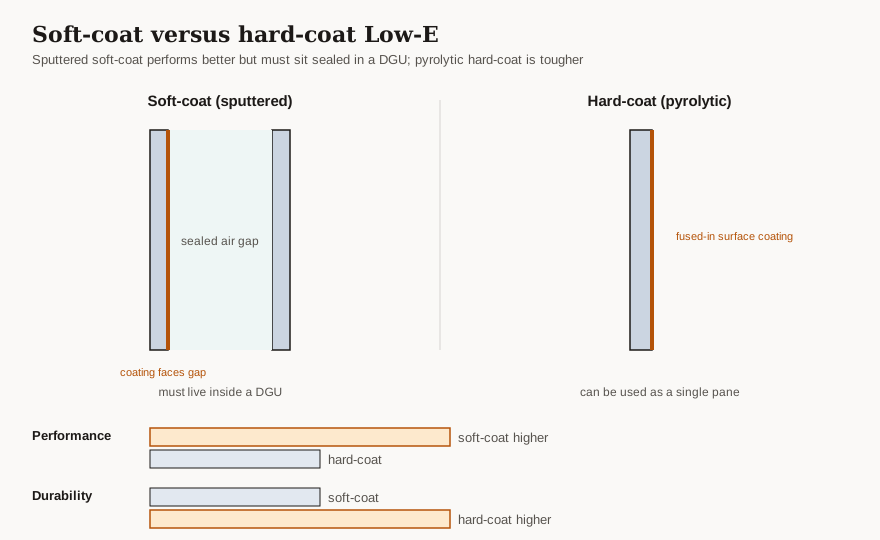
There are two ways the coating is applied, and the choice decides where the glass can go.
| Feature | Soft-coat (sputtered) | Hard-coat (pyrolytic) |
|---|---|---|
| How it is made | Sputtered onto cooled glass under vacuum (multiple silver-oxide layers) | Sprayed on molten glass during float production (fused-in) |
| Performance | Best; lowest emissivity, lowest SHGC, high LSG | Good, but less selective |
| Durability | Delicate coating; must sit inside a sealed DGU | Tough; survives handling and exposure |
| Where it goes | Inside a Double Glazed Unit, coating facing the air gap | Can be used single-glazed or in a DGU |
| Best for | The energy default for cooled and heated homes | Single-glaze upgrades, exposed faces, tighter budgets |
The short version: soft-coat is the performer, hard-coat is the survivor. For a new home in hot or composite India, the right answer is almost always a soft-coat Low-E sealed inside a DGU. Reserve hard-coat for single-glazed retrofits or surfaces where the coated face would be exposed.
The metrics Low-E improves
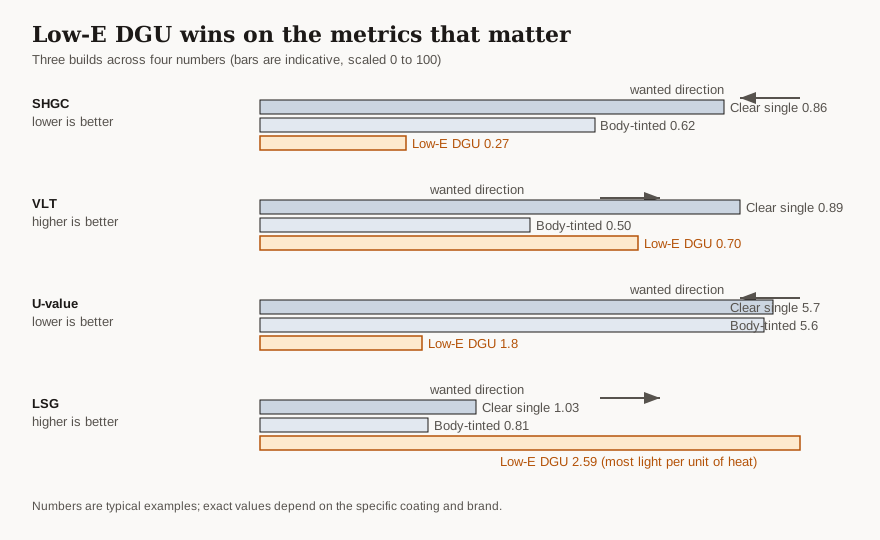
Glass performance is a four-number language. Low-E moves all four in the right direction.
| Metric | What it means | Direction you want | What Low-E does |
|---|---|---|---|
| SHGC | Solar Heat Gain Coefficient (0 to 1): fraction of solar heat admitted | LOWER in hot India | Drops it sharply |
| VLT | Visible Light Transmittance (0 to 1): daylight passing | Adequate, per code | Keeps it high |
| U-value | Heat conduction; insulation | LOWER | Lowers it |
| LSG | Light-to-Solar-Gain (VLT divided by SHGC) | HIGHER | Raises it |
LSG is the number that captures the magic. A high LSG means lots of light per unit of heat admitted, which is exactly the spectrally selective ideal: a bright room that is not a hot room. A plain tinted glass cuts heat but also dims and dulls the daylight, so its LSG stays low. A good spectrally selective Low-E does both jobs at once.
Why it is India's biggest glass energy lever
Windows are the biggest single lever on a home's heat load, and the coating is the biggest lever on the window. Compared with the alternatives, Low-E gives you the most performance per rupee:
- Versus external shading: shading helps, but only where you can build an overhang or louvre. Low-E works on every orientation, including the awkward west wall, without architecture.
- Versus a third glass pane (triple glazing): in most of hot India a third pane is overkill. The win comes from Low-E plus low SHGC, not from mass. Triple glazing belongs in cold north and hill regions or extreme-noise sites.
- Versus reflective or heavy tint: those cut heat but also cut daylight and can look dated. Low-E keeps the glass looking like glass.
This matters directly under Eco-Niwas Samhita 2018, India's residential energy code. ENS requires the wall envelope to hit an RETV (Residential Envelope Transmittance Value) of 15 W per m2 or less in composite, hot-dry, warm-humid and temperate zones, and windows are the biggest swing on RETV. It also sets a minimum VLT that depends on your window-to-wall ratio (WWR):
| WWR band | Minimum VLT |
|---|---|
| 0.00 to 0.30 | 0.27 |
| 0.31 to 0.40 | 0.20 |
| 0.41 to 0.50 | 0.16 |
| 0.51 to 0.60 | 0.13 |
| 0.61 to 0.70 | 0.11 |
The tension is clear: the more glass you have (higher WWR), the lower the SHGC you must hit to stay under RETV, yet you must still clear the minimum VLT. Only a high-LSG spectrally selective Low-E lets you cut SHGC hard while keeping daylight above the floor. That is why, as glazing area grows, Low-E stops being optional and becomes the way to stay compliant.
What it costs
Glass is priced on top of the frame, never instead of it. As a rough June 2026 guide, a basic Low-E upgrade starts around ₹100 to ₹150 per sqft of glass over plain glazing, rising with coating grade, brand and DGU build.
| Build | What you get | Indicative add (per sqft) |
|---|---|---|
| Hard-coat Low-E, single glaze | Tougher coating, budget upgrade | From around ₹100 |
| Soft-coat Low-E in DGU (air) | The energy default; sealed soft-coat | From around ₹150 |
| Soft-coat Low-E DGU plus argon | Lower U-value, the best-value step up | Add a modest premium |
A few cost notes that matter:
- Pair Low-E with a DGU, and ideally argon. Soft-coat Low-E needs the sealed gap to survive, and the DGU plus an argon fill and a warm-edge spacer pushes the U-value lower. Low-E and DGU are a package, not a choice.
- All glass prices attract 18 per cent GST on top.
- These are indicative figures. Confirm with itemised quotes from fabricators, because city, brand, pane thickness and size all move the number.
The window is three decisions stacked: the frame material, the window type, and the glass. Low-E is the highest-return upgrade in the glass decision, and it sits on top of whatever frame and shape you have already chosen.
How Low-E fits the glass family
Low-E is one member of a wider solar-control family, so it is easy to confuse the cousins. Here is how they differ:
- This guide (Low-E): the coating itself, the explainer on emissivity, soft versus hard coat, and the four metrics.
- For the broader family of heat-cutting glass, including tinted, reflective and spectrally selective options, see solar-control glass. Low-E solar control is one member of that family; the solar-control guide compares the whole set.
- For the overall view of glazing as an energy system, with single, double and triple glazing and where each pays back, see energy-efficient glass. That is the umbrella; this guide zooms into the coating layer.
- For the specific recommendation when your only concern is 45-degree-C heat, see the best glass for a hot climate. That guide names the pick; this one explains the science behind it.
- Glass is one of three window decisions. Start the glass decision at the types of glass for windows pillar, and pair it with your window frame material and window type choices.
The bottom line
If your budget allows exactly one glass upgrade, make it a soft-coat Low-E sealed in a DGU, with argon if you can stretch. It cuts SHGC and U-value, keeps VLT and LSG high, works in summer and winter, and is the most reliable way to satisfy Eco-Niwas Samhita as your glazing area grows, for around ₹100 to ₹150 per sqft over plain glass, plus GST, on top of your frame.
References
- Best glass for windows in India 2026 (IndiFrame): https://indiframe.com/blog/best-glass-for-windows-in-india
- Low-E glass and energy efficiency (Guardian Glass): https://www.guardianglass.com/eu/en/our-glass/glass-types/low-e-glass
- Types of Low-E and solar control glass (FG Glass India): https://fgglass.com/blogs-details/types-of-low-e-glass
- Glass and window solutions for homes (Saint-Gobain India): https://in.saint-gobain-glass.com/knowledge-center/glass-and-windows
- Low-E glass rating, U-factor, SHGC, VT (Mannlee): https://www.mannleecw.com/what-is-low-e-glass-rating/
- Eco-Niwas Samhita 2018 (BEE/ECBC): https://ecbc.in/econiwas.html
Export this guide
Related Guides — Deep-dive reading
Solar Control Glass in India: Cutting Heat Without Killing the Daylight
The performance family that cuts solar heat while keeping daylight: spectrally selective Low-E, body-tinted and reflective glass, the SHGC, VLT and LSG that rank them, where it is essential, and the cost on top of your frame.
Windows & GlazingBest Glass for Hot Indian Climates (2026): Beating 45-Degree Heat at the Window
Which window glass keeps the daylight but stops the heat in Delhi, Rajasthan, Telangana and the hot plains, by orientation, budget and payback.
Windows & GlazingEnergy-Efficient Facades in India: How the Building Skin Cuts Your Cooling, Heating & Lighting Bills
How a building facade drives cooling, heating and lighting energy in India, the three levers of solar-heat-gain control, insulation and daylighting, U-value, SHGC, VLT and WWR in plain terms, ECBC and Eco-Niwas expectations, and real Indian green buildings.
Building FacadesRelated Tools — Try Free
Cross-Ventilation Analyzer
Estimate airflow and air changes per hour (ACH) from room size, window areas, layout, and local wind — with NBC 2016 Part 8 compliance check.
Ventilation CalculatorBrise-Soleil Visualizer
Interactive horizontal-louvre cut-off angle calculator — sun altitude, louvre depth, and spacing inputs with a live shadow preview. Computes θ = arctan(spacing/depth) for façade shading, ECBC envelope compliance, hospital daylight design, and tropical sun-control detailing.
Sun Shading ToolWindow-to-Wall Ratio Calculator
Compute WWR percent and check it against Eco-Niwas Samhita VLT and RETV limits and climate.
Window Tool