
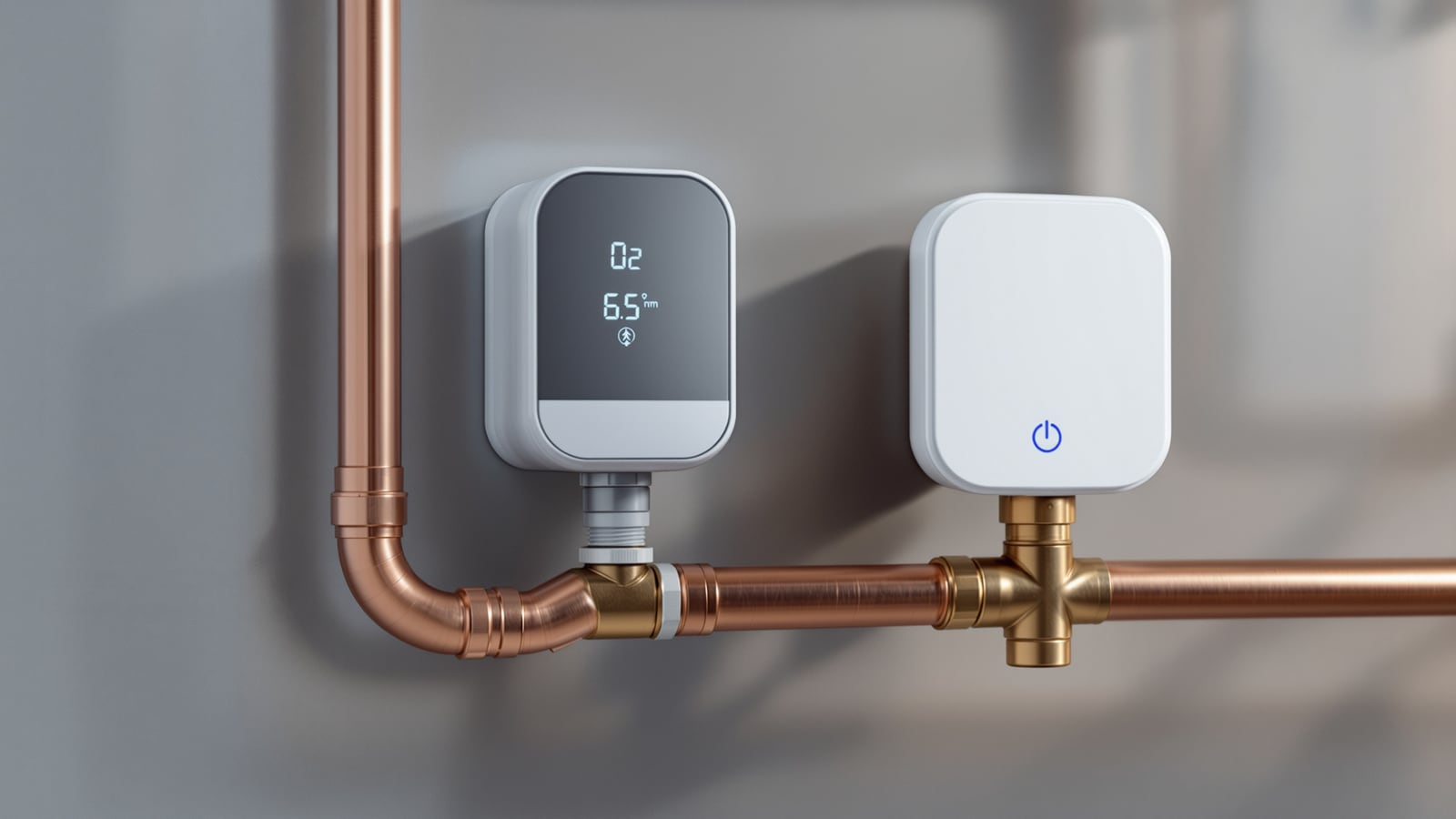
Smart Plumbing System for Indian Homes: Meters, Leak Sensors & Auto Shutoff
What a smart plumbing system actually adds in an Indian home — smart water meters and sub-metering, IoT leak sensors, automatic shutoff valves, tank and pump controllers, water-quality sensors and app monitoring — plus the honest question of when each is worth the money on an intermittent, tank-fed supply.
"Smart plumbing" sounds like a gadget catalogue, but the useful version is simpler than that: a handful of sensors and valves that watch your water supply and act on it faster than a person can. In an Indian home the case is different from the West — supply is often intermittent, most homes run off tanks and pumps, and the biggest wins are usually about not wasting stored water and catching a leak before it drains a tank overnight.
This is a smart-and-sustainable guide within the Studio Matrx sustainable plumbing guide. It builds directly on the leak detection guide for the manual side of the same problem, and on the component guides for the solenoid valves and float valves that the automated versions replace. For the sensing side of water quality, it points to the water-quality testing guide. The aim is to separate what genuinely earns its place from what is a solution looking for a problem.
Automation does not fix a badly plumbed house — it makes a well-plumbed one easier to run and harder to flood. Spend on the pipework and the tank first, then add the sensors.
What a smart plumbing system is (and is not)
Strip away the branding and a smart plumbing system is three things working together:
- Sensing — devices that measure something: flow, water level, moisture where there should be none, or water quality.
- Deciding — a controller or an app rule that turns a reading into an action ("tank full, stop the pump", "flow running for two hours straight, that is a leak").
- Acting — a valve or a pump relay that physically opens, closes or switches based on that decision.
A device that only measures and shows you a number on a phone is monitoring. A system that also acts on its own is automation. Both are useful, but they solve different problems, and the automation half is where the real protection — and the real installation care — lives.
The devices, and when each is worth it
Here is the honest version, device by device. The "when worth it" column is the one that matters — plenty of this is genuinely optional.
| Smart device | What it does | When it is worth it |
|---|---|---|
| Smart water meter / sub-meter | Measures flow through a line and logs usage to an app; some flag abnormal continuous flow | Metered municipal supply, a rented-out floor, or anyone chasing a high bill or a suspected leak |
| IoT leak / moisture sensor | A small puck that alarms (and pings your phone) when it detects water where it should be dry | Under sinks, near the geyser, behind the washing machine, in any concealed or hard-to-see wet zone |
| Automatic shutoff valve | A motorised or solenoid valve on the main that closes on command, on a leak alarm, or on a schedule | Homes left empty for days, a history of pipe bursts, or a floor above valuables you cannot afford to soak |
| Tank water-level controller | Senses overhead/underground tank level and displays it; alarms on empty or full | Almost every tank-fed home — the cheapest device with the widest payback |
| Automatic pump controller | Starts the pump when the tank is low and stops it when full, without anyone watching | Any home where someone currently walks up to switch the pump on and off, or forgets and overflows the tank |
| Water-quality sensor | Continuously reads TDS, and sometimes pH or turbidity, on the supply or the purifier output | Borewell supply, a purifier you want to trust, or an area with variable source quality |
| App / hub monitoring | Ties the sensors together, shows history, and sends alerts when you are away | Only once you have two or more devices worth tying together |
Smart water meters and sub-metering
A smart meter is a flow meter with a radio and a memory. It tells you how much water passed and, crucially, when — so a slow overnight creep with the house asleep reads unmistakably as a leak. Sub-metering means putting a second meter on one branch: the rented upper floor, the garden line, or the inlet to a single flat in a shared building, so usage can be split fairly. On an intermittent supply the meter also quietly answers a common argument — how much you actually received versus what you were billed.
IoT leak and moisture sensors
These are the highest value-for-money smart devices in most homes. A leak sensor does one thing well: it sits on the floor at a known weak point and screams — locally and on your phone — the moment it gets wet. It does not stop the water; it buys you the minutes that decide whether you mop a floor or replaster a ceiling. Put them where leaks actually start, which the leak detection guide maps out: under-sink traps, the geyser, the washing-machine hose, and the base of concealed risers.
Automatic smart shutoff valves
This is the device that turns an alarm into protection. A shutoff valve on the main line closes automatically — you can trigger it from the app, tie it to a leak sensor, or set it to close whenever the house is in "away" mode. Two mechanisms are common:
- Motorised ball valves — a small motor turns a normal ball valve a quarter-turn shut. They hold closed without power, handle full line pressure well, and are the usual choice for a whole-home shutoff.
- Solenoid valves — an electromagnet opens or closes a small valve directly. They act instantly and suit tank inlets and appliance feeds, but most need continuous power to hold one state. The solenoid valves guide covers normally-open versus normally-closed, which decides what happens in a power cut.
That power-cut behaviour is the whole design question in India. A valve that fails shut leaves you without water during an outage; one that fails open gives you no protection exactly when the mains flickers. Choose the failure mode deliberately for where the valve sits.
| Valve type | Behaviour in a power cut | Best placed on |
|---|---|---|
| Motorised ball valve | Holds its last state (open or shut) without power | The main line, as the whole-home shutoff |
| Normally-closed solenoid | Fails shut — no water until power returns | A tank inlet or appliance feed you are happy to have closed |
| Normally-open solenoid | Fails open — water keeps flowing, no protection | A feed that must stay live, with protection handled elsewhere |
Tank level controllers and automatic pump controllers
For most Indian homes this pair is where smart plumbing pays for itself, because it fixes a chore everyone does badly. A level controller reads how full the overhead (and underground) tank is and shows it on a panel or phone — no more guessing or climbing to the terrace. Pair it with an automatic pump controller and the system starts the pump when the tank runs low and cuts it the moment the tank fills, so nobody forgets and floods the terrace, and the pump never runs dry against an empty sump. The float valve is the purely mechanical version of the same idea; the float valves guide explains where a simple float still beats electronics.
Two things to insist on for pump automation: a dry-run cut-off so the motor stops if the sump is empty rather than burning out, and sensible hysteresis — a gap between the "start" and "stop" levels — so the pump does not chatter on and off around a single threshold.
Water-quality sensors
An inline sensor reads TDS, and sometimes pH or turbidity, continuously rather than as a one-off test. It is genuinely useful on a borewell or a variable source, or as a check that a purifier is still doing its job. But treat it as an early-warning light, not a lab: a continuous sensor tells you something changed, and that is your cue to run a proper test. The water-quality testing guide covers what to actually measure and when a lab test is warranted.
The Indian reality that shapes all of this
Most smart-plumbing marketing assumes a pressurised, always-on mains. Indian homes usually run the opposite way, and that changes what is useful:
- Intermittent supply and tanks. Your real buffer is the tank, not the mains. So level and pump control matter more than fancy pressure sensing, and a leak that empties a full overhead tank overnight is a bigger loss than a mains drip.
- Power cuts. Every automated valve and controller needs a decided behaviour when power drops. Prefer devices that hold their last valve state without power, and put controllers on the same backup as the pump where you can.
- Water chemistry. Hard and silty water shortens the life of moving parts inside solenoid and motorised valves. Add a strainer upstream and expect to service them.
- Connectivity. Alerts are worthless if they do not arrive. A device that alarms locally and over Wi-Fi is safer than one that relies on the cloud alone, which goes quiet the moment the router loses power.
Installation considerations
A smart device is only as good as its plumbing and its power. Before buying anything, plan for these:
- Where it cuts into the pipe. Meters and shutoff valves go on the main, at an accessible point with an isolating valve either side so you can service the device without draining the house. A concealed valve you cannot reach is a future headache.
- Power and backup. Controllers and powered valves need a supply that survives an outage if their job matters during one. Run them off the pump's backup where possible.
- Sizing and pressure. Match the valve bore to the line so you do not throttle flow. Full-bore motorised valves suit the main; small solenoids suit appliance and tank feeds.
- A manual override. Every automated valve should still be operable by hand, and every auto pump controller should have a manual switch, so a failed sensor does not leave you without water.
- Get the wet work done by a plumber. Sensors and apps you can set up yourself, but cutting into the main line, and any electrical connection to a pump, belongs with a licensed plumber and electrician. Water and wiring share too much of an Indian home to improvise.
What it costs, and where it fits the bigger picture
Prices move fast and vary by brand, so treat any figure as indicative and check current rates — the Studio Matrx plumbing cost guide is the place for numbers. As a rough hierarchy, a tank level indicator is the cheapest entry point, leak pucks and pump controllers sit in the middle, and a full whole-home metered-and-shutoff setup runs to a few tens of thousands of rupees. The order of spend rarely goes wrong if you follow payback: protect the tank, then catch leaks, then meter, then automate the shutoff.
Smart plumbing is one lever in a wider efficiency picture. Monitoring shows you where water goes; the sustainable plumbing guide covers the rest — low-flow fixtures, rainwater harvesting and reuse — that reduce how much you draw in the first place. Sensors tell you the truth about your water; what you do with that truth is where the saving is.
References
- National Building Code of India (NBC), Part 9 — Plumbing Services, for water supply practice that any smart layer sits on top of.
- Bureau of Indian Standards codes for water meters, valves and plumbing fittings.
- Central Ground Water Authority guidance where borewell metering and monitoring apply.
Names are given for orientation; confirm the current clause and edition before relying on a specific requirement.
Export this guide
Related Guides — Deep-dive reading
Smart Water Management for Indian Homes: Tanks, Leaks & Pumps
The most useful smart-home category almost nobody plans for — automatic tank level and pump control that ends dry-runs and overflows, leak detection under sinks and behind washing machines, smart meters and consumption analytics, connected purifiers, motor protection and borewell monitoring, with real Indian brands and rupee costs.
Smart HomeSmart Water Monitoring India: Track Bathroom Usage, Catch a Running Toilet, Cut the Bill (2026)
A clamp-on or inline flow sensor turns your water line into a dashboard — litres per shower, a toilet that never stops filling, a hidden drip you would never hear. This is the honest India-first guide to smart water monitoring: how sensors meter each fixture, the apps and alerts, tie-ins with auto shut-off valves, and the real rupee cost against the bill it saves.
BathroomsSmart Leak Detection India: Water Sensors, Auto Shut-Off Valves, Cost & App Alerts
A practical India-first guide to smart water-leak detection for bathrooms — spot-sensor pucks under the basin, WC and geyser that scream when they get wet, in-line smart valves that sense abnormal flow and shut the main automatically, battery versus wired, app alerts while you are away, and how the whole system protects the flat below in an apartment society.
BathroomsRelated Tools — Try Free
Rainwater Tank Sizer
How big should your rainwater tank be? Computes annual harvest, recommended tank capacity in litres, water-bill savings, and payback — for 10 Indian cities.
RWH CalculatorCross-Ventilation Analyzer
Estimate airflow and air changes per hour (ACH) from room size, window areas, layout, and local wind — with NBC 2016 Part 8 compliance check.
Ventilation CalculatorAccess-Control Battery-Backup Calculator
Size the standby battery so an access system keeps running through a power cut, with an egress life-safety note.
Battery Backup