
Smart Leak Detection India: Water Sensors, Auto Shut-Off Valves, Cost & App Alerts
A practical India-first guide to smart water-leak detection for bathrooms — spot-sensor pucks under the basin, WC and geyser that scream when they get wet, in-line smart valves that sense abnormal flow and shut the main automatically, battery versus wired, app alerts while you are away, and how the whole system protects the flat below in an apartment society.
A slow leak is the quietest, most expensive fault in an Indian bathroom. A geyser inlet that weeps a drop a minute, a concealed cistern connector that has worked loose, a waste trap under the vanity that drips into the cabinet — none of them make a sound, none set off any alarm, and by the time a brown patch blooms on the ceiling of the flat below, the water has been running for weeks. In an apartment society that ceiling belongs to your neighbour, and the argument that follows is one of the most reliable flashpoints in Indian residential life. Smart leak detection is the electronic early-warning system that catches all of this — not by waterproofing the room, but by sensing water where water should not be and, in the best systems, shutting the supply off before the damage is done.
This is a different discipline from waterproofing or plumbing quality. Waterproofing stops water passing through the floor and walls; leak detection assumes something will eventually fail and makes sure you know within seconds, not weeks. It sits inside the smart bathroom for India as arguably the most genuinely useful connected feature you can add — the one that pays for itself the first time it fires. This guide explains the two halves of a system — the spot sensors and the automatic shut-off valve — where to place them, battery versus wired, how the app alerts you while you are travelling, what it costs, and how it defends the flat below.
Leak detection does not stop leaks — it stops damage. A sensor tells you within seconds; an automatic valve shuts the main before the water reaches the flat below. In an apartment, that valve is the difference between a mopped floor and a society dispute over a ruined ceiling.
The two halves of a leak-detection system
Every smart leak-detection setup is built from two kinds of device, and you can buy either alone or both together. Understanding the split is the whole decision.
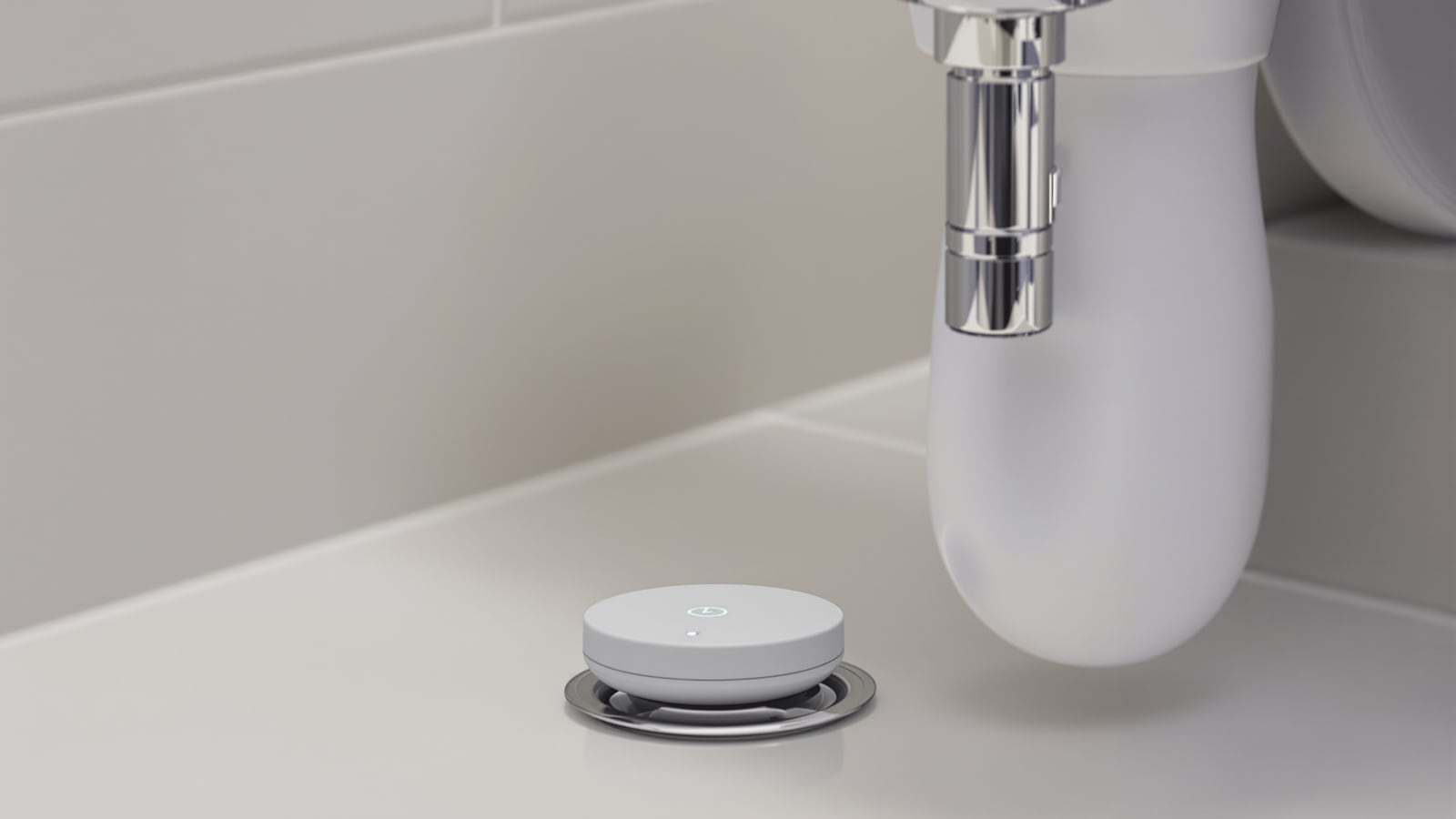
- Spot leak sensors (the pucks). Small battery or wired pucks with two metal contacts on the underside. Sit one on the floor at each place a leak is likely — under the basin, beside the WC, under the geyser, near the washing-machine point. The moment water bridges the contacts, it sounds a loud local alarm and, if it is a connected model, pushes an alert to your phone. Cheap, simple, and the first thing every home should own. Their limit: they only tell you; they do not stop the water.
- In-line smart shut-off valve (the actuator). A motorised valve fitted on the incoming water main. It watches flow through the pipe and can close automatically — either when a paired sensor gets wet, or when it detects an abnormal flow pattern on its own (water running continuously for longer than any normal tap use, or a tiny constant trickle that signals a hidden drip). When it trips, it turns the whole supply off. This is the half that actually prevents the flood.
The honest hierarchy: spot sensors are the essential baseline every flat should have; the automatic valve is the upgrade that turns a warning into protection, and it is the piece that matters most if you travel, live above a neighbour, or leave the flat locked for weeks in the monsoon.
Where to place the sensors
A leak sensor only works where the leak actually reaches it, so placement is everything. Water runs to the lowest point, so sit each puck on the floor at the low side of the fixture, touching where a first trickle would pool.
| Location | Why it leaks | Sensor placement |
|---|---|---|
| Under the wash basin | Waste trap, angle-valve and flexible-hose joints weep into the cabinet | On the cabinet base, below the trap and hose connectors |
| Beside the WC / cistern | Cistern inlet connector and flush-valve seals loosen and drip | On the floor at the base, on the connector side |
| Under the geyser | Inlet/outlet unions and the safety relief valve are classic drip points | On the floor directly below, or in the drip tray if fitted |
| At the washing-machine point | Hose couplings and the inlet tap fail under pressure cycling | On the floor beside the inlet and drain |
| Near the water-main entry | The best single spot for a whole-flat catch-all | At the lowest floor point where the main enters |
- Put a puck under every concealed or cabinet-hidden joint first — these are the leaks nobody sees. A weeping trap inside a closed vanity can rot the cabinet and seep to the slab for months in silence; a sensor on the cabinet floor catches it the first day.
- The geyser deserves its own sensor. A storage geyser holds several litres under mains pressure, its relief valve is designed to discharge, and its unions run hot-cold cycles that loosen fittings. Read the geyser and water heater guide alongside this — the geyser is the single most likely serious leak in an Indian bathroom.
- Add one at the main entry as a backstop. Wherever the supply enters the flat is the lowest common point; a sensor there catches leaks the fixture pucks miss.
This is detection, not prevention — pair it with sound bathroom leak prevention and continuous bathroom water monitoring so the sensors are the last line, not the first.
Battery versus wired, and how the alert reaches you
The two practical choices are how the sensor is powered and how it talks to you. Both matter for a device that must work reliably for years and, crucially, while you are away.
| Factor | Battery (wireless) | Wired / mains |
|---|---|---|
| Install | Drop-in, no electrician, place anywhere | Needs a point; plan at rough-in |
| Best for | Retrofits, rented flats, hidden spots | New builds, the shut-off valve itself |
| Upkeep | Replace cell every 1-3 years; needs low-battery alerts | None once wired |
| Risk | Dead battery = silent sensor | Dead on power-cut unless battery backup |
| Connectivity | Wi-Fi or Zigbee/Z-Wave to a hub | Same, plus wired options |
- For a retrofit in an existing flat, battery wireless pucks are the obvious choice — no chasing walls, place them under fixtures in minutes, and connect to your home Wi-Fi or a small hub. The one rule: buy a model that pushes a low-battery warning to the app, and act on it. A leak sensor with a dead cell is worse than none, because you think you are covered.
- Wire the shut-off valve, and back it up. The motorised valve is the one device you want on mains power (it needs energy to close), but with a battery backup so a power cut — routine in much of India — does not leave it dead. Confirm the valve fails safe and can still be closed on backup.
- The app alert is the whole point for people who travel. A connected system pushes a notification — "Leak detected under geyser, supply shut off" — to your phone wherever you are, so a leak in a locked flat during a monsoon trip is caught and stopped remotely, not discovered on your return. Check the system keeps working if home internet drops (local hub logic, SMS/cellular fallback on premium units) and that alerts go to more than one family member.
Protecting the flat below — the apartment flashpoint
This is where leak detection earns its place in Indian homes specifically. In a stand-alone house a slow leak damages your own slab and your own wallet. In an apartment, water from your bathroom finds the slab, tracks along it, and appears as a stain, then a bulge, then falling plaster on the ceiling of the flat directly below. By then the damage is theirs, the cost is contested, and the society management is dragged in. These disputes are slow, expensive and sour relationships for years — and the leak is often something as trivial as a ₹40 connector that a sensor would have flagged on day one.
- An automatic shut-off valve caps the worst case. Even if you are asleep, at work or in another city, the valve closes the main the moment a sensor is wet or flow goes abnormal — so a burst hose that would have run for hours instead runs for seconds. That is the single most powerful thing you can do to protect the neighbour below and yourself from the liability.
- Detection is not a substitute for waterproofing. A sensor tells you water has escaped; it does nothing to stop water that is already tracking through a failed membrane. Understand where these systems fail by reading waterproofing failures in bathrooms — sensors and sound waterproofing are complementary, not alternatives.
- Keep a record. A connected system logs every alert with a timestamp. In a society dispute, a log showing you were alerted and shut the supply off within minutes is strong evidence you acted responsibly.
What it costs in India
Leak detection spans a wide range because the two halves are priced very differently — a puck is pocket money, a smart valve is an appliance. Brands such as Jaquar and several plumbing and smart-home specialists offer options at different tiers; treat these as examples, not endorsements.
| Component | Typical ₹ range | What you get |
|---|---|---|
| Single spot leak sensor (local alarm) | ₹400-1,500 | Loud beep when wet; no app |
| Wi-Fi / Zigbee spot sensor | ₹1,200-3,500 each | Local alarm plus phone alert |
| Starter kit (hub + 3-4 sensors) | ₹6,000-15,000 | Covers basin, WC, geyser, main |
| In-line automatic shut-off valve | ₹18,000-60,000 | Motorised valve, abnormal-flow logic |
| Valve + sensors + install | ₹30,000-90,000+ | Full auto-shutoff system, fitted |
| Add-on: mains point + backup at valve | ₹2,000-5,000 | Wire at rough-in, not after |
For most Indian flats the sensible build is a connected starter kit of spot sensors under every fixture and the main — cheap, drop-in, immediately useful. Add the automatic shut-off valve if you live above a neighbour, travel often, or leave the flat empty for long monsoon spells, because that is exactly when a warning to an empty room is worthless and only the valve saves the day.
References
- NBC 2016 (National Building Code of India), Part 9 — plumbing services, water supply and drainage for dwellings.
- IS 2065 — Code of practice for water supply in buildings, relevant to supply-line joints and fittings.
- IS 1172 — Basic requirements for water supply, drainage and sanitation.
- IS 732 — Code of practice for electrical wiring installations; earthing and 30 mA RCCB protection for any mains-powered valve or hub in a wet zone.
- CPHEEO Manual on Water Supply — good-practice guidance on distribution, fittings and leak control.
- BIS product certification — check for IS-marked electrical safety and a stated IP rating on any mains-powered valve, sensor or hub.
Export this guide
Related Guides — Deep-dive reading
Smart Water Monitoring India: Track Bathroom Usage, Catch a Running Toilet, Cut the Bill (2026)
A clamp-on or inline flow sensor turns your water line into a dashboard — litres per shower, a toilet that never stops filling, a hidden drip you would never hear. This is the honest India-first guide to smart water monitoring: how sensors meter each fixture, the apps and alerts, tie-ins with auto shut-off valves, and the real rupee cost against the bill it saves.
BathroomsBathroom Planning for New Homes in India: Get It Right Before You Build
The bathroom decisions you cannot undo once the slab is cast — location and stacking, sunken vs non-sunken slabs, waterproofing, and the plumbing, electrical and ventilation you must coordinate with the civil work, stage by stage.
BathroomsHow to Choose a Security System (2026): The Master Buying Guide for Indian Homes and Buildings
The mental model that ties the whole buying decision together: start from your own risk, not a product; build the layers your situation actually needs; make the big architecture choices (wired vs wireless, local vs cloud, DIY vs professional); tell real product quality from marketing; and choose a vendor you can trust.
SecurityRelated Tools — Try Free
Electrical Safety & Load Audit
Home electrical audit — 10 categories, 65+ checkpoints across earthing, RCCB, MCB, wiring, switchboards, appliance circuits, DG/inverter backup.
Safety AuditMonsoon-Readiness Checklist
Pre-rain home audit across 9 categories — terrace, drains, waterproofing, electrical, HVAC, pest, vehicles, documents.
Seasonal AuditApartment Video Door System Planner
Enter flats, entrances, floors and guard desk for a first-pass building intercom plan — door stations, indoor monitors, guard station, the right architecture and an indicative cost band.
Building Planner