
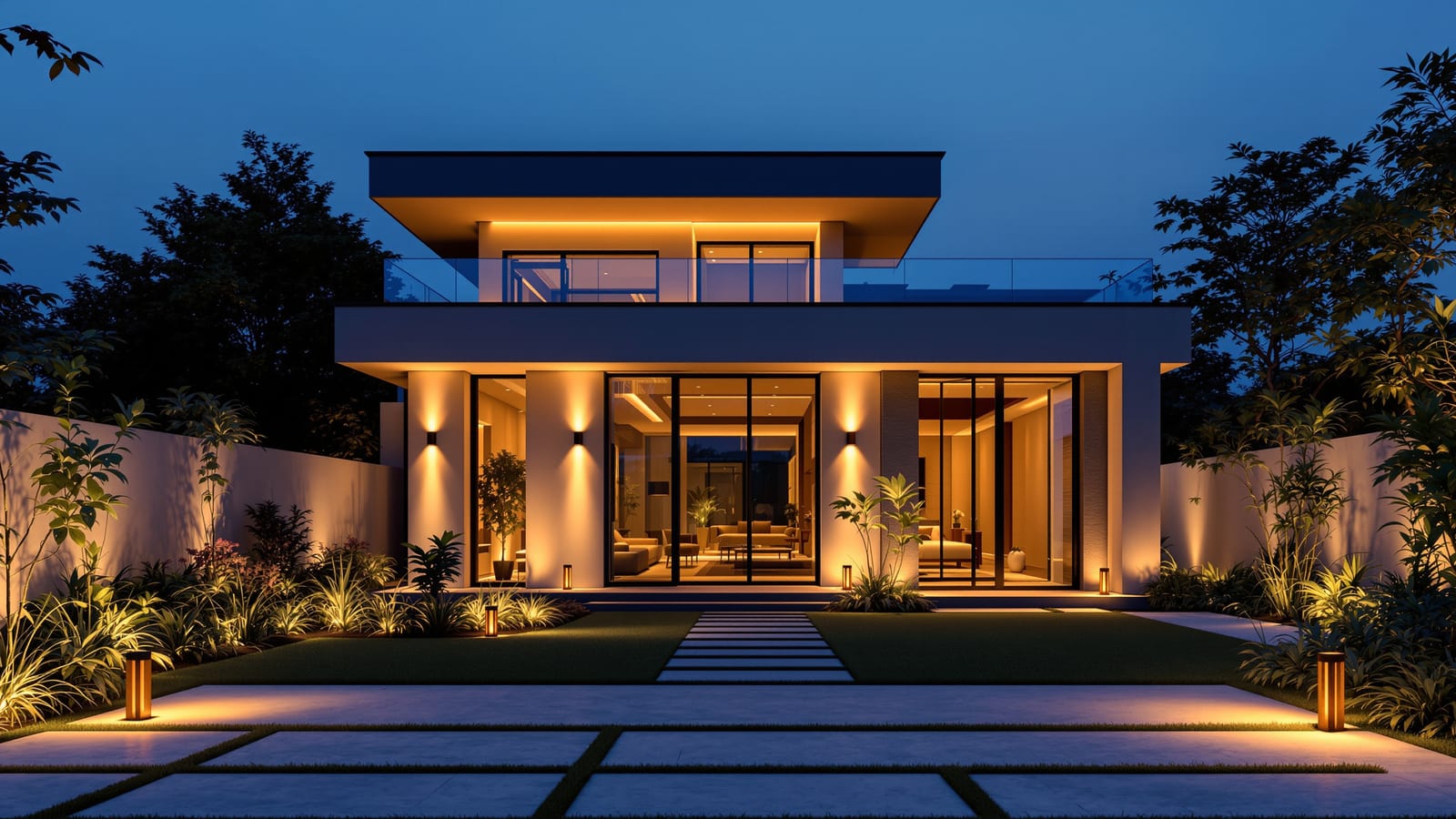
Smart Outdoor & Landscape Lighting for Indian Homes: Weatherproof, Automated, Safe
Facade, pathway, garden and security lighting done right for Indian conditions — IP65/IP66 weatherproofing for the monsoon, low-voltage vs mains outdoor wiring and earthing, motion and dusk-to-dawn automation, RGB festive facades, solar options, and brands with real prices.
Outdoor lighting is where a smart home first meets the weather, and India's weather does not forgive shortcuts. A cheap fitting that looks fine on a dry March evening can fill with water in the first heavy monsoon shower, trip your circuit, or worse, energise a metal pole that a child touches. Done properly, smart outdoor lighting is one of the most rewarding upgrades a home can make — a facade that glows gold for Diwali, a path that lights itself as you walk, a garden that comes alive at dusk without anyone touching a switch, and a security perimeter that snaps to full brightness the moment something moves. Done carelessly, it is a maintenance headache and a genuine safety risk.
This guide treats outdoor lighting as its own discipline, separate from the indoor smart lighting guide, because the rules really are different outside. We cover the four lighting zones every home has, the IP weatherproofing ratings that matter in a monsoon climate, the crucial choice between low-voltage and mains outdoor wiring, the earthing and RCCB protection that keeps it safe, sensor and schedule automation, RGB festive lighting, solar options, and current brand prices. It pairs with the smart home security systems guide for the security-lighting overlap, the smart home scenes and automations guide for the automation logic, and the smart homes pillar guide for the bigger picture. To size the spend, use the smart home cost calculator.
Indoors, a bad light bulb is an inconvenience. Outdoors, a bad light fitting is a water ingress point and a shock hazard. Weatherproofing and earthing are not upgrades on outdoor lighting — they are the baseline.
The four outdoor lighting zones
Almost every Indian home breaks down into the same four outdoor zones, and each wants a different kind of light, a different brightness, and a different automation. Planning by zone stops you from buying one type of light and using it everywhere.
Zone 1 — Facade. The face of the house: wall washes, uplights at the base of columns, cornice grazing, and gate-pillar lights. This is the zone people notice from the street, and the one where smart RGB earns its keep for festivals. Warm white (2700–3000K) flatters most Indian stone, brick and plaster; save colour for celebration scenes.
Zone 2 — Pathway. The route from gate to door, plus driveway edges and steps. Bollard lights, recessed step lights and low spike lights belong here. The job is safe footing, not drama, so aim for even, low glare light that reveals level changes — the most common outdoor accident is a missed step in the dark.
Zone 3 — Garden. Trees, shrubs, water features and boundary planting. Adjustable spike spotlights let you graze a compound wall, uplight a favourite tree, or silhouette a plant against it. This is the most creative zone and the one that most rewards dimming and scenes.
Zone 4 — Security. The perimeter, blind corners, back gate and parking. Bright, motion-triggered floodlights that snap to full output when something moves and drop to a low idle otherwise. This zone overlaps directly with your smart home security systems and cameras.
| Zone | Typical fittings | Brightness | Colour temp | Best automation |
|---|---|---|---|---|
| Facade | Wall wash, uplight, RGB grazer | Medium–high | 2700–3000K + RGB | Dusk-on, festive scenes |
| Pathway | Bollard, step, spike | Low–medium | 3000K warm | Dusk-to-dawn, low glare |
| Garden | Spike spotlight, buried uplight | Low, adjustable | 2700–3000K | Scene + dim, timer off |
| Security | Motion floodlight | High burst | 4000–5000K cool | Motion trigger + camera link |
IP ratings — the number that matters most outside
Every outdoor fitting carries an IP (Ingress Protection) rating, two digits defined under the IEC 60529 standard. The first digit is protection against solid objects and dust; the second is protection against water. Outdoors in India, the second digit is the one that decides whether your light survives its first monsoon.
| IP rating | Water protection | Suitable for |
|---|---|---|
| IP44 | Splashing water from any direction | Covered porch, sheltered balcony only |
| IP54 | Limited dust + splashing | Under deep eaves, semi-covered |
| IP65 | Dust-tight + low-pressure jets | Open facade, garden, most outdoor use |
| IP66 | Dust-tight + powerful jets | Exposed walls, coastal, heavy monsoon |
| IP67 | Dust-tight + short immersion | Ground-recessed, near water features |
| IP68 | Dust-tight + continuous immersion | Submerged pond and pool lights |
The honest rule for India: IP65 is the minimum for anything genuinely outdoors, IP66 for fully exposed walls and coastal homes, and IP67/IP68 for ground-recessed and water-feature lights. An IP44 "outdoor" light sold cheaply online is really a covered-porch fitting; put it on an open wall and the first driving rain will get inside. Coastal homes in Kerala, Goa, Chennai and Mumbai should also check for salt-mist and corrosion resistance, because a high IP rating does not by itself stop a steel bracket rusting through in two years.
A rating only holds if the fitting is installed as intended — cable glands tightened, gaskets seated, drain holes kept clear, and the light mounted the right way up so water runs off rather than pooling on a seal. A perfect IP66 luminaire fitted upside down with an open gland is an IP20 fitting in practice.
Low-voltage vs mains: the outdoor wiring choice
This is the decision that shapes cost, safety and how much you can do yourself. Outdoor lighting runs on one of two systems, and mixing them up is where danger creeps in.
Low-voltage (12V / 24V DC) landscape lighting uses a transformer or driver, usually mounted in a weatherproof box, that steps mains down to a safe 12V or 24V. The garden and path runs then carry only low voltage, which is far safer to work around wet soil and lawns, easier for a homeowner to extend, and the standard for quality landscape lighting worldwide. The trade-off is voltage drop over long cable runs and the cost of a good driver.
Mains-voltage (230V) outdoor lighting runs full household voltage out to facade fittings, floodlights and bollards. It is simpler for high-power fittings and long runs, and it is what most Indian electricians default to. But 230V in a wet outdoor environment is unforgiving, so it demands proper protection, correct cable, and — this is non-negotiable — a licensed electrician.
Whichever system you use, three protections are mandatory outdoors in India, in line with the National Electrical Code and CEA wiring safety rules:
- RCCB / RCD (30 mA) — a residual-current device that cuts power within milliseconds if current leaks to earth, for example through a person or a water-flooded fitting. Every outdoor lighting circuit must be on a 30 mA RCCB. This single device is the difference between a shock and a fatality.
- Proper earthing — every metal-bodied fitting, pole and bracket must be bonded to a good earth so a fault trips the breaker instead of energising the metal. Sandy or dry soil needs a properly installed earth pit, not a token rod.
- Correct cable and glands — UV-stable, outdoor-rated cable in conduit or buried at proper depth, entering fittings through sealed cable glands, never bare wire twisted into a junction.
Low-voltage garden and path lighting you can reasonably extend yourself once the driver is installed. Anything on 230V — facade fittings, floodlights, poles, buried mains cable — should be designed and connected by a licensed electrician. This is not the place to save a few thousand rupees.
Making it smart: sensors, schedules and control
The intelligence in outdoor lighting comes from two sensor types and a schedule, and knowing which to use where is most of the craft.
Dusk-to-dawn (photocell) sensors switch a light on when ambient light falls below a threshold and off at dawn. Perfect for path and low-level facade lights that should simply be on whenever it is dark. No app, no schedule to maintain, and they self-adjust across the seasons as sunset shifts.
Motion (PIR / radar) sensors trigger a light only when something moves, then hold it on for a set time before dropping back. This is the heart of security lighting — a floodlight that idles dim or off and blazes to full output when a person enters. Radar sensors handle India's warm nights better than basic PIR, which can be less reliable when the background is nearly body temperature.
App and schedule control lets you set civil-twilight-linked timing ("facade on at sunset, off at 11:30 PM"), run festive scenes, and check or override lights from anywhere. Sunset-linked schedules beat fixed clock times because they track the changing day length automatically — the same reason they matter in the smart home scenes and automations guide.
The best outdoor setups layer all three. A worked example: path bollards on a dusk-to-dawn sensor run all night at low level; the facade comes on at sunset and dims at 11:30 PM on a schedule; the back-corner floodlight idles off and snaps to full on motion, also switching on a camera recording. Combined with energy-aware scheduling, outdoor lighting is a natural fit for the smart home energy management guide — LED plus schedules plus sensors means lights burn only when they must.
| Trigger | Best for | Watch out for |
|---|---|---|
| Dusk-to-dawn photocell | Path, bollard, low facade | Sensor shaded by planting reads "night" early |
| Motion PIR/radar | Security floods, back gate | False triggers from pets, traffic, wind-blown branches |
| Sunset schedule (app) | Facade shows, festive scenes | Needs stable Wi-Fi at the outdoor edge |
| Manual / voice scene | Party, festival, guests | Keep a physical override for network outages |
RGB facade and festive lighting
For Indian homes, festive lighting is not a novelty — it is Diwali, Navratri, Christmas, weddings and every celebration in between. Smart RGB and RGBW facade lighting replaces the annual ritual of stringing and untangling series lights with a permanent, weather-sealed system you trigger from a scene. Warm white for everyday elegance, a saffron-white-green sweep for national days, festive golds and reds for Diwali, all from the same fittings.
Practical notes: use RGBW (with a dedicated warm-white channel) rather than plain RGB so your "white" is a real warm white and not a muddy mix. Keep facade colour tasteful for daily use and reserve saturated colour for actual events — a house glowing purple every night reads as a shopfront, not a home. And ensure the RGB controller itself is rated and housed to the same IP standard as the fittings; the controller is often the weak point people forget to weatherproof.
Solar smart outdoor lights
Solar outdoor lights have improved enormously and suit specific jobs very well: a boundary wall or far garden corner with no cable run, gate-pillar lights, and path markers. An integrated panel, LiFePO4 battery, LED and a motion or dusk sensor in one sealed unit means zero wiring and zero running cost. They are ideal where trenching a cable would cost more than the light is worth.
Be realistic about the limits. Solar output drops sharply through the monsoon and in shaded or north-facing spots, winter runtime is shorter, and the lithium batteries are a consumable that needs replacing every two to four years. Cheap all-in-one solar lights are often disappointingly dim and short-lived. Use solar to solve access problems, not as the backbone of a facade you want reliably bright every night — for that, wired LED on a schedule wins.
Brands and prices in India
| Brand | Outdoor range | Typical price band | Notes |
|---|---|---|---|
| Philips / Signify | Outdoor wall, flood, smart | ₹1,200–₹6,000 per fitting | Wide range, reliable IP-rated bodies |
| Havells | Facade, flood, bollard | ₹900–₹5,000 | Trusted electrical brand, ISI, good service |
| Wipro | Smart outdoor + garden | ₹1,000–₹4,500 | App control, energy-aware, widely stocked |
| Bajaj | Floodlight, street, garden | ₹800–₹4,000 | Value floods and street-type fittings |
| Syska | LED flood, solar, RGB | ₹700–₹3,500 | Broad LED and solar range |
| Crompton | Outdoor + solar | ₹800–₹4,000 | Solid mid-market outdoor LED |
| Gizzmo / Wisilica / niche | Smart RGB facade, controllers | ₹3,000–₹20,000+ | Project-grade RGB and DMX facade systems |
Treat these as bands, not quotes — outdoor pricing swings widely with wattage, IP rating and finish. A rough whole-home outdoor scheme (facade wash, path bollards, a few garden spikes and two motion floods) lands anywhere from ₹40,000 to ₹1.5 lakh installed depending on scale and whether you go low-voltage. Spend first on IP rating, corrosion resistance and proper protection; a beautiful fitting that leaks or a bright flood on an unearthed pole is a false economy. Once the outdoor layer is in, wire its scenes into the whole-home logic in the smart home scenes and automations guide, and sanity-check the running cost with the smart home energy savings calculator.
References
- Bureau of Indian Standards — luminaire and electrical product standards
- IEC 60529 — degrees of protection provided by enclosures (IP code)
- Central Electricity Authority — wiring safety and installation regulations
- Bureau of Energy Efficiency — LED and appliance efficiency
- Signify (Philips) India — outdoor and smart lighting range
- Havells — outdoor and smart lighting products
Export this guide
Related Guides — Deep-dive reading
Electrical Safety for Security Systems in India (2026): Powering It Without Peril
A homeowner's guide to the power side of home and RWA security systems, CCTV, alarms, gates, access control and NVRs, done so it protects you instead of quietly becoming a shock or fire hazard. What makes a supply safe, what to insist on, and why the mains work belongs to a licensed electrician.
SecuritySecurity Lighting Cost in India (2026): What Fixtures, Sensors and Wiring Really Add Up To
A homeowner's honest, indicative-band guide to what security lighting costs in India — the floodlights, wall-packs, bollards and motion lights, plus the sensors, the hidden wiring and the running electricity — with capex-versus-opex thinking, the mains-versus-solar-versus-motion trade-off, and why over-lighting wastes money and annoys the neighbours.
SecurityCompound Wall Lighting in India: Wall Lights, Bollards and Solar (2026)
A plain, India-grounded planning guide to lighting your compound wall and gate — entrance and pillar-top lights so guests find the door, wall-wash and grazing to show off texture, path and bollard lights, step lighting, and no-wiring solar fixtures — with warm-vs-cool colour, glare courtesy to neighbours, IP ratings for rain, and honest hand-offs to a licensed electrician and the Security hub.
Compound WallsRelated Tools — Try Free
Electrical Safety & Load Audit
Home electrical audit — 10 categories, 65+ checkpoints across earthing, RCCB, MCB, wiring, switchboards, appliance circuits, DG/inverter backup.
Safety AuditCross-Ventilation Analyzer
Estimate airflow and air changes per hour (ACH) from room size, window areas, layout, and local wind — with NBC 2016 Part 8 compliance check.
Ventilation CalculatorGarden Planning Toolkit
Get a tailored garden plan — planting layers, Indian species, features and a checklist — from your climate, space, sun and goals.
Planner