
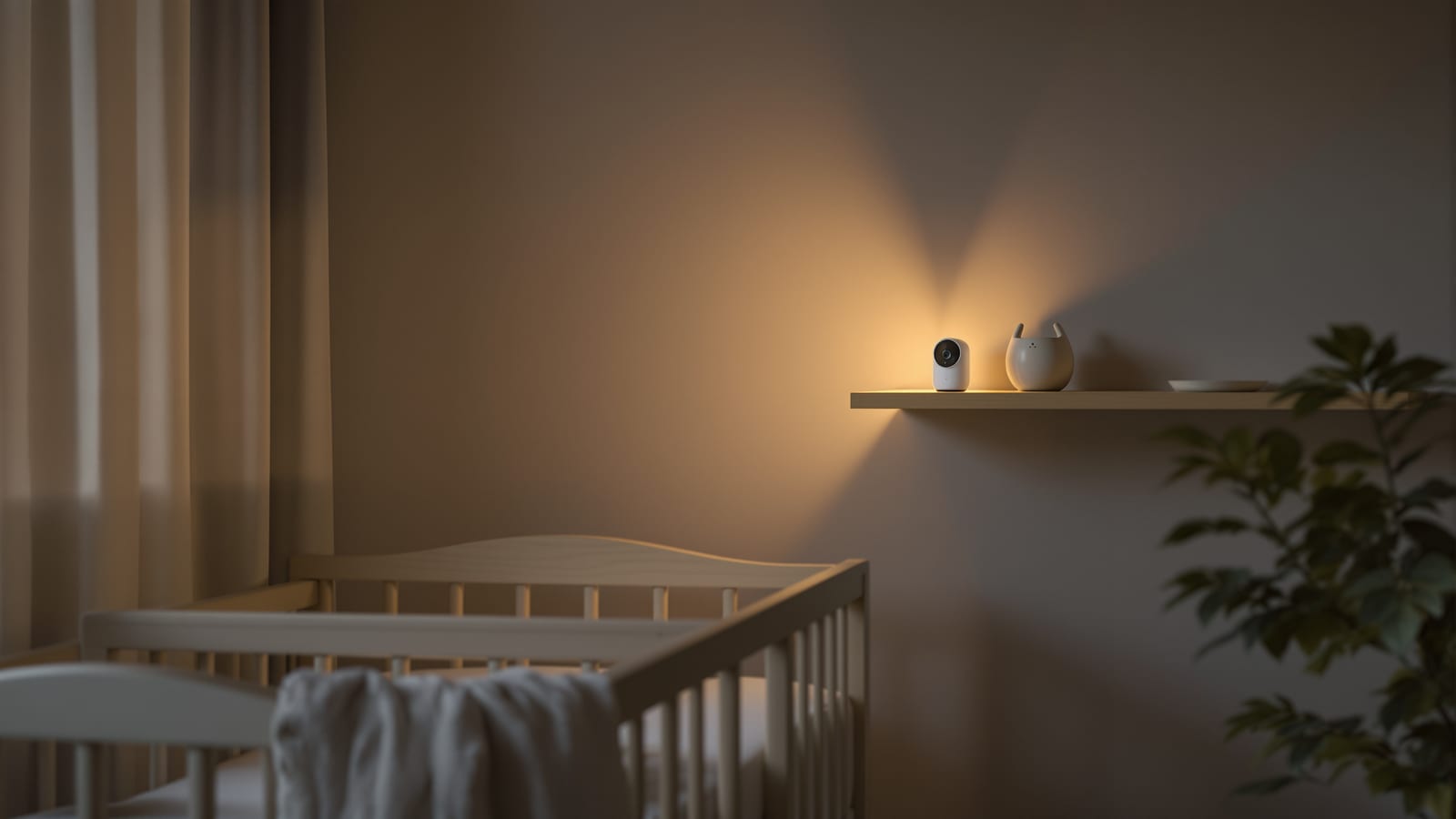
Smart Home for New Parents & Babies in India: A Calm, Practical Guide
The right smart devices give exhausted new parents a quieter night, a healthier nursery and a spare pair of hands — without turning your baby's room into a surveillance lab.
Bringing a baby home rearranges your whole day, and most of all your nights. The first weeks are a blur of feeds at 2am, nappy changes in the dark, and a constant low hum of worry about whether the room is too warm, too cold, too dry or too stuffy. This is exactly the situation smart-home technology is quietly good at — not the flashy party tricks, but small automations that hand a tired parent a little more calm and a little more sleep. Done thoughtfully, a smart home for a newborn is less about gadgets and more about a gentler night.
This guide is written for Indian homes and Indian conditions: a nursery that swings from a sticky Chennai summer to a smoky Delhi winter, helpers and grandparents coming and going, and the ever-present reality of a 2am feed when both your arms are full. It sits alongside the ultimate guide to smart homes in India; read that for the foundations, and treat this as the newborn layer on top. We will also be honest about the one area that deserves real caution — the privacy of anything with a camera pointed at your child.
A good baby-friendly smart home is invisible. The lights are already dim before you reach the cot, the room is already the right temperature, and the one thing you actually watch is your sleeping child — not an app.
The night-feed problem, and why lighting comes first
Ask any new parent what wrecks a night feed and they will say the same thing: switching on a bright ceiling light. That flood of white light wakes the baby fully, wakes you fully, and tells both your bodies it is morning. Getting the lighting right is the single highest-value smart upgrade for a nursery, and it costs very little.
The goal is warm, dim, hands-free light on the path from your bed to the cot and back. A few smart bulbs or a smart nightlight, set to a low warm glow and triggered by motion or a single voice command, replace the harsh overhead switch entirely. Our smart lighting guide for India covers bulbs, switches and scenes in depth; here the specific recipe matters.
| Time / trigger | What the light does | Why it helps |
|---|---|---|
| Motion after 10pm | Warm glow at 5-10% brightness on the floor path | Enough to walk safely, not enough to wake anyone |
| Voice command "night feed" | Nursery lamp fades to a dim amber over 3 seconds | No fumbling for a switch with a baby in your arms |
| Nightlight, always on | Steady 2200K amber, hidden low near the cot | A constant gentle reference point in the dark |
| 6am gentle wake | Lights slowly warm and brighten over 20 minutes | Eases the household into the day without a jolt |
Two settings do the heavy lifting. First, colour temperature: keep everything at night below about 2700K — warm amber, not cool white — because bright blue-white light is the most disruptive to sleep. Second, brightness: 5-10% is plenty to move around safely. Most smart bulbs from Philips (Wiz), Wipro, Syska and Havells cost ₹500-₹1,200 each and support both. A dedicated plug-in smart nightlight is an even simpler start.
The flow below shows how a single motion sensor and a voice command turn a night feed from a jarring event into a soft, half-asleep routine.
Baby monitors: capability, and an honest word on privacy
A modern smart baby monitor is a genuine comfort. The better video monitors stream to your phone, detect and alert on a cry, track room temperature and humidity, and let you talk back over two-way audio. Popular options in India span dedicated monitors and repurposed indoor cameras: Cubo Ai, Philips Avent, and cameras like Mi/Xiaomi, TP-Link Tapo, Qubo (Hero Group) and CP Plus. Features to weigh:
| Feature | What it does | Worth having? |
|---|---|---|
| Cry detection | Alerts your phone only when the baby actually cries | Very useful — cuts constant screen-watching |
| Two-way talk | Soothe with your voice from another room | Useful, especially with a toddler |
| Temp / humidity sensor | Warns if the nursery drifts too warm or dry | Useful; overlaps with a dedicated sensor |
| Night vision | See clearly in the dark without turning on lights | Essential |
| Local (SD/NVR) storage | Footage stays in your home, not a company's cloud | Important — see privacy below |
| Cloud subscription | Recordings and AI features hosted online | Convenient, but a privacy trade-off |
Now the honest part. A camera pointed at your sleeping child is the most sensitive device you will ever put in your home, and it deserves real scrutiny. Cheap cloud cameras have been repeatedly caught with weak security, default passwords and, in some notorious cases, feeds accessible to strangers. In India, the Digital Personal Data Protection (DPDP) Act, 2023 treats a child's data with heightened protection and generally requires verifiable parental consent for processing children's personal data — and a video feed of your baby is precisely that. You are the parent here, so the practical questions are about who else can reach that feed.
- Prefer local storage over cloud where you can. A monitor that records to a microSD card or a home NVR keeps the footage inside your house. This is the core argument of our local vs cloud smart home guide, and it matters most for a baby cam.
- If you use cloud, choose reputable brands and read the policy. Check where data is stored, how long it is kept, whether it is encrypted, and whether the company has a clear privacy policy. Turn on end-to-end encryption if offered.
- Lock the account down. A strong, unique password and two-factor authentication are non-negotiable. Change any default password the day you set it up.
- Segregate the camera on your network. Put cameras on a guest or IoT Wi-Fi network so a compromised camera cannot reach your phones and laptops. Our smart home security systems guide walks through this.
- Cover or unplug when not in use. Many parents simply switch the camera off during the day. That is a perfectly valid privacy choice.
None of this is meant to scare you off — a well-chosen, well-secured monitor is a wonderful thing. It is meant to make sure the one camera watching your child is one you actually control.
A healthy nursery: air, temperature and humidity
Newborns cannot tell you the room is stuffy, too dry or too warm — but sensors can. In Indian homes this is unusually important, because the nursery environment swings hard: coastal humidity, dry northern winters, and, in many cities, genuinely poor outdoor air quality that seeps indoors. A small cluster of sensors turns a room you can only guess at into one you can actually read.
| What to monitor | Comfortable range for a baby | Common Indian problem it catches |
|---|---|---|
| Temperature | Roughly 20-26°C | Overheating in summer; over-cooling from AC |
| Humidity | Roughly 40-60% RH | Winter dryness up north; monsoon dampness on the coast |
| Air quality (PM2.5) | As low as possible; below ~35 µg/m³ | Winter smog and dust drifting into the room |
| CO2 / stuffiness | Fresh, well-ventilated | A closed room with the AC on all night |
Devices like the Qubo, Atmotube, or an air-quality monitor paired with a purifier let you set the nursery as a monitored zone. The genuinely useful move is to link sensors to action: if PM2.5 rises, a smart plug switches on the air purifier; if humidity drops below 40%, a smart humidifier kicks in. This is the same sensor-to-action logic explained in our smart home remote monitoring guide — you get an alert on your phone the moment the room drifts out of the safe band, wherever you are in the house.
Smart AC: comfort without the guesswork
Air-conditioning is where a lot of new parents worry most — too cold and the baby is uncomfortable, too warm and they cannot settle. A smart AC controller (Sensibo, Cielo Breez, or the app on a modern inverter AC from LG, Daikin or Voltas) lets you set the nursery to a steady, sensible temperature and hold it there. For a nursery, three settings matter:
- A gentle set-point, not a deep chill. Around 24-26°C is comfortable for most babies; avoid a cold room with air blowing directly onto the cot.
- Temperature-triggered automation. Have the AC hold a band rather than run flat out — many smart controllers can turn the compressor off once the room reaches target and back on when it drifts, which is quieter and gentler.
- Pre-cool before bedtime. Cool the room down before you put the baby down, so the AC is barely running while they sleep and the room is silent.
Hands-free voice: help when your arms are full
The most underrated newborn upgrade is a voice assistant, precisely because so much of parenting happens with both hands occupied. Holding a feeding baby, you can dim the lights, start white noise, set a feed timer, add nappies to the shopping list, or ask how long since the last feed — all without putting the baby down or hunting for your phone. An Amazon Echo or Google Nest speaker (₹3,000-₹7,000) earns its place in a nursery faster than almost any other device.
A few genuinely useful voice routines for the newborn months:
- "Start the night feed" — dims the lamp, starts white noise, and can begin a timer.
- "How long since the last feed?" — with a compatible timer or reminder set, saves a bleary calculation at 3am.
- "Add nappies to the list" — because you will run out at the worst moment, and both hands are busy.
- "Play white noise" — a soft, steady sound that helps many babies settle.
One privacy note carries over from the camera section: a smart speaker has a microphone. Reputable assistants only stream audio after the wake word, and you can review and delete voice history in the app, but if a mic in the nursery bothers you, use a speaker with a physical mic-mute switch and turn it on when you are not using voice.
White noise and gentle wake routines
Sleep is the whole game in the first year, and a couple of automations support it directly. A white-noise routine — a steady shushing or rain sound played through a smart speaker on a schedule or on command — masks the sudden household sounds (a door, a street horn, the pressure cooker) that startle a sleeping baby awake. Set it to fade in as bedtime begins and fade out in the morning.
A gentle wake routine does the reverse: instead of the room staying pitch dark until someone flips a switch, the lights warm and brighten slowly over 15-20 minutes towards morning, easing the whole household into the day. Both routines are simple scenes you build once and forget, and they pair naturally with the lighting recipe earlier in this guide.
Smart locks for helpers, family and the maid
Newborn life means a stream of people at your door — grandparents, a maid, a nanny, a delivery of the endless supplies. A smart lock removes the friction of handing out physical keys and lets you give time-limited access instead. Godrej, Yale and Qubo sell battery-powered smart locks widely in India, and the newborn-relevant features are:
- PIN codes for helpers. Give the maid or nanny their own code, and see in the app when they came and went — useful reassurance when you are half-asleep with a baby.
- Time-limited access. A code that only works during expected hours, revocable in seconds if arrangements change.
- Remote unlock. Let in a trusted grandparent when your hands are full without getting up.
- Battery power with a key override. Crucial for reliability — the lock keeps working through a power cut, which matters in India; see the smart home power backup guide.
For a fuller picture of who-can-enter automation and how it ties into aging parents living with you, the aging-in-place smart home guide is a natural companion, since many young families in India are multi-generational households. If your family also keeps a farmhouse or hometown flat, the smart home for vacation homes guide applies the same time-limited access controls to a house that sits empty.
Safety sensors: the quiet essentials
Amid the sleep and feeding gadgets, do not skip the two sensors that exist purely to keep the household safe. In an Indian home with an LPG or PNG kitchen, a gas leak sensor that alerts your phone and sounds an alarm is inexpensive peace of mind, especially with a newborn who cannot be moved quickly. A smoke detector, ideally a smart one that pushes an alert as well as sounding locally, belongs in every home with a baby. Pair either with a smart plug and you can even have a leak automatically cut a connected appliance. These are covered more fully in our security material, but for new parents the message is simple: buy them first, before any of the nice-to-haves.
A sensible order to buy in
You do not need all of this at once, and a newborn budget is tight and precious. Spend in roughly this order:
1. Gas and smoke sensors — safety before everything.
2. Warm dimmable nursery lighting + a nightlight — the biggest quality-of-life gain per rupee.
3. A well-secured baby monitor — local storage preferred; lock the account down.
4. A voice speaker — hands-free help that pays for itself in a week.
5. Nursery sensors + AC control — a healthier, steadier room.
6. A smart lock — for the stream of helpers and family.
Run the numbers with the smart home cost calculator; most of the newborn essentials together come to a modest amount, and they buy something no gadget spec sheet captures — a calmer night. The nursery map below shows how the pieces sit together in one room.
The takeaway
A smart home does not raise your baby — you do. What it can do is remove a hundred small frictions from the hardest months: a room already at the right temperature, a light that never blinds you, a monitor you trust, and a spare set of hands in the form of a voice command. Buy safety first, lighting second, and be genuinely careful with anything carrying a camera or a microphone near your child. Start with the ultimate guide to smart homes in India for the foundations, and add the newborn layer one calm piece at a time.
References
- Digital Personal Data Protection Act, 2023 (MeitY) — India's data-protection law, including heightened protection and parental-consent requirements for processing children's personal data such as baby-camera feeds.
- CERT-In (Indian Computer Emergency Response Team) — India's national cybersecurity agency; advisories on securing IoT cameras and home devices against unauthorised access.
- Bureau of Indian Standards (BIS) — Indian safety standards for electrical appliances, LED lighting and low-voltage home electronics.
- Central Pollution Control Board (CPCB) — National Air Quality Index — the official Indian reference for PM2.5 and air-quality bands relevant to nursery air monitoring.
- Philips Avent — Baby monitors — manufacturer reference for video and audio baby-monitor features and specifications.
Export this guide
Related Guides — Deep-dive reading
Geofencing Home Security in India (2026): Convenience Without the Trap
A geofence is a virtual boundary around your home; your phone crossing it can arm the alarm as the last person leaves and light the place up as you arrive. This guide explains the genuinely useful security uses, and the honest caveats: never let a phone's location alone unlock your door, never make a geofence the only thing that arms your home, and treat continuous family tracking as sensitive data.
SecuritySecurity for People Living Alone in India (2026): Calm, Practical Habits When There Is No Second Person to Notice
Living alone is an ordinary and growing part of Indian life - the student in a new city, the working single, the elder whose children are abroad, the person after a separation. It does not call for fear. It calls for a few deliberate habits, because there is no second person in the home to notice trouble, raise the alarm, or catch an accident. This is calm self-reliance, layer by layer.
SecurityVoice Controlled Bathroom India: Waterproof Smart Speaker, Hands-Free Lights, Shower & Geyser, Privacy & Cost
A practical India-first guide to voice control in the bathroom — a splash-rated smart speaker or voice-enabled mirror that turns lights, music, exhaust fan, geyser and even the shower on and off hands-free — plus the microphone and privacy questions, the humidity and IP durability the device must survive, whether your Wi-Fi even reaches the wet corner of the house, which tasks genuinely benefit, the real accessibility win for elderly and disabled users, and what it all costs.
BathroomsRelated Tools — Try Free
CCTV Cloud vs Local Cost Calculator
Compare cloud CCTV subscription against a local NVR + HDD — upfront, 5-year total, monthly fee and break-even.
Cloud vs LocalAccess-Control Battery-Backup Calculator
Size the standby battery so an access system keeps running through a power cut, with an egress life-safety note.
Battery BackupCCTV Camera Coverage & Count Calculator
Estimate how many CCTV cameras you need, the NVR channels, storage in TB for your retention period, and an indicative all-in cost with GST.
CCTV Calculator