
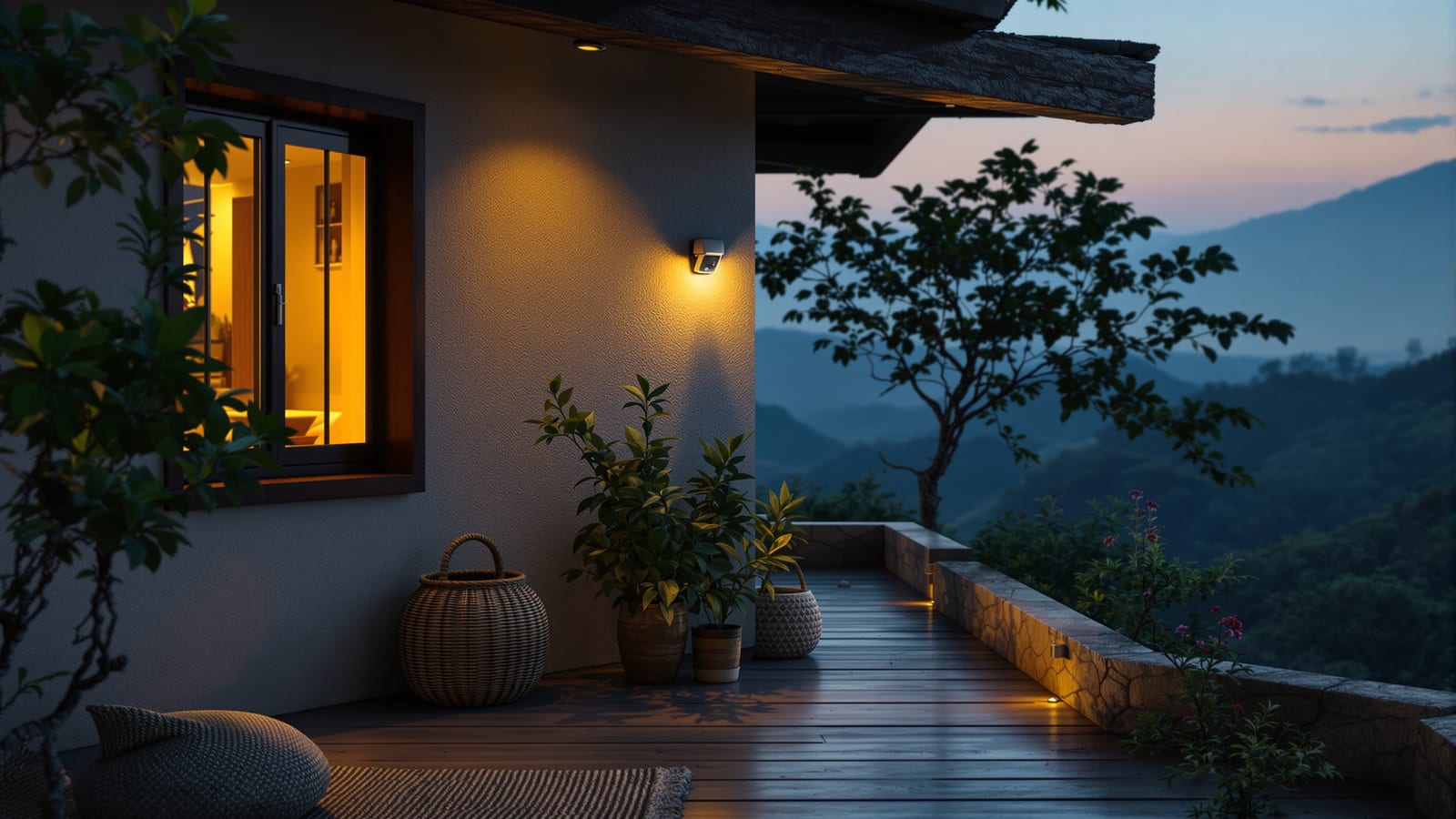
Smart Home for Second & Vacation Homes in India: Protecting an Empty House
A hill cottage in Coorg or a farmhouse near Lonavala sits empty for weeks at a time. The right smart devices let you watch, secure and warm it from your city flat — and catch a burst pipe before it becomes a bill.
A second home is a joy and a liability in equal measure. The farmhouse near Lonavala, the apartment kept for visits to aging parents in the hometown, the cottage in Coorg or Kasauli — they give you a place to escape to, and then they sit locked and dark for weeks while you are back in the city. An empty house is exactly what a burglar looks for, and it is also where a slow leak, a tripped pump or a monsoon-swollen tank can do quiet, expensive damage that nobody notices until you next open the door. This is the problem a smart home solves better than almost anything else: it lets you watch, secure and even warm a house you are hundreds of kilometres away from.
This guide is about the specific demands of a home that is usually unoccupied, which are very different from those of a home you live in. It builds directly on the smart home remote monitoring guide and the ultimate guide to smart homes in India; read those for the general setup, and treat this as the empty-house playbook.
An occupied home forgives your mistakes — someone notices the drip, hears the alarm, flips the tripped breaker. An empty home forgives nothing. Every problem runs unchecked until you arrive. Smart devices are how you become the person who notices, from 500 km away.
The empty-house threat model
Before buying anything, it helps to name what actually goes wrong with an unattended home in India. The risks fall into a few clear buckets, and a good setup addresses each one rather than piling cameras on the same corner.
| Threat | What happens when nobody is home | The smart answer |
|---|---|---|
| Break-in | House looks empty for weeks — an obvious target | Cameras, door sensors, presence simulation |
| Burst pipe / leak | Water runs for days, ruining floors and walls | Leak sensors + auto shut-off valve |
| Overflowing / empty tank | Pump runs dry or tank overflows unnoticed | Tank level + pump monitoring |
| Power cut | Fridge food spoils; backup drains; devices die | Power alerts + a plan for going offline |
| Caretaker / guest access | Handing physical keys around, no record | Smart lock with time-limited codes |
| No connectivity | You cannot see or control anything | Reliable Internet + a 4G fallback |
Everything below maps back to this list. The two figures in this guide visualise the whole picture — first the layered protection of the empty house, then the remote-access architecture that lets you reach it.
Remote monitoring: your eyes on the place
The heart of a vacation-home setup is being able to look, from your phone, and to be told the moment something changes. Cameras are the obvious piece, but the real value is in the alerts — you cannot watch a live feed all day, so the system must ping you only when it matters. Configure motion zones that ignore swaying trees and passing cattle but flag a person at the gate. Our smart home remote monitoring guide covers alert tuning in detail; the vacation-home specifics are:
- Cover the entrances, not every wall. Two or three well-placed cameras — front gate, main door, back approach — beat a dozen aimed at empty rooms.
- Add door and window contact sensors. A cheap magnetic sensor tells you a door opened even if the camera missed it, and works on the local mesh described in the smart home security systems guide.
- Use cloud clip storage as a backup. For a remote house, a short cloud recording of an event survives even if a thief takes the recorder. Balance this against the privacy and cost trade-offs in the local vs cloud smart home guide.
- Set a daily "all quiet" check. Some systems can send a once-a-day heartbeat so silence never means the system itself has died.
Smart locks: caretaker and guest access without keys
Second homes live and die by who can get in. You have a caretaker who waters the plants, a cousin who borrows the place for a weekend, a plumber who needs to come when you are not there. Handing out physical keys is how keys get copied and lost. A smart lock replaces all of that with codes you can grant and revoke from your phone.
| Access need | How the smart lock handles it |
|---|---|
| Regular caretaker | A permanent PIN, with a log of every entry and exit |
| Weekend guest | A code that only works Friday to Sunday, then expires |
| One-off tradesperson | A single-use or time-boxed code you send by message |
| You arriving late | Remote unlock from the road, or auto-unlock on approach |
| Lost trust | Revoke any code in seconds without changing the lock |
The entry log is the quiet hero here: for a house you rarely visit, knowing exactly when the caretaker came and went is real reassurance. The same time-limited codes earn their keep in a busy main home too — see the smart home for new parents guide for handing helpers and family controlled access without loose keys. Choose a battery-powered lock with a physical key override (Godrej, Yale, Qubo all sell these in India) so a flat battery or a power cut never locks you out — and pair it with the power planning below, because a remote lock that loses connectivity still needs to open the old-fashioned way.
Presence simulation: making an empty house look lived-in
Burglars watch for houses that are obviously unoccupied — dark every night, no movement, the same shut curtains for weeks. Presence simulation fights exactly this. Using smart lighting, you schedule lights (and a radio or TV on a smart plug) to switch on and off in a believable, slightly randomised pattern each evening, so from the road the house looks occupied.
The key is randomness. A light that snaps on at exactly 7:00pm every single day reads as automated to a watchful thief. Good presence simulation varies the timing by a few minutes, lights different rooms on different nights, and follows a plausible rhythm — living room in the evening, a bedroom later, everything dark by midnight. Many apps (SmartThings, Alexa, Google Home) offer a built-in random or "vacation" mode for this. It is one of the cheapest and most effective deterrents you can deploy, costing only a few smart bulbs or plugs you already have.
Water: the disaster that happens in silence
Ask anyone who owns a farmhouse what has cost them the most grief, and water comes up again and again. A supply line that bursts, a tap left cracked open, a tank float valve that fails — any of these can run for days in an empty house, warping wooden floors, staining walls and rotting joinery, all while you sip coffee in the city with no idea. This is arguably the single strongest reason to make a vacation home smart.
- Leak sensors placed under sinks, near the water heater, at the pump and by the main inlet cost a few hundred rupees each and push an instant alert the moment they detect water.
- A motorised shut-off valve takes this further: paired with the sensor, it can automatically close the main supply the instant a leak is detected, stopping the damage rather than just reporting it. This is worth the extra cost for a house that is empty for long stretches.
- Tank level monitoring tells you whether the overhead tank is full, empty or overflowing — vital when a stuck float valve can either flood the terrace or run the pump dry.
- Pump / motor monitoring via a smart plug or energy monitor flags a pump that is running when it should not be (a sign of a leak downstream) or one that has tripped.
| Water risk | Sensor | What it prevents |
|---|---|---|
| Burst supply line | Leak sensor + auto shut-off valve | Days of flooding, ruined floors |
| Overflowing tank | Tank level sensor | Wasted water, terrace damage, seepage |
| Pump running dry | Pump / energy monitor | Burnt-out motor, expensive replacement |
| Slow drip under sink | Point leak sensor | Silent rot, mould, staining |
Power, appliances and the fridge
An empty home still runs a fridge, a pump and whatever you leave plugged in, and power in rural and hill India is anything but steady. A few smart plugs and an energy monitor let you keep tabs on all of it. The most useful alert is a power-cut notification: some devices detect when mains power drops and message you, so you know before the fridge food spoils or the backup battery quietly drains. Energy monitoring on the whole house also flags anomalies — a sudden jump might mean a geyser left on or a pump stuck running. Our smart home energy management approach applies directly, scaled down to the few loads a locked house actually has.
Remote AC: arriving to a cool house
One of the genuine pleasures of a smart vacation home is pre-cooling. Instead of walking into a farmhouse that has baked shut for three weeks and waiting an hour for it to cool, you turn the AC on from the highway an hour before you arrive — via a smart AC controller like Sensibo or Cielo, or the manufacturer app on a modern LG, Daikin or Voltas inverter unit. In hill homes the same trick warms the place with a smart-plug-controlled heater before you get there. It is a small luxury, but it is the kind of thing that makes a second home feel welcoming rather than like a chore to open up. It only works, of course, if the connectivity and power are both alive — which brings us to the two things that make or break the whole setup.
Connectivity: the setup lives or dies on the Internet
Every remote feature above depends on one fragile thing: the house being online. A vacation home's Internet is usually less reliable than a city flat's, and when it drops, you go blind. Plan for it deliberately.
- Get the most reliable broadband available, even if the location only offers a modest connection. Fibre (JioFiber, Airtel, BSNL, ACT where available) is ideal; where it is not, a fixed-wireless or good 4G router may be the only option.
- Put the router and ONT on a small UPS. A mini-UPS keeps the network alive through short cuts for a couple of thousand rupees — see the smart home power backup guide. Without it, every cut takes your whole system offline.
- Add a 4G fallback for critical devices. A camera at the gate with its own 4G SIM keeps working even when the broadband is down, because it does not depend on the router at all. For a house you cannot check on in person, this independence is worth a lot.
- Favour devices with local logic. A Zigbee or Thread automation on a local hub keeps running through an Internet outage; a cloud-only device just stops. This is the core argument of the local vs cloud guide.
The architecture below shows how you reach the house from your city phone, and where a 4G fallback and local hub keep things alive when the main link fails.
When the power goes out and you are 500 km away
Long power cuts are the scenario that most tests a remote setup, because eventually the batteries backing up your router and cameras run flat, and the house goes dark to you. There is no magic fix, but there is a sensible plan:
- Prioritise a 4G camera or two. With their own SIM and battery, they outlast a broadband-plus-UPS setup and give you eyes for longest into a cut.
- Know your backup runtime. A mini-UPS on the router buys a few hours; an inverter buys longer. Beyond that, accept you will be offline and that is fine — the goal is to catch events, not to have a live feed 24/7.
- Lean on a human backstop. For a truly remote house, a trusted caretaker who can physically check after a long outage is the right complement to the technology, not a rival to it. The smart system tells them where to look.
- Fail safe, not fragile. Make sure your smart lock has a physical key and your gate has a manual option, so a dead system never means you cannot get into your own house.
Putting it together
A practical vacation-home budget, in priority order, looks like this:
1. Water leak sensors + auto shut-off — the silent disaster, stopped.
2. A smart lock with entry logging — controlled access, no loose keys.
3. A couple of cameras plus door sensors — eyes on the entrances.
4. Presence simulation via smart lights — the cheapest deterrent going.
5. Reliable Internet + a mini-UPS + a 4G fallback — so all of the above stays reachable.
6. Power and tank monitoring, remote AC — comfort and early warning on top.
Price it out with the smart home cost calculator; for a second home, the leak and access pieces alone often pay for the entire system the first time they save you from a flooded floor or a break-in. An empty house need not be a helpless one. With the right layer of sensors and a reliable way to reach them, your farmhouse or hill cottage becomes something you can genuinely watch over from anywhere — and arrive at, cool and secure, whenever you finally get away.
References
- CERT-In (Indian Computer Emergency Response Team) — India's national cybersecurity agency; advisories on securing IoT cameras, routers and remotely accessible home devices.
- Digital Personal Data Protection Act, 2023 (MeitY) — India's data-protection law governing how camera footage and personal data from home devices may be stored and processed.
- Bureau of Indian Standards (BIS) — Indian standards for locks, low-voltage electrical devices, UPS units and water fittings relevant to an unattended home.
- Central Electricity Authority (CEA) — India's power-sector regulator; reference on grid reliability and supply norms behind power-cut planning.
- TP-Link Tapo — Smart cameras and sensors — manufacturer reference for 4G and Wi-Fi cameras, contact sensors and smart plugs commonly used in Indian homes.
Export this guide
Related Guides — Deep-dive reading
Security for Holiday Homes in India (2026): Protecting a Second Home That Sits Empty — Make It Look Lived-In, Put Someone Local In Charge, and Watch It From Afar
A hill-station cottage, a Goa flat, a farmhouse or the family house back home — visited a few times a year and empty the rest, often far from where you live. This is how to secure a home you are not living in: look occupied, keep a trusted local presence, monitor it remotely, harden the empty house against break-ins and burst pipes alike, and check your insurance for long vacancy.
SecuritySmart Home Power Backup in India: Keeping It Running During Power Cuts
Load-shedding is a fact of Indian life. Here is how to make sure your router, hub, cameras and locks survive an outage — for surprisingly little money.
Smart HomeSmart Home Maintenance & Troubleshooting for Indian Homes
A smart home is not a one-time purchase — it is a small fleet of computers that needs firmware updates, fresh batteries, occasional reboots and a plan for the day a manufacturer switches off the cloud. This guide gives you a maintenance calendar, a troubleshooting flow for the failures Indian homes actually see, and the UPS and security hygiene that keep it all running through power cuts and voltage swings.
Smart HomeRelated Tools — Try Free
Security Backup Power Calculator
Size a UPS/inverter and battery to keep CCTV, NVR, router and alarm running through a power cut — load, Ah, VA and cost.
Backup PowerSmart Home Cost Calculator
13 device categories across 5 ecosystems (Apple HomeKit, Alexa, Google Home, Mi, Wipro). Live floor-plan that lights up as you add devices, per-room and per-category breakdown.
Smart Home CalculatorWindow Hardware Cost Calculator
Estimate window hardware cost — hinges, handles, locks, rollers and multipoint gears.
Window Calculator