
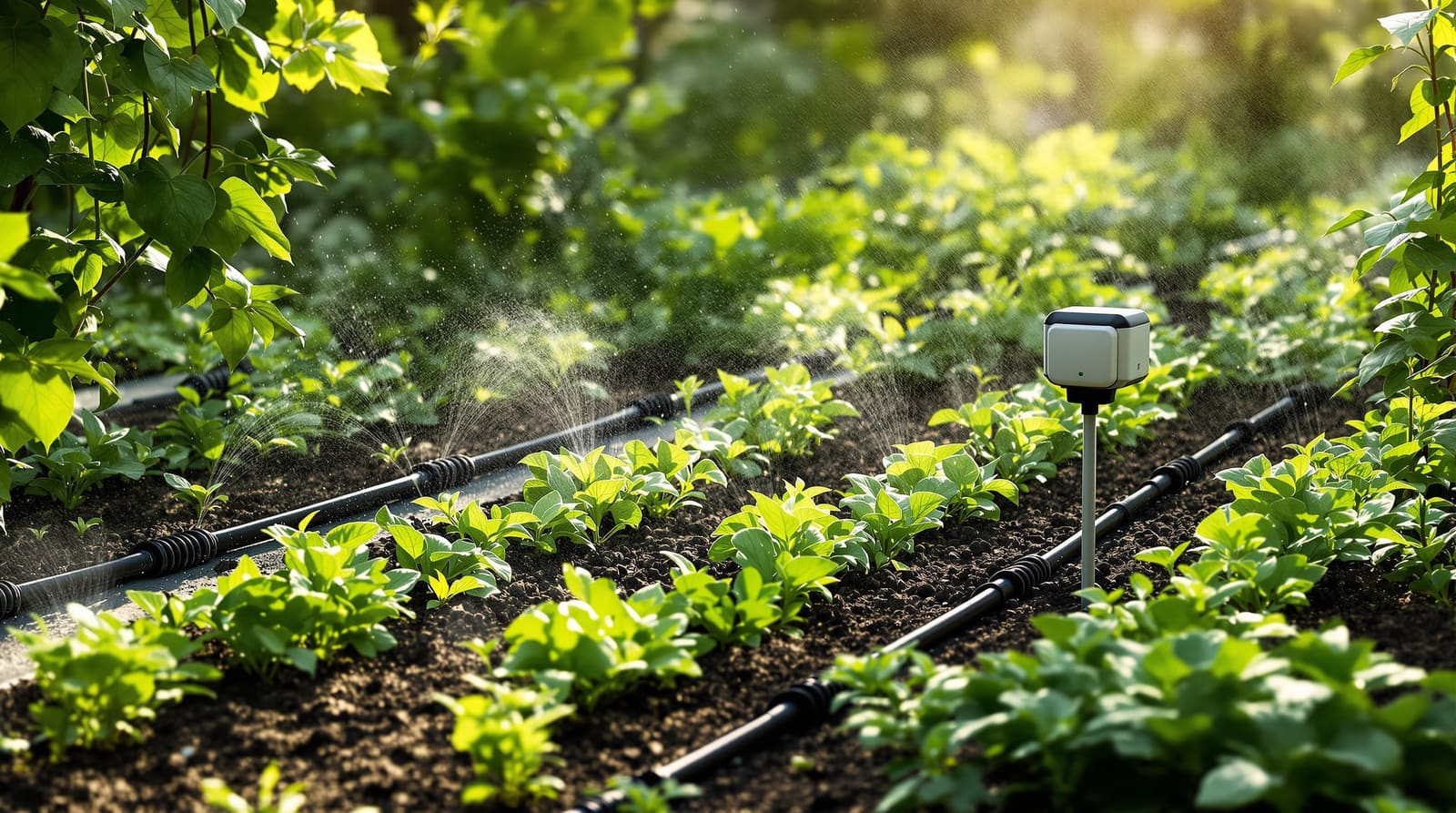
Smart Gardens Explained
The IoT garden ecosystem — sensors, hubs and automation for watering, lighting, mowing and monitoring, what genuinely works in an Indian home, and where to start
A "smart garden" is not a pile of gadgets — it is a garden that senses its own condition and acts on it, so the right amount of water, light and care happens automatically while you do less and waste less. Done well in an Indian home, it cuts water bills, keeps plants alive through your two-week holiday, and survives the realities of power cuts, voltage swings and a punishing summer. Done as a gimmick, it is a drawer full of dead sensors. This guide is the map: what a smart garden actually is, the ecosystem of parts, what is worth automating first, and how to start in stages on a real budget.
This is the pillar of our smart-landscape cluster. It deliberately stays in the automation-and-data lane. For the design side — laying out the garden, matching plants, visualising before you build — see AI in Landscape Design. For the basics of drip and hydrozoning, see Sustainable Water Management.
What "smart" actually means
A garden becomes smart when three things are joined together: it senses a real condition, a controller decides what to do, and an actuator acts — without you. A timer that waters at 6 a.m. every day regardless of rain is automation, but it is not smart; it cannot tell that the monsoon has arrived. A soil-moisture sensor that skips that watering because the bed is already wet is smart. The dividing line is feedback.
That gives us a simple, honest test for any smart-garden purchase: does the data change an action? A sensor that only shows you a pretty graph in an app is a toy. A sensor that stops a pump, opens a valve or sends a "your tank is empty" alert is earning its place. Keep that test in mind through everything below.
The ecosystem: sensors, hub, app, actuators
Every smart garden, however large or small, is built from the same four layers.
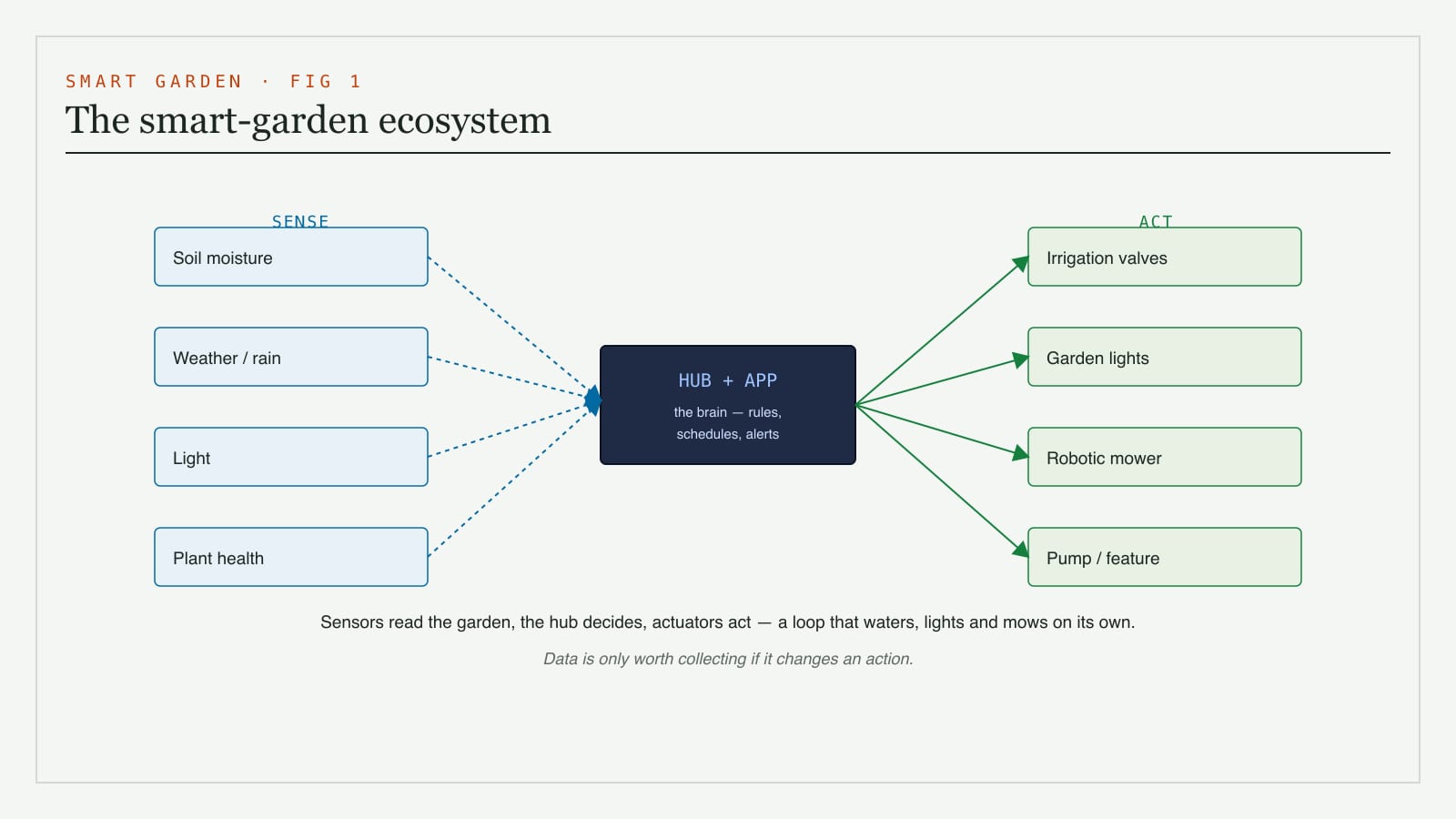
Sensors are the senses. The useful ones in an Indian garden are:
- Soil-moisture probes — the single most valuable sensor, because over- and under-watering is the commonest way plants die.
- Weather / rain — even a cheap rain sensor lets the system skip watering during the monsoon; a small weather station adds temperature, humidity and wind.
- Light — for shade-loving versus sun-loving zones, and to switch garden lighting on dusk rather than a fixed clock.
- Leaf-wetness — niche but genuinely useful for disease-prone plants like roses, since prolonged wet leaves invite fungal attack.
A hub or controller is the brain. It collects sensor readings, applies your rules ("if soil below 30 percent and no rain forecast, water for eight minutes") and switches the actuators. It may be a dedicated irrigation controller, a generic smart-home hub, or a small single-board computer.
An app is the dashboard and the override. It is where you set schedules, watch tank levels, and get the alert that matters. Treat the app as the steering wheel, not the engine — the garden should keep running sensibly even if your phone is dead.
Actuators are the muscles: solenoid irrigation valves, the garden lights, a robotic mower, a fountain or pond pump, a fertigation injector. These do the physical work.
What you can make smart — ranked by value
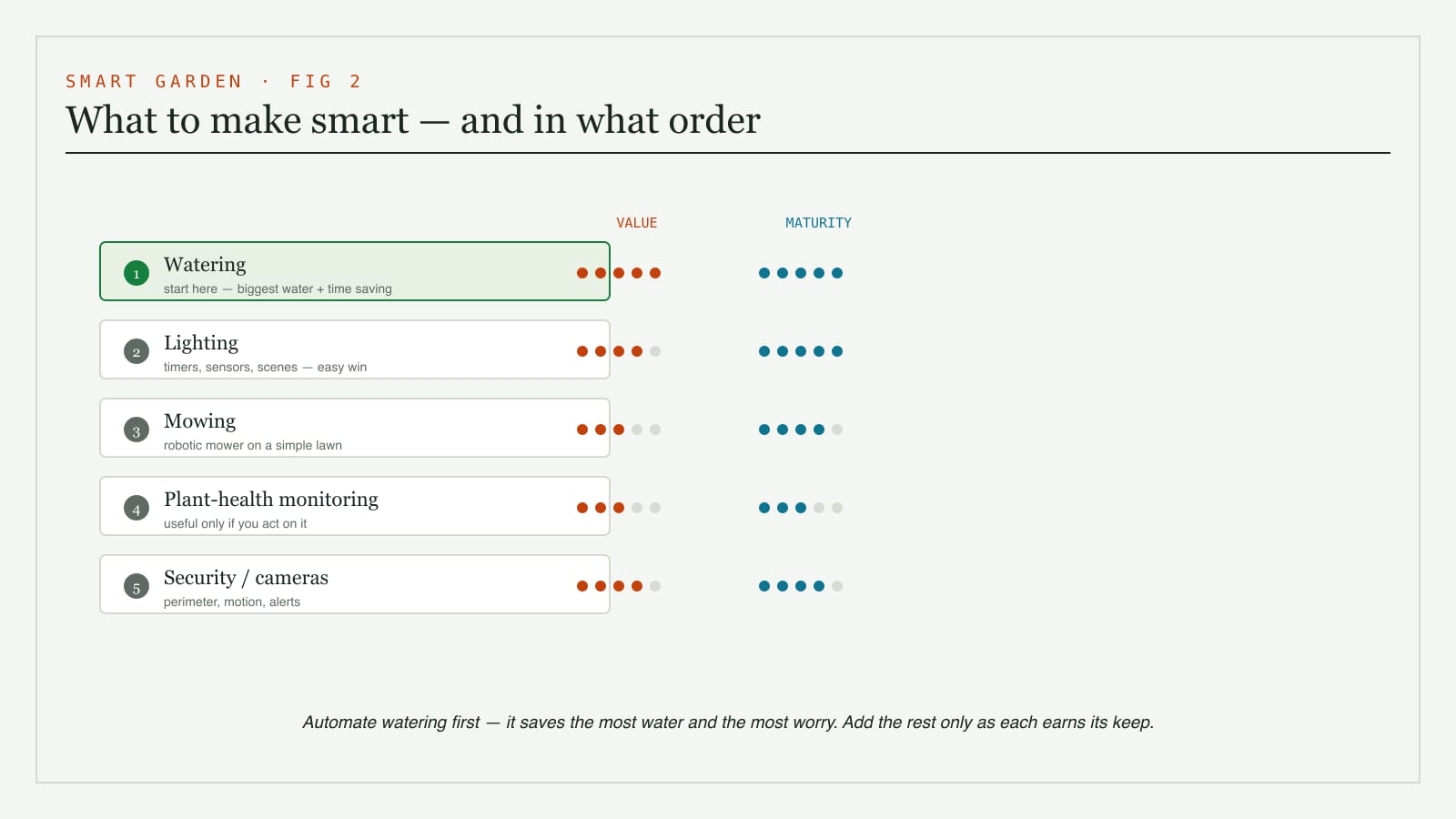
You do not automate everything at once. Some layers repay the effort immediately; others are mostly novelty in a typical Indian home today. Here is the honest ranking, each kept short with a link down to the deep-dive spoke.
| Layer | Value in an Indian home | Maturity | Start here? |
|---|---|---|---|
| Watering | Very high — saves water, plants, your holidays | Mature | Yes, first |
| Lighting | High — easy, safe, atmospheric | Mature | Yes, second |
| Mowing (robotic) | Medium — only if you have a real lawn | Maturing | Lawn-dependent |
| Plant-health monitoring | Medium — useful, easy to over-buy | Mixed | Add later |
| Security / cameras | Medium — overlaps house security | Mature | Optional |
| Water-feature pumps | Low–medium — comfort, not survival | Mature | Optional |
Watering is the highest-value automation, full stop. Water is scarce and pricey in most Indian cities, plant death is mostly a watering problem, and a controller that pauses for rain pays for itself in a season. This is where almost everyone should begin — see Smart Irrigation Systems.
Lighting is the easy second win: dusk-to-dusk switching, scenes for an evening on the terrace, and a security benefit. Pair it with the broader upkeep layer in Automated Landscape Maintenance.
Mowing only matters if you actually have a lawn — many Indian gardens are paved courtyards, terraces or planter beds with no grass at all. If you do have one, a robotic mower is a genuine time-saver; the realities are in Robotic Lawn Maintenance.
Plant-health monitoring — soil pH, nutrient hints, disease alerts — is useful but the easiest place to over-spend on data you never act on. Add it once watering and lighting are stable.
Security and water-feature pumps are comfort layers. Cameras usually fold into the home's existing security system; pump automation is pleasant but never survival-critical.
Planning where all of this goes — before you trench and wire — is far easier with a model of the garden. That is the role of Digital Twins for Landscape Planning.
Wired versus wireless, and how it all talks
How the parts connect decides reliability, range and how much you dig.
Wired systems run low-voltage cable from the controller to each valve and sensor. They are the most reliable and immune to Wi-Fi dropouts, but they mean trenching, so they suit new gardens or renovations where you are already digging.
Wireless systems are far easier to retrofit into a mature garden but depend on radio range and battery life. The common options:
| Connectivity | Range | Power use | Best for |
|---|---|---|---|
| Wi-Fi | Limited to router reach | High | Hubs, cameras, near-house devices |
| Zigbee / Z-Wave | Medium, self-meshing | Low | Sensors and switches around the plot |
| Bluetooth | Very short | Low | Handheld checks, single planters |
| LoRa | Very long (hundreds of metres) | Very low | Large plots, farms, far corners |
For a typical urban Indian garden, Wi-Fi for the hub plus Zigbee for battery sensors is the pragmatic mix. Wi-Fi rarely reaches the far end of a plot reliably, so do not put a critical valve at the boundary on Wi-Fi alone. For acreage or a farmhouse, LoRa is the standout — it crosses long distances on tiny power.
The Indian power and water reality
This is where imported "just plug it in" advice falls down. Design for the conditions:
- Power cuts. A controller that forgets its schedule on every outage is useless. Insist on non-volatile memory or a small battery backup, and keep the controller on the same inverter/UPS line as essential loads.
- Voltage swings. Indian mains can sag and spike hard. Put pumps and controllers behind a good surge protector or stabiliser; it is the cheapest insurance you will buy.
- Solar. Remote sensors and even some valves run happily on a small solar panel and battery, sidestepping both cabling and power cuts. For far corners, solar wireless is often the most robust choice.
- Water supply. Many homes water from a sump and pump, not mains pressure. Your system must sense tank level and never dry-run the pump — a dry-run cutout is essential, not optional.
- Dust and monsoon. Choose outdoor-rated, sealed enclosures (look for an IP65 or higher rating). Dust clogs cheap sensors fast; the monsoon drowns the un-sealed.
The honest take
A few hard truths to keep your money on the right side of the hype line:
1. Start with watering. It is the highest-value automation and the easiest to justify. Everything else is a nice-to-have layered on top.
2. Avoid gimmicks. A "smart pot" that tweets its mood is data you will never act on. If a device's only output is a graph, skip it.
3. Data must change an action. Re-read that test before every purchase. A reading that does not open a valve, dim a light or raise an alert is decoration.
4. Keep a manual override. Every valve should be operable by hand, every schedule should survive a dead phone. Smart should fail gracefully to "still works."
5. Local control beats cloud-only. Devices that need a far-away server to water your garden will one day fail to water your garden. Prefer systems that keep their core logic on the local hub.
Privacy and data
Garden devices are quieter on privacy than indoor ones, but two areas matter. Cameras see your home, your routines and sometimes your neighbours — choose a system with local recording, strong passwords and, ideally, the option to keep footage off the cloud. Cloud accounts for hubs and apps tie your garden to a vendor's server; favour brands that support local control so a discontinued service or a lapsed subscription cannot brick your watering. Read what each app collects, and change every default password — internet-exposed garden controllers with factory passwords are a known, avoidable risk.
A staged way to start, and what it costs
Build in layers. Each stage stands on its own, so you can stop at any point.
- Stage 1 — Smart watering. A controller with a soil-moisture probe and a rain skip on your most-watered beds. Highest value; do this first.
- Stage 2 — Smart lighting. Dusk switching and scenes; easy, satisfying, adds security.
- Stage 3 — Monitoring and alerts. Tank level, weather, plant-health where it earns its keep.
- Stage 4 — The extras. Robotic mowing if you have a lawn; automated water features; deeper integration into one app.
On cost, think in bands rather than exact figures, since prices move:
| Tier | Rough ₹ band | What it buys |
|---|---|---|
| Entry | A few thousand | Smart tap timer, rain skip, one moisture sensor |
| Mid | Tens of thousands | Multi-zone controller, sensors, smart lighting, app control |
| Premium | A lakh and up | Wired multi-zone, weather station, robotic mower, fertigation, full integration |
The entry tier alone delivers most of the water-saving benefit. Spend up only as a layer proves itself — never buy the premium kit hoping you will grow into it.
The bottom line
A smart garden is worth building when it removes a chore or prevents a loss — water wasted, plants dead, an evening spent dragging a hose. It is not worth building to collect graphs. Begin with watering, design for India's power and water realities, keep a manual fallback, and add layers only when each one earns its place. Plan it as one connected system using a digital twin, automate the watering with smart irrigation, fold in automated maintenance and, if you have a lawn, a robotic mower — and you will have a garden that, quietly, mostly looks after itself.
References & further reading
- Bureau of Indian Standards (BIS), IS/IEC 60529 — degrees of protection provided by enclosures (the IP rating system for dust and water ingress).
- Bureau of Indian Standards (BIS), IS 8835 — guidelines for the design of drip (trickle) irrigation systems.
- ICAR — Indian Council of Agricultural Research, technical bulletins on micro-irrigation and sensor-based water management.
- ICAR–IIHR (Indian Institute of Horticultural Research, Bengaluru) — extension material on irrigation scheduling and plant water requirements.
- Bureau of Energy Efficiency (BEE) — guidance on energy-efficient pumps, lighting and standby losses for outdoor electrical loads.
- Central Ground Water Board (CGWB) — reports on urban groundwater stress and the case for water-efficient irrigation in Indian cities.
Export this guide
Related Guides — Deep-dive reading
Smart Home Power Backup in India: Keeping It Running During Power Cuts
Load-shedding is a fact of Indian life. Here is how to make sure your router, hub, cameras and locks survive an outage — for surprisingly little money.
Smart HomeSmart Home Maintenance & Troubleshooting for Indian Homes
A smart home is not a one-time purchase — it is a small fleet of computers that needs firmware updates, fresh batteries, occasional reboots and a plan for the day a manufacturer switches off the cloud. This guide gives you a maintenance calendar, a troubleshooting flow for the failures Indian homes actually see, and the UPS and security hygiene that keep it all running through power cuts and voltage swings.
Smart HomeHow to Choose a Security System (2026): The Master Buying Guide for Indian Homes and Buildings
The mental model that ties the whole buying decision together: start from your own risk, not a product; build the layers your situation actually needs; make the big architecture choices (wired vs wireless, local vs cloud, DIY vs professional); tell real product quality from marketing; and choose a vendor you can trust.
SecurityRelated Tools — Try Free
Rainwater Tank Sizer
How big should your rainwater tank be? Computes annual harvest, recommended tank capacity in litres, water-bill savings, and payback — for 10 Indian cities.
RWH CalculatorLandscape Cost Calculator
Estimate a garden's cost — hardscape, softscape, lawn, irrigation, lighting and annual upkeep — by area, tier and city.
Budget CalculatorAccess-Control Battery-Backup Calculator
Size the standby battery so an access system keeps running through a power cut, with an egress life-safety note.
Battery Backup