
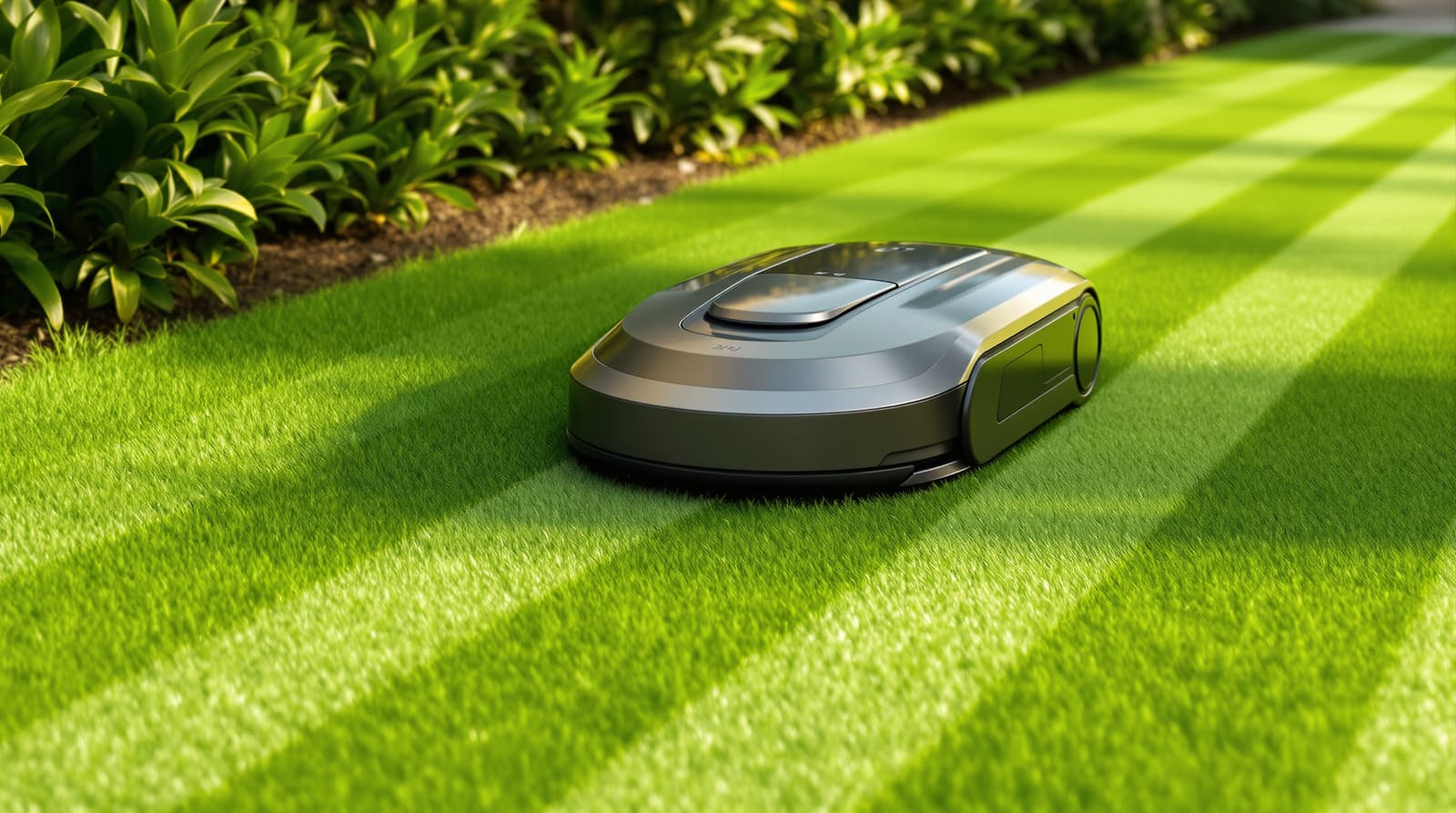
Robotic Lawn Maintenance
Robotic lawn mowers for Indian homes — how they work, whether your lawn suits one, the honest cost, theft and monsoon realities, safety and maintenance
A robotic lawn mower is a small, self-driving machine that trims your lawn a little every day and returns to a charging dock on its own — genuinely good at producing a perfect, mulched lawn quietly and without petrol, but in India, where a gardener costs a few hundred rupees a visit, it is a convenience-and-quality purchase, not the labour-saving necessity it is in Europe.
This guide is the focused deep-dive on robotic mowers. They are one slice of a larger picture — sensors, controllers, scheduled irrigation and automated upkeep — which we cover in Automated Landscape Maintenance. For the broader connected-garden view, see Smart Gardens Explained. Here we stay narrowly on the mower: how it works, whether your lawn suits one, and whether the rupees add up.
What a robotic mower actually is
A robotic mower is roughly the size of a large cat, runs on a lithium-ion battery, and carries small blades or a spinning cutting disc underneath. Unlike a petrol or push electric mower, it does not collect clippings and it does not cut a lawn in one big weekly session. Instead it follows a "little and often" philosophy: it mows for an hour or two, several times a week, shaving only a few millimetres each pass.
Those tiny clippings are dropped straight back onto the lawn — this is called mulching. Because the cuttings are so fine, they break down quickly and feed nitrogen back to the grass, so a well-run robotic lawn tends to look denser and greener over time, with no clipping rows to rake. The trade-off is that the machine is always working in the background rather than producing a single dramatic "freshly mown" moment.
The other defining difference is autonomy. You set a schedule once; the mower leaves its dock, cuts, and drives itself back to recharge when the battery is low or when rain is detected. A petrol mower needs a person for the whole cut. A robot needs a person mainly for setup, edge-trimming and occasional maintenance.
How a robotic mower works
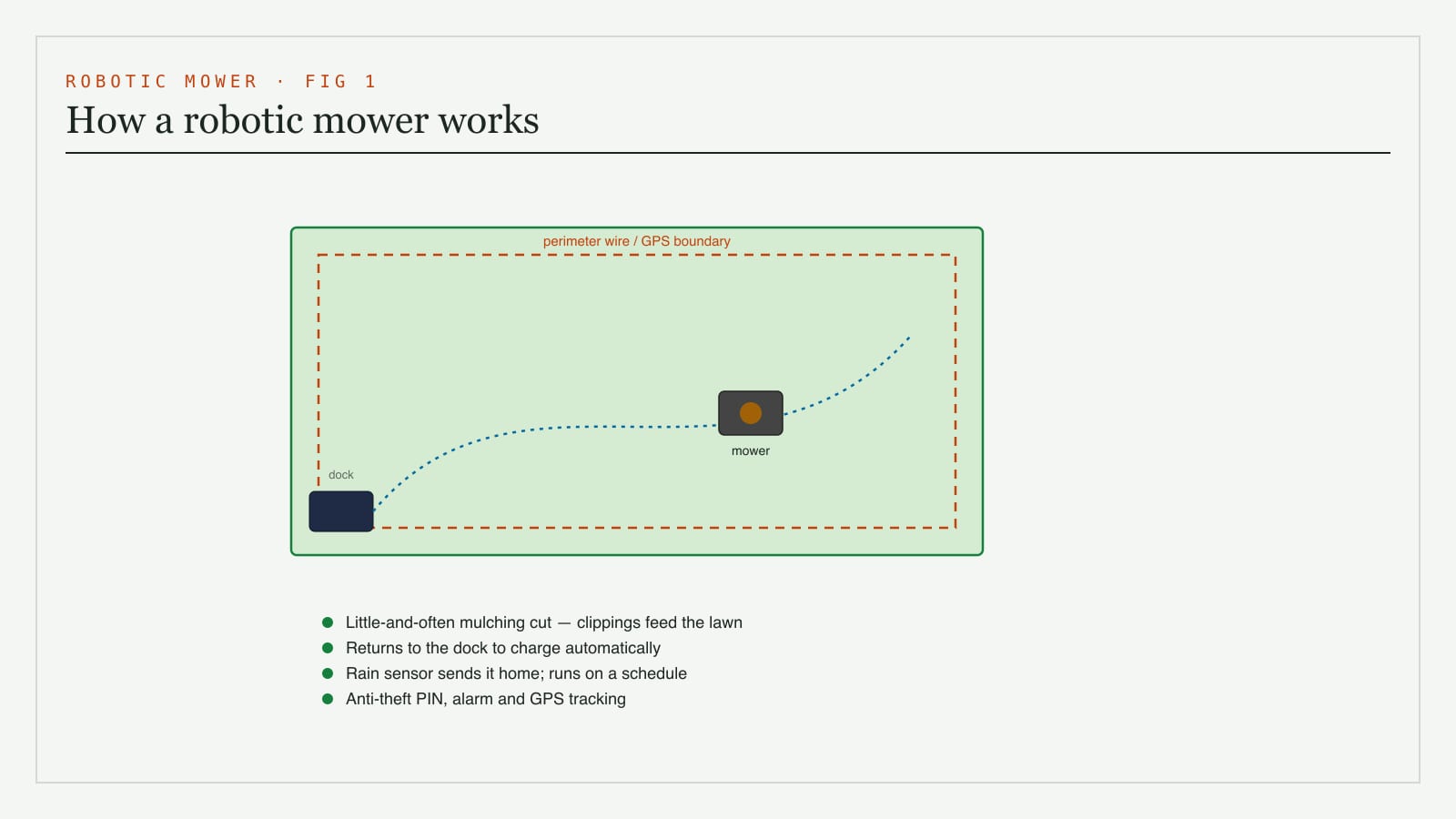
Every robotic mower needs to know two things: where the lawn ends, and where home is. The way it answers the first question is the single biggest difference between models.
Boundary wire (the traditional method)
A thin perimeter wire is pegged down or buried a few centimetres along the edge of the lawn and around any flower beds, trees or ponds you want excluded. The wire carries a low-voltage signal; the mower senses it and turns back when it reaches the edge. It is reliable and cheap, but it means physically laying (and sometimes burying) wire around the whole garden, and a cut wire — from an edging spade, a dog, or a monsoon-loosened peg — will stop the mower until you find and repair the break.
Wire-free navigation (the newer method)
Premium models now skip the wire using GPS-RTK (a base station plus satellite positioning that is accurate to a few centimetres) or camera/vision-based navigation that recognises the grass edge visually. You "draw" the boundary by walking the mower around the lawn once, or by mapping it in an app. This is far tidier to install, but RTK needs a reasonably clear view of the sky (tall buildings, dense tree canopy or a tight courtyard can degrade the signal), vision models can struggle in glare or low light, and these units cost considerably more.
The rest of the system
- Docking and charging station — a small base, usually at the lawn edge near a power point, where the mower self-parks and recharges. It needs mains power and some weather protection.
- Cutting discs or blades — small razor blades or a rotating disc. They are cheap and quick to swap, and being small they are safer and quieter than a big rotary blade.
- Scheduling — set via buttons or a smartphone app. You tell it which days and hours to run; better models auto-adjust cutting frequency to grass growth.
- Rain sensor — detects rain and sends the mower home, since cutting wet grass clogs and tears it. In the Indian monsoon this sensor matters a great deal (see limitations).
- Anti-theft features — a PIN required to operate, a loud alarm if the unit is lifted, and on better models GPS tracking so a stolen mower can be located and disabled. Given Indian theft risk, treat these as essential rather than optional.
Is your lawn suitable?
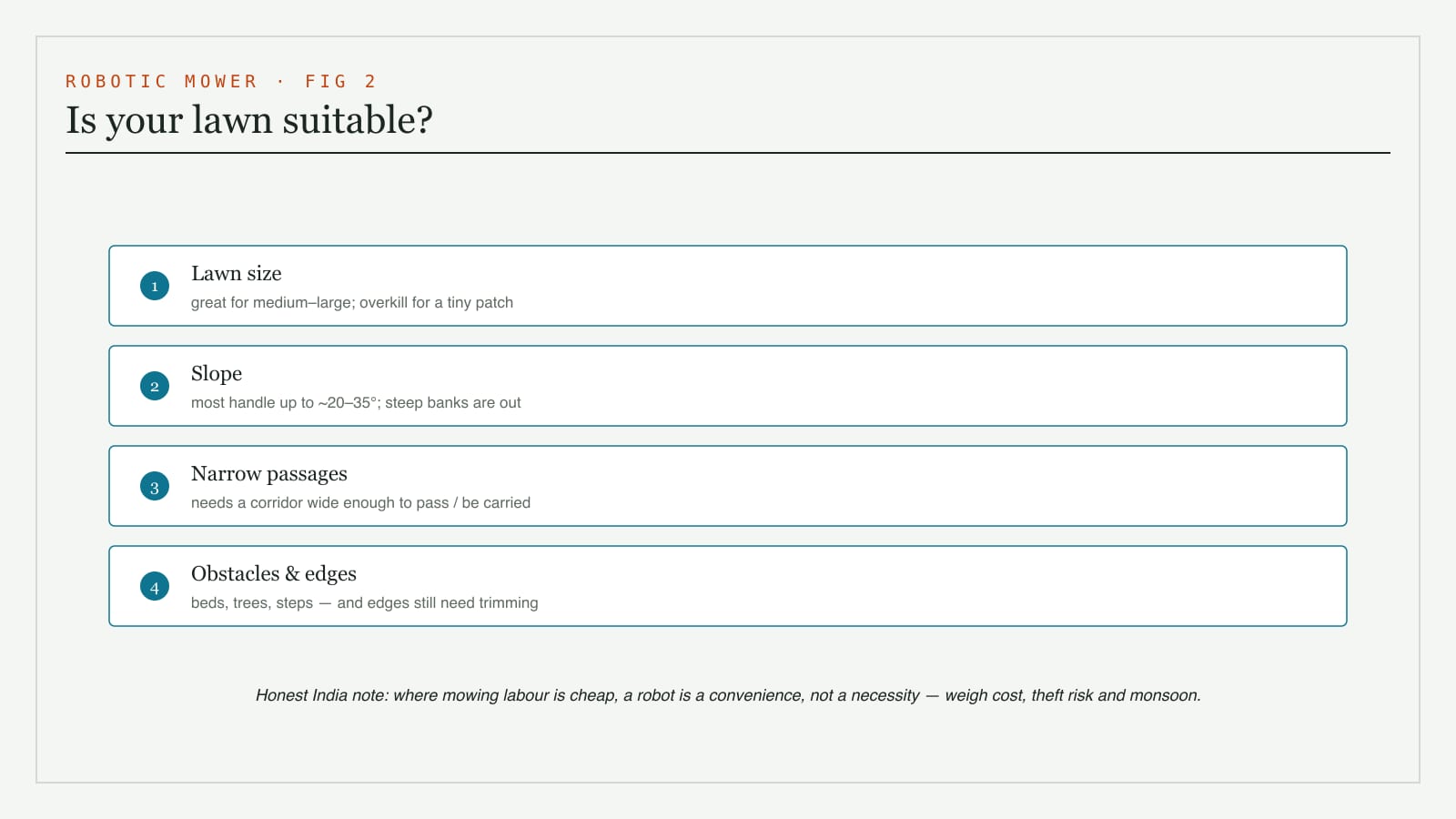
Robotic mowers suit some lawns beautifully and fight others constantly. Run through this honestly before spending.
| Factor | Robot-friendly | Robot-hostile |
|---|---|---|
| Lawn area | Within the model's rated area (entry units ~300–500 m², premium up to 2,000+ m²) | Larger than the rated area, or tiny fiddly strips |
| Slope | Gentle (most rated to ~25–35%, some to 45%) | Steep banks, terraced drops, retaining-wall edges |
| Shape | One connected lawn, gentle curves | Many separate islands the robot cannot drive between |
| Passages | Gaps wider than ~60–70 cm so it can pass through | Narrow side-returns, gates, single-paver paths |
| Obstacles | Few, with clear bed edges | Scattered pots, garden furniture, exposed roots, hose left out |
| Ground | Reasonably even | Bumpy, rutted, or with hollows that waterlog |
| Grass type | Fine, dense lawn grasses kept short | Coarse, tall, or rarely-cut grass |
Indian grasses specifically
The common Indian lawn grasses handle robotic mowing well provided they are already maintained as a short lawn. Bermuda grass (including the popular Selection-1 / "Calcutta" types) and Korean grass (a fine Zoysia) are dense, low-growing and respond nicely to frequent light cutting — exactly what a robot does. The catch is height: robots are built to nibble a millimetre or two off an already-short lawn, not to reclaim a knee-high patch after the monsoon. If your grass has grown long and tough, you must cut it down conventionally first and only then let the robot maintain it. Very uneven ground — common in older Indian gardens that were never properly levelled — is the bigger problem: the mower scalps the high spots and misses the hollows, and may get stuck.
The benefits
- A consistently perfect lawn. Daily light mulching produces an even, dense, weed-suppressed surface that a once-a-fortnight gardener cut cannot match.
- No clippings to dispose of. Mulching feeds the lawn and removes the bagging-and-dumping chore.
- Quiet. Electric and low-powered, so it can run early morning or at night without disturbing neighbours — useful in dense Indian residential layouts.
- No petrol, no fumes, low running cost. It sips electricity; there is no two-stroke fuel, no oil changes, no pull-cord.
- Time and reliability. It never skips a week because the gardener did not turn up.
Honest limitations for India
This is where India differs sharply from the European market the technology was designed for.
- The economics are different. In Europe the robot replaces expensive human labour. In India, garden labour is comparatively cheap and widely available, so the robot competes against a ₹300–600 gardener visit, not a ₹2,000 one. The payback is far slower (see the cost table).
- Monsoon and waterlogging. Sustained rain keeps the rain sensor active, so the mower may sit on its dock for days while the grass races ahead — then it is too long for the robot to manage. Waterlogged, soft ground also bogs the wheels and can trap the unit.
- Theft and security. An attractive, portable machine left outside is a target. PIN, alarm and GPS tracking reduce but do not eliminate the risk; a gated, walled garden is far safer than an open frontage.
- Wire installation and repair. Wire-guided models need careful laying, and a break can be tedious to trace. Wire-free models avoid this but cost much more and need good sky/light conditions.
- Edges still need a human. Robots cannot cut right up to a wall, fence or bed edge, and cannot strim. You will still need someone to trim edges and corners every few weeks.
- Availability and service. The category is still thin in India. Stock, spare blades, batteries and especially after-sales repair are limited outside major metros — confirm local service before buying, not after.
Installation
For a wire-guided mower: plan the boundary on paper, position the dock near a weatherproof power point at the lawn edge, lay the perimeter and any guide wires (pegged for the first season, buried later if you wish), then walk the first cut to check it turns at every edge. For a wire-free RTK or vision mower: site the base station with a clear sky view, charge it, then walk the mower around the boundary once to record the map and mark excluded zones in the app. Either way, level any obvious humps and hollows and clear loose objects before the first run. Most homeowners can self-install a wire-free unit in an afternoon; wire-guided installs on a large or complex garden are worth paying a dealer to do.
Safety
Robotic mowers are designed to be safe around a household, but they are not toys.
- Blade sensors. Lift-and-tilt sensors stop the blades instantly if the mower is picked up or tipped, and obstacle sensors make it slow and turn away on contact.
- Small blades. The cutting discs are far smaller than a rotary mower blade, reducing injury severity — but they are still sharp.
- Children and pets. Do not let small children or pets play around a running mower, and prefer scheduling cuts when the garden is empty (early morning works well). Never leave toys or chew-bones on the lawn during a run.
- Hands off. Always stop the mower and use the PIN/keypad before lifting it for cleaning or blade changes.
Maintenance of the mower
Robots are low-maintenance but not no-maintenance. Brush grass and mud off the underside and wheels regularly — caked, wet clippings are the commonest cause of poor cutting. Replace the small blades or disc when they dull (typically every couple of months in heavy use; they are inexpensive). Keep the dock contacts clean. The lithium battery lasts several seasons and is replaceable. Before the monsoon, check that the rain sensor is clean and responsive; after it, check the wire and pegs for storm damage. Store the unit charged and indoors over any long idle period.
What it costs versus a gardener
Treat the figures below as indicative planning ranges for 2026; actual prices vary by brand, lawn size and city. The honest conclusion is that for a small Indian lawn served by cheap labour, a gardener is far cheaper on a pure-rupees basis — you are paying the premium for quality, quiet and convenience.
| Option | Upfront | Annual running | Approx 5-year total (small lawn) |
|---|---|---|---|
| Gardener / mali (manual or push mower) | Negligible | ₹15,000–40,000 (visits + festival/tips) | ₹75,000–2,00,000 |
| Entry wire-guided robotic mower (~300–500 m²) | ₹60,000–1,20,000 | ₹2,000–5,000 (electricity, blades) | ₹70,000–1,45,000 |
| Premium wire-free RTK / vision mower | ₹1,50,000–3,50,000+ | ₹3,000–6,000 | ₹1,65,000–3,80,000+ |
For a small, simple, flat, walled lawn the entry robot can land roughly level with a gardener over five years while giving a noticeably better lawn — that is the sweet spot. For larger or labour-light households the case strengthens; for tiny lawns with a reliable cheap mali, it rarely pays back in rupees and is bought for the result, not the saving. Whatever you choose, integrate it into a wider plan rather than as a gadget bought in isolation: see Automated Landscape Maintenance and Smart Gardens Explained.
References & further reading
- Bureau of Indian Standards — IS/IEC 60335-2-107, Safety of household and similar electrical appliances: particular requirements for robotic battery-powered electrical lawnmowers.
- ICAR–Indian Institute of Horticultural Research (IIHR), Bengaluru — guidance on lawn establishment and turf-grass management for Indian conditions.
- ICAR turf and lawn-grass cultivation literature on Bermuda (Cynodon) and Korean (Zoysia) grasses for Indian gardens.
- Bureau of Energy Efficiency (BEE) — guidance on energy-efficient household appliances and battery-powered equipment.
- IEC 60335-1 — general safety standard for household electrical appliances (lift/tilt cut-out and obstacle-detection principles).
Export this guide
Related Guides — Deep-dive reading
How to Choose a CCTV Camera (2026): The Homeowner's Decision Guide for India
Cut through the spec-sheet noise and choose the right CCTV camera for each spot around an Indian home. What actually matters — sensor and low-light performance, lens and field of view, form factor, IP and IK ratings, honest smart features — and the marketing claims to ignore.
SecuritySmart Home Maintenance & Troubleshooting for Indian Homes
A smart home is not a one-time purchase — it is a small fleet of computers that needs firmware updates, fresh batteries, occasional reboots and a plan for the day a manufacturer switches off the cloud. This guide gives you a maintenance calendar, a troubleshooting flow for the failures Indian homes actually see, and the UPS and security hygiene that keep it all running through power cuts and voltage swings.
Smart HomeGeofencing Home Security in India (2026): Convenience Without the Trap
A geofence is a virtual boundary around your home; your phone crossing it can arm the alarm as the last person leaves and light the place up as you arrive. This guide explains the genuinely useful security uses, and the honest caveats: never let a phone's location alone unlock your door, never make a geofence the only thing that arms your home, and treat continuous family tracking as sensitive data.
SecurityRelated Tools — Try Free
Landscape Cost Calculator
Estimate a garden's cost — hardscape, softscape, lawn, irrigation, lighting and annual upkeep — by area, tier and city.
Budget CalculatorMonsoon-Readiness Checklist
Pre-rain home audit across 9 categories — terrace, drains, waterproofing, electrical, HVAC, pest, vehicles, documents.
Seasonal AuditGarden Planning Toolkit
Get a tailored garden plan — planting layers, Indian species, features and a checklist — from your climate, space, sun and goals.
Planner