
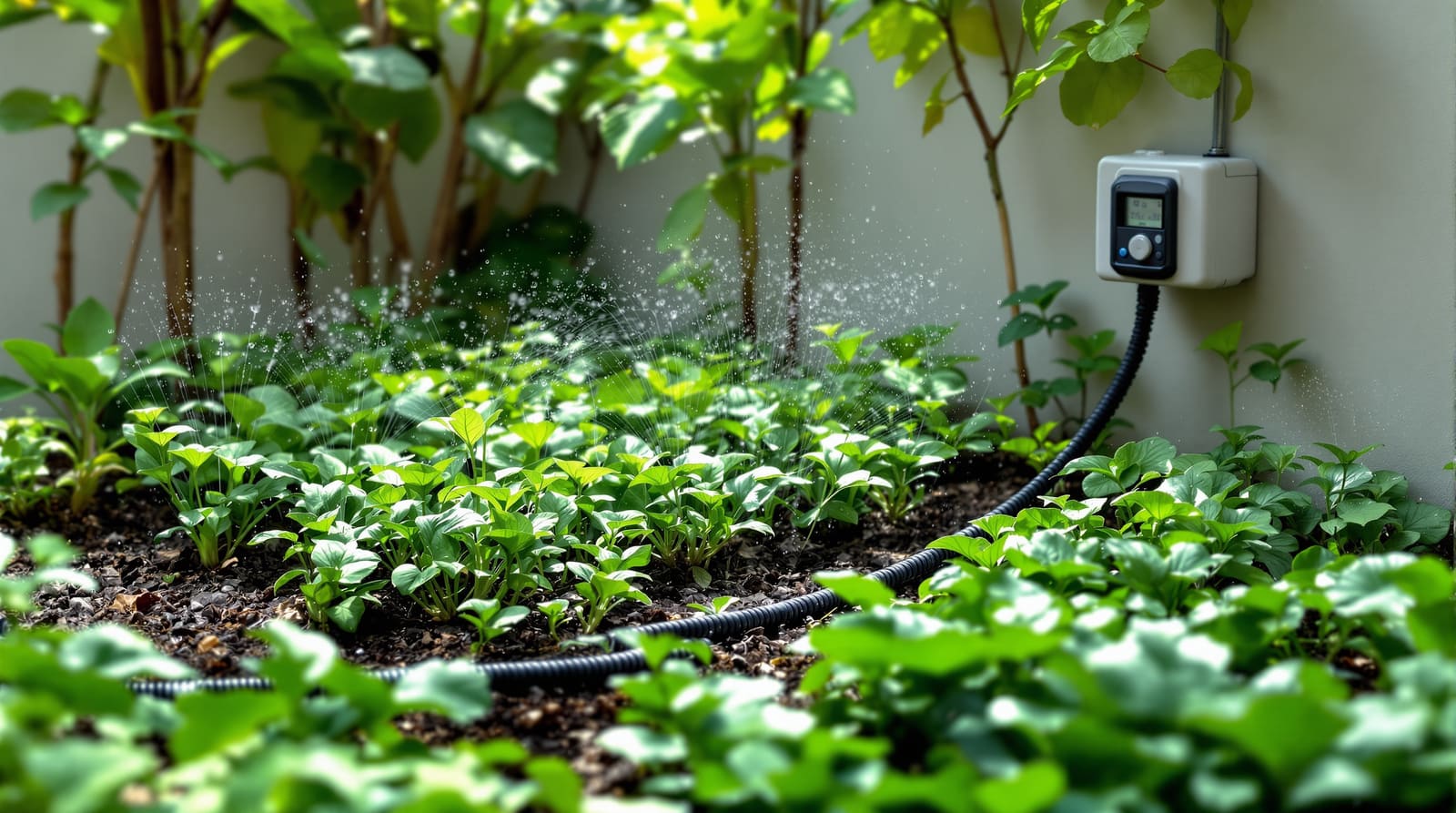
Smart Irrigation Systems
Controllers, sensors and weather data that water the right amount at the right time — the control spectrum, components, India realities, and 30-50% water savings
Smart irrigation is not about gadgets — it is about giving your garden exactly the water it needs, exactly when it needs it, and never a litre more, even when you are travelling, asleep or have simply forgotten.
For most Indian homes the watering routine is a guessing game: a hose run by feel, a mali who waters everything the same regardless of the plant or the weather, or a cheap mechanical timer that keeps drip lines running through a monsoon downpour. The result is wasted water, soggy roots, drought-stressed pots and a recurring bill that nobody can quite explain. Smart irrigation closes that gap with control logic — sensors, weather data and scheduling — layered on top of the delivery hardware. This guide stays in that lane: the brains, not the pipes. For drip-versus-sprinkler, hydrozoning fundamentals and water-budget thinking, read Sustainable Water Management in the Landscape; for where this fits in a connected home, see Smart Gardens Explained; and to feed it from your roof, Rainwater Harvesting Through Landscape Design.
Why smart irrigation is worth the trouble
A plant does not care what day of the week it is — it cares about how much water is in the soil and how fast the air and sun are pulling it out. A fixed timer ignores all of that: it waters the same volume on a cool, cloudy July morning as on a 43°C May afternoon. Smart control replaces the calendar with measurement.
The payoff is concrete:
- Water saving of roughly 30–50% versus manual or fixed-timer watering, mostly by skipping irrigation when soil is already wet (rain, monsoon, cool spells) and trimming over-application. Independent field studies of weather-based controllers consistently report savings in this band.
- Healthier plants — most home-garden plants die from over-watering, not under-watering. Sensor-driven control keeps the soil in the right moisture range instead of swinging between flooded and bone-dry.
- No more guesswork or forgetting — the system waters at dawn whether you are home or in another city, and shuts off when it rains.
- Early leak detection — a flow sensor flags a burst drip line or stuck valve before it floods a bed or empties your tank.
The control spectrum: from dumb timer to data-driven
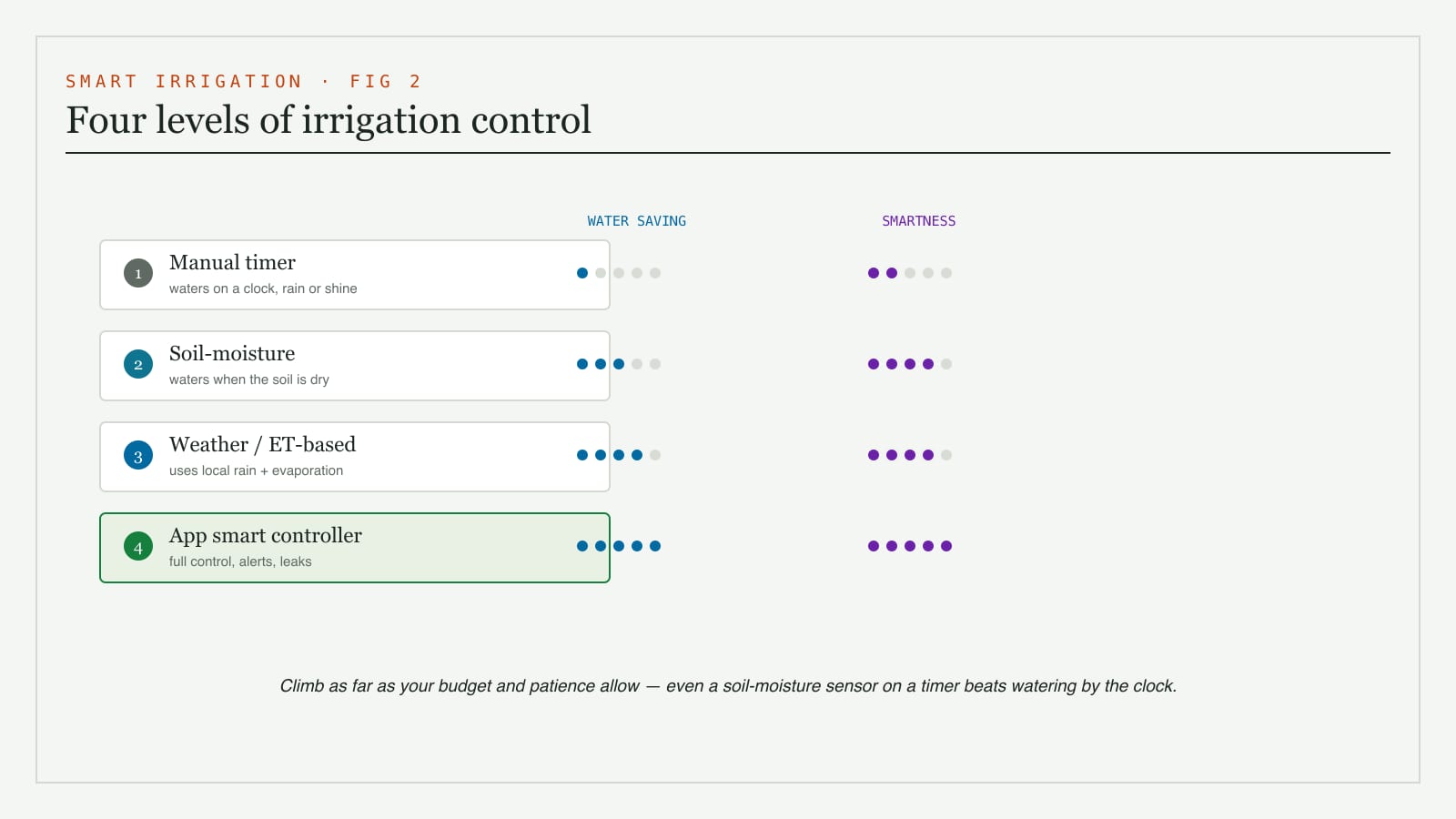
"Smart irrigation" is not one product — it is a ladder of increasing intelligence. You can climb as far up as your budget and patience allow, and a sensible Indian home often stops in the middle.
1. Manual / simple timer. A mechanical or basic digital tap timer opens for X minutes at fixed times. Cheap and reliable, but blind — it will water through a thunderstorm. Useful only as a backstop.
2. Soil-moisture-sensor control. Probes in the root zone tell the controller the actual water content; it irrigates only when soil dries below a set threshold. Directly measures what matters, but you must place and calibrate sensors per hydrozone.
3. Weather / ET-based control. The controller estimates evapotranspiration (ET) — how much water the plants and soil are losing — from local temperature, humidity, sun and wind, and tops up only that deficit. It uses a rain sensor or an online weather feed to skip or shorten cycles. This is the genuinely "smart" tier and where most water is saved.
4. Full app / smart controller. A Wi-Fi controller that combines the above, pulls a hyperlocal weather forecast, and lets you see, schedule and override everything from your phone, with usage logs and leak alerts.
These tiers are additive, not exclusive: a good app controller is essentially an ET engine plus soil sensors plus remote control in one box.
Control types compared
| Control type | How it decides to water | Water saving vs manual | Smartness | Indicative cost (₹) | Best for |
|---|---|---|---|---|---|
| Simple timer | Fixed clock schedule | 0–10% | None | 400–2,500 | A backstop, or balconies with one plant type |
| Soil-moisture control | Measured root-zone moisture | 20–40% | Reactive | 3,000–12,000 | Lawns, mixed beds, anyone who over-waters |
| Weather / ET-based | Local weather + ET model + rain skip | 30–50% | Predictive | 8,000–25,000 | Larger gardens, water-scarce cities |
| Full app / smart controller | All of the above, phone control + logs | 30–50%+ | Predictive + remote | 12,000–40,000+ | Tech-comfortable owners, frequent travellers |
Costs are for the controller and core sensors only; valves, drip hardware and installation are extra and depend on garden size.
The components of a smart system
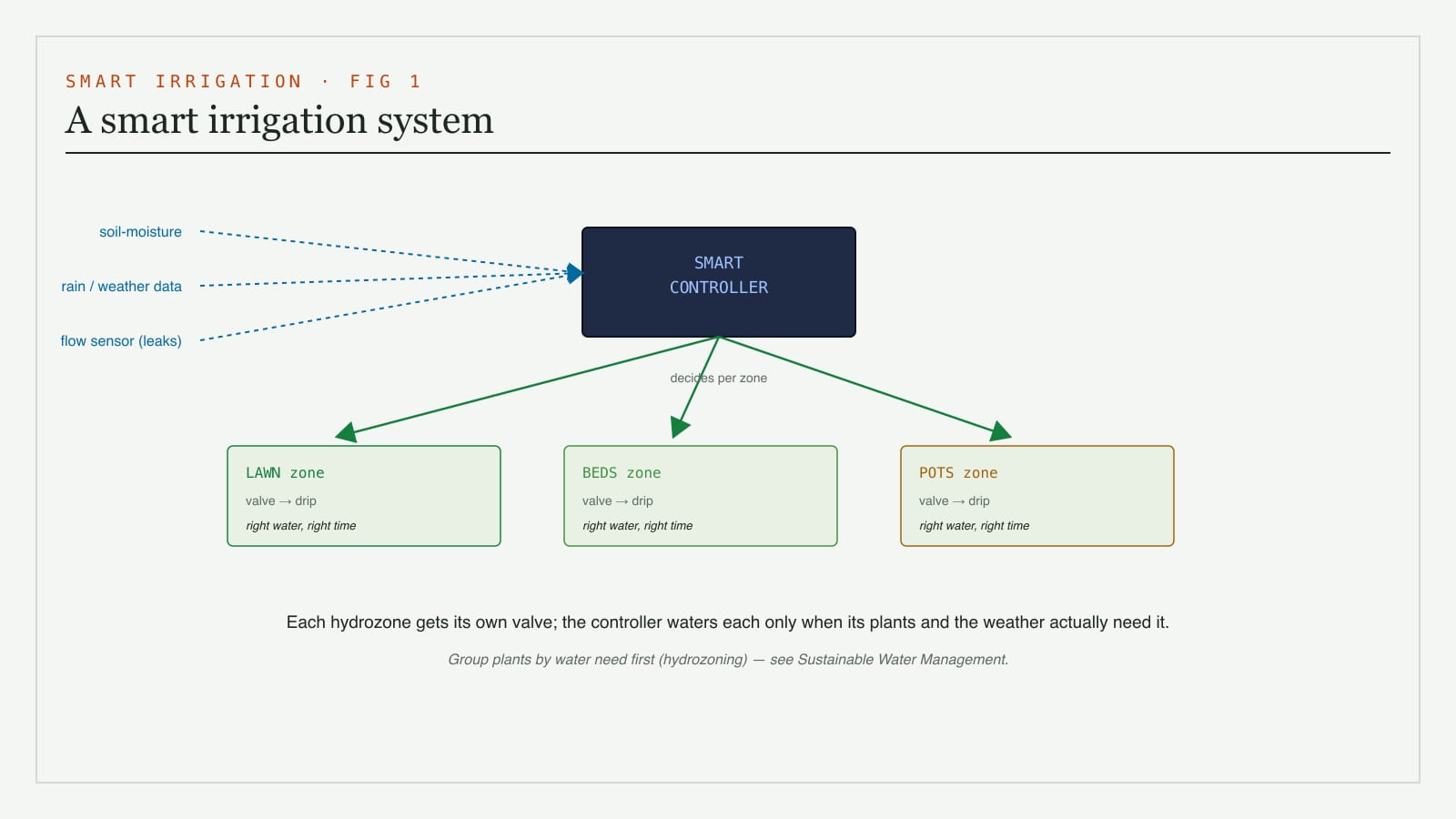
- Smart controller — the brain. Holds the schedule and logic, reads sensors, fetches weather, and switches the zone valves. Pick one with enough zones for your hydrozones plus a spare.
- Zone valves (solenoid valves). Electrically operated valves that open and close each watering zone. The controller energises one zone at a time so pressure stays adequate.
- Soil-moisture sensors. Buried probes reporting volumetric moisture. One per distinct hydrozone is the practical minimum; lawns, pots and trees each behave differently.
- Rain / weather sensor or online weather feed. A physical rain sensor cuts watering when it is actually raining; a weather feed lets the controller anticipate rain and adjust in advance. Forecast-driven skip plus a physical rain sensor is the belt-and-braces combination for the monsoon.
- Flow sensor. Measures water actually passing through. Sudden high flow signals a burst line; zero flow when a valve is open signals an empty tank or stuck valve. This is your leak alarm and the single most underrated component in India, where supply is intermittent.
Group these around your hydrozones — plants of similar water need on a shared valve so each zone is watered to its own requirement (lawn separate from natives separate from pots). Hydrozoning is the foundation; smart control simply makes each zone self-managing. The fundamentals are covered in Sustainable Water Management in the Landscape.
India realities you must design around
This is where imported marketing claims meet Indian conditions. Plan for these or the system will frustrate you.
- Erratic power and voltage. Controllers must survive cuts and surges. Choose a model with battery backup (or a 9V/AA-backed unit) that retains its schedule through an outage, and put it on a surge-protected point. A small solar-charged controller suits a garden far from a socket. Always keep a manual override valve so the mali can water during a long outage.
- Water supply timing and storage. Most homes do not have 24×7 mains pressure — they fill an underground sump or overhead tank during a supply window. Smart irrigation should draw from your tank via a pump, and the controller should be scheduled around tank availability. A level sensor that prevents the pump from running dry is worth adding.
- Monsoon shut-off. From June to September much of India needs little or no irrigation. A "seasonal adjust" or rain-skip feature, plus a physical rain sensor, prevents the classic sight of sprinklers running in a downpour. Build a clean monsoon-off mode into the schedule.
- Hard water and clogging. High-TDS borewell water scales emitters and fouls fine soil-moisture probes. Use a screen or disc filter ahead of drip zones, prefer pressure-compensating emitters, and clean sensors periodically. Hard water is the commonest reason "smart" drip degrades within a season.
- Dust and heat. Mount the controller in shade or a small enclosure; direct afternoon sun and monsoon damp shorten the life of cheap electronics.
- What is actually available. In India you will reliably find tap-timer controllers and battery solenoid timers from irrigation brands (a few hundred to a few thousand rupees), soil-moisture-sensor kits and ESP32/Arduino-based DIY controllers (popular and cheap), and a smaller selection of Wi-Fi app controllers, often imported and pricier (₹12,000+). Fully integrated ET controllers tuned to Indian micro-weather are still a niche, semi-DIY space rather than a polished mass-market product — set expectations accordingly.
Drip and smart together
Smart control and drip irrigation are complementary, not alternatives. Drip delivers water slowly and precisely to the root zone with the highest efficiency of any method; smart control decides how much and when. Pairing them compounds the saving: efficient delivery times correct volume. The practical rig for an Indian home is pressure-compensating inline drip on beds and pots, a disc filter, solenoid valves per hydrozone, and a smart controller deciding the schedule from soil and weather data. (Drip layout, spacing and emitter selection live in the water-management guide — this guide assumes the pipes are already chosen.)
Installation and retrofit
You do not need to rip out an existing garden. Most systems are retrofitted:
1. Map your hydrozones and count the valves you need.
2. Tap into the existing supply after the pump/tank, add a filter, and fit a solenoid valve per zone in a small valve box.
3. Run low-voltage wiring (or use battery/wireless valves) back to the controller, mounted in shade near power.
4. Place sensors — one soil probe per zone in a representative spot, the rain sensor in the open, the flow sensor on the main line.
5. Set hydrozone schedules and let the smart logic refine them over a few weeks.
A small balcony or terrace can run on a single battery tap-timer with a soil sensor for under ₹5,000 of DIY effort; a 200–400 m² garden with four to six zones, app control and leak detection is a half-day professional install. Keep every zone manually operable so the garden survives a dead controller or flat battery.
Water saving and a simple ROI frame
The economics turn on how much water you use and what it costs — metered municipal water and tanker top-ups make the maths far more attractive than subsidised supply.
| Item | Typical figure |
|---|---|
| Smart system extra cost over manual/timer | ₹15,000–40,000 (mid garden) |
| Water saved vs manual watering | 30–50% |
| Where the saving comes from | Rain/monsoon skips, ET-matched volume, leak alerts |
| Non-water payback | Less plant loss, no travel anxiety, no mali dependence |
| Realistic payback | 2–4 seasons on metered/tanker water; longer on cheap supply |
The honest takeaway: on heavily subsidised municipal water, the rupee payback is slow and the real return is convenience, plant health and resilience. Where you buy tankers or pay metered rates, water savings alone can justify the spend within a couple of years.
Honest limitations
- Sensors drift and foul. Soil probes need occasional cleaning and calibration, especially in hard or silty water; an uncalibrated sensor is worse than none.
- It is a system, not an appliance. Valves stick, batteries die, Wi-Fi drops. Without the manual override and a periodic check, "set and forget" becomes "set and flood".
- Weather feeds are coarse. A city-level forecast can miss a localised cloudburst; a physical rain sensor remains the reliable last line.
- The polished mass-market product is not fully here yet. Much of the genuinely smart end in India is still DIY or imported. Buy for the tier you will actually maintain, not the brochure.
- It will not fix bad design. A garden of thirsty exotics in a hot-dry climate wastes water however cleverly you schedule it. Right plant, right place and proper hydrozoning come first; smart control optimises a sound design, it does not rescue a poor one.
Start one rung up from a dumb timer — a soil sensor and a rain skip on your existing drip — prove the saving, then climb to full app control only if the convenience earns its keep.
References & further reading
- Bureau of Indian Standards, IS 14485 / IS 13488 — code of practice and components for micro/drip irrigation systems.
- Bureau of Energy Efficiency (BEE), guidance on efficient pumping and water-energy use in buildings.
- ICAR / Indian Institute of Horticultural Research (IIHR), Bengaluru — horticultural water requirement and micro-irrigation scheduling resources.
- FAO Irrigation and Drainage Paper 56, "Crop Evapotranspiration" — the standard reference for ET-based scheduling (Allen et al.).
- Central Ground Water Board (CGWB) — groundwater quality and hardness data relevant to clogging and filtration.
- Studio Matrx companion guides: Sustainable Water Management in the Landscape, Smart Gardens Explained and Rainwater Harvesting Through Landscape Design.
Export this guide
Related Guides — Deep-dive reading
Smart Water Monitoring India: Track Bathroom Usage, Catch a Running Toilet, Cut the Bill (2026)
A clamp-on or inline flow sensor turns your water line into a dashboard — litres per shower, a toilet that never stops filling, a hidden drip you would never hear. This is the honest India-first guide to smart water monitoring: how sensors meter each fixture, the apps and alerts, tie-ins with auto shut-off valves, and the real rupee cost against the bill it saves.
BathroomsHow to Choose a Security System (2026): The Master Buying Guide for Indian Homes and Buildings
The mental model that ties the whole buying decision together: start from your own risk, not a product; build the layers your situation actually needs; make the big architecture choices (wired vs wireless, local vs cloud, DIY vs professional); tell real product quality from marketing; and choose a vendor you can trust.
SecuritySmart Home Power Backup in India: Keeping It Running During Power Cuts
Load-shedding is a fact of Indian life. Here is how to make sure your router, hub, cameras and locks survive an outage — for surprisingly little money.
Smart HomeRelated Tools — Try Free
Rainwater Tank Sizer
How big should your rainwater tank be? Computes annual harvest, recommended tank capacity in litres, water-bill savings, and payback — for 10 Indian cities.
RWH CalculatorMonsoon-Readiness Checklist
Pre-rain home audit across 9 categories — terrace, drains, waterproofing, electrical, HVAC, pest, vehicles, documents.
Seasonal AuditCross-Ventilation Analyzer
Estimate airflow and air changes per hour (ACH) from room size, window areas, layout, and local wind — with NBC 2016 Part 8 compliance check.
Ventilation Calculator