
Automated Landscape Maintenance
What a garden can do for itself today — mowing, watering, lighting, monitoring and cleaning — an honest maturity map, the gardener's continuing role, and what to automate first
A modern Indian home garden can quietly run most of its own routine upkeep — watering, mowing, lighting, cleaning and monitoring — but automation today reduces skilled-gardener hours rather than replacing them, and only some of the kit genuinely earns its keep in Indian conditions.
Most Indian homeowners do not lose a garden because they chose the wrong plants. They lose it because the upkeep is relentless — the daily watering forgotten during a work trip, the gardener who stops turning up, the monsoon weeds that win in a fortnight. Automated landscape maintenance is the answer to that fragility: a layer of timers, sensors, robots and apps that keep the garden alive and tidy when nobody is paying attention. This guide stays in the automation lane — the smart, data-driven side of running a garden. For the design side, see AI in Landscape Design; for the broader picture of where this is all heading, Future of Landscape Architecture; and for an overview of the connected garden as a whole, Smart Gardens Explained.
Why automate maintenance at all
Three forces push Indian homeowners towards automation, and they are not the ones marketing leads with.
- Time and consistency. Plants do not forgive inconsistency. A lawn watered heavily on Sunday and forgotten till Friday is worse off than one given a measured dose daily. Automation removes the human variable — the system does the same correct thing every day, including when you travel.
- Labour availability and cost. This is the real driver in 2026. A reliable, skilled mali in a metro now commands a meaningful monthly retainer, and dependable help is genuinely hard to find and keep. Automation does not eliminate the gardener (more on that below), but it lets one visit a week do what used to need three.
- Resource discipline. Sensor-driven watering uses markedly less water than a hose on a timer, which matters where municipal supply is rationed or borewells are falling. (For the underlying drip and hydrozoning fundamentals, see Sustainable Water Management — this guide will not re-explain them.)
What can be automated today
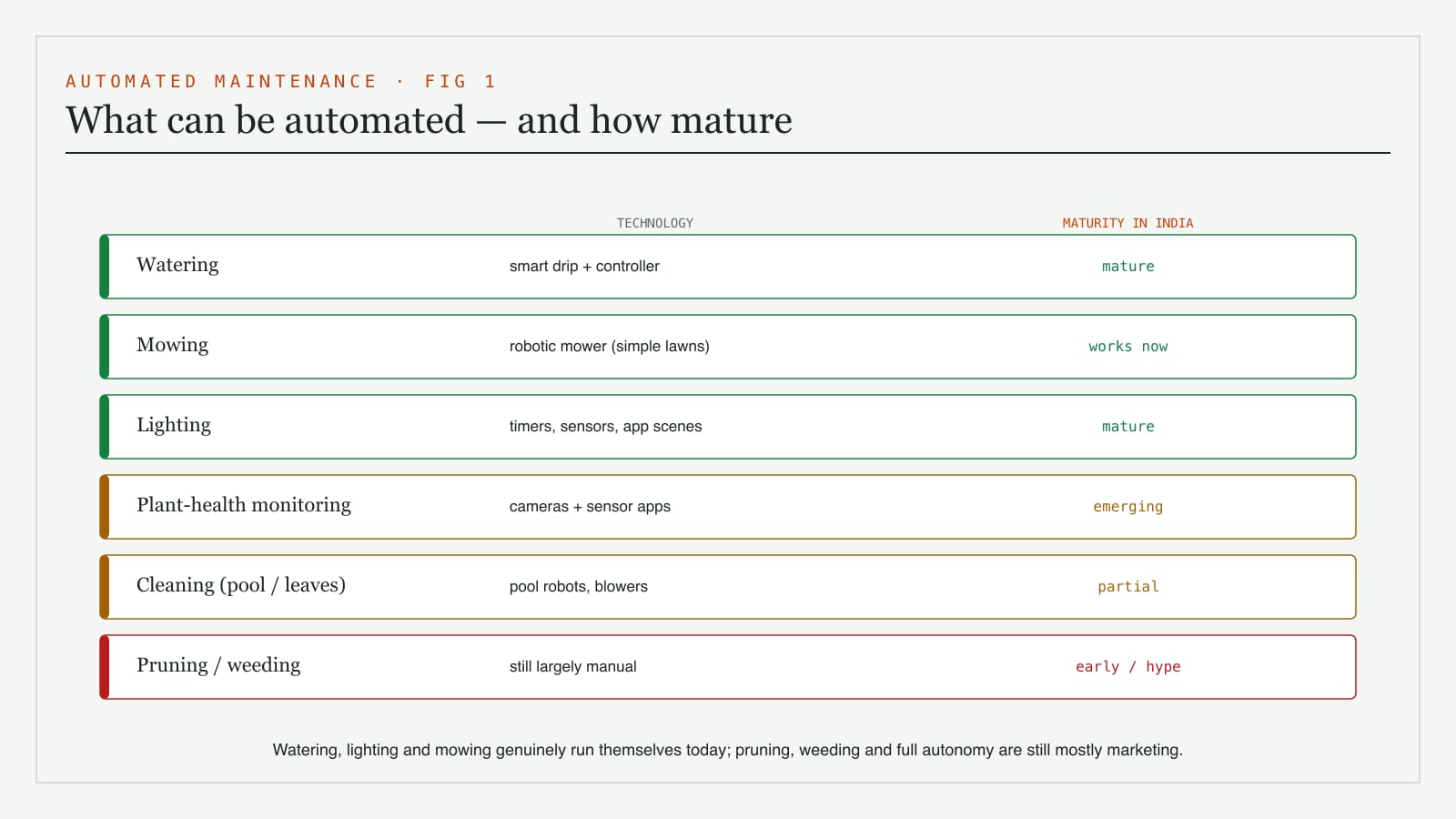
The honest answer is "most routine, repetitive physical tasks — and almost none of the judgement-based ones." Here is the full picture, task by task.
Mowing
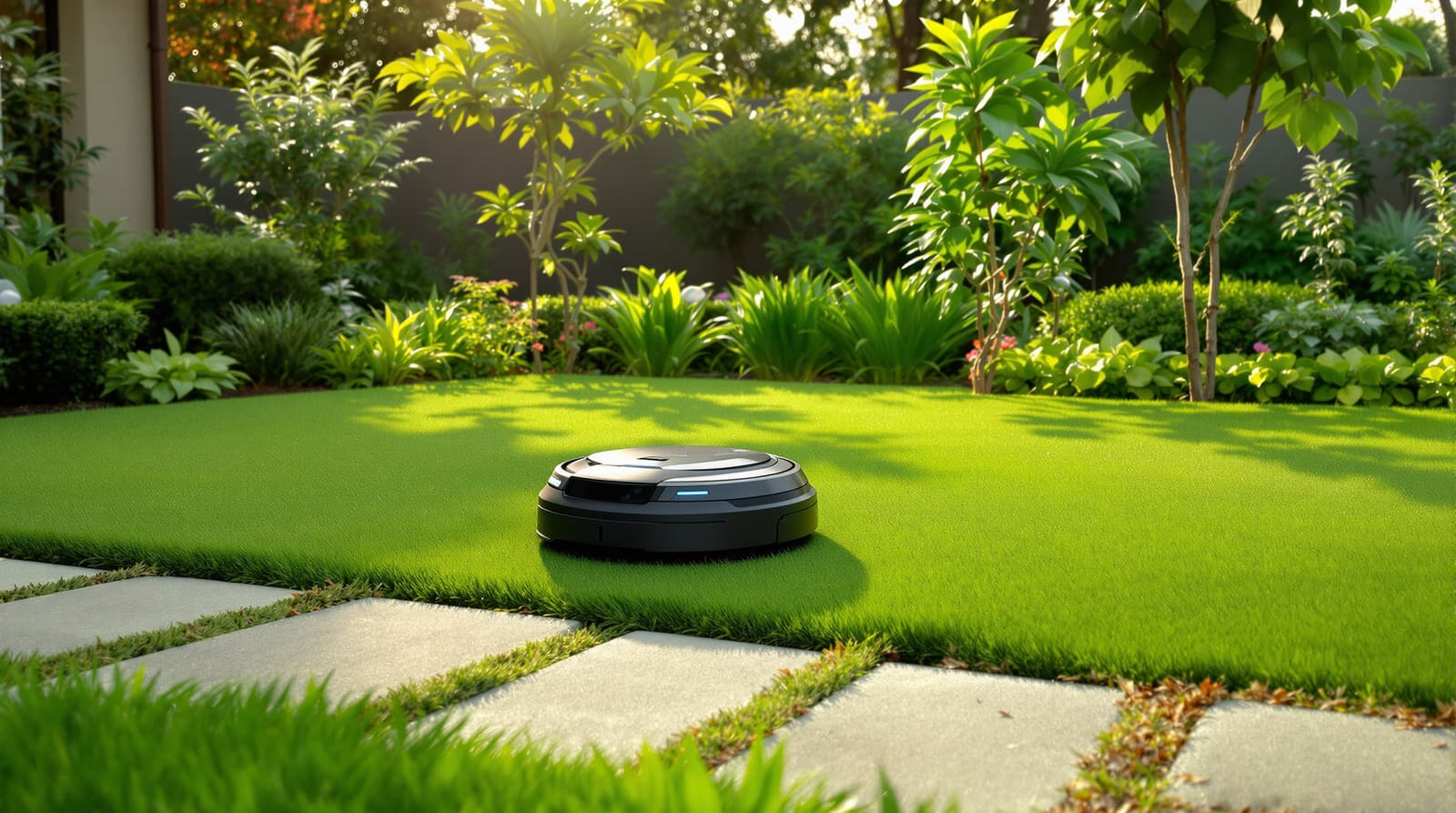
Robotic mowers cut a little, often, mulching the clippings back into the lawn so it stays at a constant height. Boundary-wire models have been around for years; the newer wave uses GPS/RTK and vision to navigate without a buried perimeter wire. In an Indian garden they work well on flat-to-gently-sloping, obstacle-light lawns of Bermuda or buffalo grass, and struggle on steep banks, very coarse grass left long, and heavily cluttered plots. This guide treats mowing at overview level only — for the deep dive on models, install, monsoon and theft realities, see the sibling guide Robotic Lawn Maintenance.
Watering
The most mature, highest-value automation in any Indian garden. A controller drives solenoid valves on drip and micro-spray zones; the question is only how smart the trigger is. A basic battery tap-timer is cheap and reliable; a Wi-Fi controller adds app control and weather skip (it cancels a cycle if rain is forecast or measured); soil-moisture sensors close the loop so the garden is watered by need, not by clock. This is where most homeowners should spend first. Again, the irrigation hardware fundamentals live in Sustainable Water Management.
Lighting
Genuinely mature and cheap. Path, accent and security lights can run on astronomical timers (which track local sunset through the year), photocell dusk-to-dawn sensors, PIR motion sensors, or app/voice schedules. Solar bollards with built-in dusk sensors need no wiring at all. Lighting automation is reliable, low-risk and a sensible first or second project.
Plant-health and pest monitoring
This is the fastest-moving and most over-hyped category. What works: soil-moisture and temperature probes, simple soil-NPK and pH meters, and weather-linked apps that flag frost or heat stress. Camera- and app-based pest/disease identification (photograph a leaf, get a likely diagnosis) is improving quickly but is an advisory — it suggests, a human confirms and acts. Continuous AI "garden cameras" that auto-detect stress exist but are early, and few are tuned to Indian species or pests. Treat monitoring as decision support, not autopilot.
Leaf, debris and pool cleaning
Robotic pool cleaners are mature and excellent where there is a pool. Robotic leaf and debris collection for open gardens is essentially not a real consumer product in India yet — leaf blowers remain manual or gardener-operated. Do not budget for a "leaf robot."
Fertigation
Injecting soluble fertiliser into the drip line on a schedule (fertigation) is well-proven in Indian horticulture and farming, and a simple Venturi injector or dosing pump can be added to a home drip system. It is mid-maturity for homes: effective but needs correct dosing and periodic flushing to avoid emitter clogging, so it is better commissioned and reviewed by someone who understands EC/dosing.
Security
Cameras, motion-triggered lights and connected gate/intercom systems are fully mature and often the reason a homeowner first runs cabling and Wi-Fi to the garden — useful, because that same infrastructure then powers everything else.
The maturity map — what actually works in an Indian garden
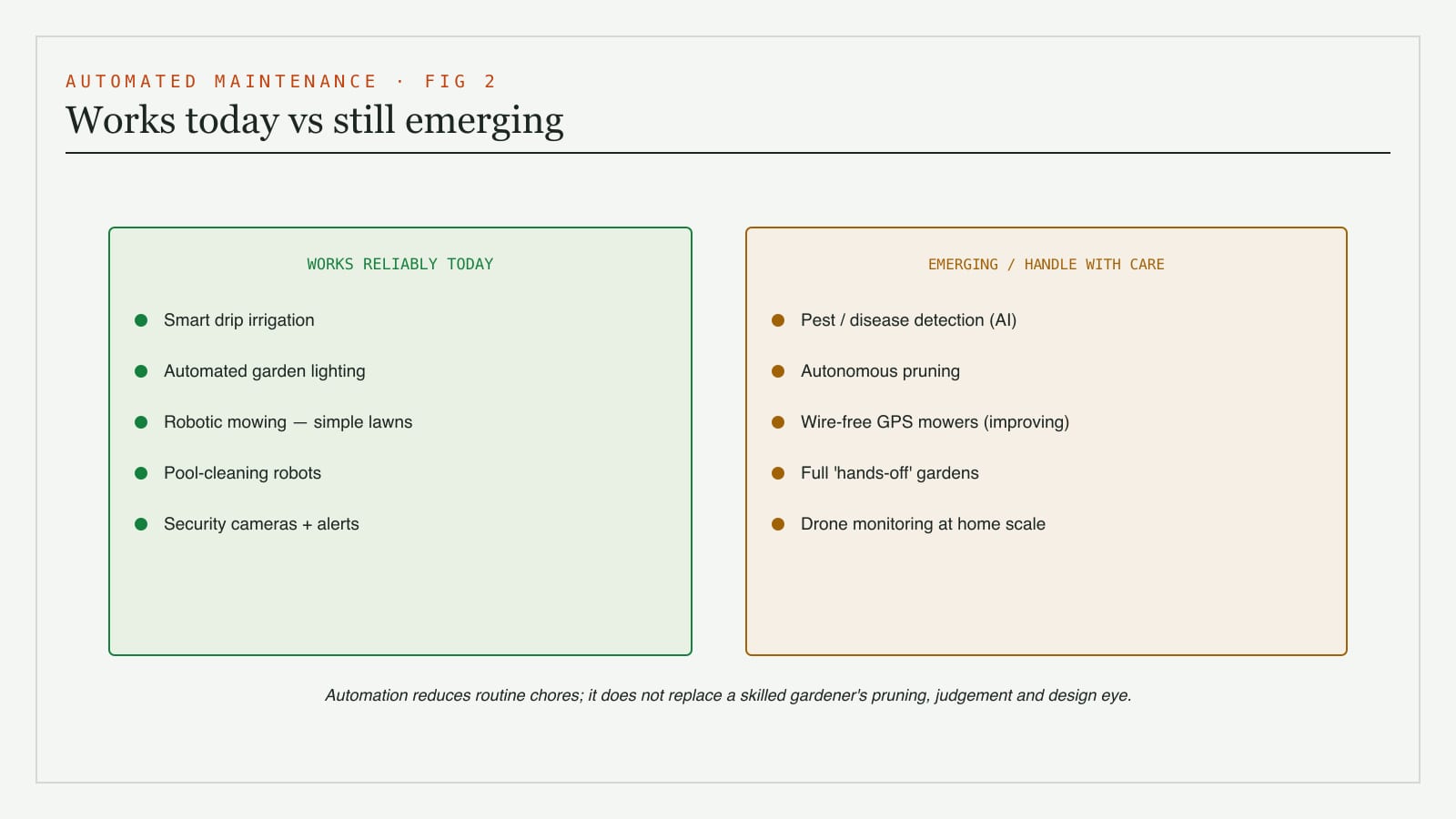
Marketing blurs "available" with "works reliably here." This table separates them for Indian home conditions.
| Task | Automation tech | Maturity in India (2026) | Rough cost (₹) |
|---|---|---|---|
| Watering | Wi-Fi controller + solenoid valves + soil-moisture sensor | Mature, high value | 6,000–40,000 |
| Lighting | Astro/PIR timers, photocells, solar bollards | Mature, low risk | 3,000–30,000 |
| Security | Cameras, motion lights, connected gate | Mature | 10,000–60,000 |
| Mowing | Robotic mower (wire or GPS/RTK) | Works on the right lawn | 60,000–2,50,000+ |
| Pool cleaning | Robotic pool cleaner | Mature (if you have a pool) | 35,000–1,50,000 |
| Fertigation | Venturi/dosing injector on drip | Mid — needs setup + flushing | 4,000–35,000 |
| Plant-health monitoring | Soil probes, app/camera diagnosis | Emerging — advisory only | 1,500–20,000 |
| Leaf/debris collection | "Leaf robots" | Hype — not a real home product | — |
A rough rule: anything that repeats a fixed physical action on a flat, defined area is mature; anything that needs to diagnose, judge or work across messy terrain is emerging or hype.
The gardener is not going away
This is the most important and least-marketed truth. Automation handles the routine: watering, cutting grass, switching lights, raising an alert. It does not prune a flowering shrub correctly, shape a hedge, decide that a plant is failing and should be replaced, repot, divide, treat a specific pest outbreak, or redesign a bed that has outgrown its spot. Those are skilled, judgement-based tasks.
So the realistic model is not "fire the mali." It is: automation takes the dull, daily, easily-forgotten work off the gardener's plate, so a skilled person's fewer visits go entirely into care that actually needs a brain and a trained hand. Homeowners who expect automation to eliminate skilled help end up with a tidy lawn and a slowly declining garden. Budget for both the kit and the (reduced) human care.
The realities nobody puts on the box
Automation is itself a thing that needs maintaining, and Indian conditions are unforgiving.
- Power. Outages and voltage swings are routine. Controllers and chargers should be on a UPS or have battery backup and retain their schedule through a cut; cheap units that forget their programming after every outage are a daily annoyance.
- Connectivity. Garden Wi-Fi is often weak at the far end of the plot. Prefer kit that works offline on its own stored schedule and uses the app/cloud only for convenience — never buy a watering controller that stops watering when the internet drops.
- Dust, heat, monsoon and pests. Sensors drift and clog with dust; UV degrades cheap plastic; the monsoon floods low-lying enclosures; and rodents and ants genuinely chew low-voltage wiring. Insist on a sealing rating of at least IP65 for anything outdoors, mount controllers in shade, and route cabling in conduit.
- Calibration and drift. Soil-moisture and NPK sensors need occasional re-checking against reality — a wet-looking reading on a dry bed means the probe, not the bed, is the problem.
- Theft and safety. A robotic mower is a visible, portable, expensive object; PIN locks, alarms and GPS tracking matter. Keep blades and charging stations away from where children and pets play.
The takeaway: factor in a small ongoing time and money cost to keep the automation working. A neglected smart system fails silently, which is more dangerous than a hose you simply forgot to use.
Cost framing and what to automate first
You do not buy this all at once. Spend where the rupee saves the most plant-stress and the most labour, then expand. The sequence below assumes a typical urban home garden.
| Priority | What to automate | Why first | Typical first spend (₹) |
|---|---|---|---|
| 1 | Watering (timer → Wi-Fi → soil sensor) | Highest plant-survival value; saves water; cheap to start | 6,000–20,000 |
| 2 | Lighting | Cheap, reliable, instant quality-of-life and security gain | 3,000–15,000 |
| 3 | Security/cameras | Often justifies the Wi-Fi + power run the rest depends on | 10,000–40,000 |
| 4 | Mowing (if you have real lawn) | High value but only on the right turf and plot shape | 60,000+ |
| 5 | Fertigation / monitoring | Refinements once the basics are dependable | 5,000–25,000 |
| — | Leaf robots, AI auto-care | Skip — not yet real for Indian homes | — |
A sane first move
If you do only one thing, automate watering with a controller that holds its schedule offline and add a single soil-moisture sensor on your thirstiest zone. It is the cheapest intervention with the biggest effect on whether the garden is alive when you get back from a trip — and it is the foundation every other layer plugs into.
Build the connected garden the way you would build a house: get the watering and the wiring right first, layer convenience and intelligence on top, and keep a skilled human in the loop for everything that needs a decision rather than a schedule.
References & further reading
- Bureau of Indian Standards (BIS) — IS/IEC 60529, Degrees of Protection Provided by Enclosures (IP Code) — the ingress-protection ratings to specify for outdoor controllers and sensors.
- Bureau of Indian Standards (BIS) — IS 12232, Code of Practice for Micro Irrigation Systems — drip and micro-irrigation design and operation basics.
- ICAR — Indian Institute of Horticultural Research (IIHR), Bengaluru — extension material on fertigation, drip scheduling and protected cultivation for Indian conditions.
- Bureau of Energy Efficiency (BEE) — guidance on outdoor and landscape lighting controls (timers, sensors) and energy-efficient luminaires.
- Food and Agriculture Organization (FAO) — Crop evapotranspiration (Irrigation and Drainage Paper 56) — the reference framework behind weather-based and sensor-based watering decisions.
- Central Ground Water Board (CGWB), India — reports on groundwater status, relevant to water-discipline and sensor-driven irrigation in Indian gardens.
Export this guide
Related Guides — Deep-dive reading
False Alarm Prevention for Burglar Alarms in India: Causes & Fixes (2026)
Why home alarms cry wolf — ceiling fans, pets, heat, insects, weak batteries, power blips and poor door alignment — and how correct placement, the right sensors and simple upkeep keep the system trusted and armed.
SecurityGeofencing Home Security in India (2026): Convenience Without the Trap
A geofence is a virtual boundary around your home; your phone crossing it can arm the alarm as the last person leaves and light the place up as you arrive. This guide explains the genuinely useful security uses, and the honest caveats: never let a phone's location alone unlock your door, never make a geofence the only thing that arms your home, and treat continuous family tracking as sensitive data.
SecurityRobotic Lawn Maintenance
Robotic lawn mowers for Indian homes — how they work, whether your lawn suits one, the honest cost, theft and monsoon realities, safety and maintenance
LandscapeRelated Tools — Try Free
Landscape Cost Calculator
Estimate a garden's cost — hardscape, softscape, lawn, irrigation, lighting and annual upkeep — by area, tier and city.
Budget CalculatorRainwater Tank Sizer
How big should your rainwater tank be? Computes annual harvest, recommended tank capacity in litres, water-bill savings, and payback — for 10 Indian cities.
RWH CalculatorBefore vs After — Cost Reality Check
Compare what you expected to pay vs what you actually paid, category by category.
Reality Check