
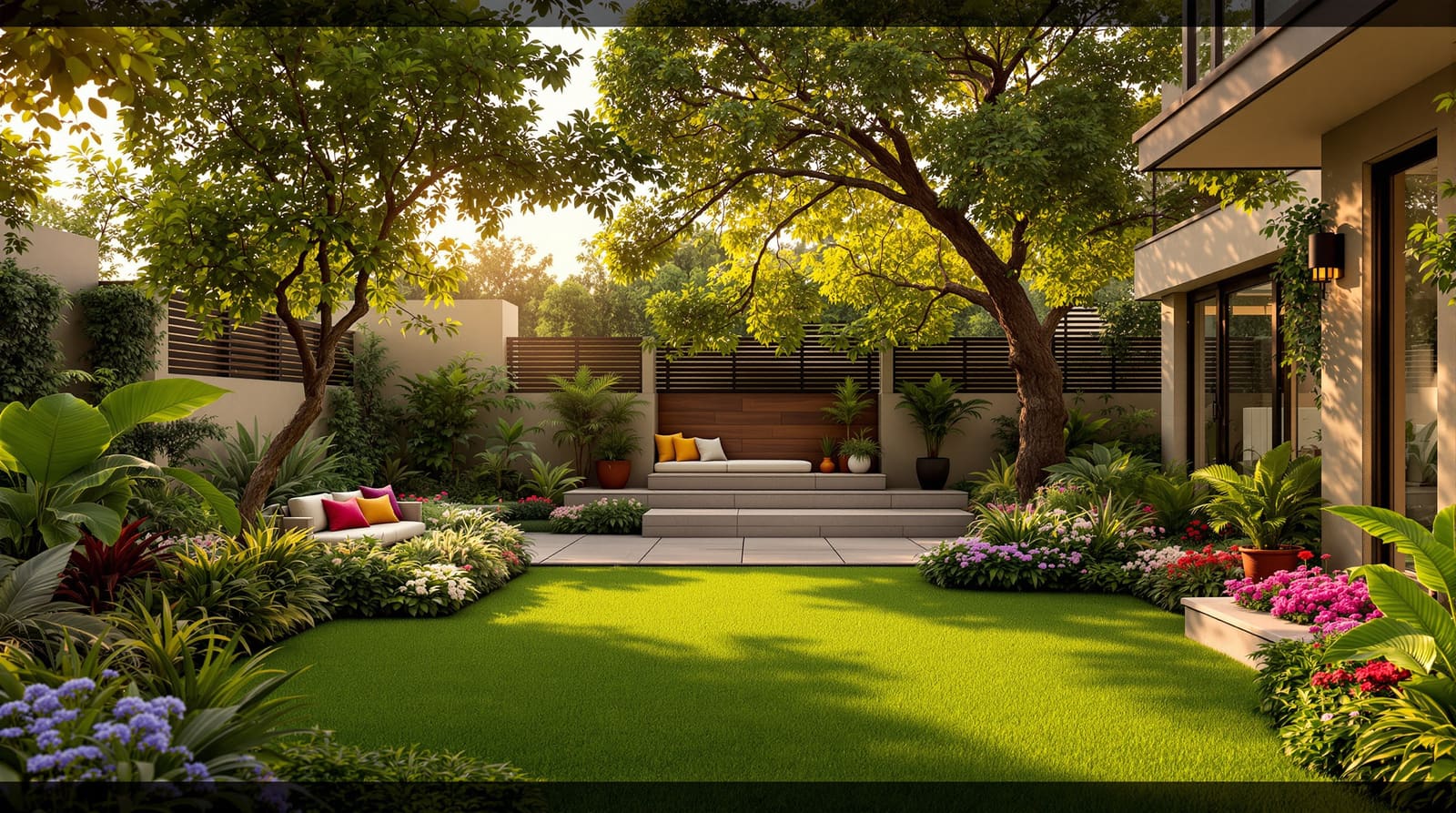
Digital Twins for Landscape Planning
A live, data-fed virtual model of your garden — how it differs from a 3D render, what it simulates (shade, sun, water, growth over years), the honest maturity, and the homeowner on-ramp
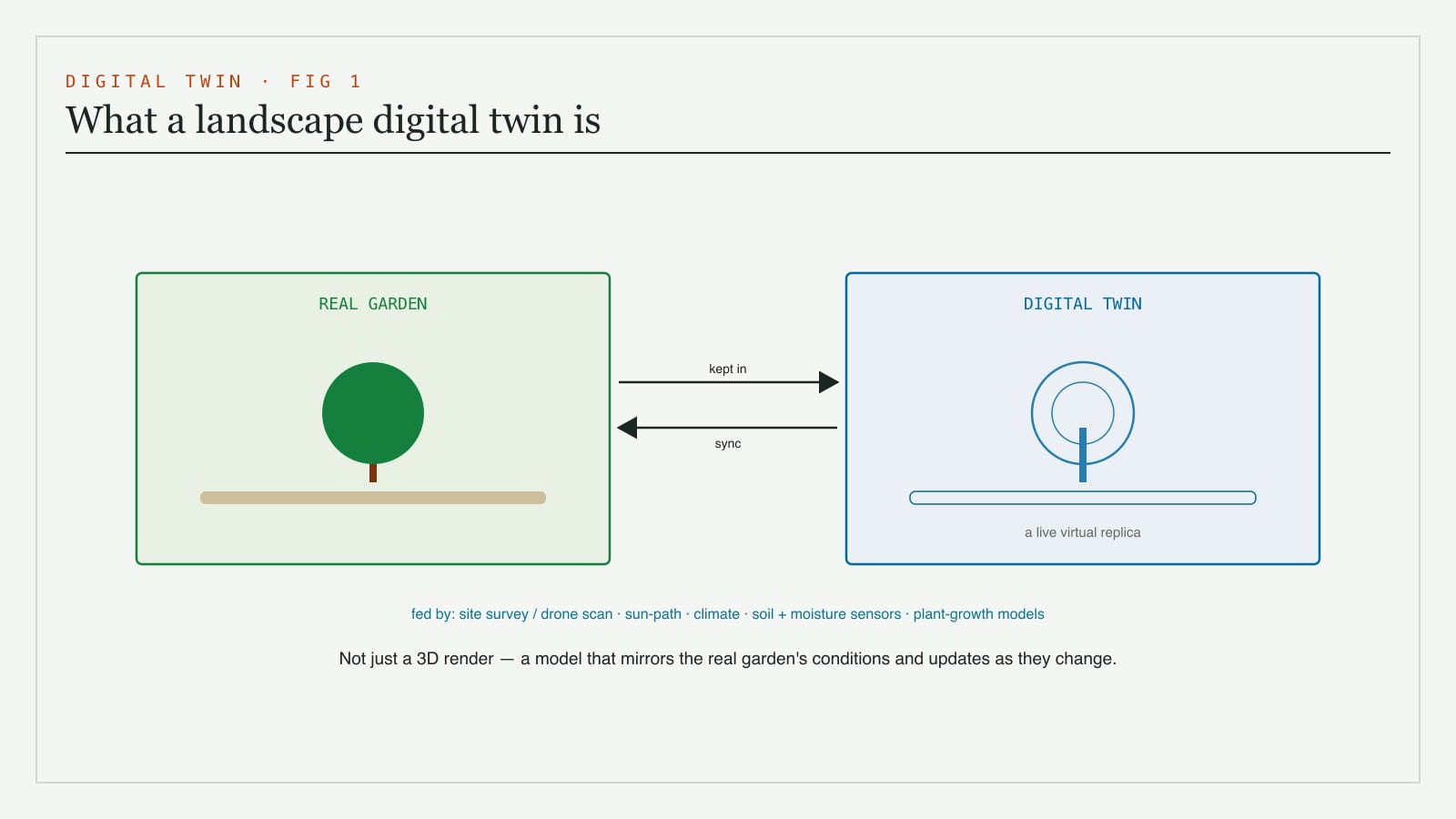
A landscape digital twin is a living, data-fed virtual copy of your actual garden — not a pretty render, but a 3D model wired to real measurements that grows, shades, drains and ages along with the real thing, so you can test a decision on the screen years before you pay for it in the soil.
The idea sounds futuristic, and for most Indian homes today the full version still is. But the underlying logic — plan with data, not guesswork — is already reaching homeowners through sun-path apps, growth simulators and AI visualisation. This guide explains what a digital twin actually is, what feeds it, what you can decide with it, and — honestly — how much of it you can use right now in an Indian garden.
This is the smart, data side of running a landscape. If you want the creative side — generating layouts, matching plants to your climate, visualising a redesign — that lives in AI in Landscape Design. For where the whole field is heading over the next decade, see Future of Landscape Architecture. This guide stays narrowly in one lane: using a twin to plan and manage a garden over time.
What a digital twin actually is (in plain terms)
A digital twin is a virtual replica of a specific real object — here, your garden — that mirrors its real conditions through data and updates as those conditions change. The term comes from aerospace and manufacturing, where engineers run a live model of a physical engine alongside the real one to predict wear and failure. Applied to landscape, it means a 3D model of your plot that knows your true levels, your sun angles, your soil, your rainfall — and can therefore simulate the future rather than just depict the present.
The key word is live. A static 3D model is a snapshot — accurate the day it was built, frozen thereafter. An AI render is a single beautiful image generated from a prompt or photo. A twin is neither: it is a model bound to data sources, so it can answer questions like "where will shade fall in December three years from now?" instead of merely showing you a scene.
Twin vs static model vs AI render
| Property | AI render | Static 3D model | Digital twin |
|---|---|---|---|
| What it is | One generated image | A frozen 3D scene | Live model bound to real data |
| Based on your real site? | Loosely (a photo/prompt) | Yes, if surveyed | Yes — measured + sensed |
| Changes over time? | No | No | Yes — tracks reality |
| Can simulate the future? | No | Only manual edits | Yes — growth, sun, water |
| Effort & cost | Minutes, very low | Days, moderate | Weeks+, high (today) |
| Who uses it in India now | Homeowners, designers | Architects, contractors | Institutions, large projects |
The honest takeaway: an AI render answers "what could it look like?", a static model answers "how does it fit?", and a true twin answers "what will happen if?" — the last being the hardest and most valuable.
What feeds a digital twin
A twin is only as good as the data flowing into it. Four families of input matter.
- Geometry — the shape of your plot. This is the foundation. At the high end it comes from a drone survey or photogrammetry (many overlapping photos stitched into a 3D point cloud), or a laser scan. For a homeowner, a measured site survey, your sanctioned site plan and phone-based photogrammetry apps get you a usable approximation. Accurate levels matter most for anything involving water.
- Sun and climate data. Sun-path geometry is pure astronomy — for your exact latitude and longitude the model can compute the sun's angle and the shadow it casts on any date and hour, for free and forever. Layered on top: long-run climate normals (rainfall, temperature, humidity) from public records, and increasingly live weather feeds.
- Soil and moisture sensors. This is what makes a twin "live" rather than merely calculated. Inexpensive soil-moisture probes, a small weather station, or a tank-level sensor feed real readings back into the model. In an Indian context this also means tracking borewell yield, municipal supply timing and monsoon behaviour — the variables that actually govern a garden here.
- Plant growth models. Each plant has a known growth habit — mature height, canopy spread, root behaviour, growth rate, water demand. A twin attaches these to the plants you place, so the model can age your garden forward. The catch: published growth data is mostly Western; Indian species (and Indian growing conditions, which are faster and harsher) are less standardised, so growth simulation here is more approximate.
The first two inputs are cheap and largely available to any homeowner. The third and fourth are where cost, effort and honest data gaps appear.
What you can simulate — and the decision it informs
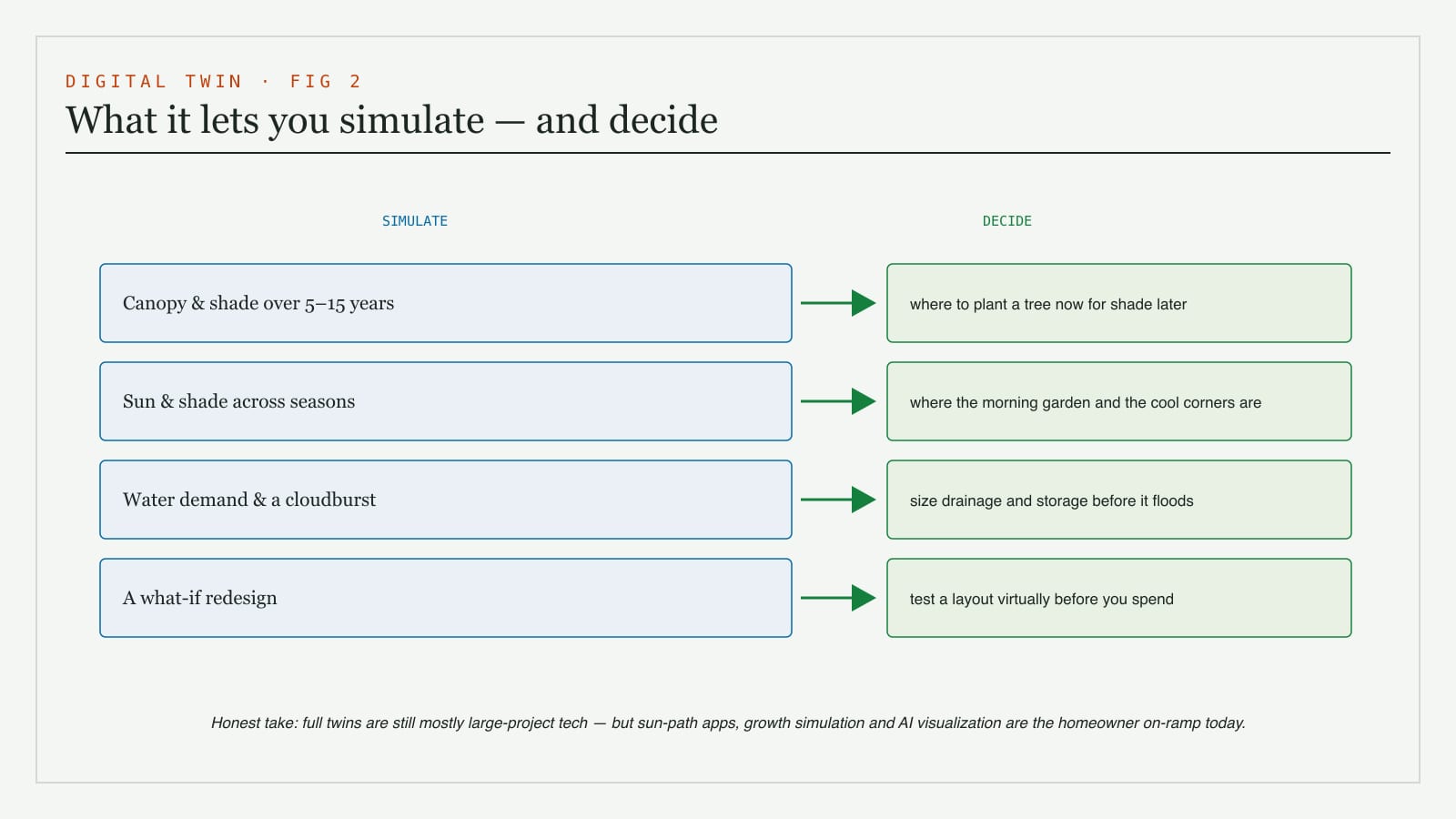
The value of a twin is not the model; it is the decisions you make differently because of it. Here is what is genuinely simulable and what each simulation lets you decide.
| You can simulate | The decision it informs |
|---|---|
| A tree's canopy and shade at 5 / 10 / 15 years | Where to plant so shade lands on the right wall — and not on the solar panel, the kitchen garden, or the neighbour's plot |
| Sun and shade hour-by-hour across seasons | Where to put the seating, the lawn, the pots that need full sun vs shade |
| Rainwater flow and ponding in a cloudburst | Where to slope paving, place drains, and site a recharge pit before the first monsoon floods a corner |
| Water demand of a planting scheme over a year | Whether your borewell/tank can sustain it; where to hydrozone (see the water guide) |
| A what-if redesign (move the tree, widen the path) | Compare options on screen at zero cost before excavation |
| Maintenance load and cost as plants mature | Whether a low-maintenance palette is worth the higher upfront spend |
Two of these deserve emphasis for Indian conditions. Shade-over-time is the single most under-planned decision in Indian gardens: a sapling that looks charming today becomes, in eight years, a tree that darkens the whole house or undermines a compound wall. A twin lets you see that future and place the tree deliberately. Cloudburst drainage is the second: Indian monsoon rain arrives in violent bursts, and ponding kills plants and damages foundations. Simulating where water goes — before you lay paving — prevents an expensive mistake.
The honest maturity: who can actually use this in India today
This is where hype must be separated from reality. A complete, sensor-fed, self-updating landscape digital twin is, in India today, largely an institutional and large-project tool. It appears in smart-city parks, large campuses, golf courses, resorts and premium villa developments — places that can justify a drone survey, a sensor network and a specialist to maintain the model. For an ordinary home garden, the full version is overkill and unaffordable.
But the useful pieces are already in homeowner hands, and they form a sensible ladder:
- Sun-path tools (available now, free or near-free). Apps and online calculators show shadow patterns for your exact location and date. This is real twin-thinking you can use this week — no model required.
- Simple growth simulation (emerging). Some design apps now age a planting plan forward to show approximate mature size. Treat the numbers as indicative, not precise — especially for Indian species.
- AI visualisation as a stepping stone (available now). Generating a realistic image of a proposed garden is not a twin, but it is the most accessible rung on the ladder: it makes the idea concrete and surfaces obvious problems early. This is exactly what AI in Landscape Design covers.
- Sensor-light "smart garden" setups (emerging, affordable). A soil-moisture probe driving drip irrigation is a tiny, practical slice of the twin idea — real data changing real behaviour. The full picture is in Smart Gardens Explained.
A realistic homeowner workflow in 2026 is not "commission a digital twin." It is: get an accurate measured plan, run a free sun-path check for the worst months, use AI visualisation to test the look, and add a moisture sensor once planting is in. That is twin-thinking at a homeowner's budget — and it captures most of the value.
Where Studio Matrx DesignAI-style tools fit
Studio Matrx's DesignAI sits on the accessible rungs of this ladder. It is a visualisation and decision-support tool — generating and comparing layouts, helping you see a redesign before committing — not a sensor-fed engineering twin. Think of it as the on-ramp: it makes the "what could this look like?" and "which option do I prefer?" questions cheap to answer, which is precisely where most homeowners lose money to guesswork. As growth and climate data improve, these tools move further along the path from render towards twin — but they are honest about being a design aid, not a live replica of your soil.
The data and effort cost
Nothing here is free in effort even when it is free in rupees.
- Sun-path and climate: effectively free. Public latitude/longitude astronomy and open climate normals. The cost is an hour of your attention.
- Geometry: a measured survey or a sanctioned plan you likely already have. A phone photogrammetry scan costs nothing but patience. A professional drone survey runs into tens of thousands of rupees and is only worth it on a large or sloping plot.
- Sensors: a basic soil-moisture sensor and controller is modest in cost, but the real cost is upkeep — Indian dust, voltage spikes and monsoon humidity are hard on cheap electronics, so budget for replacement and surge protection.
- The model and its maintenance: this is the hidden cost of a true twin. A model that is not kept in sync with reality quietly becomes a static model again. For a homeowner this maintenance burden is usually not worth it; for a managed estate it is the whole point.
The principle: spend on the inputs that change your decisions (levels, sun, water) and skip the ones that merely look impressive.
The trajectory
The direction of travel is clear and grounded, not sci-fi. Three things are converging: sun and climate data are already free and exact; survey is getting cheaper as phone photogrammetry improves; and AI visualisation is collapsing the cost of seeing an option. The missing piece for India is reliable local plant-growth and soil data — and that is improving slowly. Over the next several years, expect the homeowner experience to shift from "a render" towards "a model that quietly ages your garden forward and warns you about shade and drainage" — a light, affordable twin, not a research instrument. The full sensor-fed twin will stay in the institutional and high-end tier for a while yet.
For most Indian homeowners, the right move is not to wait for the technology to arrive whole. It is to start using the parts that already work — sun-path, accurate levels, AI visualisation, a single moisture sensor — and let the rest mature around you.
References & further reading
- Bureau of Indian Standards, IS 2470 (Code of practice for installation of septic tanks) and related site-drainage codes — for grounding any water-flow and drainage planning in Indian practice.
- Indian Council of Agricultural Research (ICAR) and ICAR–Indian Institute of Horticultural Research (IIHR), Bengaluru — horticultural references for plant growth habit and water demand of Indian species.
- India Meteorological Department (IMD), Climatological Normals — public rainfall, temperature and humidity records for site-specific climate inputs.
- Bureau of Energy Efficiency (BEE), ECBC and passive-design guidance — for the solar-geometry and shading principles underlying sun-path analysis.
- National Building Code of India (NBC 2016), Part on building services and site planning — for surface water disposal and site-level rainwater management standards.
- Grieves, M. & Vickers, J., "Digital Twin: Mitigating Unpredictable, Undesirable Emergent Behavior in Complex Systems" (2017) — the foundational definition of the digital-twin concept, for the underlying theory.
Export this guide
Related Guides — Deep-dive reading
Digital Twins in Residential Design: A Living Model of Your Home
What a digital twin really is, and how a data-connected model of your house could help you design, build and run it
Future-Ready HomesAI in Landscape Design: How Technology Is Reshaping the Garden
An honest field guide for the Indian homeowner — what AI does brilliantly for your garden, where it quietly fails, and how to use it before you hire a pro
LandscapeThe Homeowner's Guide to Compound Walls and Gates in India (2026)
A plain-language, start-to-finish walkthrough of building a boundary wall and gate in India — plan and permit first, then material and height, foundation and structure, building and supervision, the gate, finishes, lighting and greenery, budget and long-term upkeep — with a stage-by-stage roadmap, a full planning checklist and answers to the questions every homeowner asks.
Compound WallsRelated Tools — Try Free
Landscape Cost Calculator
Estimate a garden's cost — hardscape, softscape, lawn, irrigation, lighting and annual upkeep — by area, tier and city.
Budget CalculatorCross-Ventilation Analyzer
Estimate airflow and air changes per hour (ACH) from room size, window areas, layout, and local wind — with NBC 2016 Part 8 compliance check.
Ventilation CalculatorBrise-Soleil Visualizer
Interactive horizontal-louvre cut-off angle calculator — sun altitude, louvre depth, and spacing inputs with a live shadow preview. Computes θ = arctan(spacing/depth) for façade shading, ECBC envelope compliance, hospital daylight design, and tropical sun-control detailing.
Sun Shading Tool