
Bathroom Mirror India: Plain vs LED vs Backlit vs Smart, Size, Height & Cost (2026)
The complete India-first guide to bathroom mirrors — plain, LED, backlit, smart, anti-fog and magnifying types; the right size and mounting height over a basin; copper-free silvered glass that resists black-edge corrosion in humid bathrooms; fixing to tile, lighting a mirror the right way, demister pads and rupee costs.
The mirror is the one fitting in a bathroom that every person uses every single day, up close, in good light or bad. It is also the fitting most often bought last, cheapest, and wrong — a plain glass rectangle grabbed off a hardware shelf, hung too high, lit from a single point above so your own face throws shadows over itself. A mirror is not a decoration you bolt on at the end; it is a piece of equipment for seeing yourself clearly, and in an Indian bathroom it has to do that while surviving years of monsoon humidity, health-faucet spray and hard-water splash without rotting at the edges. Get three things right — the type, the size and mounting height, and the light — and an ordinary bathroom starts to feel considered.
This guide is India-first. It assumes a room that stays humid for hours after a hot shower, hard water that films glass white, load-shedding that a battery-free mirror should not care about, and a mason who will drill straight through your waterproofing if you let him. It sits under the bathroom design guide for India, which frames the whole room. Once you have settled on a type, the dedicated deep-dives go further: LED bathroom mirrors, smart bathroom mirrors, anti-fog mirrors, magnifying mirrors and how to light a bathroom mirror properly.
A mirror is chosen in three moves — type, size-and-height, and light. The glass is the easy part; the light and the height are what decide whether you can actually see your face.
The six types of bathroom mirror
Every mirror on the market is a variation on six ideas. Pick the type first — it sets the price band and the wiring you need — then worry about shape and frame.
- Plain (silvered) mirror — a sheet of float glass with a reflective silver coat and a protective back, framed or frameless. Cheapest, needs no power, lasts decades if the edges are sealed and the back kept dry. The workhorse; the only real risk is edge corrosion (below).
- LED mirror (front-lit) — a plain mirror with LED strips built behind a frosted band etched into the front face, so light shines through the glass from the sides or top. Even, shadow-free light on your face. Needs a 230V feed behind the mirror.
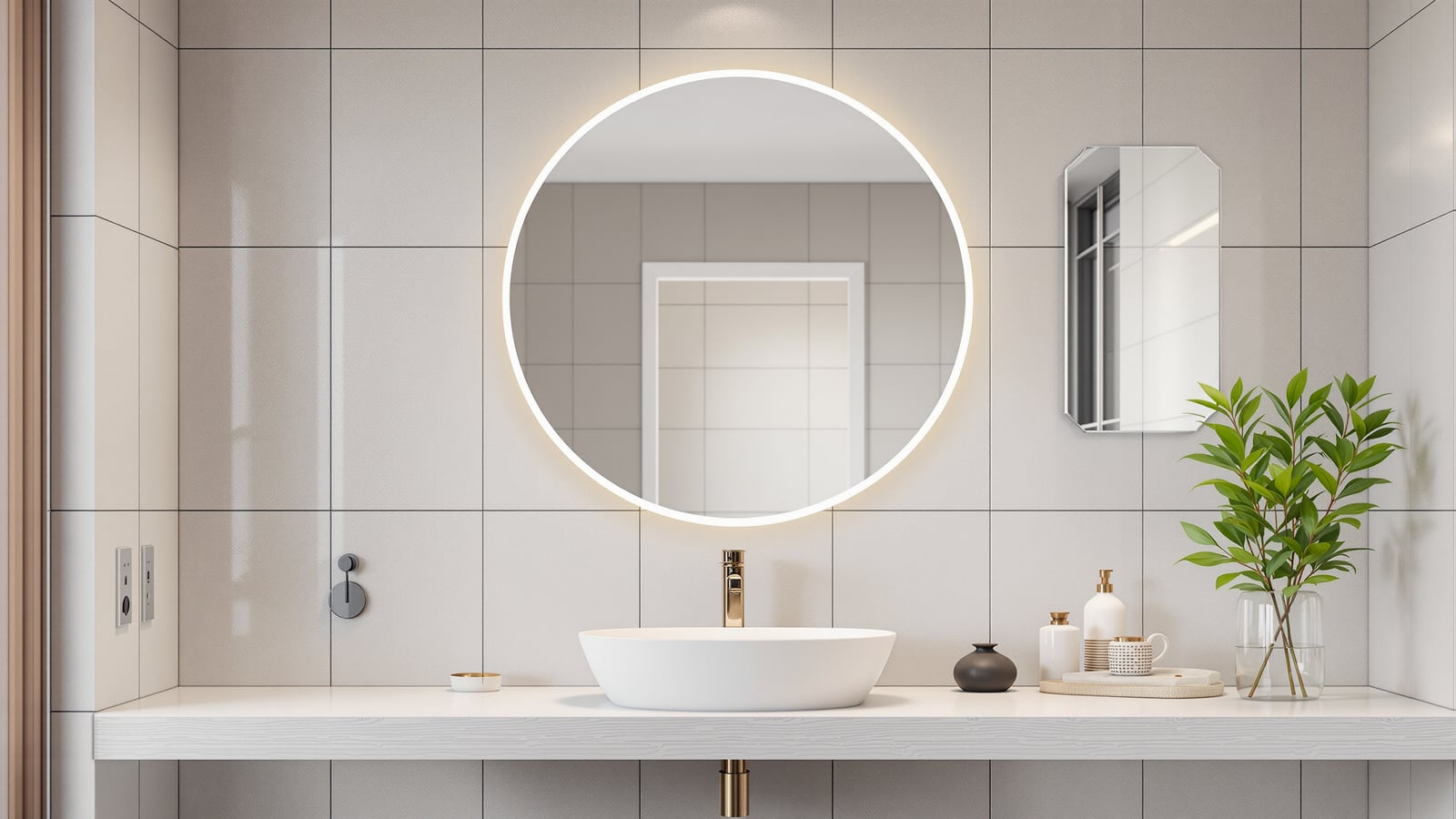
- Backlit mirror — LEDs sit behind the mirror around its perimeter and wash the wall, giving a floating "halo" glow. Beautiful ambience, but the light bounces off the wall rather than lighting your face, so it is a mood layer, not a task light — pair it with front light.
- Smart mirror — an LED mirror with extras: a demister pad, motion or touch sensor, colour-temperature switching (warm to cool white), a clock/Bluetooth/anti-fog display, sometimes a small screen. Convenience at a price; more electronics to fail in a wet room.
- Anti-fog mirror — carries a demister heating pad bonded to the back that warms the glass above dew point so it never mists over after a shower. Sold as a standalone feature or built into LED/smart mirrors. Detailed in the anti-fog mirror guide.
- Magnifying mirror — a small 3x–10x concave mirror, wall-arm or inset, for shaving, brows and lenses. Always a second mirror beside or within the main one; covered in the magnifying mirror guide.
Which type for which bathroom
| Type | Power needed | Lights your face? | Indicative cost (₹) | Best for |
|---|---|---|---|---|
| Plain silvered | None | No (relies on room light) | 800 – 6,000 | Budget, guest, utility baths |
| LED front-lit | 230V | Yes — even, shadow-free | 6,000 – 25,000 | Any daily-use vanity |
| Backlit (halo) | 230V | No — ambience only | 7,000 – 22,000 | Feature walls, add to front light |
| Smart (demist + sensor) | 230V | Yes | 15,000 – 60,000+ | Master baths, tech-led homes |
| Anti-fog (demister) | 230V (12–40W pad) | Depends on model | +2,000 – 6,000 add-on | Shower-adjacent, high-humidity |
| Magnifying (3x–10x) | Usually none | N/A (task) | 900 – 8,000 | Shaving, make-up, alongside main |
The one that actually matters in India: copper-free silvered glass
Here is the failure you will see in nine out of ten old Indian bathrooms — a black, cloudy stain creeping in from the edges and screw holes of the mirror. That is not dirt; it is the silver reflective layer oxidising. Traditional mirrors are made by silvering, then protecting the silver with a copper layer and paint. In a humid, splash-prone bathroom, moisture wicks under the backing at any cut edge or drilled hole and attacks the copper first, which corrodes and lifts the silver — the classic "black edge" or desilvering.
The fix is glass made to a corrosion-resistant spec:
- Copper-free silvered mirror — the silver is protected by copper-free, low-lead paint layers instead of copper. With no copper to corrode, black-edge desilvering is dramatically slower. This is the single most important thing to specify for an Indian bathroom, and good LED/smart mirrors already use it.
- Look for the standard — quality safety-and-silvering mirror is made to EN 1036 (silvered glass mirrors for internal use) and IS 3438 (silvered glass mirrors in India). Ask the supplier for a copper-free, "CE"/EN-1036-grade product with a warranty against desilvering (5–15 years is common on good glass).
- Seal every cut edge and hole. Even copper-free glass corrodes faster if raw edges sit wet. Insist on polished/beveled sealed edges, keep the mirror off direct splash, and never drill a plain mirror on site without re-sealing the hole.
- Ventilate. An exhaust fan or window that clears humidity fast (see the bathroom design guide) protects the mirror as much as it protects the ceiling and paint.
Size and mounting height — the geometry of a good mirror
Most mirror regret is really height and size regret. Two rules solve it.
Width. A vanity mirror should be as wide as the basin or vanity, or a little narrower — never wider than the counter. A single mirror centred on the basin, roughly the basin's width, reads clean. Over a double vanity, either one long mirror spanning both basins or two mirrors, one centred on each.
Height and position. The usable part of the mirror must bracket eye level for the range of people using it. Practical Indian numbers:
- Bottom edge of the mirror: 100–150 mm above the basin rim or backsplash — high enough to clear splashes and the tap, low enough that a shorter adult still sees their chest.
- Centre of the mirror at about 1550–1650 mm from the finished floor — this puts eye level (average adult eye height ~1500–1600 mm) in the middle third of the glass.
- Top edge: aim for 1900–2000 mm so tall members of the house see the top of their head. A taller mirror simply serves more heights at once, which is why full-height or 900–1100 mm-tall mirrors are popular.
- Magnifying mirror on an extending arm mounts to the side at roughly 1600 mm to the pivot, so it swings to the user rather than the user stooping to it.
| Dimension | Recommended (mm) | Note |
|---|---|---|
| Mirror width | = basin/vanity width (or slightly less) | Never wider than the counter |
| Bottom edge above basin rim | 100 – 150 | Clears splash and tap spout |
| Mirror centre from floor | 1550 – 1650 | Puts eye level mid-glass |
| Top edge from floor | 1900 – 2000 | Serves taller users |
| Mirror height (glass) | 700 – 1100 | Taller = more heights covered |
| Front light centre from floor | ~1650 – 1700 | At/above eye level, both sides |
Lighting a mirror properly — front vs backlit
This is where cheap bathrooms give themselves away. A single downlight or a strip above the mirror lights the top of your head and drops your eyes, nose and chin into shadow — the worst possible light for shaving or make-up. Good mirror light comes at the face from the front and the sides, at roughly eye level, so it fills the hollows instead of casting them.
- Front-lit / LED mirror is the easy win — the etched frosted band pushes even, near-shadowless light straight at your face. For a plain mirror, mount vertical lights on both sides at eye level (wall sconces or LED strips), or a light bar across the top plus side light. Two sources beat one.
- Backlit / halo light bounces off the wall behind the mirror. Gorgeous, floating, and great for night-time ambience or a nightlight — but it does not light your face. Treat it as a second layer over a front source, never the only light.
- Colour temperature: choose 3500–4000K (neutral white) for a bathroom — warm enough to be pleasant, cool enough to show true skin tone and let make-up match daylight. Smart mirrors that switch warm-to-cool let you have both.
- CRI 90+: insist on a high Colour Rendering Index so colours (skin, make-up, clothes) look true, not sallow.
The full method — layouts, lux levels and fittings — is in the bathroom mirror lighting guide.
Demister pads and anti-fog
A mirror fogs because warm, moist bathroom air hits cold glass and condenses. A demister pad — a thin heating film bonded to the back of the mirror — warms the glass a few degrees above dew point so vapour never condenses on it. It draws a small load (typically 12–40W, sized to the mirror), is wired to the light circuit or its own switch, and pays for itself the first winter morning you don't have to wipe the glass. Sprays and "anti-fog" coatings exist but wear off; a heated pad is the durable answer. Full detail in the anti-fog mirror guide.
Electrical safety and fixing to tile
A powered mirror is an electrical appliance in a wet room, so treat it like one.
- IP rating and zones. Any light or mirror near the basin should be rated for splash — IP44 minimum in the immediate vanity area. Follow NBC 2016 Part 8 and IS 732 for bathroom electrical zoning: no ordinary socket right beside the basin, and all circuits on a 30 mA RCD/RCCB. Have a licensed electrician terminate the mirror behind it in a proper connector, not a twisted joint.
- Rough-in before tiling. A hard-wired LED or smart mirror needs its 230V feed and a fused connection point in the wall behind where the mirror will sit — plan this at the plumbing/electrical stage, exactly like the basin height, or you will be chasing a wall later.
- Fixing to tile — drill, don't hammer. Mark the fixing holes, drill with a tile/ceramic bit at low speed with no hammer action (hammer mode cracks glaze and tiles), ideally through the grout line or with masking tape to stop the bit skating. Use wall plugs and non-corroding (stainless/brass) screws rated for the mirror's weight; big mirrors need fixings into the masonry behind, not just the tile.
- Protect the waterproofing. In wet-zone walls, drilling can pierce the waterproofing membrane — seal every drilled hole with a dab of sealant before inserting the plug so water can't track in behind the tile.
- Frameless mirror mounting uses either chrome clips, concealed J-channel, or mirror adhesive plus mechanical clips (never adhesive alone on a heavy mirror over a basin). Leave a 3–5 mm air gap and ventilation behind the glass so the back stays dry — trapped moisture is what kills the silvering.
A quick buying checklist
- Copper-free silvered glass to IS 3438 / EN 1036, with a written anti-desilvering warranty.
- Polished, sealed edges; correct size (basin width) and height (centre ~1600 mm).
- Front or side light at eye level, 3500–4000K, CRI 90+, IP44 — add backlit only as a second layer.
- Demister pad if the mirror faces the shower or you use it on cold mornings.
- Hard-wired feed roughed in behind the mirror; 30 mA RCD; licensed electrician.
- Fixed with tile bit (no hammer), stainless/brass screws, sealed holes, ventilated back.
References
- National Building Code of India (NBC) 2016, Part 8 (Building Services) — bathroom electrical layout, wet-area zoning and ventilation.
- IS 732 — Code of practice for electrical wiring installations; bathroom circuits, RCD/earthing.
- IS 3438 — Silvered glass mirrors (specification), including quality of silvering for internal use.
- EN 1036 — Glass in building: silvered mirrors for internal use (copper-free grade and desilvering resistance).
- IS 2835 / IS 14900 — Float glass and transparent float glass for glazing and mirror substrate quality.
- Bureau of Indian Standards (BIS) — for current editions of the above and product certification.
Export this guide
Related Guides — Deep-dive reading
LED Bathroom Mirror India: Backlit vs Front-Lit, Colour Temperature, Cost & The Point Behind the Glass
A practical India-first guide to LED and backlit bathroom mirrors — integrated shadow-free face lighting, 2700K-6500K colour temperature and tunable white, halo backlight versus sandblasted front strips, plus the concealed electrical point, IP rating, demister and driver access you must plan behind the mirror before you tile.
BathroomsBathroom Mirror Lighting India: Shadow-Free Vanity Light, Colour Temp, CRI & Cost (2026)
Why a single ceiling downlight throws ugly shadows on your face, how vertical sconces either side of the mirror beat a light bar above, when a backlit mirror is glow not task light, plus the colour temperature, CRI, mounting height, IP rating and 2026 rupee costs that actually get make-up and shaving right.
BathroomsSmart Bathroom Mirror India: Touch Display, Voice, Defogger, Cost & Is It Worth It
A practical India-first guide to smart bathroom mirrors — the embedded touch display showing time, weather and news, the Bluetooth speaker, voice assistant, mood-lighting scenes and defogger — plus the power and optional data point behind the glass, the IP and electrical safety it demands, how hard water and monsoon humidity decide whether it lasts, and whether it is really worth the money over a good LED mirror.
BathroomsRelated Tools — Try Free
Electrical Safety & Load Audit
Home electrical audit — 10 categories, 65+ checkpoints across earthing, RCCB, MCB, wiring, switchboards, appliance circuits, DG/inverter backup.
Safety AuditCross-Ventilation Analyzer
Estimate airflow and air changes per hour (ACH) from room size, window areas, layout, and local wind — with NBC 2016 Part 8 compliance check.
Ventilation CalculatorWindow Size Calculator
Get the right window size, glazing area and openable area for any room using NBC daylight rules.
Window Tool