
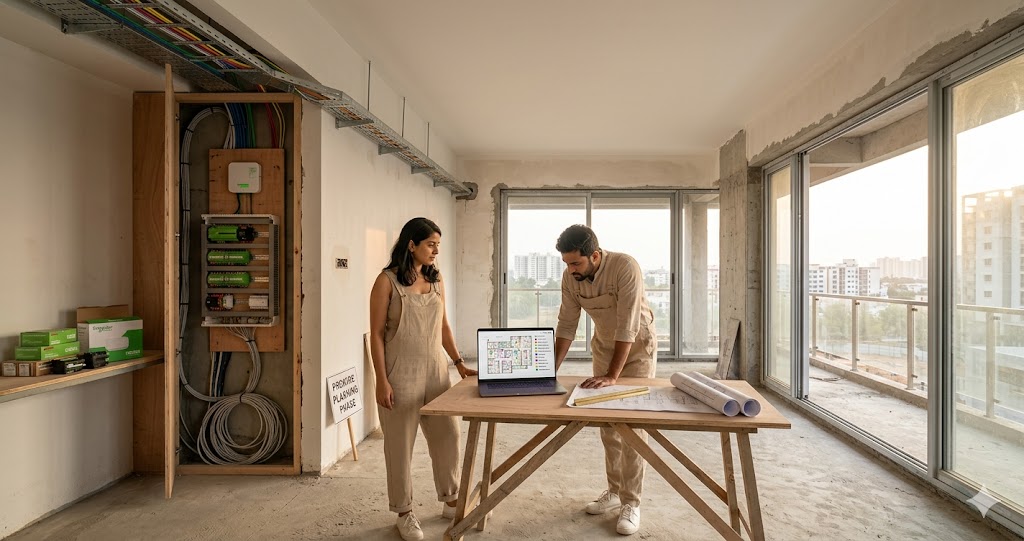
Smart Apartment Planning — Tech-Enabled Planning-Phase for Indian Apartments (2026)
Loxone / KNX / Crestron prewire · AI plan iteration · AR walkthrough · IoT topology at design stage
Smart apartment planning is the discipline of designing the technology spine of an apartment before the first wall is plastered — not after handover. In 2026 India, the readers Googling this query are not asking which Alexa to buy; they are asking how to make sure their 1,400–2,400 sqft 3 BHK or 4 BHK is wired, sensored, and digitally modelled so it can absorb a decade of smart-home, AI, and AR layers without surgery.
The query sits at an interesting overlap. It is not the same as general apartment layout planning (which is about bedroom adjacencies, kitchen triangles, and storage). It is not the same as a smart-home retrofit (which is what you do after handover, painfully). Smart apartment planning is the tech-aware planning phase — the moment when conduits, structured cabling, AV closets, sensor positions, and digital twins are baked into the drawings the architect signs off on.
"You can install a smart switch in a week. You cannot reroute a Cat6A trunk through a finished gypsum ceiling without ripping it open. The decisions that matter are the ones made before the contractor pours the screed."
For the broader layout discipline see our apartment interior planning India guide; for the post-handover smart-home subsystem see smart home design India; for AI-aided plan iteration see the AI floor plan generator and AI room planner references; for the zoning logic underneath both see space zoning Indian homes.
This guide refreshes every 12 months. Last verified: May 2026 · Next verify: May 2027.
What Smart Apartment Planning Actually Means in 2026 India
Smart apartment planning, in the way Indian architects and integrators use the term in 2026, refers to the planning-phase integration of three technology layers into an apartment design, all before structural finalisation:
1. The physical infrastructure layer — structured cabling (Cat6A/Cat7), fibre risers, conduit topology, a dedicated AV/IT closet of roughly 6–10 sqft, dedicated 20 A circuits for high-draw smart loads, PoE+ runs to camera and access-point positions, and the routing of HVAC and water lines so leak sensors and zone valves are reachable.
2. The automation subsystem layer — selection at planning stage of a backbone protocol (Loxone Tree, KNX TP1, BACnet/IP for higher-end builds, Zigbee 3.0 / Matter-over-Thread for retrofit-friendly subsets) plus controller placement, gateway provisioning, and a documented IP plan that the electrician and the AV vendor both work to.
3. The digital-design layer — the use of AI-aided floor-plan iteration and AR walkthrough before the design contract is signed off, so the client can actually walk through the apartment, test sightlines, check whether the sofa in the living room blocks the view of the TV, and confirm the kitchen triangle works — all on a phone or VR headset, with the architect iterating in hours instead of weeks.
A 2025 Knight Frank India tech-and-real-estate note flagged smart-home spend in premium Bengaluru and Mumbai apartments rising from 1.8 percent to 4.2 percent of fit-out budgets between 2022 and 2025, with most of the cost overrun attributed to retrofitting infrastructure that should have been planned in. That is the gap this guide is about.
Five things smart apartment planning is NOT:
- It is not buying smart bulbs and plug-in motion sensors after moving in. That is consumer-IoT retrofit. It works, but it caps you at a shallow automation depth.
- It is not the same as the apartment's general interior planning — the layout, zoning, and storage discipline covered in apartment interior planning India. Smart planning sits on top of that, not instead of it.
- It is not a synonym for "luxury apartment". A 1,150 sqft 2 BHK in a Pune project can be smart-planned at the structured-cabling level for under ₹1.8 lakh, well below the cost of a single Boffi tap.
- It is not the same as the smart-home design discipline (smart home design India), which is about subsystem choice (lighting, climate, security, AV) and assumes infrastructure already exists. Smart planning is the upstream activity that makes smart-home design feasible.
- It is not a builder add-on. Brigade, Prestige, Lodha, and Oberoi offer "smart home ready" SKUs, but in practice these are conduit-only — the protocol, controller, and AV closet still need to be specified by the owner's designer.
In short: smart apartment planning is the tech-aware planning phase, executed before the architect locks RCC and MEP drawings, that future-proofs the apartment for a decade.
Why Smart Apartment Planning Matters Now
Three forces have made this discipline mainstream in Indian metros between 2023 and 2026.
First, the cost curve flipped. A KNX TP1 backbone in 2018 cost roughly ₹6.5 lakh for a 3 BHK fit-out, putting it firmly in luxury territory. By Q1 2026, the same KNX backbone using Schneider Wiser KNX, Gira E2, or ABB i-bus components lands at ₹2.4–2.9 lakh, and Loxone Tree-based systems start at ₹1.6 lakh. Add Matter-over-Thread for the consumer layer and a 3 BHK can be fully smart-planned for under 5 percent of the fit-out budget — within reach of any premium-tier buyer.
Second, AI-aided design tooling reached production quality. Generative floor plans, AR walkthrough on iOS LiDAR phones, and voice-intake briefs (the Studio Matrx AI onboarding flow, for instance, takes a 10-minute spoken brief and returns a structured programme document with adjacency diagrams) have collapsed the cost of running two or three plan iterations before the design contract is signed. Anarock Consumer Sentiment Survey H2 2025 reported that 38 percent of premium-segment buyers in NCR and Bengaluru asked for an AR walkthrough before committing to a fit-out designer, up from 9 percent in H2 2023.
Third, the regulatory layer matured. The DPDP Act 2023 came into operational force in late 2024, which means any IoT subsystem inside an apartment that processes personal data (camera feeds, voice transcripts, biometric door locks) now has data-residency and consent obligations. Planning the data architecture — local processing where possible, named data fiduciary for cloud loads, segmented IoT VLAN — is now a design-phase concern, not an IT afterthought.
The buyer segment driving this is fairly precise: 32–48 year olds, household income ₹40 lakh+ per annum, buying or fitting out 1,400–2,800 sqft apartments in Bengaluru (Whitefield, Sarjapur, Hebbal), Mumbai (Powai, BKC-adjacent, Lower Parel), NCR (Golf Course Extension, Sector 150 Noida, Dwarka Expressway), Pune (Kharadi, Baner-Balewadi), and Chennai (OMR, ECR). JLL India's H2 2025 Residential Market Update sized this premium-and-above segment at roughly 78,000 units annual absorption across the top 7 metros — a serious market for a discipline that did not have a name three years ago.
The Nine Defining Characteristics
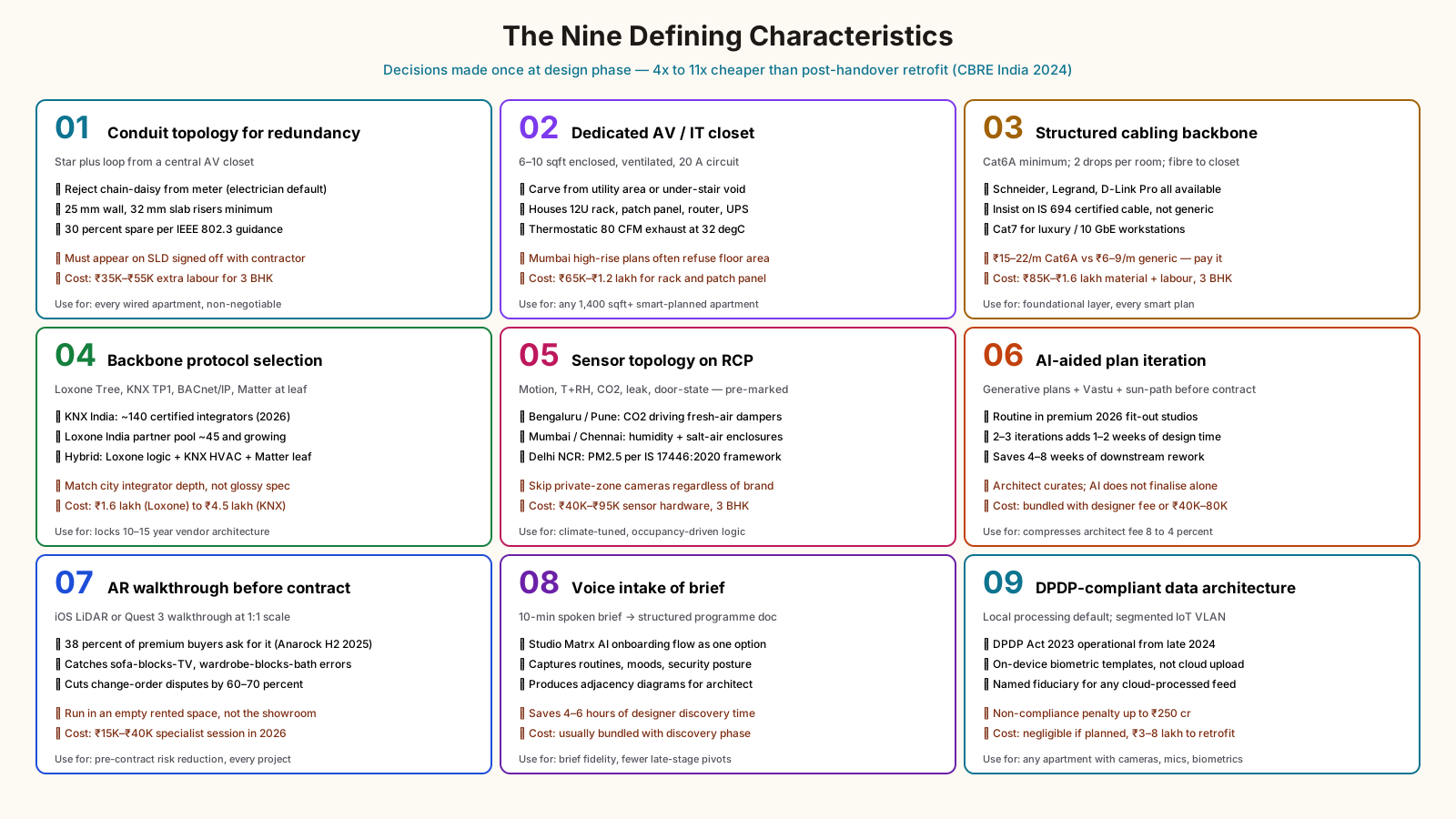
| # | Characteristic | What it means | India-specific note | Typical cost or constraint |
|---|---|---|---|---|
| 1 | Conduit topology designed for redundancy | Star plus loop conduit runs from a central AV closet, not chain-daisy from the meter | Indian electricians default to chain wiring; insist on star topology in the SLD signed off with the contractor | ₹35K–₹55K extra labour for 3 BHK |
| 2 | Dedicated AV/IT closet | 6–10 sqft enclosed space with 20 A circuit, ventilation, and Cat6A patch panel | Carve from utility area or under-stair void; Mumbai high-rise plans often refuse to give floor area for this — push back at planning stage | 6–10 sqft floor area + ₹65K–₹1.2 lakh for rack and patch panel |
| 3 | Structured cabling backbone | Cat6A minimum (Cat7 in luxury); 2 drops per room; fibre to AV closet from common riser | Schneider, Legrand, D-Link Pro all available; ensure UL/IS 694 certified cable, not generic | ₹85K–₹1.6 lakh for 3 BHK material + labour |
| 4 | Backbone protocol selection | Loxone Tree, KNX TP1, BACnet/IP, or hybrid with Matter-over-Thread at the leaf | KNX requires India-certified integrator (KNX India lists ~140 in 2026); Loxone partner network is smaller but growing | ₹1.6 lakh (Loxone) to ₹4.5 lakh (KNX premium) for backbone gear |
| 5 | Sensor topology planned at design phase | Motion, climate (T+RH), CO2, water-leak, door-state sensors marked on RCP | Bengaluru and Pune apartments benefit from CO2 sensors driving fresh-air dampers; Mumbai apartments benefit from humidity sensors driving dehumidification | ₹40K–₹95K for sensor hardware in 3 BHK |
| 6 | AI-aided plan iteration | Use generative plan tools and AR walkthrough before architect contract sign-off | Tools like the AI floor plan generator and AI room planner flows are now routine in premium fit-out studios | 2-3 iterations adds 1-2 weeks but saves 4-8 weeks of rework |
| 7 | AR walkthrough before contract | iOS LiDAR or Quest-based walkthrough of the proposed plan at 1:1 scale | Sets client expectations early; reduces change-order disputes that average ₹2.8 lakh per 3 BHK fit-out per Houzz India 2024 data | ₹15K–₹40K for a one-off AR session via specialist studios |
| 8 | Voice intake of brief | Spoken intake captured and structured into a programme document | Studio Matrx AI onboarding is one option; also offered by some design studios as part of discovery | Usually bundled; saves 4-6 hours of designer time |
| 9 | DPDP-compliant data architecture | Camera, mic, biometric data processed locally where possible; cloud loads have named fiduciary | DPDP Act 2023 operational from late 2024; non-compliance penalty up to ₹250 cr | Negligible incremental cost if planned; ₹3-8 lakh remediation if not |
The taxonomy matters because each row is a decision the architect and integrator make once — and the cost of revisiting any of them after the screed is poured is between 4x and 11x the planning-phase cost, per a 2024 CBRE India fit-out cost study.
A Worked Example: 1,800 sqft Brigade Cornerstone 3 BHK, Whitefield Bengaluru
Consider an actual representative project — a 1,800 sqft 3 BHK in Brigade Cornerstone Utopia, Whitefield, taken at bare-shell handover in March 2025, fit-out completed September 2025, smart layer commissioned by November 2025. The owner is a 39-year-old product-engineering leader, household ₹1.1 cr per annum, family of four. The brief was "future-proof for 10 years, no visible tech, must work when the broadband is down."
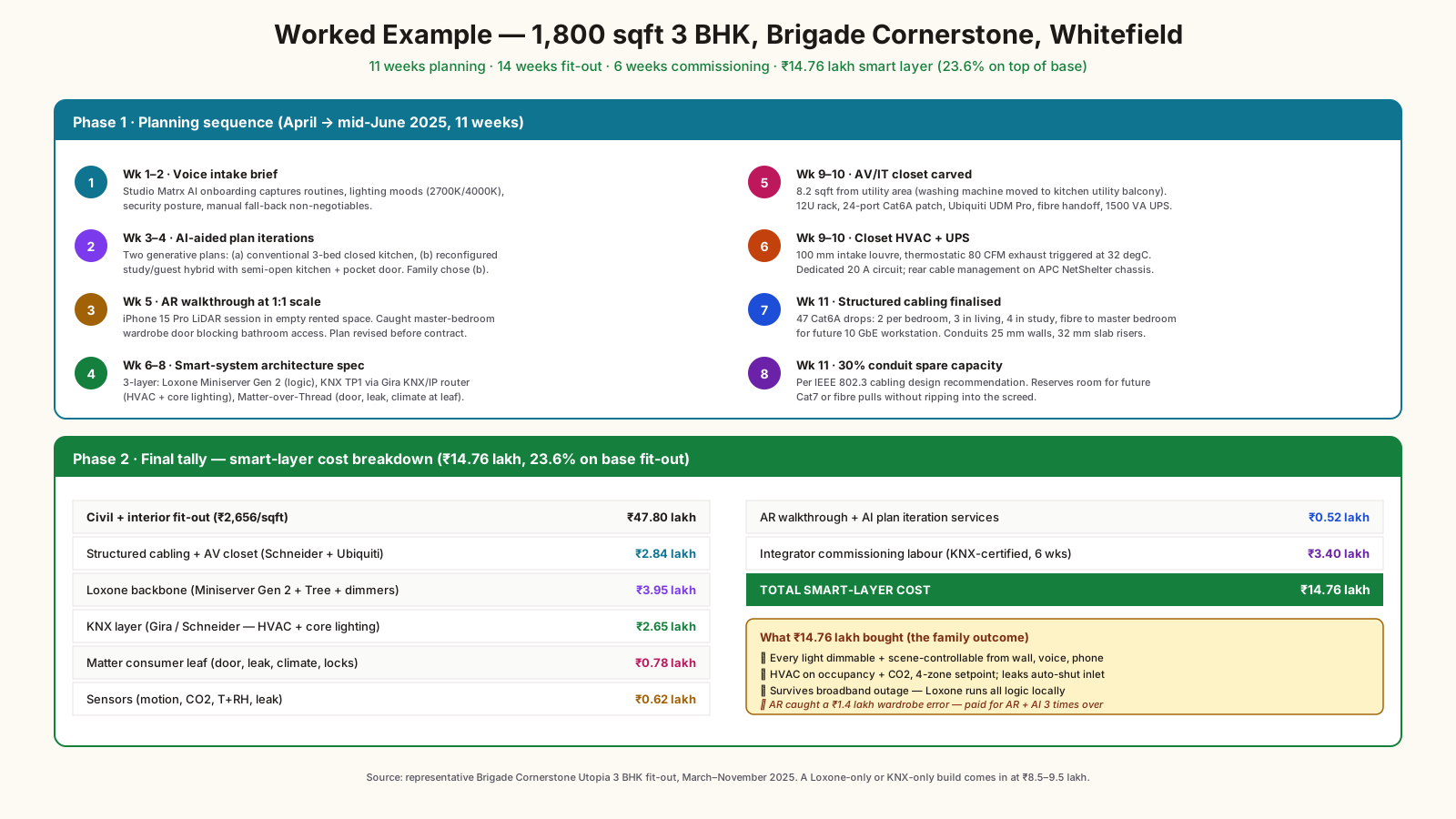
The planning phase ran 11 weeks, from April through mid-June 2025, and used the following sequence:
Week 1–2: The designer ran a voice-intake brief via Studio Matrx AI onboarding, capturing the family's daily routines, preferred lighting moods (warm 2700K in evening living, 4000K in morning kitchen), security posture (no always-on cameras inside private zones), and a non-negotiable that the master bedroom must have manual fall-back for every automated function.
Week 3–4: Two AI-aided plan iterations were generated using the kind of approach described in our AI floor plan generator reference, exploring (a) a conventional 3-bedroom plan with a closed kitchen and (b) a reconfigured plan with the second bedroom converted to a study/guest hybrid and a semi-open kitchen with a pocket door. The family chose option (b).
Week 5: An AR walkthrough at 1:1 scale was run on an iPhone 15 Pro with LiDAR using a third-party studio; the family walked the plan in an empty rented space and discovered the master-bedroom wardrobe door would block access to the bathroom. The plan was revised before contract.
Week 6–8: The smart-system architecture was specified in parallel with the architectural finalisation. Loxone Miniserver Gen 2 was chosen as the backbone (₹1.62 lakh material), with Loxone Tree extensions for in-room I/O. KNX TP1 was layered for the HVAC and lighting load only, via a Gira KNX/IP router (₹78K), because the family wanted to retain the option of switching shading and HVAC vendors without ripping out the backbone. Matter-over-Thread was specified for the consumer leaf — door sensors, Aqara water-leak sensors, Eve climate sensors — giving a 3-layer architecture: Loxone for logic, KNX for high-reliability loads, Matter for consumer-IoT retrofit-friendly devices.
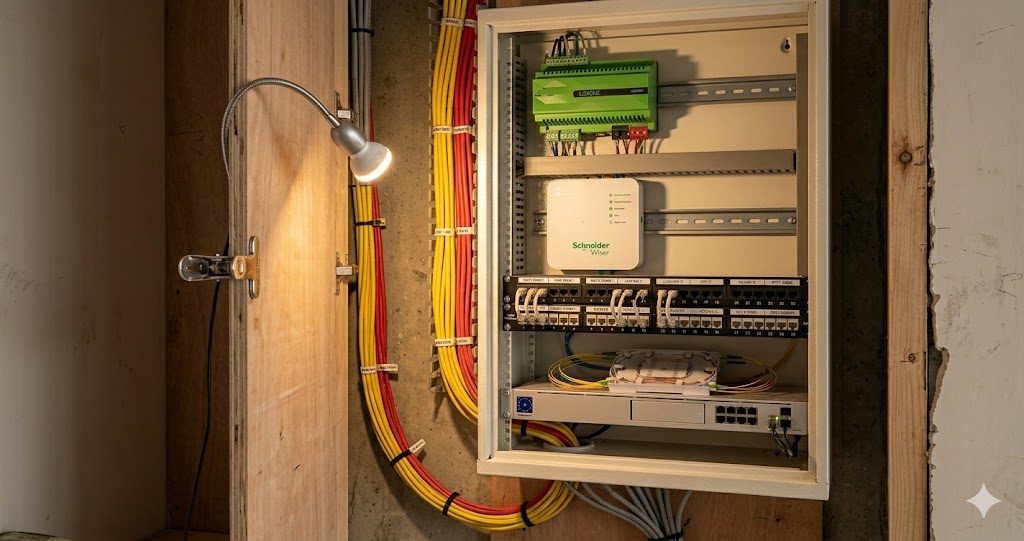
Week 9–10: The AV/IT closet was carved from a 8.2 sqft section of the utility area (originally washing-machine space; the machine moved to the kitchen utility balcony). The closet got a 12U wall-mount rack, a Cat6A patch panel (24 ports), a Ubiquiti UDM-Pro router, two PoE+ switches, fibre handoff from the building's GPON OLT, and a 1500 VA online UPS. Ventilation was a 100 mm intake louvre with a thermostatic 80 CFM exhaust fan triggered at 32 degC.
Week 11: The structured cabling plan was finalised — 47 Cat6A drops across the apartment, 2 per bedroom, 3 in the living room, 4 in the home-office study, fibre to the master bedroom for a future 10 GbE workstation. Conduits were specified as 25 mm rigid PVC in walls, 32 mm in slab risers, with 30 percent spare capacity per the IEEE 802.3 cabling design recommendation.
The fit-out then ran 14 weeks (June 18 to September 24, 2025) and the smart layer was commissioned in 6 weeks (September 25 to November 5).
Final tally:
- Civil + interior fit-out: ₹47.8 lakh (₹2,656 per sqft)
- Structured cabling + AV closet (Schneider + Ubiquiti + cabling): ₹2.84 lakh
- Loxone backbone (Miniserver Gen 2 + Tree extensions + relays + dimmers): ₹3.95 lakh
- KNX layer (Gira/Schneider — HVAC and core lighting): ₹2.65 lakh
- Matter consumer leaf (door, leak, climate, locks): ₹78K
- Sensors (motion, CO2, T+RH, leak): ₹62K
- AR walkthrough + AI-aided plan iterations (one-off services): ₹52K
- Integrator commissioning labour (KNX-certified, 6 weeks): ₹3.4 lakh
- Total smart-layer cost: ₹14.76 lakh, or 23.6 percent on top of base fit-out — high because the family chose the 3-layer architecture; a Loxone-only or KNX-only build would have come in at ₹8.5-9.5 lakh.
What the family got: every light is dimmable and scene-controllable from wall switches, voice (Apple HomePod on local Matter), or phone; HVAC runs on occupancy plus CO2 with a 4-zone setpoint; water leaks under every sink, washing machine, and water heater shut the inlet valve automatically; the AV closet doubles as the home-office network rack; the entire system survives broadband outage because the Loxone Miniserver runs all logic locally. The AR walkthrough caught one ₹1.4 lakh wardrobe-door mistake before contract — paying for the entire AR + AI iteration cost three times over.
If you are running an exercise like this, cross-link the layout discipline in space zoning Indian homes with the smart-home subsystem choices in smart home design India; the two need to be co-designed, not sequenced.
Smart Apartment Planning vs Adjacent Categories
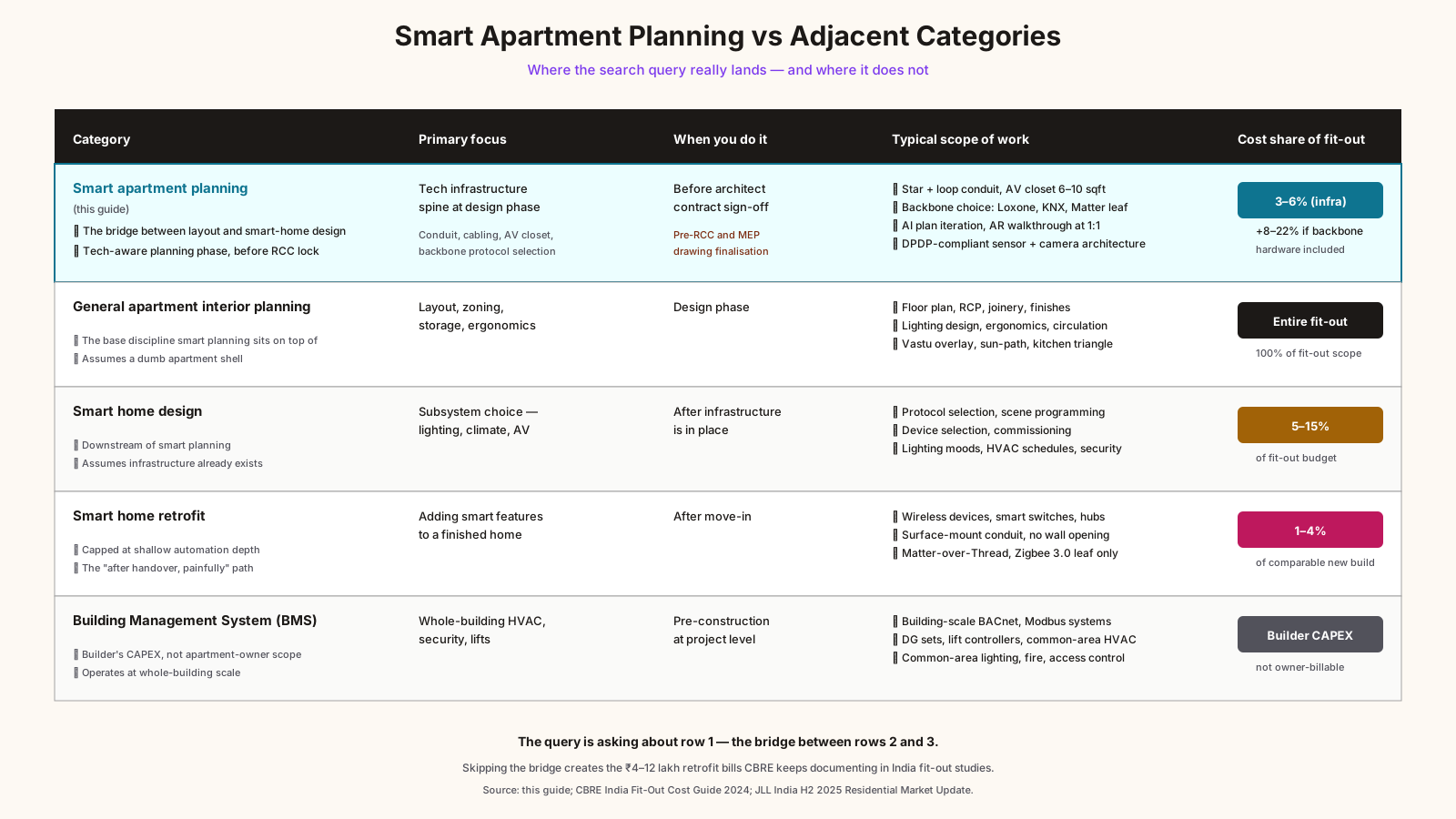
| Category | Primary focus | When you do it | Typical scope of work | Typical cost share of fit-out |
|---|---|---|---|---|
| Smart apartment planning (this guide) | Tech infrastructure spine at design phase | Before architect contract sign-off | Conduit, cabling, AV closet, backbone selection, AI plan iteration, AR walkthrough | 3-6 percent (infra only) + 8-22 percent if backbone hardware included |
| General apartment interior planning | Layout, zoning, storage, ergonomics | Design phase | Floor plan, RCP, joinery, finishes, lighting design | Entire fit-out |
| Smart home design | Subsystem choice — lighting, climate, security, AV | After infrastructure is in place | Protocol selection, scene programming, device selection, commissioning | 5-15 percent of fit-out |
| Smart home retrofit | Adding smart features to a finished home | After move-in | Wireless devices, smart switches, hubs, surface-mount cabling | 1-4 percent of comparable new fit-out, but capped at shallow depth |
| Building Management System (BMS) | Whole-building HVAC, security, lifts | Pre-construction at project level | Building-scale BACnet/Modbus systems | Builder's CAPEX, not apartment-owner's |
The distinction the search query is really asking about is the first row vs the second and third. Smart apartment planning is the bridge between general interior planning (which assumes a dumb apartment) and smart home design (which assumes infrastructure already exists). Skipping the bridge is what creates the ₹4-12 lakh retrofit bills CBRE keeps documenting in its India fit-out studies.
Materials, Finishes and Brand Landscape
Smart apartment planning is unusual among interior categories because the "materials" are mostly invisible — conduit, cable, controllers, sensors. The brand choices nonetheless matter, because backbone protocols are not interoperable and a wrong choice locks the apartment in for 10–15 years.
| Subsystem | Premium India option | Mid-tier India option | Entry option | India availability and notes |
|---|---|---|---|---|
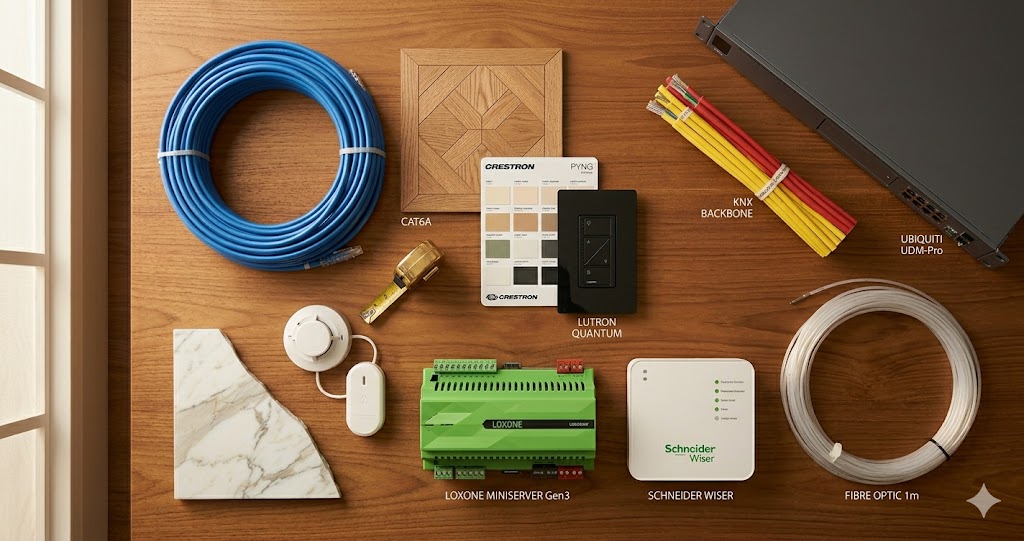
| Backbone — wired | KNX TP1 (Gira, ABB, Schneider Wiser KNX, Jung) | Loxone Tree | Schneider Wiser Z-Wave or Hue Pro | KNX India has ~140 certified integrators (2026); Loxone India partner count ~45; KNX more expensive but more vendor-independent |
| Backbone — premium AV-grade | Crestron Home, Lutron HomeWorks QSX | Control4 OS3 | Loxone | Crestron and Lutron require dealer-only programming; Crestron India dealer network is thin outside Mumbai/NCR/Bengaluru |
| Lighting control | Lutron HomeWorks QSX, KNX-based DALI | Loxone dimmers, Schneider Wiser KNX | Wipro Garnet smart, Philips Hue Pro | Lutron is the global benchmark; in India HomeWorks adds ₹4-7 lakh to a 3 BHK over KNX-DALI |
| Climate / HVAC | Daikin VRV with Intesis KNX gateway, Mitsubishi City Multi | Daikin Sky Air with Intesis Modbus gateway | Hitachi inverter splits with IR-bridge | VRV planning is a structural decision — slab penetrations and outdoor unit positioning must be in the architect's drawings |
| Structured cabling | Schneider Cat6A shielded, Belden DataTuff | Legrand Cat6A UTP, D-Link Pro Cat6 | Finolex Cat6 UTP | Insist on IS 694 certification; ₹15-22/m for Cat6A vs ₹6-9/m for generic — the saving is not worth it |
| AV closet rack | APC NetShelter, Schneider Wiser | Rittal CS Top, D-Link wall-mount | Generic 9U wall-mount | Premium racks include rear cable management; cheaper racks become a maintenance nightmare in 3 years |
| Sensors | Steinel KNX presence, Theben KNX, Eltako | Aqara FP2, Hue motion | Xiaomi Mi, TP-Link Tapo | Steinel and Theben are the German benchmarks; Aqara has caught up at half the cost on Matter-over-Thread |
| Water leak | Phyn Plus (USA, available in India via importers), Aqara T1 | Aqara water sensors + smart shutoff valve | Cheap WiFi point sensors | Phyn measures flow patterns and pressure — true preventive; Aqara is reactive but adequate |
| Network — router and switching | Ubiquiti Unifi (UDM Pro + USW Pro) | TP-Link Omada Pro | Mikrotik hAP ax | Ubiquiti has best India support footprint; Cisco Meraki is enterprise-class but requires annual license |
| AR walkthrough tooling | Studio-grade (Twinmotion, Enscape with VR) | LiDAR iPhone-based walkthrough | Polycam consumer scan | Studios in Bengaluru, Mumbai, NCR now offer ₹15-40K AR walkthrough sessions |
| AI plan iteration | Architect-led with custom generative plans | AI floor plan generator class tools | Consumer floor-plan apps | The architect-led path costs more but produces plans that respect Indian RCC, MEP, and Vastu constraints |
"The wrong backbone is not the one that's cheapest or the one that's most expensive. It's the one whose certified integrator pool in your city is under five — because a smart apartment without a maintainable integrator is a smart apartment for exactly one move-out cycle."
A practical pattern in 2026 India: Loxone Tree for the backbone, KNX for HVAC and core lighting, Matter-over-Thread for the consumer leaf, Ubiquiti for network. This combination gives local-first operation, vendor independence for the high-reliability subsystems, retrofit-friendliness at the leaf, and a network stack that one integrator can support. It is what most premium-tier Bengaluru and Pune integrators default to for 1,400-2,400 sqft apartments in 2026.
If you are early in the moodboard phase, the Studio Matrx moodboard builder lets you pin reference imagery for the AV-closet aesthetic, sensor enclosure choices, and the visible-tech zones (kitchen displays, entrance keypads), so the integrator and the interior designer are working from the same visual brief.
Eight Pitfalls Common in 2026 India
1. Treating smart planning as a post-handover decision. The single most common mistake. Once the screed is poured and gypsum is up, every cable run becomes surface-mount conduit or a destructive rip-out. A 2024 CBRE India study of 312 premium fit-outs found owners who deferred smart planning paid 3.8x the cost of those who planned at design phase. Mitigation: integrate the smart-system architect from concept stage, not from snagging.
2. Choosing the wrong backbone protocol for the budget. Crestron and Lutron HomeWorks are exquisite but require dealer-only programming, locking the owner into a single vendor's labour rates for life. For a 3 BHK under ₹15 lakh smart-layer budget, KNX or Loxone are almost always better. Mitigation: size the backbone to the budget and your city's integrator ecosystem.
3. Skipping the AV/IT closet. Many builder apartments give zero floor area to network and AV space, forcing the router onto a kitchen wall and structured-cabling termination into ugly surface boxes. Mitigation: carve 6-10 sqft from utility area, under-stair, or by absorbing a wardrobe section at planning stage.
4. Under-spec'ing the conduit. Indian contractors default to 16 mm or 20 mm conduits that fit the immediate cable count but leave no spare capacity. In 5 years, when the owner wants fibre or Cat7, the conduits are full. Mitigation: specify 25 mm minimum in walls, 32 mm in slab risers, with 30 percent spare capacity per IEEE 802.3 guidance.
5. Buying smart locks and cameras before deciding the data architecture. DPDP Act 2023 makes the owner a data fiduciary for cloud-processed personal data — biometric door logs, voice transcripts, camera feeds. Buying Ring or Google Nest before deciding whether you want US-based cloud processing of your toddler's voice is a compliance and values mistake. Mitigation: decide data-residency posture at planning stage; default to local-processing for private-zone devices.
6. Ignoring the Vastu and society-rules layer. Apartment Vastu (see Vastu modern homes) constrains where the kitchen, main door, and pooja niche go, which in turn constrains where the network rack and main automation panel make sense. RWAs additionally restrict drilling into shared walls. Mitigation: check society bye-laws and run a Vastu overlay during AI-aided plan iteration.
7. Picking a backbone integrator who is not certified. KNX requires KNX Association certification. Loxone has its own partner certification. A 2024 Houzz India review analysis of 1,800 smart-home installs found 31 percent of "smart home regret" reviews mentioned an uncertified integrator. Mitigation: verify certification numbers against KNX India, Loxone India, or the relevant vendor directory before signing.
8. Forgetting the manual fall-back. Every automated function — lighting, HVAC, shading — must have a physical electrical-only fall-back that works when controllers are dead and broadband is out. Mitigation: specify dual-control wall switches (smart and traditional rocker behind the same plate), and verify every load can be operated manually during commissioning.
India-Specific Considerations
National Building Code 2016, Part 8 (Building Services), Section 2 (Electrical and Allied Installations) is the baseline for any wiring decision inside an Indian apartment. NBC 2016 requires that all wiring conduits be of approved material with adequate mechanical protection, and that low-voltage extra-low-voltage (ELV) and 230 V circuits maintain a minimum separation of 50 mm where they run in parallel for more than 1 m. This matters for smart planning because automation low-voltage runs (KNX TP1 at 30 V DC, Loxone Tree at 24 V DC, sensor bus at 12 V) must be in separate conduits from the 230 V mains; an electrician who runs them together is non-compliant and creates EMI problems that surface only in commissioning.
IS 694:2010 (PVC insulated cables) and IS 8130:2013 (conductors) govern the certification of mains cabling; for ELV automation, IS/IEC 11801 governs structured cabling. Insist on the IS-marked cables, not generic.
DPDP Act 2023, operational from 2024, makes any IoT subsystem inside an apartment that processes personal data subject to consent, purpose-limitation, and data-fiduciary obligations. For a residential apartment owner, this means:
- Cloud-connected cameras facing private zones (bedrooms, bathrooms) should be avoided regardless of the law — but if used, must run on Indian-data-resident services or local processing.
- Voice assistants (Alexa, Google, Apple) record transient voice data; Apple's local-processing posture (HomePod with Siri running on-device for many requests) is the least exposed.
- Biometric smart locks (face, fingerprint) store biometric templates; choose vendors with on-device template storage (no cloud upload).
- Visitor logs from smart intercoms must have retention policies; the building's RWA may also be a data fiduciary in its own right.
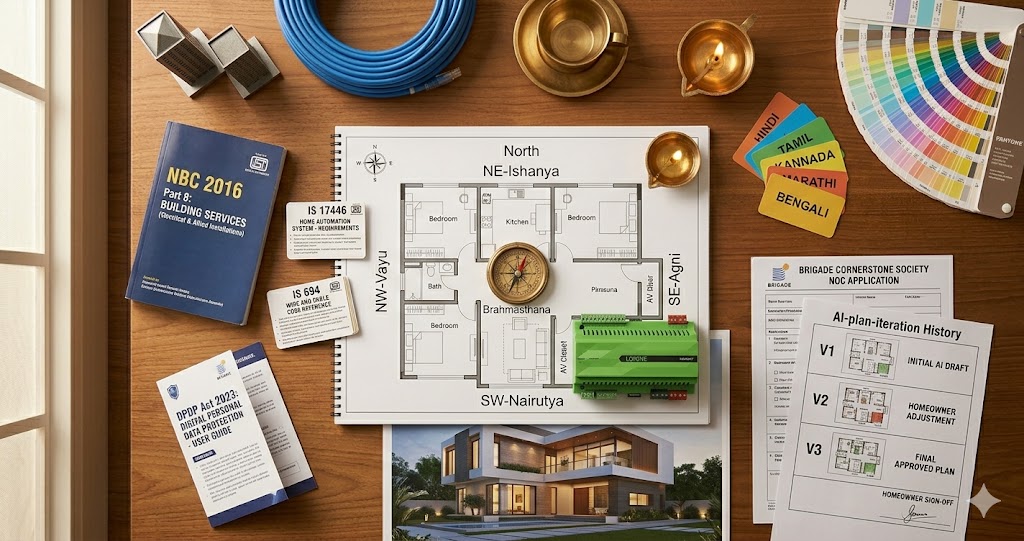
Vastu compatibility matters more than non-Indian smart-planning literature acknowledges. The traditional placement of the main door (north or east preferred), kitchen (south-east), and pooja niche (north-east) constrains the natural locations for the AV closet (best in the south-west or south, away from the pooja and main door zones), the main sensor cluster (where occupancy is heaviest — usually the living room which Vastu places in the east), and the primary network drop (often the home office or study, which Vastu suggests in the west or south-west). The good news: AV-closet placement in the south-west is also electrically and acoustically optimal because it tends to be the lowest-traffic, lowest-noise zone of an apartment.
Society and RWA rules vary widely. Premium gated communities (Brigade, Prestige, DLF Camellias, Lodha World Towers) typically permit owner-specified smart-system installations during fit-out; mid-segment societies (older Hiranandani, K Raheja blocks) often restrict drilling into shared walls and modifying conduit runs in slabs. Always pull the society bye-laws before the integrator quote, and budget 2-3 weeks for RWA approvals if substantial changes to common-area conduits are needed.
Climate zones drive the sensor topology. Bengaluru and Pune (moderate, low humidity most of year) benefit from CO2 sensors driving fresh-air dampers because windows tend to stay closed in dust season. Mumbai (warm, humid, coastal) benefits from humidity sensors driving dehumidification in master bedroom and study; salt-air corrosion also means stainless-steel sensor enclosures over standard plastic for any sensor near a window. Delhi NCR (extreme summer, severe winter, high PM2.5) benefits from PM2.5 sensors integrated into the HVAC fresh-air logic — relevant per the IS 17446:2020 indoor air-quality framework. Chennai (warm, humid, coastal) is similar to Mumbai with additional cyclone-season redundancy needs.
Regional vendor differences are real. Bengaluru has the deepest KNX and Loxone pool (~32 KNX-certified integrators in 2026); Mumbai is strongest in Crestron and Lutron (~18 dealers); NCR is balanced; Pune is strong in Loxone; Chennai and Hyderabad have growing KNX pools but thin Crestron. Match the backbone to local integrator depth, or budget fly-in commissioning at ₹85K-1.5 lakh per week.
The Budget Bands for 2026 India
| Tier | Apartment context | What you get | Typical 3 BHK smart-layer cost | Representative vendors |
|---|---|---|---|---|
| Entry — "Smart-planned, light automation" | 1,150-1,400 sqft 2-3 BHK in mid-segment Bengaluru/Pune | Structured cabling (Cat6A 30 drops), AV closet, conduit-only for future automation, Matter consumer leaf (smart switches in 8-10 locations, leak sensors, motion in 3 rooms), no backbone hardware | ₹1.6-2.8 lakh | Schneider Wiser, TP-Link Tapo, Aqara Matter, Finolex Cat6 |
| Mid — "Loxone-only backbone" | 1,400-1,800 sqft 3 BHK in premium Whitefield/Hebbal/Kharadi/Sector 150 | Full Loxone Tree backbone, lighting + climate + shading + security, 8-12 scenes, voice integration, AR walkthrough at design phase | ₹6.5-9.8 lakh | Loxone Miniserver Gen 2, Schneider Wiser KNX, Aqara, Ubiquiti UDM SE |
| Premium — "KNX + Loxone + Matter hybrid" | 1,800-2,400 sqft 3-4 BHK in Brigade Cornerstone, Prestige Falcon City, Lodha Park, Oberoi Sky City | 3-layer architecture, KNX for HVAC and core lighting, Loxone for logic, Matter consumer leaf, dedicated AV with 9.2.4 home theatre prep, 4-zone HVAC, biometric entry, all DPDP-compliant | ₹13-19 lakh | Gira KNX, ABB i-bus, Loxone, Lutron Caseta Pro, Daikin VRV with Intesis gateway |
| Super-premium — "Crestron / Lutron HomeWorks" | 2,400-4,500 sqft 4-5 BHK or penthouse in DLF Camellias, Lodha Altamount, Oberoi Three Sixty West, Embassy Boulevard | Crestron Home or Lutron HomeWorks QSX, custom touch panels in every room, 14-22 lighting scenes, multi-zone whole-home audio (Sonos Architectural or Bose Professional), shading on all windows, dealer-programmed | ₹35 lakh-1.2 cr | Crestron, Lutron HomeWorks, Lutron RA3 for premium-but-not-super, Savant, Control4 |
The numbers above assume the apartment is at bare-shell handover (no fit-out done by the builder) and that the owner is engaging an architect or interior designer who works with a smart-system integrator from day one. Builder-provided "smart-home ready" SKUs typically cover only the entry-tier infrastructure (Cat6 drops in 4-5 locations, conduit for future) and should not be confused with a smart-planned apartment.
For homeowners trying to make sense of which fit-out partner is competent to lead this exercise, our choosing an interior designer India guide covers the credential checks and scope-discipline questions worth running before contract.
When Smart Apartment Planning Is NOT the Right Fit
Smart apartment planning is not always the right answer. Five contexts where the discipline is wasted effort or actively wrong:
Short-tenure rentals. If the apartment is rented and the lease is under 3 years, structured cabling and backbone hardware are not recoverable investments. A consumer-IoT retrofit using Matter-over-Thread sensors, smart switches, and a portable hub (Apple TV 4K with HomeKit, or a Hubitat C8) gets 60 percent of the experience at 8 percent of the cost.
Heritage or legacy buildings with conservation restrictions. Buildings in Mumbai's Fort/Colaba, Bengaluru's central cantonment, Chennai's Mylapore-Triplicane heritage zones, or Delhi's Lutyens zone may have ASI or heritage-committee restrictions on drilling and conduit installation. In these cases a wireless-first retrofit, with all controllers and sensors surface-mounted in matching aesthetic enclosures, is the only feasible path.
Investment-only purchases. If the apartment is being bought as an investment and will be flipped within 4-5 years, smart-layer ROI is poor. Indian secondary-market buyers in 2026 pay a 1.5-3 percent premium for smart-home features, but the smart-layer cost is 8-22 percent of fit-out — a clear negative trade.
Owners who genuinely value manual-only control. Some owners, particularly older buyers and those with strong privacy convictions, simply do not want automation. Forcing a smart layer on them creates frustration and ongoing maintenance burden. The right answer is to plan the conduits at design phase (a ₹40K-80K future-proofing investment) but skip the backbone hardware until or unless future owners want it.
Apartments where the structural envelope cannot host a proper AV closet. Some 800-1,100 sqft 2 BHK plans simply do not have 6-10 sqft of stealable area. In these cases the smart-planning discipline narrows to structured cabling and Matter-only leaf — backbone hardware moves to a closet-mounted enclosure or is skipped entirely.
Honesty matters here because a one-size-fits-all push toward smart planning damages the discipline's credibility. The right framing is: smart planning is the default for any 1,400 sqft+ owner-occupied premium apartment with a 7+ year holding intent — and is genuinely optional otherwise.
The 5-Year Trajectory: 2030 Outlook
Three forces will shape smart apartment planning between 2026 and 2030.
Matter and Thread become the assumed leaf-layer default. By 2028, virtually every consumer-IoT device sold in India for residential use will support Matter-over-Thread or Matter-over-Wi-Fi. This means the leaf layer becomes vendor-agnostic by default, and the backbone-protocol decision matters only for the high-reliability subsystems (HVAC, core lighting, shading, security). Loxone, KNX, and the others will increasingly become "backbone-only" rather than full-stack ecosystems.
AI-generated plans absorb the routine 60 percent of layout work. By 2028-2029, AI-aided floor-plan generation will produce the first three iterations of a 3 BHK plan in under 4 hours, including Vastu-compliance check, sun-path overlay, and smart-system conduit overlay. The architect's role shifts to curating and editing AI-generated plans, compressing design-phase fees from 8-12 percent of fit-out down to 4-6 percent while raising the quality floor.
AR walkthrough at 1:1 scale becomes standard pre-contract practice. As LiDAR-capable phones reach 70 percent of premium-segment buyers by 2028 (per IDC India Q3 2025 forecasts), AR walkthrough moves from a ₹15-40K specialist service to a near-free feature inside design-platform apps, collapsing wardrobe-door-blocks-bathroom class change-orders.
DPDP enforcement matures and local-processing wins. As enforcement intensifies through 2027-2028, design-phase data-architecture decisions become as routine as the electrical SLD. Vendors offering credible local processing (Loxone, Home Assistant Yellow, Apple HomeKit Secure Video, Frigate NVR) will pull ahead of cloud-only competitors.
Smart planning becomes a credentialed sub-discipline. By 2029, expect KNX India or a new body to offer a "Smart-Home Design Certified" credential for interior designers and architects, similar to LEED AP in green building. This will professionalise the field and reduce the integrator-vs-designer turf wars that currently slow 30-40 percent of premium projects.
The net direction is clear: smart planning becomes cheaper, more standardised, more AI-aided, and more compliance-aware over the next 5 years.
Frequently Asked Questions
Q1. Can I add smart-home features to a finished apartment without ripping out walls?
Yes, but the depth is capped. Wireless backbone protocols (Matter-over-Thread, Zigbee 3.0, Z-Wave) let you replace switches, add sensors, and install smart locks without conduit changes. You will not get the reliability or scene complexity of a wired KNX or Loxone backbone, but for a 2 BHK apartment looking for 60-70 percent of the experience, this is a defensible path. Budget ₹1.8-3.5 lakh for a wireless retrofit of a 2-3 BHK.
Q2. Is KNX or Loxone better for an Indian 3 BHK?
For most owner-occupied premium 3 BHK apartments in 2026 India, Loxone is the better single-backbone choice. It is cheaper (₹1.6-2.5 lakh vs ₹2.4-4.5 lakh for KNX), easier to programme, and the Loxone Miniserver runs all logic locally. KNX wins for vendor independence and for projects where the owner wants to mix-and-match HVAC, lighting, and shading from different vendors. A hybrid (Loxone for logic, KNX for HVAC and core lighting) is increasingly the premium default.
Q3. How do I find a certified KNX or Loxone integrator in India?
KNX Association maintains a directory at knx.org searchable by country; KNX India's chapter site lists certified integrators by city. Loxone India publishes a partner directory at loxone.com/enen/partners. Verify certification number before signing. Bengaluru has the deepest pool (~32 KNX, ~18 Loxone), Mumbai is strong in Crestron and Lutron, NCR is balanced.
Q4. What is the DPDP Act 2023 impact on smart-home cameras inside my apartment?
As an apartment owner, if your camera or smart-home device processes personal data of any person (family, visitors, domestic staff), you may be a data fiduciary under DPDP. For private-zone cameras (bedrooms, bathrooms) the right answer is to not install them. For common-area cameras (living room, entrance), prefer local-processing vendors (HomeKit Secure Video on Apple TV, Frigate NVR on a local server) over cloud-first vendors. If you use cloud, choose Indian-data-resident services and document your data-fiduciary obligations. Penalty for non-compliance can reach ₹250 cr, though enforcement against individual residential owners is unlikely in 2026 — corporate housing and serviced-apartment operators are the primary enforcement targets.
Q5. Do builders' "smart-home ready" apartments save me money on smart planning?
Slightly. Most builder smart-ready SKUs (Brigade, Prestige, Lodha, Oberoi) provide Cat6 drops in 4-6 locations and conduit for future automation. This saves ₹40K-90K against a full retrofit. They do not provide backbone hardware, AV closet, sensor placement, or integrator commissioning — all of which still need to be specified by the owner's designer.
Q6. How does AI-aided plan generation actually work for an apartment?
AI floor-plan tools take constraints (apartment dimensions, programme — number of bedrooms, kitchen type, Vastu requirements, budget) and generate multiple layout options in minutes. The architect then curates and edits. For a deeper walkthrough see our AI floor plan generator and AI room planner references. The Studio Matrx AI onboarding flow captures the brief by voice and feeds it into the planning loop. Premium-tier projects in 2026 routinely run 2-3 AI-aided iterations before architect contract sign-off.
Q7. What is the AR walkthrough actually for?
To let the owner walk through the proposed plan at 1:1 scale, on-site or in a rented empty space, before the design contract is signed. iOS LiDAR phones and Meta Quest 3 both support this. The discipline catches mistakes that drawings miss — wardrobe doors that block bathrooms, sofa positions that block TV sightlines, kitchen islands that crowd circulation. Houzz India 2024 data suggests AR walkthrough cuts change-order disputes by 60-70 percent.
Q8. Can I do smart apartment planning if I'm renting?
Mostly no. The structured-cabling and AV-closet decisions require landlord permission and are not recoverable when you move. A wireless Matter-based retrofit is the right answer for renters — sensors, smart switches that replace existing rocker switches, a portable hub. Total spend ₹40K-1.2 lakh, fully portable to the next apartment.
Q9. How much does smart planning add to architect or designer fees?
Engaging a smart-system integrator from concept stage adds 0.8-1.5 percent to the architect's fee equivalent — usually billed separately by the integrator as a design retainer (₹40K-1.2 lakh for a 3 BHK depending on backbone complexity). This is recoverable many times over through avoided retrofit costs and reduced change orders.
Q10. Does smart planning increase my apartment's resale value?
In 2026 India, secondary-market buyers pay a 1.5-3 percent premium for fully smart-planned apartments. This is a small fraction of the 8-22 percent smart-layer fit-out cost, so smart planning is not primarily a resale ROI play. By 2029-2030 the resale premium is forecast to rise to 4-6 percent as smart-planned apartments become the expected default in premium segments.
References
1. National Building Code of India 2016 (Bureau of Indian Standards), particularly Part 8 (Building Services) and Part 9 (Plumbing Services) — bis.gov.in.
2. IS 694:2010 — PVC insulated cables, Bureau of Indian Standards.
3. IS/IEC 11801 series — Information technology — Generic cabling for customer premises.
4. IS 17446:2020 — Acceptable indoor air quality in commercial and institutional buildings.
5. Digital Personal Data Protection Act 2023 — Ministry of Electronics and Information Technology, meity.gov.in.
6. Knight Frank India, "India Real Estate H2 2025 Residential Market Update" (January 2026).
7. JLL India, "Residential Market Update H2 2025" (February 2026).
8. CBRE India, "India Fit-Out Cost Guide 2024" — premium residential segment data.
9. Anarock, "Consumer Sentiment Survey H2 2025" — premium segment smart-home expectations.
10. Houzz India, "Indian Homeowner Renovation Report 2024" — change-order and smart-home regret data.
11. KNX Association — knx.org and KNX India chapter materials, 2025 design guidelines.
12. IBEF, "Indian Real Estate Industry Report" (December 2025) — ibef.org.
13. IDC India, "Smart Home Devices Tracker Q3 2025" — Matter and Thread adoption forecasts.
14. Magicbricks Research, "PropIndex Q4 2025" — premium apartment segment pricing trends.
15. 99acres Insite, "Buyer Sentiment Q1 2026" — smart-home feature importance ranking.
Related Guides
- Apartment interior planning India — the general layout, zoning, and storage discipline that smart planning sits on top of.
- Smart home design India — the post-infrastructure subsystem design discipline.
- AI floor plan generator — the AI-aided plan iteration approach referenced throughout this guide.
- AI room planner — room-level AI planning that complements whole-apartment AI plan generation.
- Space zoning Indian homes — the zoning logic that determines where the AV closet, sensor clusters, and automation panels naturally belong.
- Choosing an interior designer India — credential checks and scope-discipline questions for selecting a fit-out partner competent to lead smart planning.
Export this guide
Related Guides — Deep-dive reading
Penthouse Design — Top-Floor Luxury in Indian Towers (2026)
DLF Camellias / Lodha Altamount / Oberoi Sky Suites · Private terraces · ₹15-150 crore market
Design StylesPoE vs Wi-Fi CCTV: Which Home Security Cameras Are Better?
One camera type runs power and video down a single Cat6 cable to an NVR and almost never drops out; the other clips to a wall in minutes and streams over your home Wi-Fi. This guide settles PoE vs Wi-Fi CCTV for Indian homes — reliability, video quality and bandwidth, cabling and power, retrofit versus new-build effort, NVR versus SD and cloud storage, hacking risk, real rupee costs, scalability and outdoor use — and gives a clear verdict for each kind of home.
Smart HomeSmart Home Design for Architects & Designers (India)
The smart layer is an architectural system, not an accessory bought after handover. Here is how to design it at concept and schematic stage, coordinate with your MEP consultant and integrator, and produce drawings that a contractor can actually build.
Smart HomeRelated Tools — Try Free
Cross-Ventilation Analyzer
Estimate airflow and air changes per hour (ACH) from room size, window areas, layout, and local wind — with NBC 2016 Part 8 compliance check.
Ventilation CalculatorSmart Home Cost Calculator
13 device categories across 5 ecosystems (Apple HomeKit, Alexa, Google Home, Mi, Wipro). Live floor-plan that lights up as you add devices, per-room and per-category breakdown.
Smart Home CalculatorApartment Video Door System Planner
Enter flats, entrances, floors and guard desk for a first-pass building intercom plan — door stations, indoor monitors, guard station, the right architecture and an indicative cost band.
Building Planner